
- Home
- »
- Distribution & Utilities
- »
-
Volt VAR Management Market Size, Industry Report, 2033GVR Report cover
![Volt VAR Management Market Size, Share & Trends Report]()
Volt VAR Management Market (2026 - 2033) Size, Share & Trends Analysis Report By Component (Hardware, Software, Services), By Deployment Level (Distribution Network, Transmission Network), By Utility Type, By Region, And Segment Forecasts
- Report ID: GVR-4-68040-394-1
- Number of Report Pages: 110
- Format: PDF
- Historical Range: 2021 - 2024
- Forecast Period: 2026 - 2033
- Industry: Energy & Power
- Report Summary
- Table of Contents
- Segmentation
- Methodology
- Download FREE Sample
-
 Download Sample Report
Volt VAR Management Market Summary
The global Volt VAR management market size was estimated at USD 527.2 million in 2025 and is projected to reach USD 824.1 million by 2033, growing at a CAGR of 5.8% from 2026 to 2033. The market is witnessing steady growth as utilities accelerate grid modernization initiatives and deploy advanced distribution automation technologies to enhance voltage stability, reduce line losses, and improve overall network efficiency.
Key Market Trends & Insights
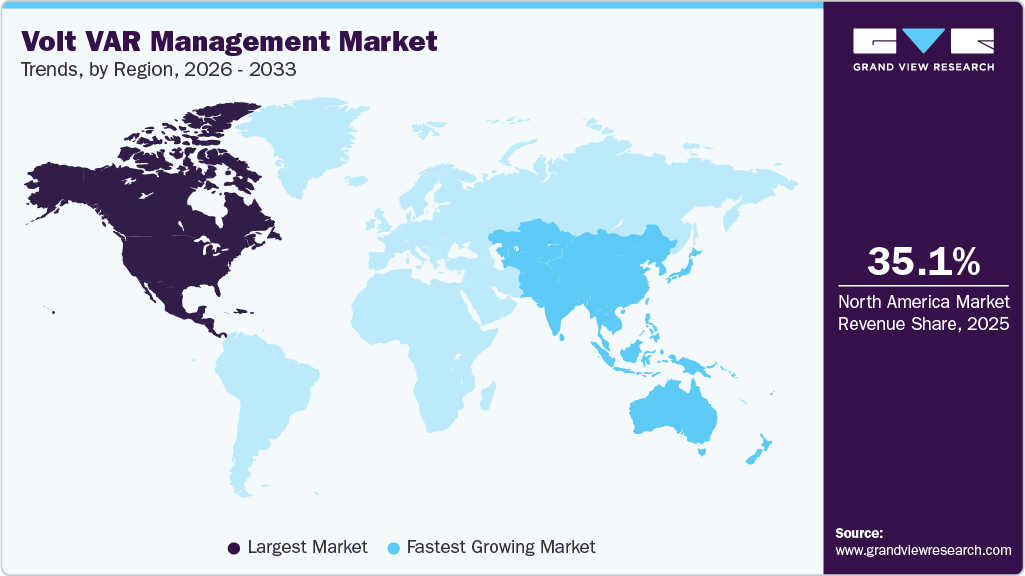
- The North America Volt/VAR management market held the largest global share of 35.1% in 2025.
- The U.S. Volt VAR management industry is expected to grow significantly from 2026 to 2033.
- By component, hardware held the largest market share of 60.2% in 2025.
- By deployment level, distribution network segment held the largest market share of 70.2% in 2025.
- By utility type, the investor-owned utilities led the market with the largest revenue share of 55.8% in 2025.
Market Size & Forecast
- 2025 Market Size: USD 527.2 Million
- 2033 Projected Market Size: USD 824.1 Million
- CAGR (2026-2033): 5.8%
- North America: Largest market in 2025
- Asia Pacific: Fastest growing market
Volt/VAR management systems enable intelligent coordination of reactive power assets, ensuring optimized power flow, improved load balancing, and enhanced system performance across distribution networks. Rising integration of distributed energy resources (DERs), including solar PV, wind generation, battery storage, and electric vehicle charging infrastructure, is increasing voltage variability at the grid edge. This shift toward decentralized power generation is driving demand for real-time voltage control, automated capacitor switching, smart inverter coordination, and advanced analytics platforms. Utilities are increasingly adopting integrated solutions within advanced distribution management systems (ADMS) to maintain grid reliability, support two-way power flow, and comply with evolving regulatory standards focused on energy efficiency and emission reduction.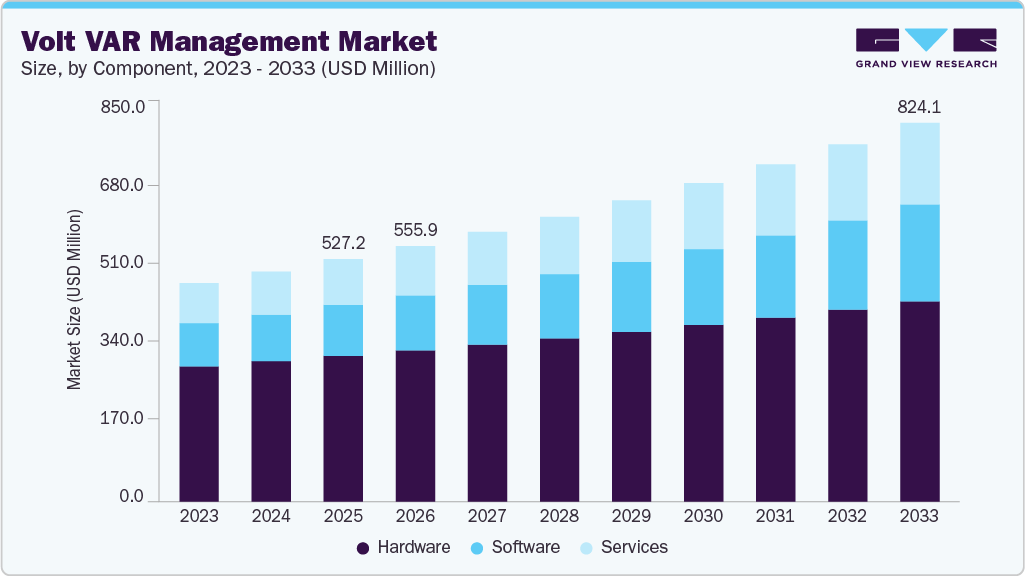
Growing investments in smart grid infrastructure, digital substations, and grid intelligence platforms are further strengthening market expansion. Volt/VAR optimization supports peak load management, asset life extension, deferred capital expenditure, and improved power quality, making it a strategic priority for distribution utilities. Technology providers are incorporating AI-driven optimization algorithms, edge computing, and cloud-based monitoring architectures to deliver scalable, adaptive voltage control solutions. As electricity demand continues to rise globally and grid complexity increases, Volt/VAR management solutions are becoming essential for ensuring resilient, efficient, and digitally enabled power distribution networks.
Drivers, Opportunities & Restraints
The primary driver of the Volt/VAR management industry is the accelerating need for grid modernization and voltage stability across increasingly complex power distribution networks. Rising penetration of distributed energy resources (DERs), including rooftop solar, wind power, battery storage, and electric vehicle charging infrastructure, has intensified voltage fluctuations and bidirectional power flow challenges at the distribution level. Utilities are under growing pressure to minimize technical losses, improve power factor, enhance power quality, and ensure regulatory compliance. Additionally, increasing electricity demand, urban expansion, and the digitalization of grid infrastructure are reinforcing the adoption of advanced voltage optimization and reactive power control solutions to enhance operational efficiency and grid resilience.
A significant opportunity lies in the integration of Volt/VAR optimization within advanced distribution management systems (ADMS), smart grid platforms, and AI-driven grid analytics. The expansion of smart meter deployments, digital substations, and automated feeder management systems provides a strong foundation for real-time voltage monitoring and control. Emerging markets in the Asia Pacific, Latin America, and the Middle East & Africa present substantial growth potential due to grid expansion projects and rising investments in distribution network upgrades. Furthermore, utilities are increasingly leveraging Volt/VAR management to defer capital expenditure on new infrastructure, extend asset life, reduce peak load stress, and improve energy efficiency metrics, creating long-term value propositions for solution providers.
However, the market faces restraints related to high initial deployment costs, integration complexities with legacy grid infrastructure, and cybersecurity concerns associated with connected grid systems. Implementation often requires coordination across multiple hardware and software layers, including capacitor banks, voltage regulators, smart inverters, and supervisory control systems, which can increase project timelines and operational risks. In addition, limited technical expertise in certain developing regions and budget constraints among smaller utilities may slow adoption rates. Despite these challenges, ongoing digital transformation initiatives and regulatory emphasis on grid efficiency continue to support steady market expansion.
Component Insights
The hardware segment dominated the Volt/VAR management market, accounting for the largest revenue share of 60.2% in 2025, driven by the widespread deployment of physical grid control and monitoring equipment across distribution networks. Hardware components such as capacitor banks, voltage regulators, on-load tap changers, smart inverters, sensors, and feeder controllers form the foundational infrastructure required for effective Volt/VAR optimization. Utilities continue to prioritize investments in these assets to enhance voltage stability, reduce line losses, and improve power quality across aging and expanding grid systems. The modernization of substations, expansion of smart grid infrastructure, and integration of distributed energy resources (DERs) further strengthen demand for advanced hardware solutions capable of supporting real-time reactive power management and automated voltage control.
The software segment is projected to register the fastest CAGR of 8.5% during the forecast period, supported by the growing adoption of advanced analytics, grid automation platforms, and cloud-based optimization solutions. Software-driven Volt/VAR management enables real-time data processing, predictive voltage control, load forecasting, and intelligent coordination of distributed grid assets within advanced distribution management systems (ADMS). As utilities increasingly focus on digital transformation, operational efficiency, and data-driven decision-making, demand for AI-enabled optimization algorithms and centralized control platforms is accelerating. The rising adoption of smart meters, digital substations, and integrated grid management systems is expected to drive software adoption further, positioning it as a critical enabler of next-generation voltage optimization strategies.
Deployment Level Insights
The distribution network segment led the Volt/VAR management industry, accounting for the largest revenue share of 70.2% in 2025, primarily driven by the growing need for voltage regulation and reactive power optimization at the grid edge. Distribution networks experience greater voltage variability due to the integration of distributed energy resources (DERs), bidirectional power flow, and fluctuating load patterns. Utilities are prioritizing the deployment of Volt/VAR management across feeders, substations, and secondary distribution lines to minimize technical losses, enhance power quality, and maintain regulatory voltage limits. Ongoing investments in smart grid infrastructure, automated feeder control, and digital substations are further strengthening the adoption of Volt/VAR solutions at the distribution level.
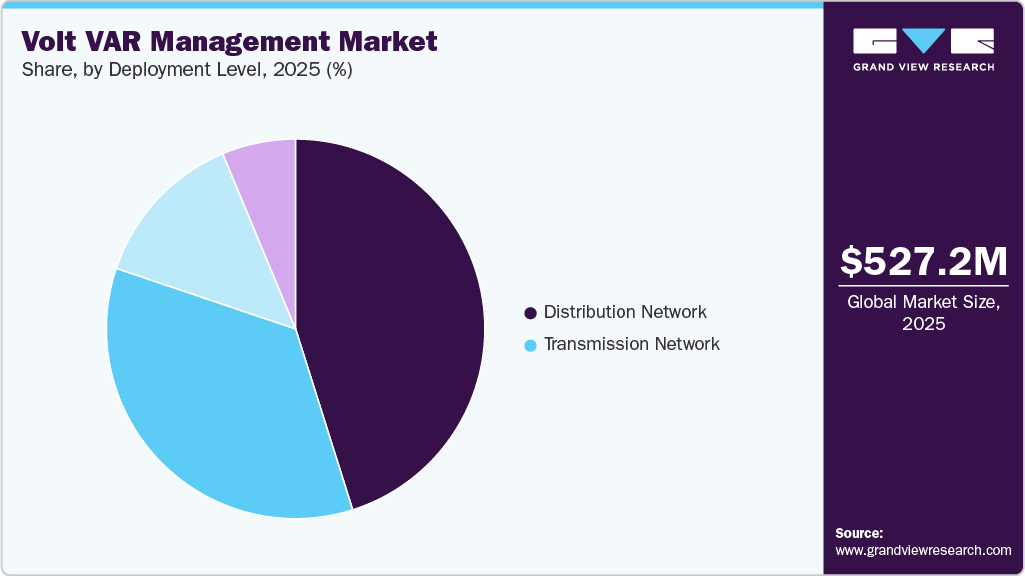
The distribution network segment is also projected to register the fastest CAGR of 6.2% during the forecast period, driven by grid modernization initiatives and rising electricity demand across urban and industrial regions. As renewable penetration increases and electrification expands through electric vehicles and distributed storage systems, maintaining voltage stability at the distribution level becomes increasingly critical. Utilities are deploying advanced monitoring systems, intelligent voltage controllers, and integrated optimization platforms to enhance grid resilience and defer costly infrastructure upgrades. This sustained focus on distribution-level efficiency and reliability is expected to continue supporting strong growth in this segment over the coming years.
Utility Type Insights
The investor-owned utilities segment accounted for the largest revenue share of 55.8% in 2025, supported by substantial investments in grid modernization, smart grid deployment, and advanced distribution management systems. These utilities operate an extensive transmission and distribution infrastructure. They are increasingly implementing Volt/VAR management solutions to enhance voltage stability, reduce technical losses, improve power quality, and meet regulatory efficiency standards. Strong capital expenditure capabilities, regulatory compliance requirements, and large-scale renewable energy integration initiatives further drive the adoption of advanced reactive power optimization technologies among investor-owned utilities.
The industrial captive networks segment is projected to register the fastest CAGR of 9.7% during the forecast period, driven by rising demand for reliable, high-quality power supply in large industrial facilities, manufacturing plants, mining operations, and energy-intensive complexes. Industrial operators are increasingly deploying Volt/VAR management systems within captive power networks to optimize internal load distribution, minimize voltage fluctuations, enhance equipment performance, and reduce energy costs. The growing emphasis on operational efficiency, digital energy management, and the integration of on-site renewable generation and storage systems is expected to accelerate adoption across industrial captive networks in the coming years.
Regional Insights
North America Volt VAR Management Market Trends
North America accounted for the largest revenue share of 35.1% in 2025, supported by strong investments in grid modernization, distribution automation, and advanced energy management infrastructure. Utilities across the region are increasingly deploying Volt/VAR optimization solutions to enhance feeder efficiency, reduce line losses, improve voltage profiles, and strengthen overall grid reliability. The rising penetration of distributed energy resources (DERs), electric vehicle charging networks, and smart meters is further driving the need for intelligent reactive power control systems integrated within advanced distribution management platforms.
U.S. Volt/VAR Management Market Trends
The U.S. represents the key revenue contributor within North America, driven by large-scale smart grid deployment programs and regulatory emphasis on energy efficiency and grid resilience. Federal and state-level initiatives to integrate renewable energy and modernize infrastructure are accelerating the adoption of automated voltage control and reactive power management solutions. Increasing grid stress from extreme weather events, distributed solar expansion, and growing electrification is further strengthening demand for scalable Volt/VAR optimization technologies across utilities.
Europe Volt/VAR Management Market Trends
Europe is witnessing the steady adoption of Volt/VAR management solutions, supported by ambitious decarbonization goals and high renewable penetration across major economies. Distribution operators are implementing advanced voltage optimization systems to manage intermittency from wind and solar resources while ensuring compliance with strict power quality standards. Investments in digital grid infrastructure and cross-border interconnections are further strengthening regional demand.
Modernization of aging distribution networks and growing emphasis on operational efficiency are expected to sustain market expansion across Western, Northern, and selected Eastern European countries.
Asia Pacific Volt/VAR Management Market Trends
Asia Pacific is projected to register fastest CAGR of 6.9% during the forecast period, driven by rapid urban expansion, industrialization, and ongoing power distribution upgrades across emerging economies. Utilities in countries such as India, Japan, South Korea, Australia, and Southeast Asia are focusing on reducing technical losses and improving voltage stability as their distribution networks expand. Rising renewable energy capacity additions and grid interconnection projects are further increasing the need for advanced voltage regulation systems.
Government-backed grid reform programs, smart meter rollouts, and digital substation investments are expected to accelerate the deployment of Volt/VAR management platforms across the region, supporting long-term market growth.
Latin America Volt/VAR Management Market Trends
Latin America is experiencing robust growth, supported by expanded distribution networks, renewable energy integration initiatives, and regulatory efforts to reduce technical losses. Countries including Brazil, Mexico, and Chile are enhancing grid monitoring capabilities and adopting automated voltage control technologies to improve reliability and efficiency. Increasing industrial activity and urban development projects are further contributing to adoption across the region.
Middle East & Africa Volt/VAR Management Market Trends
The Middle East & Africa market is expanding gradually, driven by grid expansion projects, smart city initiatives, and renewable energy investments. Utilities across GCC countries are integrating advanced voltage management systems to support large-scale clean energy targets and enhance distribution performance. In Africa, ongoing electrification programs and efforts to minimize distribution losses are encouraging the implementation of automated reactive power control solutions, supporting steady market growth.
Key Volt VAR Management Company Insights
Some of the key participants in the global Volt VAR management market include ABB, S&C Electric Company, DC Systems, Beckwith Electric, Utilidata, Open Systems International, Landis+Gyr, Advanced Control Systems, Siemens, Schneider Electric, Eaton, and General Electric. These companies continue to strengthen their competitive positioning by offering integrated hardware and software solutions designed to optimize voltage regulation, reactive power control, and distribution network efficiency across utility and industrial applications.
Industry leaders are focusing on enhancing grid intelligence through advanced distribution management systems (ADMS), real-time analytics platforms, and automated feeder control technologies. Investments in smart capacitor bank controllers, voltage regulators, edge computing devices, and AI-driven optimization algorithms are enabling utilities to reduce technical losses, improve power factor, and maintain voltage compliance under dynamic load conditions. Many providers are also expanding cybersecurity capabilities, cloud-based monitoring platforms, and scalable software architectures to support increasingly digital and decentralized grid environments.
As utilities modernize aging infrastructure and integrate higher levels of distributed energy resources, vendors are accelerating innovation in predictive voltage control, DER coordination, and automated reactive power balancing. Strategic partnerships, regional expansion initiatives, and continuous product development remain central to capturing growth opportunities in smart grid and distribution automation markets. Ongoing advancements in grid digitalization and efficiency optimization are expected to reinforce market competitiveness and support the long-term expansion of the global Volt/VAR management industry.
Key Volt VAR Management Companies:
The following key companies have been profiled for this study on the Volt VAR Management market
- ABB
- Advanced Control Systems
- Beckwith Electric
- DC Systems
- Eaton
- General Electric
- Landis+Gyr
- Open Systems International
- S&C Electric Company
- Schneider Electric
- Siemens
- Utilidata
Recent Developments
-
In October 2025, ABB strengthened its grid automation portfolio by enhancing its advanced distribution management system (ADMS) capabilities with improved Volt/VAR optimization functionalities. The update focused on real-time reactive power coordination and enhanced support for DER integration. It advanced analytics-driven voltage control to help utilities reduce technical losses and improve feeder performance across modern distribution networks.
-
In November 2025, Schneider Electric expanded its EcoStruxure Grid platform with upgraded Volt/VAR management modules designed to optimize voltage profiles and improve power quality across complex distribution systems. The enhancements emphasized predictive analytics, automated capacitor bank control, and enhanced interoperability with smart inverters and distributed grid assets to support evolving smart grid infrastructure requirements.
Volt VAR Management Market Report Scope
Report Attribute
Details
Market size value in 2026
USD 555.9 million
Revenue forecast in 2033
USD 824.1 million
Growth rate
CAGR of 5.8% from 2026 to 2033
Base year for estimation
2025
Historical data
2021 - 2024
Forecast period
2026 - 2033
Quantitative Units
Revenue in USD million and CAGR from 2026 to 2033
Report coverage
Revenue forecast, competitive landscape, growth factors, and trends
Segments covered
Component, deployment level, utility type, region
Regional scope
North America; Europe; Asia Pacific; Latin America; Middle East & Africa
Country scope
U.S.; Canada; Mexico; Germany; UK; France; Italy; Spain; China; India; Japan; Australia; Brazil; Argentina; Saudi Arabia; UAE; South Africa
Key companies profiled
ABB; Advanced Control Systems; Beckwith Electric; DC Systems; Eaton; General Electric; Landis+Gyr; Open Systems International; S&C Electric Company; Schneider Electric; Siemens; Utilidata
Customization scope
Free report customization (equivalent up to 8 analysts working days) with purchase. Addition or alteration to country, regional & segment scope.
Pricing and purchase options
Avail customized purchase options to meet your exact research needs. Explore purchase options
Global Volt VAR Management Market Report Segmentation
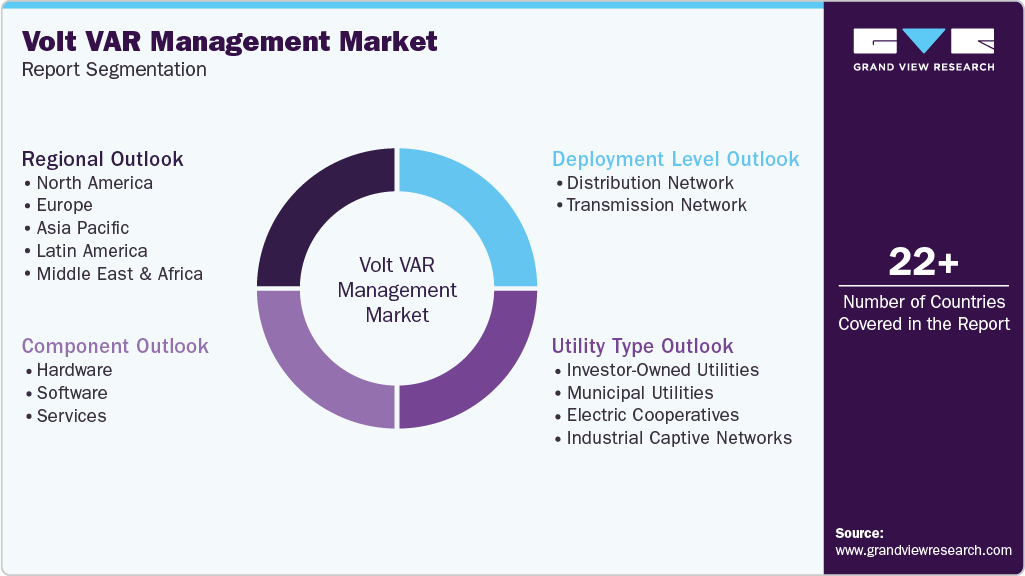
This report forecasts revenue growth at the global, regional, and country levels and provides an analysis of the latest industry trends in each of the sub-segments from 2021 to 2033. For this study, Grand View Research has segmented the global Volt VAR management market report based on component, deployment level, utility type, and region:
-
Component Outlook (Revenue, USD Million, 2021 - 2033)
-
Hardware
-
Software
-
Services
-
-
Deployment Level Outlook (Revenue, USD Million, 2021 - 2033)
-
Distribution Network
-
Transmission Network
-
-
Utility Type Outlook (Revenue, USD Million, 2021 - 2033)
-
Investor-Owned Utilities
-
Municipal Utilities
-
Electric Cooperatives
-
Industrial Captive Networks
-
-
Regional Outlook (Revenue, USD Million, 2021 - 2033)
-
North America
-
U.S.
-
Canada
-
Mexico
-
-
Europe
-
Germany
-
UK
-
France
-
Italy
-
Spain
-
-
Asia Pacific
-
China
-
India
-
Japan
-
Australia
-
-
Latin America
-
Brazil
-
Argentina
-
-
Middle East & Africa
-
Saudi Arabia
-
UAE
-
South Africa
-
-
Frequently Asked Questions About This Report
b. The global Volt/VAR management market is expected to grow at a compound annual growth rate of 5.8% from 2026 to 2033 to reach USD 824.1 million by 2033.
b. The global Volt/VAR management market was estimated at USD 527.2 million in 2025 and is expected to reach USD 555.9 million in 2026.
b. Based on the component segment, hardware held the largest revenue share of more than 60% in 2025.
b. Some of the key players operating in the global Volt/VAR management market include ABB, S&C Electric Company, DC Systems, Beckwith Electric, Utilidata, Open Systems International, Landis+Gyr, Advanced Control Systems, Siemens, Schneider Electric, Eaton, and General Electric, among others.
b. The key factors driving the growth of the Volt/VAR management market include increasing grid modernization initiatives, rising integration of distributed energy resources (DERs), growing need to reduce technical losses and improve power quality, expansion of smart grid and advanced distribution management systems (ADMS), and regulatory emphasis on voltage stability, energy efficiency, and reliable power distribution infrastructure.


Share this report with your colleague or friend.
Need a Tailored Report?
Customize this report to your needs — add regions, segments, or data points, with 20% free customization.


ISO 9001:2015 & 27001:2022 Certified
We are GDPR and CCPA compliant! Your transaction & personal information is safe and secure. For more details, please read our privacy policy.
Trusted market insights - try a free sample
See how our reports are structured and why industry leaders rely on Grand View Research. Get a free sample or ask us to tailor this report to your needs.












