
- Home
- »
- Clothing, Footwear & Accessories
- »
-
U.S. Seamless Apparel Market Size, Industry Report, 2033GVR Report cover
![U.S. Seamless Apparel Market Size, Share & Trends Report]()
U.S. Seamless Apparel Market (2026 - 2033) Size, Share & Trends Analysis Report By Product (Sports Bra, Leggings, Tops), By Material (Polymide, Polyester, Elastane, Blends), By End Use (Lifestyle, Athletes, Shapewear Consumers), And Segment Forecasts
- Report ID: GVR-4-68040-841-6
- Number of Report Pages: 110
- Format: PDF
- Historical Range: 2021 - 2025
- Forecast Period: 2026 - 2033
- Industry: Consumer Goods
- Report Summary
- Table of Contents
- Segmentation
- Methodology
- Download FREE Sample
-
 Download Sample Report
U.S. Seamless Apparel Market Summary
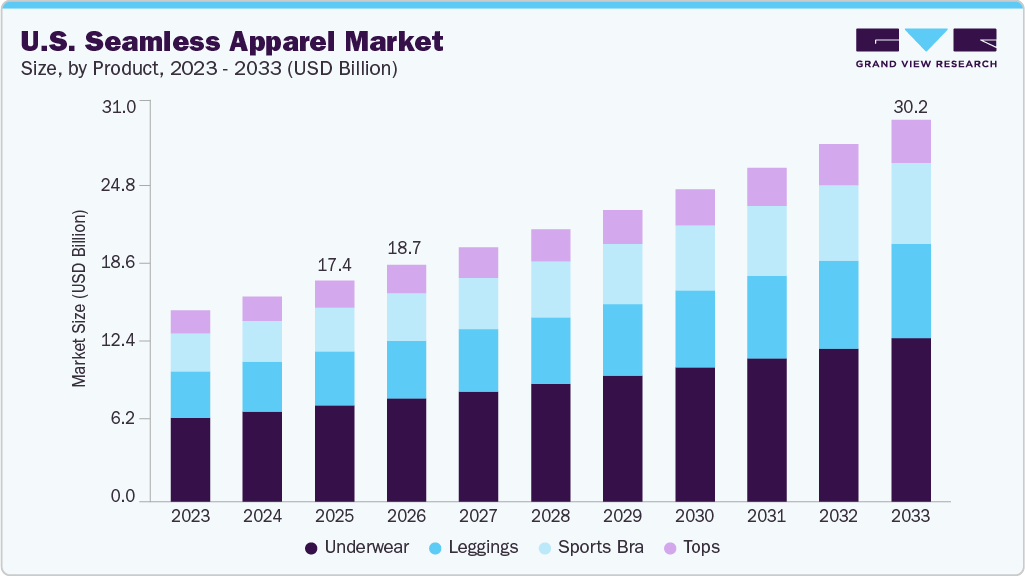
The U.S. seamless apparel market size was estimated at USD 17.43 billion in 2025 and is projected to reach USD 30.18 billion by 2033, growing at a CAGR of 7.1% from 2026 to 2033. Advances in 3D knit-to-shape manufacturing have become particularly influential, enabling U.S. producers to minimize fabric waste, reduce labor intensity, and shorten production cycles. Industry coverage across textile and apparel media has highlighted how next-generation knitting systems can significantly cut material offcuts by producing garments directly in three dimensions, aligning with U.S. brands’ growing focus on cost efficiency, sustainability compliance, and near-market manufacturing.
Seamless construction is widely embedded across American activewear, athleisure, and intimates, where consumers associate fewer seams with improved comfort, flexibility, and durability. Performance-led brands such as Nike and Under Armour have expanded seamless knitting across training tops, base layers, and compression apparel, positioning seamless design not as a premium add-on but as a functional standard. For instance, in June 2025, Nike introduced a new performance material called FlyWeb, created using 3D printing technology from a flexible TPU polymer. This innovation enables the design of ultra-light, seamless garments with precisely engineered zones for support, breathability, and stretch, eliminating the need for bulky seams or multiple fabric layers. First showcased in a custom sports bra worn by elite runner Faith Kipyegon during a record attempt, FlyWeb represents Nike’s move toward next-generation apparel that merges cutting-edge manufacturing with athlete-centric functionality, signaling a shift in how performance wear may be produced in the future. This shift reflects evolving U.S. consumer expectations around fit precision, movement adaptability, and garments that transition easily between workouts, work-from-home routines, and casual wear.
Seamless garments appeal due to their body-conforming structure, reduced friction points, and lightweight feel, which enhances all-day comfort. At the same time, sustainability considerations are becoming integral to purchase decisions. Flat knitting, bonded construction, and reduced paneling help lower material usage and energy consumption, resonating with environmentally conscious American shoppers who expect transparency around waste reduction and responsible manufacturing.
Furthermore, companies such as Spanx and SKIMS have expanded seamless offerings that emphasize invisible finishes, targeted compression zones, and smooth silhouettes under clothing. These collections respond to strong demand for second-skin aesthetics, size-inclusive fits, and discreet performance, reinforcing seamless apparel’s relevance beyond sportswear into everyday essentials. For instance, in May 2025, SPANX rolled out a fresh wave of innovations across several categories, blending its signature shaping technology with everyday wardrobe staples. The latest drop includes updated shapewear pieces designed to smooth and contour under clothing, comfortable loungewear and activewear that don’t compromise on style, and a flattering new denim range with cuts from straight-leg to subtle flares in both classic and seasonal hues. Each piece is crafted to offer support, comfort, and a sculpted finish, proving the brand’s ongoing commitment to versatile, confidence-boosting fashion.
Key Brand Share Insights
In the U.S. seamless apparel industry, brands are targeting niche and underpenetrated use cases by tailoring product development to specific lifestyle, professional, and performance needs. This includes advancing fabric engineering for durability, breathability, and stretch recovery, while also broadening size ranges and refining fit to reflect diverse body profiles across the U.S. workforce and consumer base. Companies are aligning product design and messaging with American expectations around comfort, compliance, and everyday usability, while optimizing distribution through DTC platforms, specialty retail, and corporate partnerships. By responding to evolving work patterns, hybrid lifestyles, and function-specific apparel requirements, U.S.-focused seamless apparel brands are strengthening differentiation and positioning themselves for sustained domestic growth.
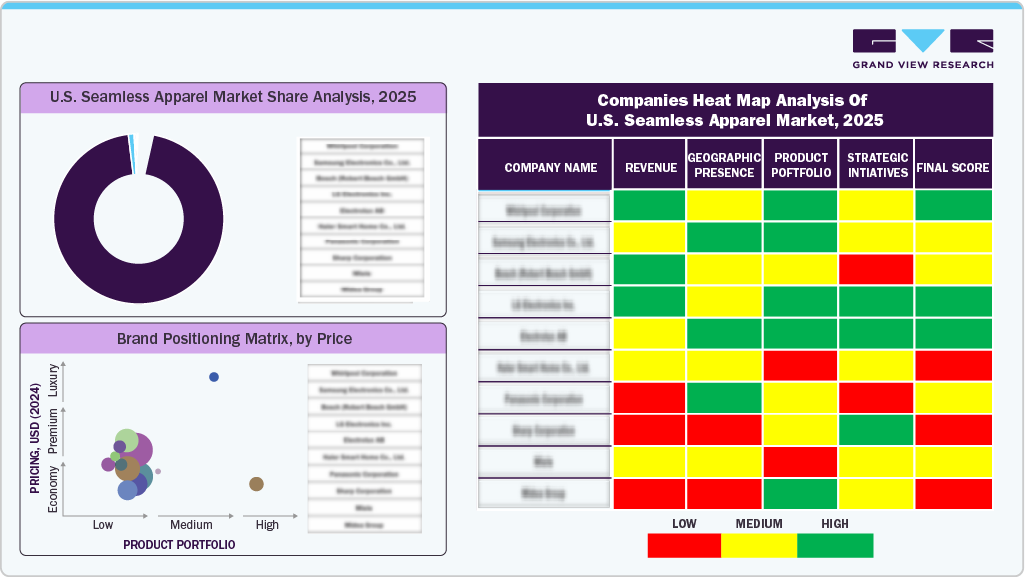
Key U.S. Seamless Apparel Companies:
- VF Corp
- Puma
- Skechers
- H&M (sport)
- Columbia Sportswear
- Li Ning
- Zalando
- New Balance
- JD Sports
- Lidl (sport)
- North Face
- Brooks
- Ice Breaker
- Foot Locker
- Inditex (sport)
- Superdry
- Patagonia
- Fila
- Dick's Sporting Goods
- Salomon
- Odlo
- Hoka
- On Running
- Deckers
- Intersport
- XBionic
- Asics
- Kari Traa
Consumer Insights
In the U.S. seamless apparel market, consumer expectations around comfort are increasingly anchored in active moisture control and thermal balance, not just softness or stretch. Buyers expect garments with higher perspiration efficiently across varied indoor and outdoor conditions, from climate-controlled offices to high-intensity workouts. This has elevated demand for engineered yarn systems that combine capillary-driven moisture dispersion with controlled airflow. Rather than relying on heavy elastane content, brands are adopting softer, low-tension stretch architectures that deliver recovery and flexibility without compression fatigue, reinforcing comfort as a functional, body-responsive outcome.
Sustainability-led performance has emerged as a distinct differentiator as consumers increasingly associate recycled fibers, durable knit structures, and low-waste construction with better long-term performance. Seamless apparel that maintains shape, elasticity, and breathability over repeated wear aligns with American buying behavior that favors fewer, higher-quality garments. As a result, brands are engineering seamless pieces to withstand laundering, friction, and extended use, positioning longevity as part of both environmental responsibility and value perception.
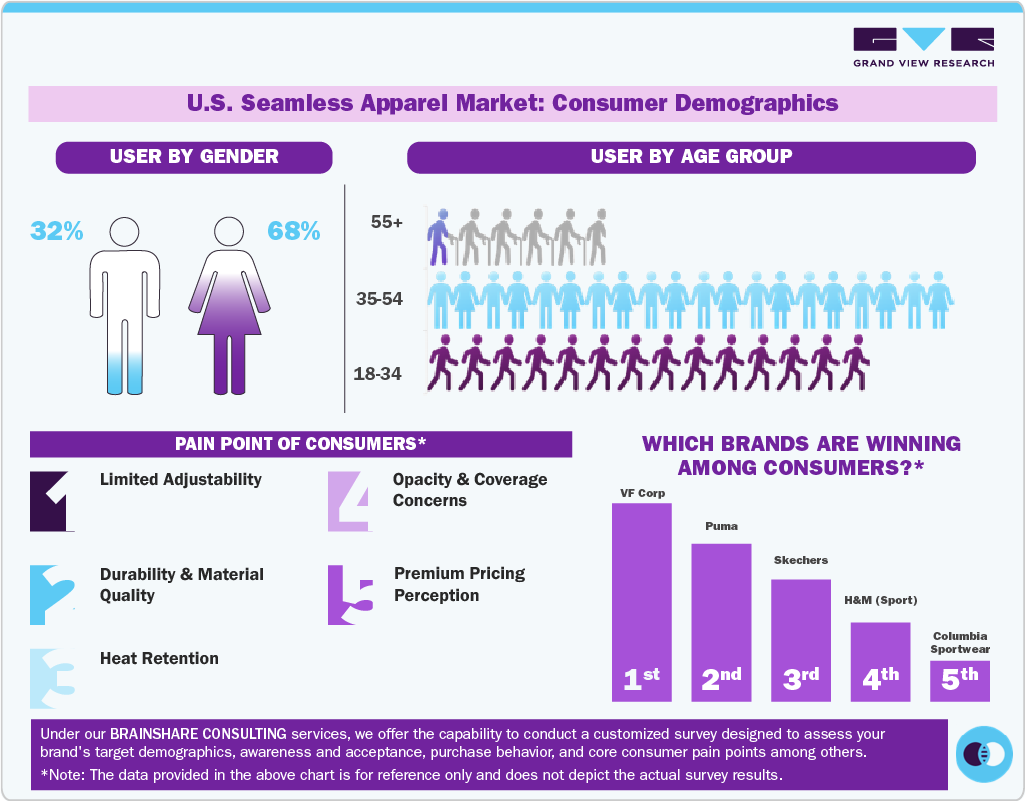
Consumers are increasingly favoring seamless designs that apply stretch and support selectively, responding to how different muscle groups engage during walking, training, or prolonged sitting. This approach improves mobility and reduces unnecessary pressure, helping limit fatigue over extended wear. At the same time, buyers expect these technical benefits to be delivered within visually understated styles that transition easily from active to casual settings. As a result, performance is now judged by how seamlessly it integrates into everyday dressing, with functionality embedded discreetly rather than overtly expressed.
Seamless innerwear has reshaped how American consumers interpret structure and support. Shaping is viewed as a tool for confidence, stability, and freedom of motion rather than visual alteration. This mindset has extended into activewear and loungewear, where subtle support, smooth surfaces, and friction-free construction are expected as standard.
Product Insights
Seamless leggings apparel accounted for a revenue share of 24.43% in 2025. Consumers increasingly favor leggings that can handle high-intensity training while remaining comfortable for extended wear, driving preference toward seamless constructions that reduce pressure points and irritation. Seamless leggings produced using circular knitting techniques deliver uniform stretch, targeted compression, and a smooth finish that aligns with U.S. demand for body-contouring styles without restrictive seams. As comfort-led fashion continues to influence everyday dressing, seamless leggings are being purchased not only as workout gear but also as core lifestyle apparel.
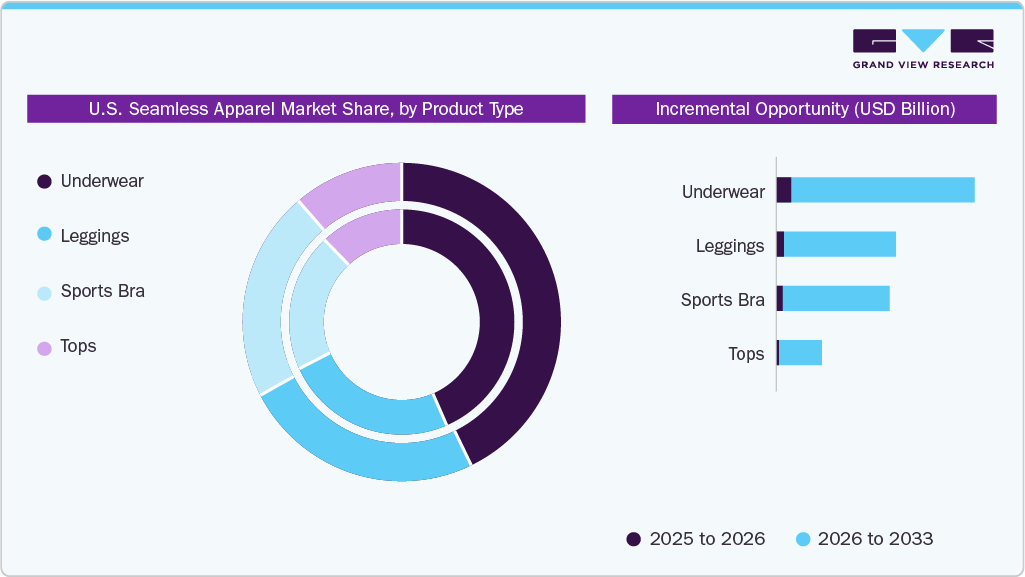
Seamless sports bras are projected to grow at a CAGR of 7.9% over the forecast period of 2026-2033. Buyers increasingly seek seamless sports bras that combine zoned support, moisture management, and lightweight construction, reflecting expectations for performance without bulk. Purchasing decisions are also influenced by demand for adaptable designs that can be worn beyond workouts, neutral color palettes suited to layering, and extended sizing that accommodates a wide range of body profiles.
Material Insights
Polyamide seamless apparel accounted for a revenue share of 45.0% in 2025, reflecting strong consumer preference for materials that balance durability with long-term comfort. U.S. shoppers value polyamide for its ability to retain shape after repeated washing, resist abrasion, and deliver a smooth, second-skin feel, qualities that align with high usage across leggings, sports bras, innerwear, and performance base layers. Seamless polyamide constructions also support consistent compression and flexibility, meeting expectations for garments worn across extended daily hours.
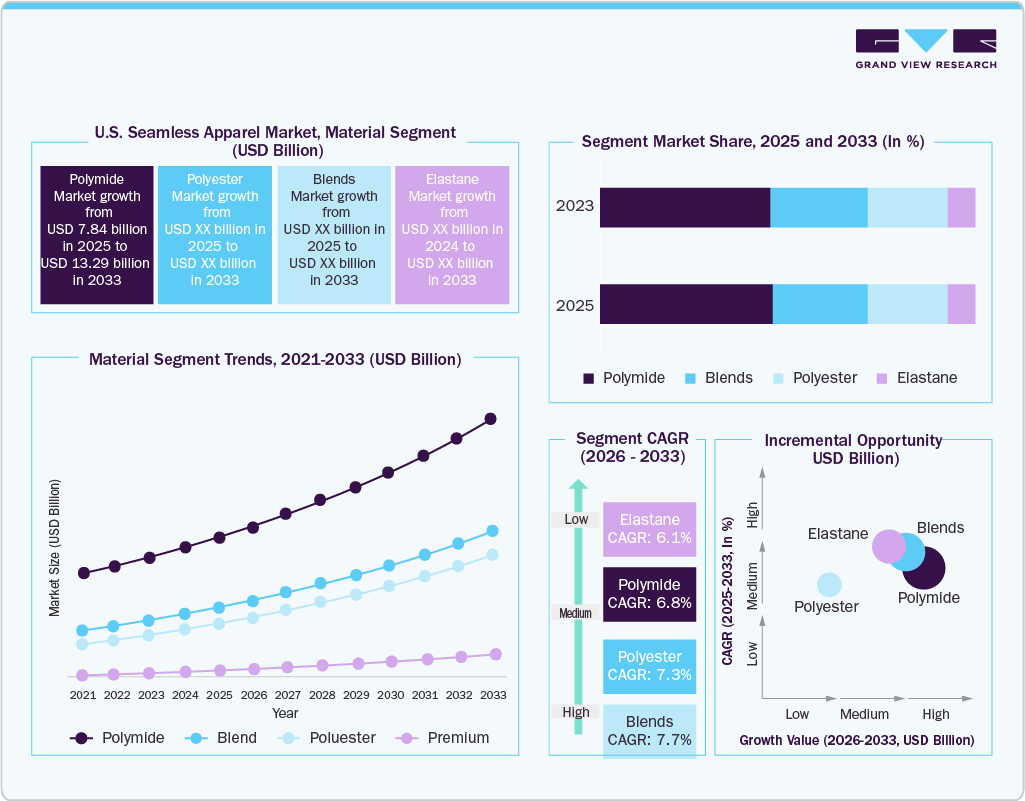
Blends seamless apparels are projected to grow at a CAGR of 7.7% over the forecast period of 2026-2033. U.S. consumers increasingly choose blends such as polyamide-elastane and polyester-elastane because they hold shape during frequent washing and extended wear while remaining flexible for movement-intensive activities. These blended fabrics are widely used across leggings, sports bras, innerwear, and loungewear, where seamless construction improves fit consistency and reduces discomfort. Growth is further reinforced by American lifestyle patterns that favor multi-use apparel suitable for workouts, home wear, and casual outings, making blended seamless garments a practical, high-rotation wardrobe choice.
End Use Insights
Lifestyle seamless apparel accounted for a revenue share of 45.60% in 2025. Consumers increasingly choose seamless garments for everyday wear because they deliver sustained comfort, flexibility, and a streamlined appearance across long hours of use. The category benefits directly from the normalization of athleisure in daily life. Seamless tops, leggings, and intimate apparel are favored for their smooth construction, reduced pressure points, and minimalist aesthetics, making them well-suited to lifestyle dressing that prioritizes ease of movement and visual simplicity without compromising wearability.
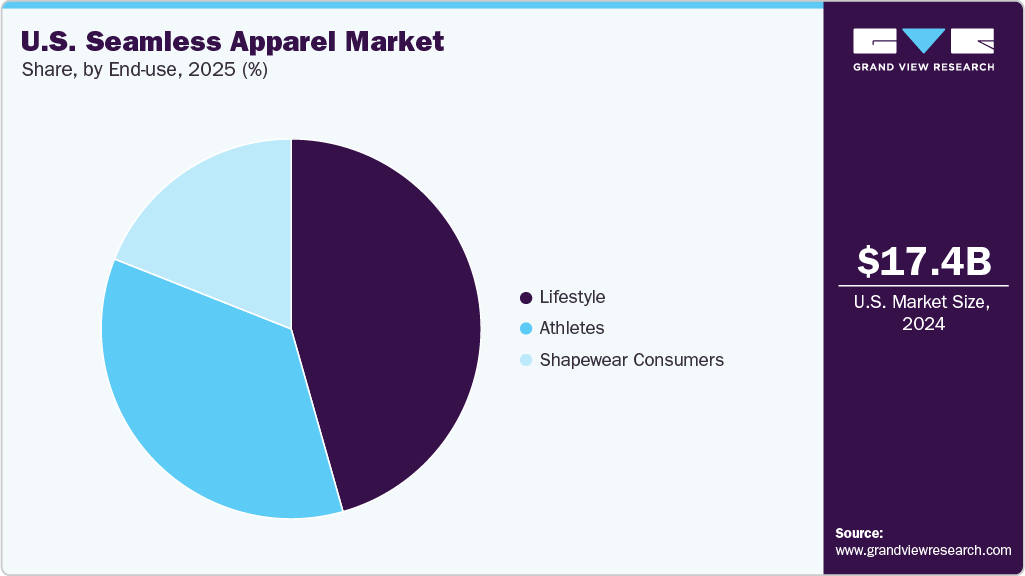
Seamless apparel for shapewear consumers is projected to grow at a CAGR of 7.6% over the forecast period of 2026-2033, driven by rising demand for everyday shaping solutions that deliver a smooth finish without visible lines. U.S. consumers increasingly adopt seamless shapewear for regular wear as awareness grows around posture support, light compression, and confidence enhancement beyond occasion-based use. Advances in seamless knitting are enabling targeted shaping zones, improved breathability, and adaptive stretch, allowing brands to offer better fit consistency across a wide range of body types. Growth is further supported by preference for lightweight, skin-friendly materials that remain comfortable over extended wear periods, reinforcing shapewear’s transition into a daily-use category.
Recent Developments
-
In September 2025, Nike and SKIMS teamed up to launch NikeSKIMS, a new women’s apparel brand built around performance and fit, debuting its first collection. The inaugural line, showcased in a campaign featuring more than 50 elite athletes including Serena Williams and Sha’Carri Richardson, blends Nike’s sport-driven innovation with SKIMS’ body-focused design to create pieces that sculpt and perform from workouts to everyday wear. With seven core collections and 58 silhouettes offering layered outfits, the range delivers technical fabrics, neutral styling, and solutions-oriented construction aimed at supporting women across fitness levels while redefining activewear aesthetics and inclusivity.
-
In September 2024, Adanola launched its Fall 2024 campaign featuring French model Tina Kunakey, centering on the brand’s highly successful Ultimate Leggings, a style that has sold over one million pairs since its debut in 2020. The campaign highlights the leggings’ design, which uses recycled polyamide with four-way stretch, a higher waistband for contouring, and a seamless front for comfort and support. Positioned as versatile pieces for both fitness and daily wear, the promotion reinforces how the Ultimate Leggings helped establish Adanola’s presence in the activewear market and reflects the brand’s growth trajectory.
U.S. Seamless Apparel MarketReport Scope
Report Attribute
Details
Market size value in 2026
USD 18.70 billion
Revenue forecast in 2033
USD 30.18 billion
Growth rate
CAGR of 7.1% from 2026 to 2033
Actuals
2021 - 2025
Forecast period
2026 - 2033
Quantitative units
Volume million units; revenue in USD million/billion,and CAGR from 2026 to 2033
Report coverage
Revenue & volume forecast, company ranking, competitive landscape, growth factors, and trends
Segments covered
Product, material, end use
Country scope
U.S.
Key companies profiled
VF Corp; Puma; Skechers; H&M (sport); Columbia Sportswear; Li Ning; Zalando; New Balance; JD SpIce Breaker; Foot Locker; Inditex (sport); Superdry; Patagonia; Fila; Dick's Sporting Goods; Salomon; Odlo; Hoka; On R-Deckers; Intersport; XBionic; Asics; Kari Traa
Customization scope
Free report customization (equivalent up to 8 analysts working days) with purchase. Addition or alteration to country, regional & segment scope.
Pricing and purchase options
Avail customized purchase options to meet your exact research needs. Explore purchase options
U.S. Seamless Apparel Market Report Segmentation
This report forecasts volume & revenue growth at the country level and provides an analysis of the latest trends and opportunities in each of the sub-segments from 2021 to 2033. For this study, Grand View Research has segmented the U.S. seamless apparel market report on the basis of product, material, and end use.
-
Product Outlook (Volume Million Units; Revenue, USD Billion, 2021 - 2033)
-
Sports Bra
-
Leggings
-
Tops
-
Underwear
-
-
Material Outlook (Volume Million Units; Revenue, USD Billion, 2021 - 2033)
-
Polymide
-
Polyester
-
Elastane
-
Blends
-
-
End Use Outlook (Volume Million Units; Revenue, USD Billion, 2021 - 2033)
-
Lifestyle
-
Athletes
-
Shapewear Consumers
-
Frequently Asked Questions About This Report
b. The U.S. seamless apparel market size was estimated at USD 17.43 billion in 2025 and is expected to reach USD 18.70 billion in 2026.
b. The U.S. seamless apparel market is expected to grow at a compound annual growth rate of 7.1% from 2026 to 2033 to reach USD 30.18 billion by 2033.
b. Key factors that are driving the U.S. seamless apparel market growth include rising demand for comfort-led activewear and athleisure, growing fitness participation, and consumer preference for garments that offer flexibility, durability, and a refined fit for all-day wear.
b. Seamless leggings apparel accounted for a revenue share of 24.43% in the year 2025 in the U.S. seamless apparel industry, due to strong demand for form-fitting bottoms that provide comfort, flexibility, and support across workouts, athleisure, and everyday use. The absence of seams improves wearability, reduces irritation, and enhances durability, reinforcing repeat purchases and category growth.
b. Some key players operating in the U.S. seamless apparel market include VF Corp; Puma; Skechers; H&M (sport); Columbia Sportswear; Li Ning; Zalando; New Balance; JD SpIce Breaker; Foot Locker; Inditex (sport); Superdry; Patagonia; Fila; Dick's Sporting Goods; Salomon; Odlo; Hoka; On R-Deckers; Intersport; XBionic; Asics; Kari Traa


Share this report with your colleague or friend.
Need a Tailored Report?
Customize this report to your needs — add regions, segments, or data points, with 20% free customization.


ISO 9001:2015 & 27001:2022 Certified
We are GDPR and CCPA compliant! Your transaction & personal information is safe and secure. For more details, please read our privacy policy.
Trusted market insights - try a free sample
See how our reports are structured and why industry leaders rely on Grand View Research. Get a free sample or ask us to tailor this report to your needs.












