U.S. Power Rental Market Summary
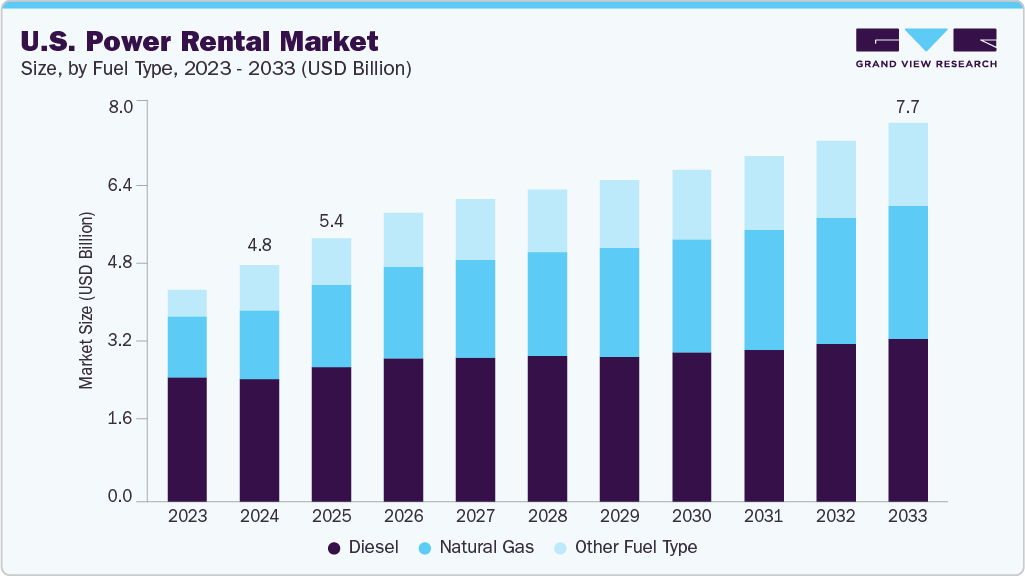
The U.S. power rental market size was estimated at USD 4.82 billion in 2024 and is projected to reach USD 7.71 billion by 2033, growing at a CAGR of 4.6% from 2025 to 2033. Growth is supported by strong demand from construction, oil & gas, utilities, and event management sectors, where temporary power solutions are essential for maintaining operations during outages, peak loads, and periods of limited grid access.
Key Market Trends & Insights
- By fuel type, the diesel segment led the market with the largest revenue share of 51.7% in 2024.
- By equipment, the generators segment accounted for the largest market revenue share in 2024.
Market Size & Forecast
- 2024 Market Size: USD 4.82 Billion
- 2033 Projected Market Size: USD 7.71 Billion
- CAGR (2025-2033): 4.6%
Increasing weather-related disruptions, such as heatwaves, hurricanes, and wildfires, along with aging grid infrastructure, are accelerating the deployment of rental generators and associated equipment for both emergency and planned applications.
In addition, the market is benefiting from the shift toward hybrid, battery-integrated, and low-emission power solutions that enhance operational efficiency, reduce fuel consumption, and improve sustainability in rental applications.
Regionally, Texas, California, Florida, and New York account for a significant share of the U.S. power rental industry due to their large industrial bases, frequent major events, and heightened exposure to grid instability. Major operators, including Aggreko plc, United Rentals Inc., Caterpillar Inc., Sunbelt Rentals (Ashtead Group), and Herc Rentals (Herc Holdings Inc.), are expanding their fleets, deploying advanced telematics and digital monitoring systems, and investing in lower-emission and hybrid technologies to meet evolving customer and regulatory requirements. The growing adoption of smart energy-management platforms is further enhancing reliability and cost efficiency for end-users, especially in remote and off-grid environments. While the long-term shift toward renewables and distributed energy resources may influence demand patterns, rental power is expected to remain a vital, flexible solution through 2033 for resilience, continuity, and operational efficiency across the U.S. energy and industrial landscape.
Drivers, Opportunities & Restraints
The U.S. power rental industry is primarily driven by the increasing need for reliable, temporary power solutions across construction, utilities, oil & gas, and event sectors. Frequent power outages caused by hurricanes, wildfires, and aging grid infrastructure have accelerated the demand for mobile generators and backup power systems nationwide. The surge in infrastructure modernization projects, funded by both federal and state programs, continues to enhance equipment utilization, particularly in the construction and industrial sectors. In addition, the expansion of data centers, manufacturing facilities, and healthcare institutions has increased the requirement for uninterrupted power supply, further fuelling the adoption of rental power units. Stringent energy reliability requirements from utilities and industrial operators, coupled with the rising trend of renting high-cost equipment rather than owning it, continue to reinforce market growth across both short-term and long-term applications.
Opportunities in the U.S. power rental industry are expanding with the introduction of hybrid and renewable-integrated rental solutions that combine diesel, gas, and battery energy storage systems. Market leaders are investing in cleaner, more fuel-efficient generator fleets to meet emerging carbon reduction goals. The integration of digital fleet management and remote monitoring systems enables predictive maintenance, real-time performance tracking, and fuel optimization, creating new service-based business opportunities. In addition, growing investments in large-scale events, emergency management, and temporary grid stabilization projects are expanding the market’s reach. The ongoing transition toward decentralized power systems, combined with the adoption of low-emission and Tier 4-compliant rental equipment, offers further growth potential that aligns with sustainability objectives and regulatory compliance.
However, the U.S. power rental industry faces restraints from fluctuating fuel prices, tightening emission norms, and the growing penetration of renewable energy and battery storage solutions. The volatility in diesel and natural gas costs can impact rental margins and operating costs, especially during peak demand periods. Furthermore, the push toward clean energy transition and the rapid deployment of microgrids and distributed energy resources may gradually reduce dependency on conventional generator-based rental systems. Seasonal demand fluctuations, high maintenance requirements, and logistical challenges in equipment deployment also present operational hurdles for service providers. Despite these restraints, the U.S. power rental industry is expected to maintain steady growth through 2033, supported by increasing power reliability needs, climate-related disruptions, and continued investments in infrastructure and industrial expansion.
Fuel Type Insights
The diesel segment led the market with the largest revenue share of 51.7% in 2024, due to its high power density, proven reliability, and well-established fuel logistics network. It remains the preferred choice for demanding applications such as construction, oil & gas operations, mining activities, and emergency backup, where rapid response and sustained performance are essential. Diesel-powered units are particularly effective in remote and off-grid environments where refueling infrastructure is scarce and operational certainty is crucial. Major rental operators are upgrading their diesel inventories with telematics and remote diagnostic capabilities to improve uptime and optimize fleet utilization.
The “Other” fuel category, including propane, hybrid/battery-integrated systems, renewables, and biofuel-based power, is expected to grow at the fastest CAGR of 7.4% during the forecast period. This momentum is driven by corporate sustainability commitments and tightening air-quality regulations that are pushing end-users to adopt lower-emission alternatives. Hybrid systems combining generators with battery storage are gaining traction among utilities, data centers, and event organizers seeking quieter operation, reduced fuel consumption, and improved environmental performance. Propane and renewable-fueled units are increasingly preferred in urban, indoor, and environmentally sensitive sites where noise and emissions restrictions are strict. Supportive incentives for clean energy deployment and ongoing technological advances are prompting rental providers to diversify their fleets, accelerating the shift toward greener fuel options across the market.
Equipment Insights
The generators segment led the market with the largest revenue share of 69.4% in 2024. Their versatility and scalability enable them to support a wide range of applications, from small, portable solutions for events and commercial tasks to multi-megawatt systems used in industrial outages, utility maintenance, and large-scale construction projects. Diesel and natural gas generators continue to anchor rental fleets due to their ability to meet varying load profiles and deliver reliable performance under harsh or unpredictable operating conditions.
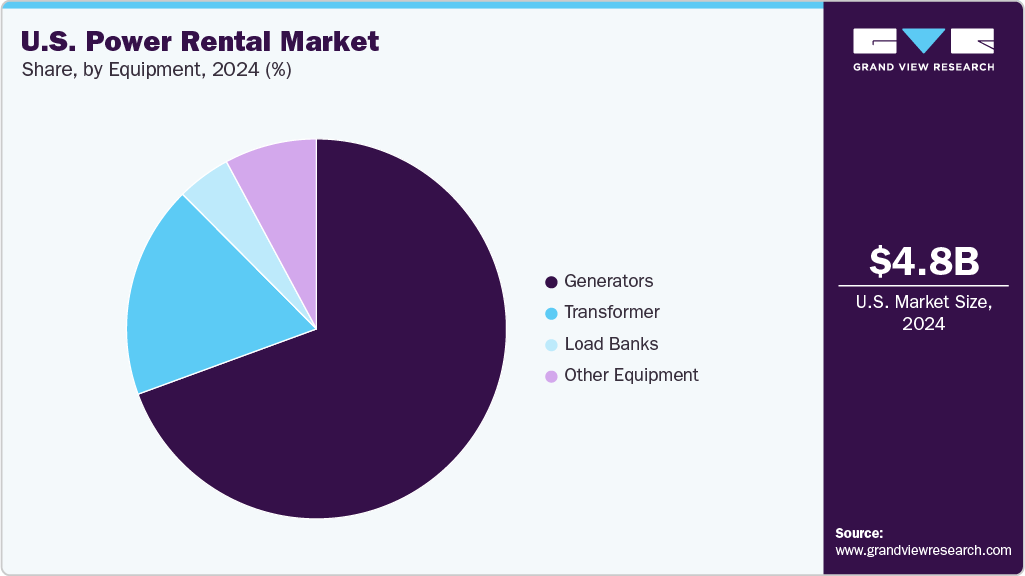
The load bank segment is projected to record at the fastest CAGR of 10.6% over the forecast period, driven by increasing demand for testing, commissioning, and performance verification of power systems in data centers, manufacturing plants, hospitals, utilities, and renewable energy installations. Load banks play a critical role in ensuring system reliability, particularly as backup power infrastructure becomes more sophisticated. The expansion of battery storage and hybrid power solutions is also driving demand for load banks used in functional testing and grid-synchronization assessments. Technological improvements, including compact mobile units and enhanced remote-monitoring capabilities, are supporting broader adoption among industrial and utility customers focused on preventive maintenance and power quality assurance.
Key U.S. Power Rental Company Insights
Some of the key players operating in the market include United Rentals and Aggreko, among others.
-
Caterpillar Inc., established in 1925 and headquartered in Texas, U.S., is a leading OEM whose broad Cat genset lineup (from mobile rental units to large industrial sets) and deep dealer network make it a backbone supplier for U.S. rental fleets and large project rentals. Its engines and rental-ready power solutions (with dealer-backed service and parts) are widely specified by rental operators for construction, utilities, and industrial outages. It also supports rental market modernization through Tier-compliant engine platforms, telematics-enabled controllers, and integrated service contracts, which rental firms use to shorten mobilization time and improve uptime guarantees.
-
Generac Holdings Inc., established in 1959 and headquartered in Wisconsin, U.S., is a major supplier of residential, commercial, and light-industrial generators and has expanded into hybrid and total energy solutions. Its product breadth (portable to multi-MW) and dealer network make it relevant to smaller rental fleets and last-mile rental needs in events, light construction, and small commercial backup.
Key U.S. Power Rental Companies:
- Atlas Copco
- Briggs & Stratton
- Caterpillar
- Cummins
- Doosan
- Generac Holdings Inc.
- Hipower
- Kohler
- Multiquip
- Taylor Power Systems
Recent Developments
- In April 2025, United Rentals announced a strategic expansion of its temporary power solutions network across the United States, focusing on increasing generator fleet capacity and enhancing rapid-response capabilities for industrial, construction, and utility customers. The initiative includes the addition of new Tier 4 Final diesel generators, hybrid power modules, and mobile battery-energy storage systems at key hubs in Texas, California, and the Midwest.
U.S. Power Rental Market Report Scope
|
Report Attribute
|
Details
|
|
Market Definition
|
The total annual revenue generated from the rental of temporary power generation equipment, such as generators, transformers, load banks, hybrid/BESS units, and associated distribution systems, across industrial, commercial, utility, construction, and emergency applications within the United States.
|
|
Market size value in 2025
|
USD 5.37 billion
|
|
Revenue forecast in 2033
|
USD 7.71 billion
|
|
Growth rate
|
CAGR of 4.6% from 2025 to 2033
|
|
Base year for estimation
|
2024
|
|
Historical data
|
2021 - 2023
|
|
Forecast period
|
2025 - 2033
|
|
Quantitative units
|
Revenue in USD million/billion and CAGR from 2025 to 2033
|
|
Report coverage
|
Revenue forecast, competitive landscape, growth factors, and trends
|
|
Segments covered
|
Fuel type, equipment
|
|
Country scope
|
U.S.
|
|
Key companies profiled
|
Atlas Copco; Briggs & Stratton; Caterpillar; Cummins; Doosan; Generac Holdings Inc.; Hipower; Kohler; Multiquip; Taylor Power Systems
|
|
Customization scope
|
Free report customization (equivalent to up to 8 analyst working days) with purchase. Addition or alteration to country, regional & segment scope.
|
|
Pricing and purchase options
|
Avail customized purchase options to meet your exact research needs. Explore purchase options
|
U.S. Power Rental Market Report Segmentation
This report forecasts revenue growth at the U.S. level and provides an analysis of the latest industry trends in each of the sub-segments from 2021 to 2033. For this study, Grand View Research has segmented the U.S. power rental market report based on the fuel type and equipment.
-
Fuel Type Outlook (Revenue, USD Million, 2021 - 2033)
-
Diesel
-
Natural Gas
-
Other Fuel Type
-
Equipment Outlook (Revenue, USD Million, 2021 - 2033)
-
Generators
-
Transformer
-
Load Banks
-
Other Equipment
Frequently Asked Questions About This Report
b. The U.S. power rental market size was estimated at USD 4.82 billion in 2024 and is expected to reach USD 5.37 billion in 2025.
b. The U.S. power rental market is expected to grow at a compound annual growth rate of 4.6% from 2025 to 2033 to reach USD 7.71 billion by 2033.
b. Based on the fuel type segment, Diesel held the largest revenue share of more than 51% in 2024.
b. Some of the key players operating in the U.S. power rental market include United Rentals, Sunbelt Rentals, Herc Rentals, Aggreko, Caterpillar, Cummins, Atlas Copco, Kohler Power, Generac Power Systems, and APR Energy.
b. The U.S. power rental market is primarily driven by rising demand for reliable temporary power across construction, industrial, utility, and commercial operations, especially during outages or peak-load periods. Ongoing infrastructure expansion and the growing need for scalable, flexible power solutions at remote or fast-paced project sites further accelerate market growth.

 Download Sample Report














