U.S. Frozen Food Market Summary
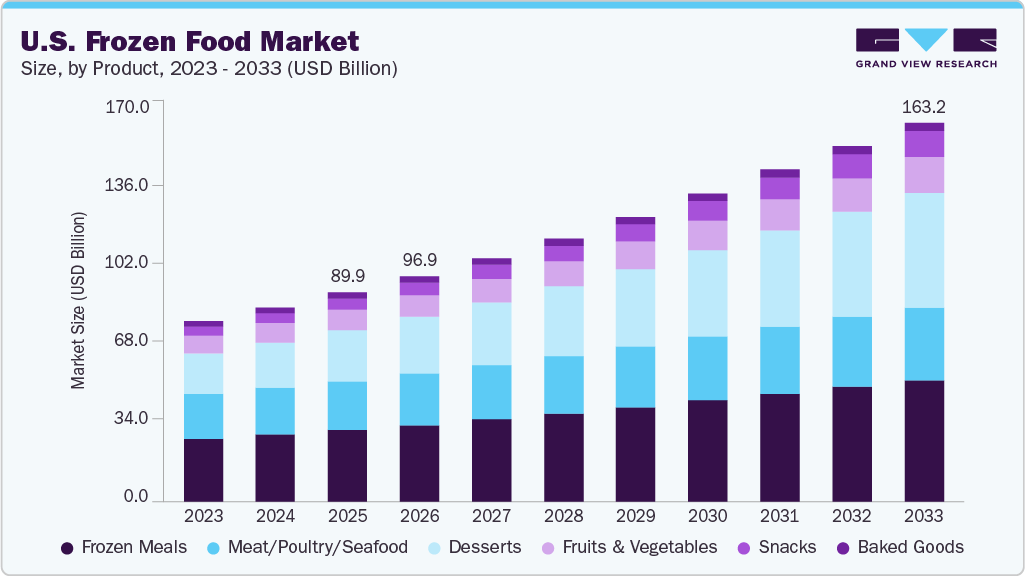
The U.S. frozen food market size was estimated at USD 89.94 billion in 2025 and is projected to reach USD 163.25 billion by 2033, growing at a CAGR of 7.7% from 2026 to 2033. The rise in dual-income households and busier lifestyles in the U.S. has fueled the demand for frozen, ready-to-eat, and ready-to-cook meals, making them a popular choice among consumers who seek quick, nutritious, and easy meal solutions.
Key Market Trends & Insights
- Northeast dominated the U.S. frozen food market with the largest revenue share of 16.1% in 2025.
- By product, the frozen meals segment led the market with the largest revenue share of 34.4% in 2025.
- By distribution channel, the traditional grocery stores segment led the market with the largest revenue share of 36.8% in 2025.
Market Size & Forecast
- 2025 Market Size: USD 89.94 Billion
- 2033 Projected Market Size: USD 163.25 Billion
- CAGR (2026-2033): 7.7%
- Northeast U.S.: Largest market in 2025
The rising prevalence of gluten-free diets among consumers, driven by the various health benefits offered by these products, will boost the market for gluten-free frozen ready meals. For instance, in March 2022, Halo Top, an ice cream brand from Wells Enterprises, Inc., launched a line of fruity frozen desserts with new sorbet pints. These products are available in three flavors: raspberry, mango, and strawberry. In addition, these products are made from real fruits, with less sugar & calories, and are vegan-certified and gluten-free. A rise in the trend of healthy eating among buyers will further drive the market growth.
The growing penetration of online platforms is one of the major market strategies of frozen food companies. For instance, in September 2023, Yelloh, formerly known as Schwan’s Home Delivery, launched a new website and mobile app to enhance customer experience in ordering frozen meals and treats. This transformation marks a significant step in the company's evolution, maintaining its commitment to delivering high-quality frozen foods that customers have enjoyed for over 70 years. Customers can retain their existing accounts but will need to sign in on the new platform.
Product Insights
The frozen meals segment led the market with the largest revenue share of 34.4% in 2025. The U.S. frozen meal industry is growing rapidly due to increasing demand for convenient, ready-to-eat meal options, lifestyle changes, dietary preferences, and rising disposable incomes. As the working population grows, many individuals have less time to prepare meals from scratch, which is contributing to market growth. Frozen meals offer a quick, easy alternative that requires minimal preparation time.Consumers are also becoming more aware of the environmental impact of food waste, which encourages them to choose frozen meal options. For instance, according to data published by The Investor’s Podcast Network in August 2023, nearly 40% of all food in the U.S. is wasted. Frozen meals can help address these concerns by reducing food waste.
The frozen snacks segment is expected to grow at the fastest CAGR of 11.0% from 2026 to 2033. Busy schedules, convenience, the expansion of e-commerce, and changing lifestyles are driving the demand for frozen snacks. As more people move into urban areas seeking career growth opportunities, fast-paced lifestyles are increasing the demand for convenient food alternatives, such as frozen snacks. Moreover, the rise of social media platforms and the sharing of new recipes has led consumers to seek out frozen snacks that can be prepared with minimal effort. With a growing number of health-conscious consumers, many frozen snack companies are now offering healthier options for those seeking nutritious, convenient alternatives.
Distribution Channel Insights
The traditional grocery stores segment led the market with the largest revenue share of 36.8% in 2025. The frozen food category in traditional grocery stores is growing due to factors such as their close proximity to residential areas and the convenience frozen foods offer, including time-saving meal options. These stores provide a wide array of products for consumers to choose from. In addition to frozen food options, traditional grocery stores stock goods required for day-to-day convenience, which appeals to U.S. households as they can purchase items in bulk. Their extensive frozen food selection includes a variety of products, including snacks, desserts, prepared meals, and more. This range allows consumers to meet their dietary needs and preferences all in one place.
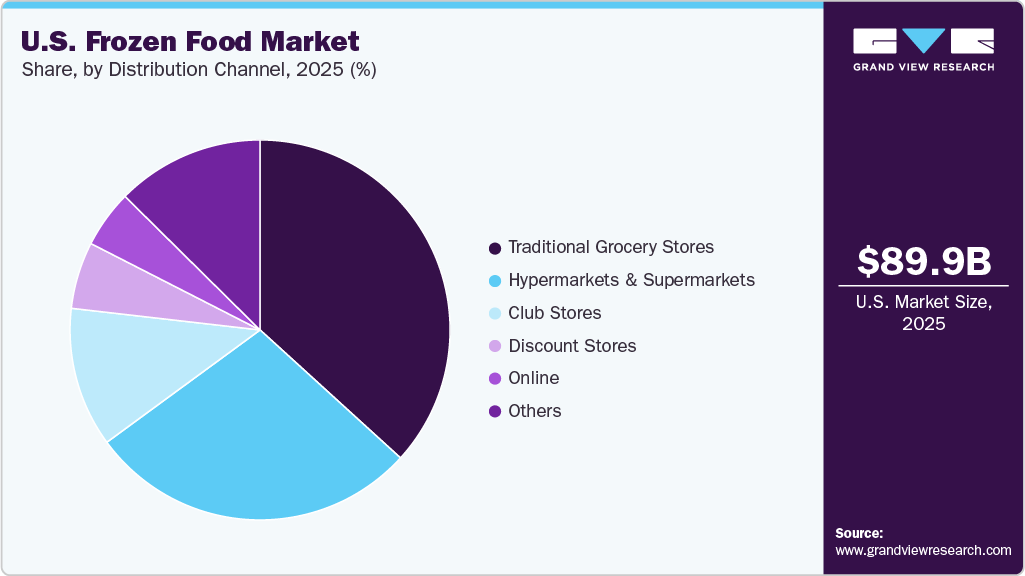
The online segment is expected to grow at the fastest CAGR of 11.9% from 2026 to 2033. The U.S. frozen food industry is growing, driven by lifestyle changes and the growing number of working professionals seeking convenient, delicious meals. Online stores offer a significant advantage to these busy consumers, allowing them to place orders with just a click. Moreover, the increase in internet connectivity across the nation further accelerated online shopping, providing consumers with access to a wide range of products
Regional Insights
The Northeast region dominated the U.S. frozen food market with the largest revenue share of 16.1% in 2025. The market for frozen food in the Northeast U.S. is rising as consumers increasingly prioritize convenience, longer shelf life, and reduced food waste amid busy urban lifestyles and higher living costs. Cold weather conditions and dense metropolitan populations support strong freezer adoption, while improvements in flash-freezing technology have enhanced taste, texture, and nutritional quality, narrowing the gap with fresh food.
The frozen food market in the South-Central U.S. is expected to grow at the fastest CAGR of 10.4% from 2026 to 2033. As more households prioritize easy-to-prepare options, frozen foods have become a staple, particularly for budget-conscious families and younger demographics. Retailers in the South-Central U.S. are expanding their frozen food offerings, including organic and culturally inspired products, to meet evolving consumer preferences, further boosting consumption across the region.
Key U.S. Frozen Foods Company Insights
Numerous well-established and emerging players characterize the U.S. frozen food industry. Manufacturers in the U.S. frozen food industry are pursuing a range of strategic initiatives to keep pace with evolving consumer demands and market trends. For instance, in June 2024, Nestlé S.A. introduced a diverse array of innovations, adding over 50 new products to grocery store shelves. The new range included notable choices in both single-serve and multi-serve frozen meals, as well as frozen vegetables and snacks. These launches further strengthened Conagra's robust portfolio of industry-leading brands.
Key U.S. Frozen Food Companies:
- Unilever PLC
- Nestlé S.A.
- General Mills, Inc.
- Nomad Foods Ltd.
- Tyson Foods Inc.
- Conagra Brands Inc.
- Wawona Frozen Foods
- Bellisio Parent, LLC
- McCain Foods
- The Kraft Heinz Company
Recent Developments
-
In June 2025, Nissin Foods, a pioneer in the instant ramen category, expanded its portfolio by launching a new line of frozen food products targeting health-conscious consumers. The range is specifically designed to appeal to GLP-1 users and individuals seeking nutrient-dense, balanced meal options, marking the company’s strategic move beyond its traditional instant noodle offerings into the better-for-you frozen foods segment.
-
In October 2024, Nestlé S.A. launched Mexican and Asian frozen meals in the U.S. It will market frozen products sold under the Mings and Tapatío brands. Celebrity chef Ming Tsai created the Mings brand and combines a “fusion of East-West flavors,” while Tapatío will feature Mexican frozen meals.
-
In September 2024, Authentic Asia, a brand under Bellisio Foods, introduced a new line of single-serve frozen meals. These meals showcase the regional flavors of Asia with restaurant-quality ingredients and the convenience of at-home preparation. Designed to offer a takeout-style experience, the meals featured a unique two-tray package that allowed rice and noodles to cook separately from the protein, sauce, and vegetables. This packaging ensured that each dish preserved its authentic taste and texture after just a few minutes in the microwave.
U.S. Frozen Food Market Report Scope
|
Report Attribute
|
Details
|
|
Market size value in 2026
|
USD 97.00 billion
|
|
Revenue forecast in 2033
|
USD 163.25 billion
|
|
Growth rate
|
CAGR of 7.7% from 2026 to 2033
|
|
Base year for estimation
|
2025
|
|
Historical data
|
2021 - 2024
|
|
Forecast period
|
2026 - 2033
|
|
Quantitative units
|
Revenue in USD million/ billion, and CAGR from 2026 to 2033
|
|
Report coverage
|
Revenue forecast, company ranking, competitive landscape, growth factors, and trends
|
|
Segments covered
|
Product, distribution channel, region
|
|
Country scope
|
U.S
|
|
Regional scope
|
Southeast; Northeast; Great Lakes; Mid-South; South Central; West; California; Plains
|
|
Key companies profiled
|
Unilever PLC; Nestlé S.A.; General Mills, Inc.; Nomad Foods Ltd.; Tyson Foods Inc.; Conagra Brands Inc.; Wawona Frozen Foods; Bellisio Parent, LLC; McCain Foods; The Kraft Heinz Company.
|
|
Customization scope
|
Free report customization (equivalent up to 8 analysts working days) with purchase. Addition or alteration to country, regional & segment scope.
|
|
Pricing and purchase options
|
Avail customized purchase options to meet your exact research needs. Explore purchase options
|
U.S. Frozen Food Market Report Segmentation
This report forecasts revenue growth at the regional, and country levels and provides an analysis of the latest industry trends and opportunities in each of the sub-segments from 2021 to 2033. For this study, Grand View Research has segmented the U.S. frozen food market report based on the product, distribution channel, and region.
-
Product Outlook (Revenue, USD Million, 2021 - 2033)
-
Frozen Meals
-
Breakfast Food
-
Dinners/Entrees
-
Pizza
-
Meat/Poultry/Seafood
-
Seafood
-
Processed Poultry
-
Poultry
-
Meat
-
Desserts
-
Ice Cream/Sherbet
-
Novelties
-
Desserts/Toppings
-
Fruits & Vegetables
-
Fruits
-
Strawberries
-
Raspberries
-
Blueberries
-
Blackberries
-
Peaches
-
Cherries
-
Apricots
-
Apples
-
Others
-
Vegetables
-
Mixed Vegetables
-
Broccoli
-
Beans
-
Corn
-
Peas
-
Prepared Vegetables
-
Corn on the Cob
-
Spinach
-
Onion Rings
-
Zucchini
-
Carrots
-
Onions
-
Snacks
-
Baked Goods
-
Distribution Channel Outlook (Revenue, USD Million, 2021 - 2033)
-
State Outlook (Revenue, USD Million, 2021 - 2033)
-
U.S.
-
Southeast
-
Northeast
-
Great Lakes
-
Mid-South
-
South Central
-
West
-
California
-
Plains
Frequently Asked Questions About This Report
b. Some key players operating in U.S. frozen food market include Unilever PLC, Nestlé S.A., General Mills, Inc., Nomad Foods Ltd., Tyson Foods Inc., and others.
b. Key factors that are driving the market growth include rising ready-to-eat food products and increasing snacking culture
b. U.S. frozen snacks is expected to grow at a CAGR of 10.9% from 2026 to 2033. Busy schedules, convenience, the expansion of e-commerce, and changing lifestyles are driving the demand for frozen snacks. As more people move into urban areas seeking career growth opportunities, fast-paced lifestyles are increasing the need for convenient food alternatives like frozen snacks.
b. The U.S. frozen food market size was estimated at USD 89.94 billion in 2025 and is expected to reach USD 97.00 billion in 2026.
b. The U.S. frozen food market is expected to grow at a compounded growth rate of 7.7% from 2026 to 2033 to reach USD 163.25 billion by 2033.

 Download Sample Report














