
- Home
- »
- Homecare & Decor
- »
-
Student Accommodation Market Size, Industry Report, 2033GVR Report cover
![Student Accommodation Market Size, Share & Trends Report]()
Student Accommodation Market (2026 - 2033) Size, Share & Trends Analysis Report By Accommodation (Purpose-Built Student Accommodation, University-Managed Accommodation), By Education Grade, By Occupancy, By Location, By Region, And Segment Forecasts
- Report ID: GVR-4-68040-437-0
- Number of Report Pages: 110
- Format: PDF
- Historical Range: 2021 - 2025
- Forecast Period: 2026 - 2033
- Industry: Consumer Goods
- Report Summary
- Table of Contents
- Segmentation
- Methodology
- Download FREE Sample
-
 Download Sample Report
Student Accommodation Market Summary
The global student accommodation market size was estimated at USD 12.37 billion in 2025 and is expected to reach USD 19.05 billion by 2033, growing at a CAGR of 5.7% from 2026 to 2033. The continuous rise in the global student population, particularly international students, is a significant driver of growth for the market.
Key Market Trends & Insights
- North America led the global student accommodation industry with a share of 41.89% in 2025.
- By accommodation, purpose-built student accommodation (PBSA) led the market with a share of 43.44% in 2025.
- By education grade, undergraduate students led the market with a share of 61.51% in 2025.
- By occupancy, double occupancy led the student accommodation industry with a share of 45.25% in 2025.
- By location, off-campus led the market with a share of 72.14% in 2025.
Market Size & Forecast
- 2025 Market Size: USD 12.37 Billion
- 2033 Projected Market Size: USD 19.05 Billion
- CAGR (2026-2033): 5.7%
- North America: Largest market in 2025
With more students pursuing higher education abroad, the demand for quality, safe, and convenient housing has surged. Countries such as the U.S., the UK, Australia, and Canada remain top destinations for international students, leading to increased pressure on existing accommodation infrastructure. Universities, while expanding their intake, are often unable to meet the housing demands of the growing student population, thereby creating opportunities for private developers and investors to step in with PBSA. This trend is expected to continue as the pursuit of global education becomes increasingly popular, fueled by the expanding middle class in developing countries and the growing importance of obtaining international qualifications.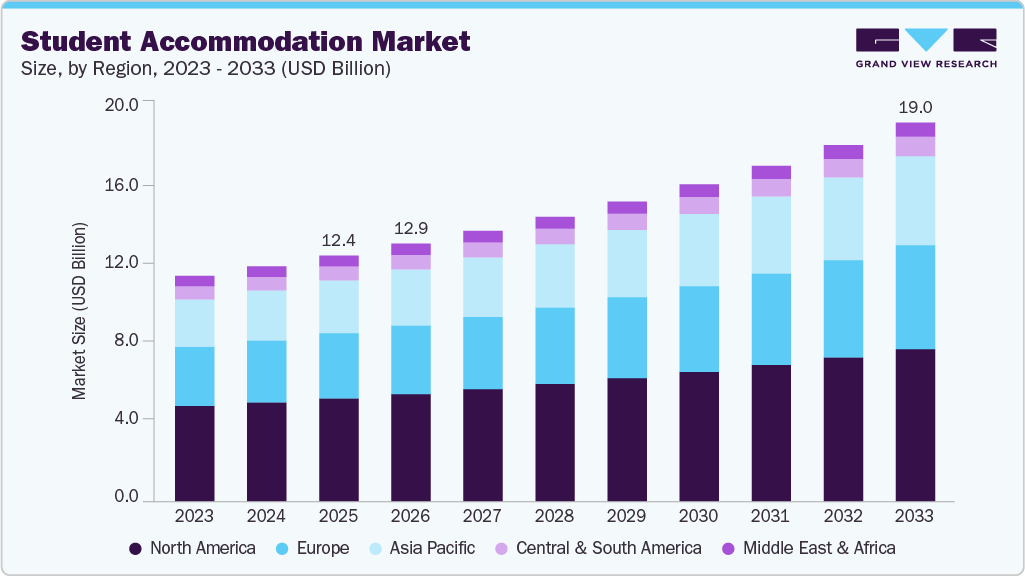
The growing number of internationally mobile students remains a key driver of the global Purpose-Built Student Accommodation (PBSA) market. According to the Open Doors 2025 Report by the Institute of International Education, U.S. colleges and universities hosted 1,177,766 international students in the 2024-2025 academic year, a 5% increase from the previous year and one of the highest enrollment levels on record. International students now account for around 6% of total U.S. higher education enrollment, highlighting sustained global demand for overseas education.
Globally, student mobility is also expanding rapidly. Recent education mobility estimates show that approximately 6.9 million students studied outside their home countries in 2024, the highest level ever recorded, with projections suggesting the number could exceed 10 million by 2030.
In addition, in 2025, UNESCO reported that worldwide higher education participation reached 264 million students, reflecting substantial expansion in tertiary education systems and reinforcing long-term demand for student housing across major study destinations such as the U.S., UK, Canada, Australia, France, and Germany.
Government policies and support play a crucial role in driving market growth. Many governments, particularly in developed countries, actively promote their educational institutions to attract international students, thereby indirectly boosting demand for student housing. In addition, in some regions, governments offer incentives to private developers to invest in student housing and related properties, such as tax breaks or subsidies, to help meet the housing demand. Urban planning policies also increasingly incorporate provisions for student housing, recognizing its importance in supporting the educational infrastructure. This supportive regulatory environment encourages investment and development in the sector, ensuring that student accommodation keeps pace with the growing demand.
The integration of technology into student accommodation is emerging as a strong growth driver, catering to the tech-savvy student population. Smart living features, such as automated climate control, keyless entry, high-speed internet, and digital communication platforms, are becoming standard in modern student housing. These technological advancements not only enhance the living experience but also address safety, security, and convenience concerns, which are top priorities for students and their families. In addition, the use of data analytics and property management software allows for more efficient operations and maintenance, further attracting both students and investors to the market. As students increasingly seek accommodation that meets their digital lifestyle needs, demand for technologically advanced living spaces continues to grow, fueling market expansion.
The evolving preferences and lifestyle changes among students are significantly influencing market growth. Today’s students are increasingly seeking out housing options that offer more than just a place to sleep; they desire spaces that support their academic, social, and personal development. This shift has led to a greater demand for accommodation that offers a balanced mix of private and communal spaces, fostering a sense of community while preserving individual privacy. Amenities such as fitness centers, study lounges, social event spaces, and sustainable living features are becoming crucial determinants of students' housing choices. The preference for high-quality, experience-oriented living environments is driving developers and property managers to innovate and upgrade their offerings, thereby accelerating market growth.
Consumer Insights
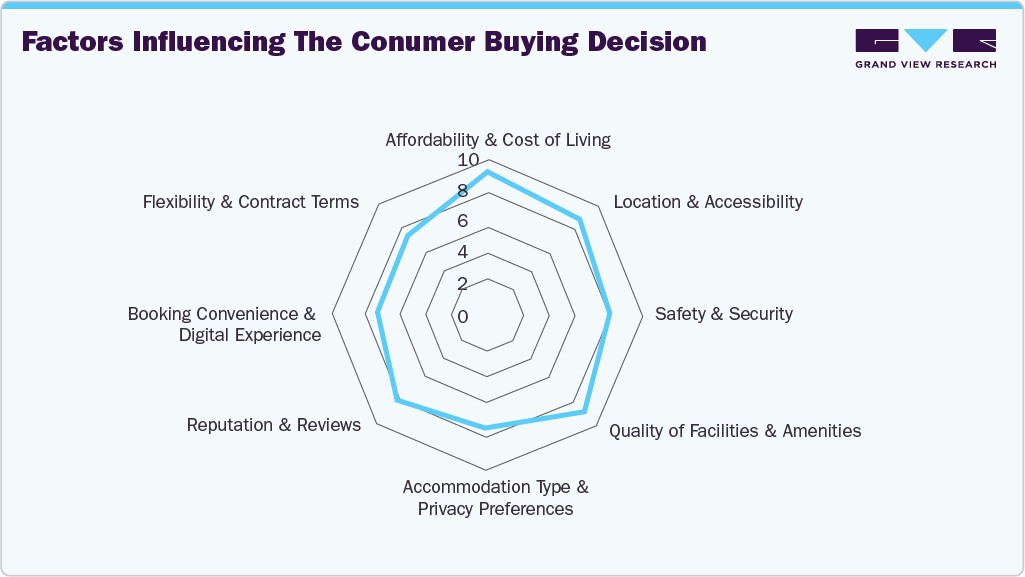
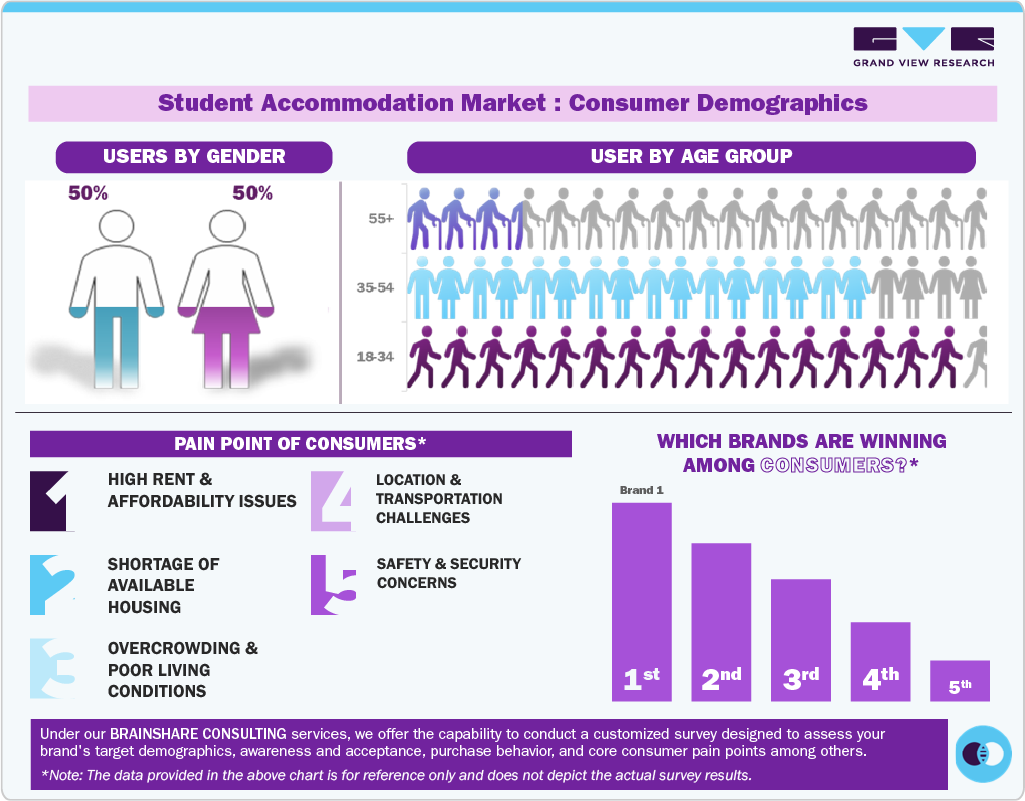
Affordability and the cost of living remain the primary factors influencing student accommodation decisions, as students carefully balance tuition costs with daily living expenses. Rising rental prices and inflation have heightened sensitivity to housing costs, making affordable rents, inclusive utility packages, and flexible payment options highly attractive. Students increasingly evaluate accommodation based on overall value for money, preferring options that combine reasonable pricing with essential facilities such as internet access, furnishings, and maintenance services.
Location and accessibility also play a crucial role in accommodation selection. Students typically prefer housing situated close to universities, public transportation networks, supermarkets, and social or recreational areas to reduce commuting time and transportation expenses. Safe neighborhoods and convenient access to campus resources enhance comfort and academic productivity, making strategically located accommodations more desirable among both domestic and international students.
Accommodation Insights
Purpose-built student accommodation (PBSA) held the largest revenue share of the student accommodation industry in 2025, accounting for a share of 43.44%. PBSAs are specifically designed to meet students' academic, social, and lifestyle needs, making it highly attractive compared to traditional housing options. These accommodations typically offer fully furnished rooms, dedicated study areas, high-speed internet connectivity, communal lounges, and shared facilities that support both learning and social interaction.
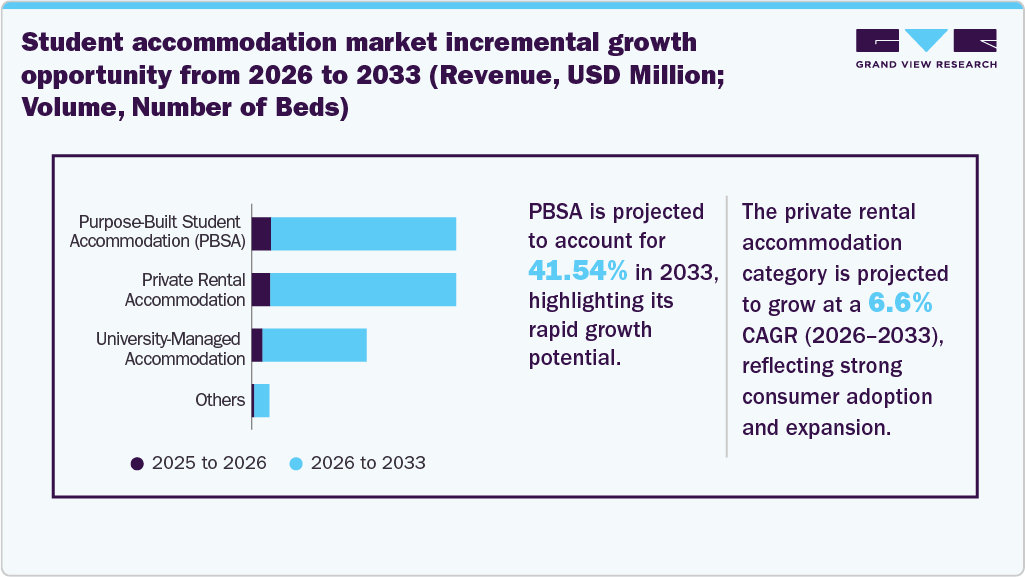
The private rental accommodation is anticipated to witness a CAGR of 6.6% from 2026 to 2033. The rising number of students pursuing higher education abroad, particularly from emerging economies, has created an unprecedented demand for quality housing that offers both flexibility and independence. Unlike traditional university-managed accommodations, private rentals cater to students' desire for a more personalized living experience, with better amenities, privacy, and proximity to urban centers.
Location Insights
Off-campus accommodation held the largest revenue share of the student accommodation industry in 2025, accounting for a share of 72.14%. Off-campus housing often offers a broader range of rental options, allowing students to select accommodation based on budget, room type, and preferred living arrangements. Sharing apartments or houses with peers also helps reduce individual living costs, given the limited on-campus housing availability. In addition, off-campus living provides students with greater personal freedom and exposure to city life beyond the university environment. Access to public transport, restaurants, retail stores, and entertainment areas enhances convenience and social experience.
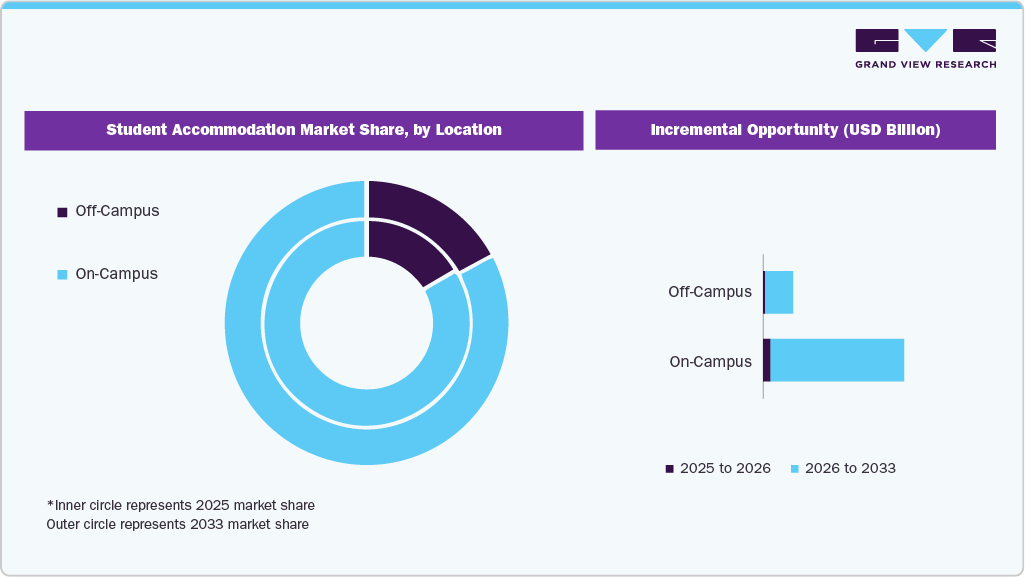
The demand for on-campus accommodation is anticipated to witness a CAGR of 6.7% from 2026 to 2033. Living on campus provides immediate access to classrooms, libraries, laboratories, and university facilities, helping students save time on commuting and focus more on academics. Universities are also expanding residential infrastructure to attract international students who often prefer institution-managed housing during their initial years of study.
Occupancy Insights
Double-sharing occupancy held the largest revenue share in the student accommodation industry in 2025, accounting for a share of 45.25%. Sharing a room allows students to significantly reduce individual rental and utility expenses, making it an attractive option for those managing limited budgets. At the same time, double occupancy encourages social interaction, peer bonding, and collaborative living, helping students build friendships and support networks.
Single sharing occupancy is anticipated to witness a CAGR of 6.5% from 2026 to 2033. Many students prefer personal space that allows them to focus on academic work without distractions, especially with the rise of hybrid learning and online coursework. Single-occupancy rooms offer quieter study conditions, better mental well-being, and greater control over daily routines, making them attractive to postgraduate, international, and working students.
Education Grade Insights
The demand among undergraduate students held the largest revenue share of the student accommodation industry in 2025, accounting for a share of 61.51%. The continuous growth in undergraduate enrollment remains a key driver of demand in the student housing market. According to the National Student Clearinghouse Research Center, total U.S. postsecondary enrollment reached 19.4 million students in Fall 2025, including 16.2 million undergraduate students, reflecting a 1.2% year-over-year increase in undergraduate enrollment. This marks another year of recovery and sustained growth following pandemic-related declines in higher education participation.
In addition, the Clearinghouse’s Spring 2025 Current Term Enrollment Estimates reported that undergraduate enrollment rose 3.5% year-on-year, reaching approximately 15.3 million students, indicating renewed interest in higher education pathways.
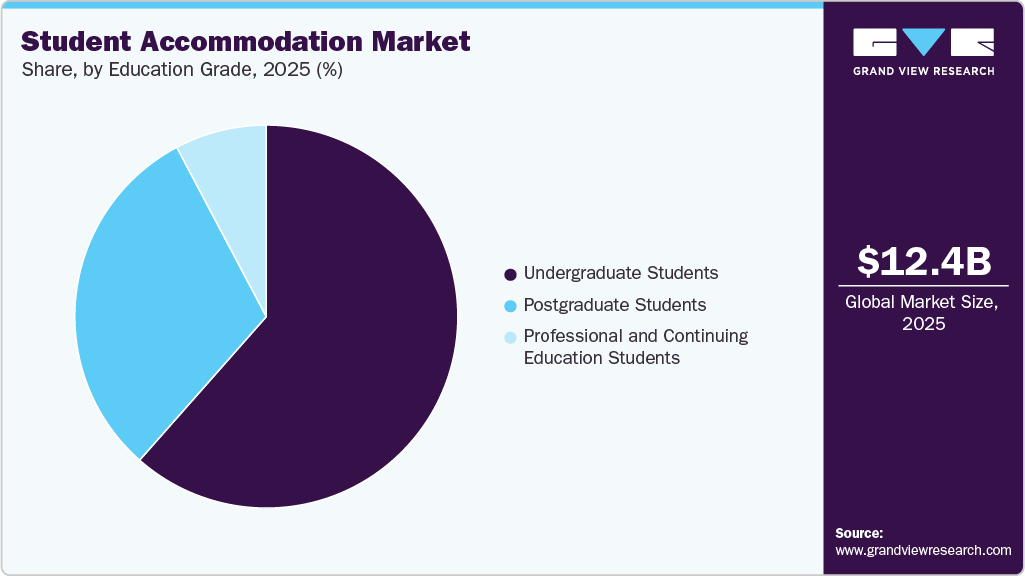
The demand for accommodations among post-graduate students is anticipated to witness a CAGR of 6.6% from 2026 to 2033. The increasing enrolment in higher education, particularly among international students pursuing advanced degrees, has driven demand for quality housing solutions that offer convenience, safety, and a conducive environment for academic pursuits. Post-graduates often seek accommodation well-connected to academic institutions and equipped with amenities that support both study and lifestyle needs.
The competitive nature of graduate programs and the demands of research-oriented courses necessitate an environment that minimizes distractions and supports academic excellence. As a result, there is a growing preference among post-graduates for accommodations that offer a balanced combination of privacy, comfort, and proximity to academic resources. The rise in global mobility and the trend of pursuing education abroad have increased the need for reliable, secure housing solutions for post-graduate students, particularly in urban areas with high concentrations of educational institutions. This trend is further reinforced by the increasing recognition of the role of well-designed student accommodation in enhancing the overall academic experience, thereby attracting and retaining top-tier talent.
Regional Insights
North America Student Accommodation Market Trends
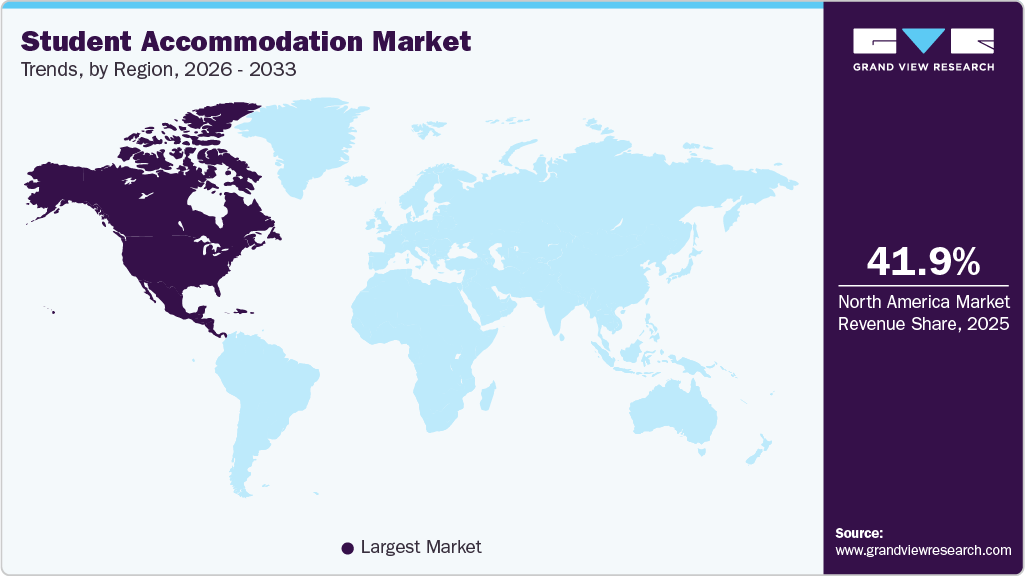
The student accommodation industry in North America held the largest global revenue share in 2025, accounting for a share of 41.89%. Universities across the U.S. and Canada continue to attract a growing number of domestic and international students due to high-quality education, diverse academic programs, and strong career opportunities. The recovery and expansion of international student inflows after pandemic disruptions have significantly boosted demand for on-campus and off-campus housing, particularly in major university cities. This steady growth in student populations is creating sustained pressure on housing supply, encouraging investment in purpose-built student accommodation and modern rental solutions.
U.S. Student Accommodation Market Trends
The student accommodation industry in the U.S. held the largest revenue share of 67.96% in the North American region in 2025. Rising institutional investment is a key driver of growth in the U.S. market, as student housing has emerged as a stable, recession-resistant real estate asset class. Investors, private equity firms, and real estate developers are increasingly allocating capital to purpose-built student accommodation due to consistently high occupancy rates, predictable rental income, and long-term demand tied to stable university enrollment. This substantial interest in investment is accelerating new project development, modernizing existing properties, and expanding portfolios in major university cities, thereby strengthening overall market growth and improving the quality and availability of student housing across the U.S.
Canada Student Accommodation Market Trends
The student accommodation industry in Canada is anticipated to witness a CAGR of 5.6% from 2026 to 2033. Purpose-built student accommodation is emerging as the fastest-professionalizing segment. Developers and investors are increasingly focusing on PBSA projects that offer modern amenities, security, and community living environments explicitly tailored to students, helping reduce pressure on traditional rental housing markets.
Asia Pacific Student Accommodation Market Trends
The student accommodation industry in the Asia Pacific is anticipated to witness a CAGR of 6.8% from 2026 to 2033. Expanding middle-class populations, improved access to higher education, and government initiatives promoting global education hubs have significantly increased student migration across countries such as Australia, China, India, Singapore, and Malaysia. The growing inflow of international students, along with large domestic student populations relocating to urban education centers, is creating sustained demand for organized, safe, and professionally managed student housing, encouraging the development of purpose-built student accommodation and modern rental solutions across the region.
The student accommodation industry in India held a revenue share of 34.59% in 2025. A growing number of students are relocating from smaller towns to major education hubs such as Bengaluru, Pune, Delhi-NCR, Hyderabad, and Chennai. Over 75% of students live away from their hometowns, creating sustained demand for organized accommodation solutions beyond traditional college hostels. Increasing domestic migration remains the primary demand driver, while international student numbers are also gradually rising.
The student accommodation industry in China is anticipated to witness a CAGR of 4.2% from 2026 to 2033. China’s vast domestic student population is a primary driver of growth in its market. With millions of students enrolled in universities and colleges each year, the continuous expansion of higher education participation is generating strong demand for both on-campus dormitories and off-campus housing. The increasing migration of students from smaller cities and rural regions to major academic hubs such as Beijing, Shanghai, and Guangzhou further intensifies housing demand, prompting universities and private developers to expand accommodation capacity and modernize student living facilities nationwide.
Europe Student Accommodation Market Trends
The student accommodation industry in Europe held a revenue share of 26.51% in 2025. Pension funds, private equity firms, and global real estate investors are actively investing in purpose-built student accommodation due to stable occupancy levels, predictable rental income, and long-term demand supported by strong university enrollment. This rising investment activity is accelerating large-scale developments, modernization of existing properties, and expansion of professionally managed student housing across major European university cities.
The student accommodation industry in the UK held a revenue share of 32.6% in 2025. The country continues to attract students worldwide due to its globally recognized universities, diverse academic programs, and strong post-study work opportunities. Increasing inflows of students from Asia, the Middle East, and Europe are significantly boosting demand for purpose-built student accommodation and private rental housing, particularly in major university cities.
The student accommodation industry in France is anticipated to witness a CAGR of 5.1% from 2026 to 2033. France market is experiencing growth driven by rising domestic and international student enrollments. Major education hubs such as Paris, Lyon, Toulouse, and Nantes continue to attract large student populations, creating sustained pressure on housing availability each academic year.
Central & South America Student Accommodation Market Trends
The student accommodation industry in Central & South America is anticipated to witness a CAGR of 4.2% from 2026 to 2033. Due to limited university-owned housing, students often rely on private rentals, shared apartments, and informal housing arrangements. Private rental accommodation is projected to be the fastest-growing segment as urban student populations expand and flexible living options become more attractive to domestic and international students.
Middle East & Africa Student Accommodation Market Trends
The student accommodation industry in the Middle East & Africa held a revenue share of 4.40% in 2025. The Middle East & Africa (MEA) region is witnessing increasing investment in higher education, driving strong growth in student populations and mobility. Expanding universities, government education initiatives, and growing international student inflows are boosting demand for dedicated student housing across major academic cities.
Key Student Accommodation Company Insights
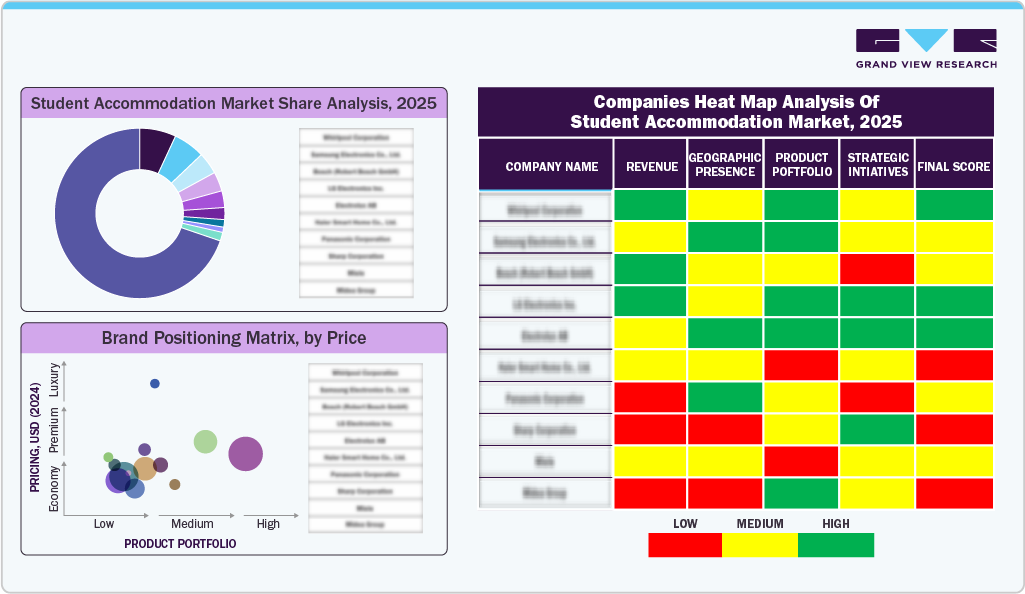
Leading players in the market include American Campus Communities (ACC), Global Student Accommodation Group, and Campus Living Villages. The global market is highly competitive, characterized by established purpose-built student accommodation (PBSA) operators, real estate developers, university housing providers, private landlords, and emerging co-living and student housing platforms expanding across major education hubs worldwide. Market participants are increasingly focusing on modern infrastructure development, technology-enabled property management, flexible leasing models, and amenity-rich living environments to meet evolving student expectations for affordability, convenience, safety, and community-oriented living.
Key Student Accommodation Companies:
The following key companies have been profiled for this study on the student accommodation market
- American Campus Communities (ACC)
- Global Student Accommodation Group
- Campus Living Villages
- The Student Hotel (TSH)
- The Unite Group
- Harrison Street
- Greystar Real Estate Partners
- APG Asset Management
- Kohlberg Kravis Roberts & Co. L.P.
- Mapletree Investments Pte Ltd
Recent Developments
-
In January 2026, New Era Living launched its 2026/27 student accommodation offering, featuring major savings and a city-wide shuttle service, highlighting the growing focus on affordability and convenience in the student housing market. The initiative introduced discounted rental packages along with a dedicated shuttle service connecting key university locations across Sheffield, helping students reduce transportation costs and improve accessibility.
-
In July 2025, Centurion Corporation launched EPIISOD, a new premium, purpose-built student accommodation (PBSA) brand in Sydney, reflecting the growing shift toward high-quality, experience-driven student housing. The flagship EPIISOD Macquarie Park development, located near Macquarie University, will provide approximately 732 student beds and is scheduled to welcome residents by Semester 1 of 2026. The project emphasizes hotel-style living, with modern amenities including wellness facilities, innovative technology, curated community programs, and inclusive lifestyle services designed to enhance academic success and student well-being.
Student Accommodation Market Report Scope
Report Attribute
Details
Market size in 2026
USD 12.9 billion
Revenue Forecast in 2033
USD 19.05 billion
Growth rate (Revenue)
CAGR of 5.7% from 2026 to 2033
Actuals
2021 - 2025
Forecast period
2026 - 2033
Quantitative units
Revenue in USD billion and CAGR from 2026 to 2033
Report coverage
Revenue forecast, company ranking, competitive landscape, growth factors, and trends
Segments covered
Accommodation, education grade, location, occupancy, region
Region Covered
North America; Europe; Asia Pacific; Central & South America; Middle East & Africa
Country Covered
U.S.; Canada; Mexico; UK; Germany; France; Italy; Spain; China; India; Japan; Australia; Brazil; UAE; South Africa
Key companies profiled
American Campus Communities (ACC); Global Student Accommodation Group; Campus Living Villages; The Student Hotel (TSH); The Unite Group; Harrison Street; Greystar Real Estate Partners; APG Asset Management; Kohlberg Kravis Roberts & Co. L.P; Mapletree Investments Pte Ltd
Customization scope
Free report customization (equivalent to up to 8 analysts’ working days) with purchase. Addition or alteration to country, regional & segment scope.
Pricing and purchase options
Avail customized purchase options to meet your exact research needs. Explore purchase options
Global Student Accommodation Market Report Segmentation
This report forecasts revenue growth at global, regional & country levels and provides an analysis of the latest trends and opportunities in each of the sub-segments from 2021 to 2033. For this study, Grand View Research has segmented the student accommodation market report based on accommodation, education grade, occupancy, location, and region.
-
Accommodation Outlook (Volume, Number of Beds; Revenue, USD Billion, 2021 - 2033)
-
Purpose-Built Student Accommodation (PBSA)
-
University-Managed Accommodation
-
Private Rental Accommodation
-
Others (Homestays, etc.)
-
-
Education Grade Outlook (Volume, Number of Beds; Revenue, USD Billion, 2021 - 2033)
-
Undergraduate Students
-
Postgraduate Students
-
Professional and Continuing Education Students
-
-
Location Outlook (Volume, Number of Beds; Revenue, USD Billion, 2021 - 2033)
-
Off-campus
-
On-campus
-
-
Occupancy Outlook (Volume, Number of Beds; Revenue, USD Billion, 2021 - 2033)
-
Single
-
Double
-
Triple/ Multi
-
-
Regional Outlook (Volume, Number of Beds; Revenue, USD Billion, 2021 - 2033)
-
North America
-
U.S.
-
Canada
-
Mexico
-
-
Europe
-
Germany
-
UK
-
France
-
Italy
-
Spain
-
-
Asia Pacific
-
China
-
India
-
Japan
-
Australia
-
-
Central & South America
-
Brazil
-
-
Middle East and Africa
-
UAE
-
South Africa
-
-
Frequently Asked Questions About This Report
b. Some of the key players operating in the student accommodation market include American Campus Communities (ACC), Global Student Accommodation Group, Campus Living Villages, The Student Hotel (TSH), The Unite Group, Harrison Street, Greystar Real Estate Partners, APG Asset Management, Kohlberg Kravis Roberts & Co. L.P., and Mapletree Investments Pte Ltd.
b. The growth of the global student accommodation market is majorly driven by The continuous rise in the global student population, particularly international students, along with the growing demand for quality, safe, and convenient housing among students.
b. The global student accommodation market was estimated at USD 12.37 billion in 2025 and is expected to reach USD 12.96 billion in 2026.
b. The global student accommodation market is expected to grow at a compound annual growth rate of 5.7% from 2026 to 2033 to reach USD 19.05 billion by 2033.
b. North America dominated the student accommodation market with a share of over 41.9% in 2025. The regional demand is driven by the expansion of university and college programs and the influx of international students.


Share this report with your colleague or friend.
Need a Tailored Report?
Customize this report to your needs — add regions, segments, or data points, with 20% free customization.


ISO 9001:2015 & 27001:2022 Certified
We are GDPR and CCPA compliant! Your transaction & personal information is safe and secure. For more details, please read our privacy policy.
Trusted market insights - try a free sample
See how our reports are structured and why industry leaders rely on Grand View Research. Get a free sample or ask us to tailor this report to your needs.












