
- Home
- »
- Renewable Energy
- »
-
Solid Recovered Fuel Market Size, Industry Report, 2033GVR Report cover
![Solid Recovered Fuel Market Size, Share & Trends Report]()
Solid Recovered Fuel Market (2026 - 2033) Size, Share & Trends Analysis Report By Fuel Grade (High-Grade SRF, Mid-Grade SRF), By Processing Technology (MBT, Advanced Dry Recovery), By End Use (Cement Manufacturing, Power & CHP), By Region, And Segment Forecasts
- Report ID: GVR-4-68040-858-5
- Number of Report Pages: 120
- Format: PDF
- Historical Range: 2021 - 2024
- Forecast Period: 2026 - 2033
- Industry: Energy & Power
- Report Summary
- Table of Contents
- Segmentation
- Methodology
- Download FREE Sample
-
 Download Sample Report
Solid Recovered Fuel Market Summary
The global solid recovered fuel market size was estimated at USD 7.37 million in 2025 and is projected to reach USD 12.14 million by 2033, growing at a CAGR of 6.5% from 2026 to 2033. The market growth is primarily driven by the rising demand for alternative fuels, increasing pressure to reduce landfill waste, and stringent environmental regulations promoting sustainable waste management practices.
Key Market Trends & Insights
- Europe solid recovered fuel market held the largest share of 37.01% of the global market in 2025.
- By fuel grade, Mid-Grade SRF segment held the largest market share in 2025.
- By processing technology, MBT segment held the largest market share in 2025.
- By end use, cement manufacturing segment held the largest market share of 68.43% in 2025.
Market Size & Forecast
- 2025 Market Size: USD 7.37 Million
- 2033 Projected Market Size: USD 12.14 Million
- CAGR (2026-2033): 6.5%
- Europe: Largest market in 2025
- Asia Pacific: Fastest growing market
SRF, produced from non-hazardous municipal and commercial waste, is gaining strong traction as a cleaner substitute for fossil fuels in energy-intensive industries such as cement manufacturing, power generation, and industrial heating due to its high calorific value and lower carbon footprint.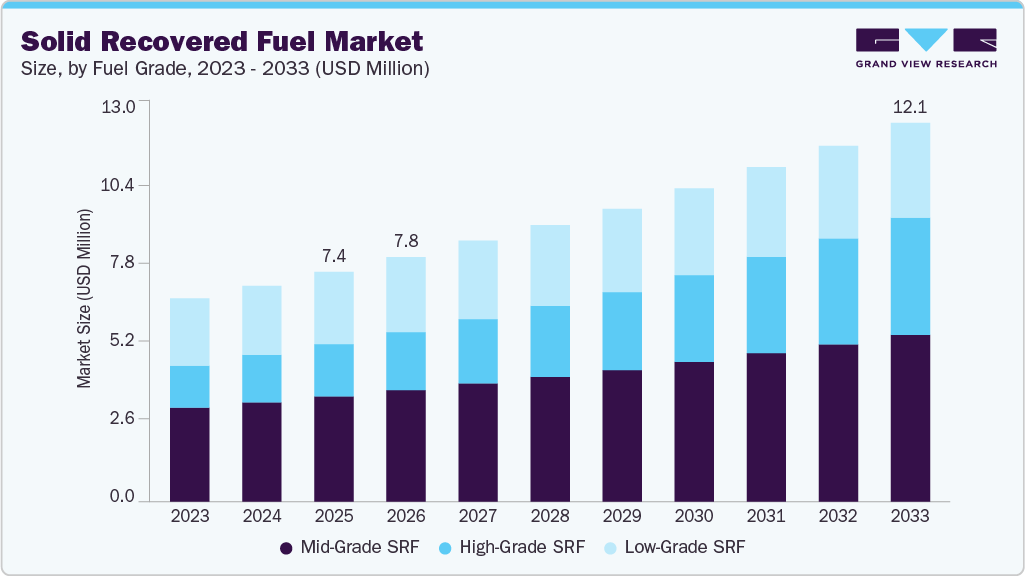
Growing investments in advanced waste processing infrastructure, coupled with expanding circular economy initiatives, are accelerating SRF adoption across developed and emerging economies. Governments and regulatory bodies are implementing landfill diversion targets and waste-to-energy policies, further supporting market expansion. Moreover, technological advancements in mechanical biological treatment (MBT), pelletization, and fuel quality standardization are improving combustion efficiency and operational reliability. Strategic partnerships among waste management companies, energy producers, and industrial manufacturers continue to strengthen supply chains and commercialization opportunities, positioning solid recovered fuel as a critical solution for sustainable energy generation and long-term emissions reduction.
Drivers, Opportunities & Restraints
The growing global emphasis on sustainable waste management and the transition toward low-carbon energy sources primarily drive the Solid Recovered Fuel (SRF) market. Rapid urbanization and industrialization have significantly increased municipal and commercial waste generation, prompting governments and industries to seek efficient alternatives to landfill disposal. SRF is gaining widespread recognition as a reliable substitute for conventional fossil fuels due to its high calorific value, cost efficiency, and ability to reduce greenhouse gas emissions. Stringent environmental regulations targeting landfill reduction and carbon emissions, particularly across Europe and parts of the Asia Pacific, are encouraging the adoption of waste-to-energy technologies. Moreover, rising energy demand from energy-intensive industries such as cement, lime, and power generation is accelerating the integration of SRF into industrial fuel mixes to support long-term decarbonization strategies.
Despite these growth drivers, the market faces several restraints. High initial capital requirements for advanced waste processing facilities, including mechanical biological treatment (MBT) plants and fuel refinement systems, can limit adoption among smaller operators. Variability in waste composition often affects fuel quality and combustion performance, creating operational challenges for end users. Regulatory inconsistencies across regions, along with complex permitting processes for waste-to-energy projects, may further delay infrastructure development. Public concerns regarding emissions from waste-derived fuels and limited awareness about SRF benefits in developing economies can also hinder market penetration. Additionally, underdeveloped waste segregation systems in certain regions reduce the efficiency of SRF production and supply chains.
The market presents significant opportunities through technological advancements in waste sorting, shredding, drying, and pelletization that improve fuel consistency and energy output. Increasing investments in circular economy initiatives are encouraging industries to convert waste into valuable energy resources, unlocking new revenue streams while reducing environmental impact. Emerging economies are expected to offer strong growth potential as governments strengthen waste management frameworks and prioritize landfill diversion. Furthermore, strategic partnerships between waste management companies, industrial fuel users, and energy providers are fostering integrated supply networks that enhance market scalability. As global sustainability targets intensify and industries seek economically viable alternatives to coal, SRF is positioned to play a crucial role in advancing resource efficiency, supporting cleaner industrial operations, and contributing to long-term emissions reduction goals.
Fuel Grade Insights
The Mid-Grade SRF segment accounted for the largest market share of 45.77% in 2025, primarily driven by its balanced combination of cost efficiency and energy performance. Mid-grade fuel delivers a favorable calorific value while maintaining comparatively lower processing costs than high-grade alternatives, making it a preferred choice for industries such as cement manufacturing, industrial heating, and combined heat and power (CHP) plants. Its broad availability from municipal and commercial waste streams ensures a steady supply, enabling industrial facilities to incorporate SRF into their existing fuel mix with minimal infrastructure adjustments. Additionally, tightening environmental regulations aimed at reducing landfill dependency and lowering carbon emissions are encouraging industries to adopt mid-grade SRF as a practical and economically viable alternative to conventional fossil fuels.
The High-Grade SRF segment is projected to register the fastest CAGR of 10.6% during the forecast period, supported by the rising demand for premium-quality alternative fuels that offer higher combustion efficiency and reduced environmental impact. Produced through advanced sorting, drying, and refining processes, high-grade SRF contains lower moisture and impurity levels, resulting in superior calorific value, lower ash generation, and more stable thermal performance. These characteristics make it particularly suitable for industrial operators striving to improve energy efficiency while complying with stringent emission standards. Furthermore, ongoing technological advancements in waste processing and increasing investments in modern treatment infrastructure are enhancing production reliability and fuel consistency. As industries accelerate their transition toward cleaner energy sources and circular economy practices, high-grade SRF is expected to play a critical role in driving the next phase of market growth.
Processing Technology Insights
The Mechanical Biological Treatment (MBT) segment accounted for the largest market share of 51.17% in 2025, driven by its efficiency in processing mixed municipal solid waste and converting it into usable solid recovered fuel. MBT integrates mechanical sorting with biological stabilization to separate recyclable materials while reducing the biodegradable content of waste, ultimately improving fuel quality and calorific value. Technology is widely adopted across regions with stringent landfill diversion targets, as it significantly minimizes waste volume while supporting energy recovery initiatives. Additionally, the ability of MBT facilities to handle large waste streams makes them a cost-effective solution for municipalities and waste management companies seeking scalable and environmentally compliant processing methods.
The advanced dry recovery segment is projected to grow at a CAGR of 8.4% during the forecast period, supported by increasing demand for high-efficiency waste processing technologies that enhance material recovery and fuel consistency. This method utilizes automated sorting systems, air classification, and sensor-based separation technologies to extract high-calorific fractions without relying on biological treatment, resulting in faster processing cycles and reduced operational complexity. As industries prioritize higher-quality SRF to improve combustion performance and meet emission standards, advanced dry recovery is gaining traction as a reliable alternative.
End Use Insights
The Cement Manufacturing segment accounted for the largest market share of 68.43% in 2025, primarily driven by the sector’s high energy requirements and strong focus on reducing fuel costs and carbon emissions. Cement kilns are particularly well-suited for solid recovered fuel due to their ability to operate at extremely high temperatures, ensuring efficient combustion with minimal residual waste. The industry has increasingly integrated SRF as a substitute for traditional fossil fuels such as coal and petcoke, supporting both economic and environmental objectives. Additionally, tightening emission regulations and sustainability commitments across the construction value chain are encouraging cement producers to adopt alternative fuels that align with long-term decarbonization strategies while maintaining operational efficiency.
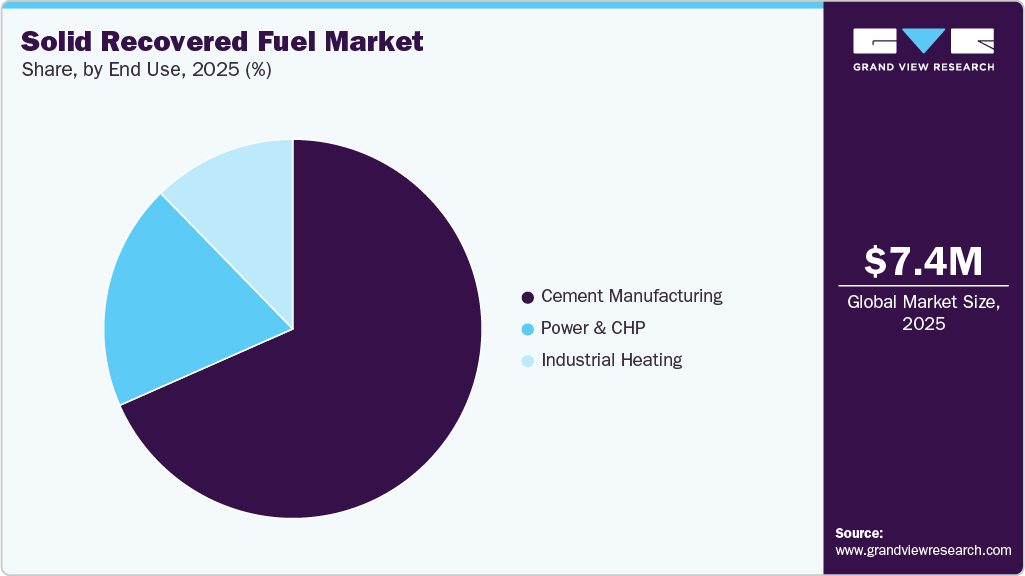
The Power & CHP segment is projected to grow at the fastest CAGR of 8.2% during the forecast period, supported by the rising demand for diversified and lower-carbon energy sources. Utilities and independent power producers are increasingly exploring SRF to reduce dependency on conventional fuels while improving energy security. Combined heat and power plants benefit from SRF’s ability to generate both electricity and thermal energy efficiently, making it an attractive option for industrial clusters and district heating networks seeking optimized energy utilization.
Regional Insights
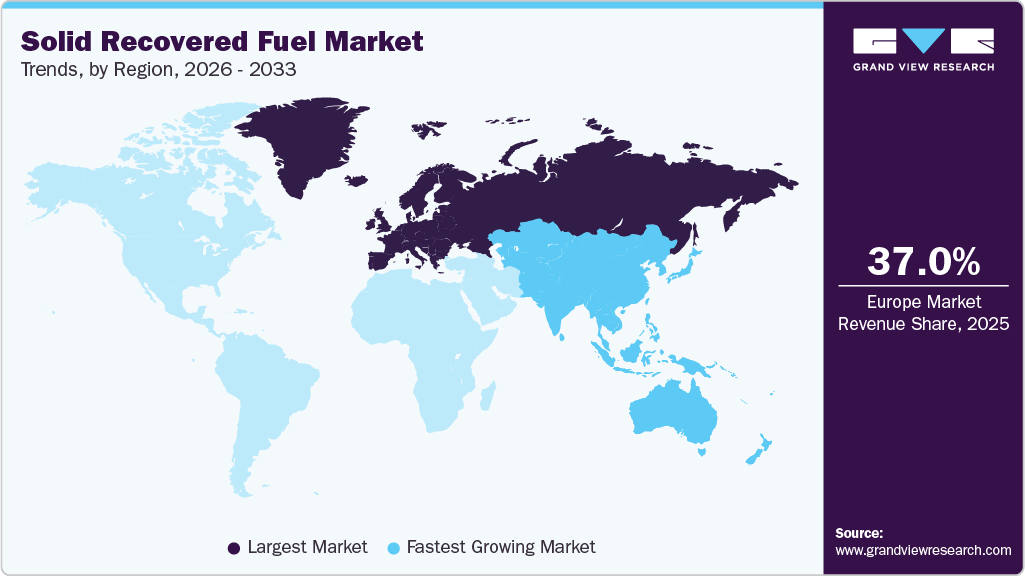
Europe accounted for the largest revenue share of 37.01% in 2025, primarily driven by stringent environmental regulations, aggressive landfill diversion targets, and well-established waste-to-energy infrastructure. The region has been at the forefront of circular economy adoption, encouraging industries to convert non-recyclable waste into alternative fuels such as SRF. Countries including Germany, the Netherlands, Italy, and the UK have significantly invested in advanced waste processing facilities and co-processing capabilities within cement plants, supporting large-scale SRF utilization. Moreover, strong policy support aimed at reducing dependence on coal and lowering industrial emissions continues to reinforce Europe’s leadership in the global solid recovered fuel market.
North America Solid Recovered Fuel Market Trends
North America represents a substantial share of the global solid recovered fuel market, supported by increasing emphasis on sustainable waste disposal and energy recovery. The region is witnessing steady adoption of SRF across cement kilns and industrial heating applications as companies aim to reduce fuel costs and comply with emission standards. Technological advancements in waste sorting and processing, combined with growing investments in integrated waste management systems, are strengthening market development. Additionally, supportive regulatory frameworks promoting landfill reduction are encouraging the transition toward alternative fuels.
The United States leads the North American market, accounting for the majority share of regional revenue. Rising waste volumes, strong industrial energy demand, and increasing focus on sustainable fuel alternatives drive market growth. Cement manufacturers and industrial facilities are gradually incorporating SRF into their energy mix to enhance operational efficiency while lowering environmental impact. Furthermore, the presence of advanced waste processing technologies and ongoing investments in waste-to-energy projects are supporting long-term market expansion, positioning the U.S. as a key contributor to regional growth.
Asia Pacific Solid Recovered Fuel Market Trends
Asia Pacific is projected to register the fastest CAGR of 9.2% during the forecast period, supported by rapid urbanization, rising municipal waste generation, and increasing demand for cost-effective alternative fuels. Governments across countries such as China, India, Japan, and South Korea are strengthening waste management frameworks while promoting waste-to-energy technologies to address landfill overflow and environmental concerns. Expanding industrialization, particularly in the cement and power sectors, is further accelerating SRF adoption as companies seek economically viable pathways to meet sustainability targets.
Latin America Solid Recovered Fuel Market Trends
Latin America is expected to witness steady growth during the forecast period, driven by improving waste management practices and growing awareness regarding landfill diversion. Countries such as Brazil, Mexico, and Chile are increasingly exploring alternative fuel solutions to address rising urban waste while supporting industrial decarbonization efforts. Strengthening regulatory structures and gradual investments in waste processing infrastructure are enabling the adoption of SRF, positioning the region as an emerging opportunity within the global market.
Middle East & Africa Solid Recovered Fuel Market Trends
The Middle East & Africa (MEA) solid recovered fuel market is anticipated to grow at a moderate pace, supported by expanding construction activity and rising demand from the cement sector. Several countries are prioritizing integrated waste management strategies to reduce environmental impact and improve resource utilization. Although the market remains at a developing stage due to infrastructure and investment challenges, increasing government focus on sustainability and diversification of energy sources is expected to drive gradual SRF adoption across the region.
Key Solid Recovered Fuel Company Insights
Some of the key players operating in the global Solid Recovered Fuel (SRF) market include Veolia Environment S.A., SUEZ, Renewi plc, Biffa plc, FCC Environment, Covanta Holding Corporation, Hitachi Zosen Corporation, Babcock & Wilcox Enterprises, Inc., Wheelabrator Technologies Inc., and Dalkia, among others.
These companies are actively engaged in waste collection, advanced processing, fuel refinement, and energy recovery initiatives aimed at converting non-recyclable waste into high-calorific alternative fuels. Market participants are prioritizing investments in mechanical biological treatment (MBT), automated sorting technologies, and pelletization processes to improve fuel consistency and operational efficiency. Strategic collaborations with municipalities, industrial fuel users, and energy providers are strengthening supply chains while supporting landfill diversion goals. Additionally, increasing regulatory pressure to reduce carbon emissions, along with growing industrial demand for cost-effective fuel alternatives, is encouraging these players to expand processing capacities and modernize infrastructure, positioning solid recovered fuel as a critical component of circular economy frameworks and sustainable industrial energy strategies.
Key Solid Recovered Fuel Companies:
The following key companies have been profiled for this study on the solid recovered fuel market.
- Babcock & Wilcox Enterprises, Inc.
- Biffa plc
- Covanta Holding Corporation
- Dalkia
- FCC Environment
- Hitachi Zosen Corporation
- Renewi plc
- SUEZ
- Veolia Environment S.A.
- Wheelabrator Technologies Inc.
Recent Developments
-
In March 2025, Veolia Environment S.A. and Solvay inaugurated the Dombasle Énergie project in Dombasle-sur-Meurthe, France. This initiative involves replacing three coal-fired boilers at Solvay's soda ash production plant with a cogeneration unit powered by solid recovered fuel (SRF) derived from non-hazardous waste. The facility is expected to process 350,000 metric tons of SRF annually, reducing the plant's CO₂ emissions by approximately 50% and eliminating the need to import 200,000 tons of coal each year.
Solid Recovered Fuel Market Report Scope
Report Attribute
Details
Market Definition
The Solid Recovered Fuel market represents the global revenue generated from the production and utilization of high-calorific fuel derived from non-hazardous waste for use in energy-intensive industries such as cement, power generation, and industrial heating.
Market size value in 2026
USD 7.83 million
Revenue forecast in 2033
USD 12.14 million
Growth rate
CAGR of 6.5% from 2026 to 2033
Base year for estimation
2025
Historical data
2021 - 2024
Forecast period
2026 - 2033
Quantitative units
Revenue in USD million/billion and CAGR from 2026 to 2033
Report coverage
Revenue forecast, competitive landscape, growth factors, and trends
Segments covered
Fuel Grade, processing technology, end use region
Regional scope
North America; Europe; Asia Pacific; Latin America; Middle East & Africa
Country scope
U.S.; Canada; Mexico; Germany; UK; France; Italy; Spain; China; India; Japan; Brazil; Argentina; Saudi Arabia; UAE; South Africa
Key companies profiled
Veolia Environment S.A.; SUEZ; Renewi plc; Covanta Holding Corporation; Biffa plc; FCC Environment; Hitachi Zosen Corporation; Babcock & Wilcox Enterprises, Inc.; Wheelabrator Technologies Inc.; Dalkia
Customization scope
Free report customization (equivalent up to 8 analysts working days) with purchase. Addition or alteration to country, regional & segment scope.
Pricing and purchase options
Avail customized purchase options to meet your exact research needs. Explore purchase options
Global Solid Recovered Fuel Market Report Segmentation
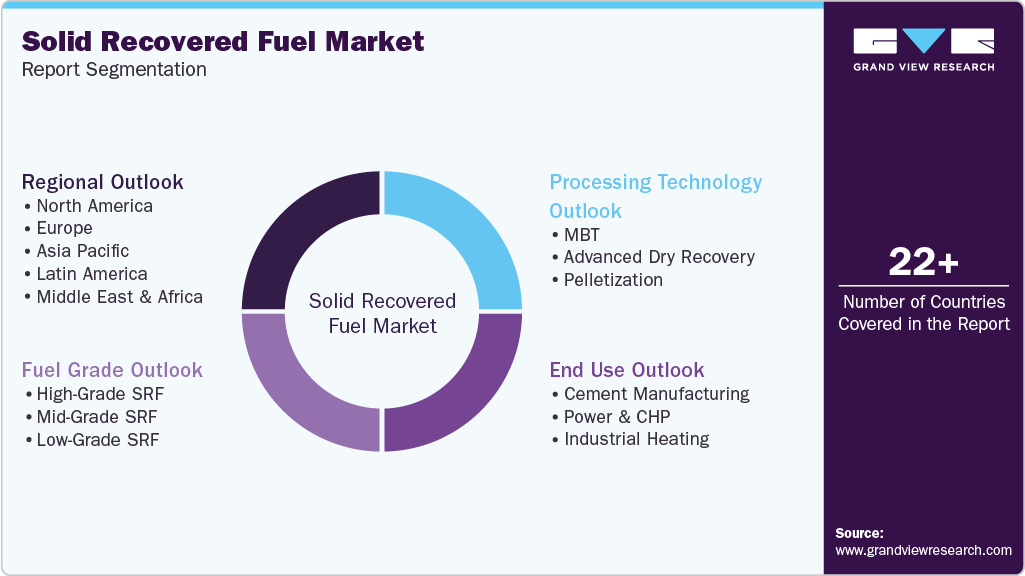
This report forecasts revenue growth at global, regional, and country levels and provides an analysis of the latest industry trends in each of the sub-segments from 2021 to 2033. For this study, Grand View Research has segmented the solid recovered fuel market report based on fuel grade, processing technology, end use and region:
-
Fuel Grade Outlook (Revenue, USD Million, 2021 - 2033)
-
High-Grade SRF
-
Mid-Grade SRF
-
Low-Grade SRF
-
-
Processing Technology Outlook (Revenue, USD Million, 2021 - 2033)
-
MBT
-
Advanced Dry Recovery
-
Pelletization
-
-
End Use Outlook (Revenue, USD Million, 2021 - 2033)
-
Cement Manufacturing
-
Power & CHP
-
Industrial Heating
-
-
Regional Outlook (Revenue, USD Million, 2021 - 2033)
-
North America
-
U.S.
-
Canada
-
Mexico
-
-
Europe
-
Germany
-
UK
-
France
-
Italy
-
Spain
-
-
Asia Pacific
-
China
-
India
-
Japan
-
-
Latin America
-
Brazil
-
Argentina
-
-
Middle East & Africa
-
Saudi Arabia
-
UAE
-
South Africa
-
-
Frequently Asked Questions About This Report
b. The global solid recovered fuel market size was estimated at USD 7.37 million in 2025 and is expected to reach USD 7.83 million in 2026.
b. The global solid recovered fuel market is expected to grow at a compound annual growth rate of 6.5% from 2026 to 2033 to reach USD 12.14 million by 2033.
b. Based on the processing technology segment, MBT held the largest revenue share of over 51% in the solid recovered fuel market in 2025.
b. Some of the key vendors operating in the global solid recovered fuel market include Veolia Environment S.A., SUEZ, Renewi plc, Covanta Holding Corporation, Biffa plc, FCC Environment, Hitachi Zosen Corporation, Babcock & Wilcox Enterprises, Inc., Wheelabrator Technologies Inc., and Dalkia, among others.
b. The key factors driving the solid recovered fuel market include increasing regulatory pressure to reduce landfill waste, rising demand for alternative low-carbon fuels, growing adoption of circular economy practices, and expanding industrial efforts to lower emissions while improving energy efficiency.


Share this report with your colleague or friend.
Need a Tailored Report?
Customize this report to your needs — add regions, segments, or data points, with 20% free customization.


ISO 9001:2015 & 27001:2022 Certified
We are GDPR and CCPA compliant! Your transaction & personal information is safe and secure. For more details, please read our privacy policy.
Trusted market insights - try a free sample
See how our reports are structured and why industry leaders rely on Grand View Research. Get a free sample or ask us to tailor this report to your needs.












