
- Home
- »
- Renewable Energy
- »
-
Solar Panel Recycling Market Size, Industry Report, 2033GVR Report cover
![Solar Panel Recycling Market Size, Share & Trends Report]()
Solar Panel Recycling Market (2026 - 2033) Size, Share & Trends Analysis Report By Type (Thermal, Mechanical, Laser), By Technique (Monocrystalline, Polycrystalline, Thin Film), By Shelf Life (Normal Loss, Early Loss), By Region, And Segment Forecasts
- Report ID: GVR-1-68038-617-2
- Number of Report Pages: 110
- Format: PDF
- Historical Range: 2021 - 2024
- Forecast Period: 2026 - 2033
- Industry: Energy & Power
- Report Summary
- Table of Contents
- Segmentation
- Methodology
- Download FREE Sample
-
 Download Sample Report
Solar Panel Recycling Market Summary
The global solar panel recycling market size was estimated at USD 384.4 million in 2025 and is projected to reach USD 609.7 million by 2033, growing at a CAGR of 6.0% from 2026 to 2033. This growth is driven by the increasing installation of solar energy systems worldwide, leading to a corresponding rise in end-of-life panels that must be managed effectively.
Key Market Trends & Insights
- The Europe solar panel recycling market held the largest share of over 39.0% in 2025.
- The solar panel recycling industry in the U.S. is expected to grow at the significant CAGR over the forecast period.
- By type, the mechanical segment dominated the market with a share of over 59.0% in 2025.
- By shelf life, the early loss segment dominated the market with a share of over 80.0% in 2025.
- By technique, the monocrystalline segment dominated the market with a share of over 49.0% in 2025.
Market Size & Forecast
- 2025 Market Size: USD 384.4 Million
- 2033 Projected Market Size: USD 609.7 Million
- CAGR (2026-2033): 6.0%
- Europe: Largest market in 2025
- Asia Pacific: Fastest growing market
In 2025, tightening environmental regulations and expanding sustainability initiatives are increasingly driving stakeholders to adopt structured solar panel recycling practices to minimize environmental impact and support circular economy objectives. Governments in major solar markets are strengthening compliance frameworks, while manufacturers are expanding take-back and recycling programs to meet regulatory and ESG requirements. At the same time, advances in automated and hybrid recycling technologies are improving recovery efficiency and lowering processing costs, encouraging wider commercial adoption of formal recycling systems.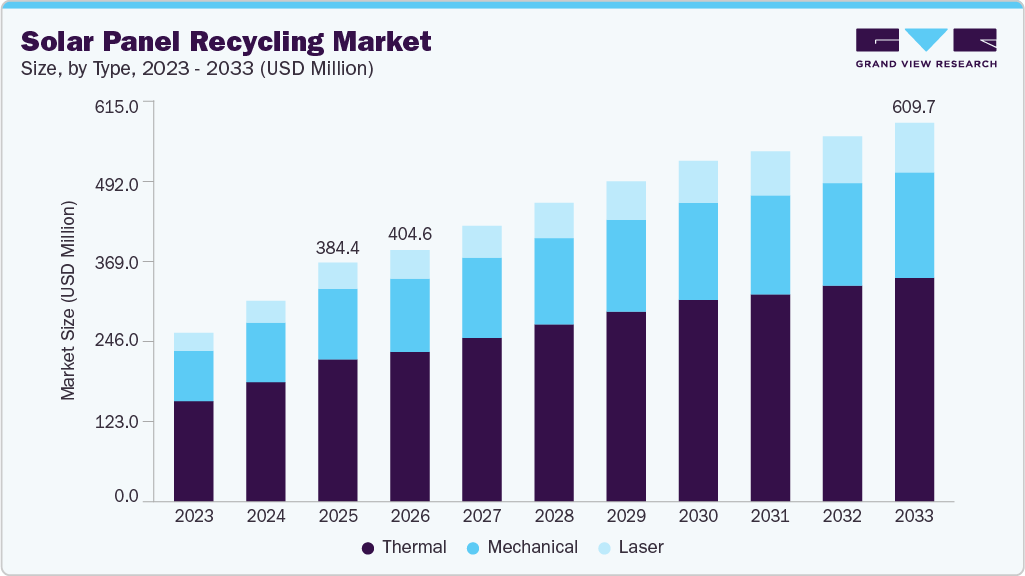
Regulatory frameworks continue to play a central role in shaping market development, with the European Union reinforcing WEEE compliance and producer responsibility obligations. At the same time, countries such as India and China introduced updated guidelines and monitoring mechanisms for photovoltaic waste management in 2025. These policies are promoting safer disposal, higher collection rates, and improved recovery of valuable materials such as silicon, silver, and aluminum. Together, stronger regulatory enforcement and technological progress are strengthening the long-term sustainability and scalability of the global solar panel recycling industry.
Drivers, Opportunities & Restraints
In 2025, the global solar panel recycling market will be significantly driven by real-world expansions in recycling infrastructure and regulatory action, exemplified by legislative efforts such as Washington State’s strengthened producer responsibility and take-back framework for PV modules, which came into effect early in the year and require manufacturers to manage end-of-life panels. In parallel, major manufacturers like Hanwha Qcells launched dedicated recycling divisions (EcoRecycle) in the United States capable of processing up to 250 MW of panels annually, addressing both sustainability goals and regulatory compliance, and reflecting how expanding installed solar capacity and environmental policy are concretely increasing recycling activity worldwide.
Several innovative technological and commercial opportunities emerged in 2025 that are reshaping solar panel recycling prospects, such as the introduction of highly automated, low-waste recycling technology by U.S. startup PV Circonomy, which reports a certified recovery rate above 99 % for silicon PV panels using proprietary separation equipment. Additionally, new, scalable research in India, led by MIT World Peace University, is converting otherwise hard-to-recover PV waste into construction materials, promising dual revenue streams and demonstrating how novel material recovery and reuse methods can expand the economic value of recycling beyond traditional commodity markets.
Despite strong growth indicators, the solar panel recycling sector in 2025 continues to face economic and logistical constraints, as studies show that formal recycling remains financially unviable in many markets due to high collection and processing costs relative to the value of recovered materials. For example, research regarding India’s projected solar waste challenge notes that without significant improvements in economic viability and infrastructure, including approximately 300 processing facilities and significant capital investment, large volumes of end-of-life panels will remain unmanaged. These costs and infrastructure constraints are similarly evident globally, where high operational expenses and inefficiencies continue to challenge the scalability of recycling programs.
Type Insights
The mechanical segment led the solar panel recycling industry, accounting for the largest share of over 59.0% in 2025, driven by the established, cost-effective nature of mechanical recycling processes. These methods physically break down solar panels through shredding, crushing, and grinding, efficiently recovering valuable materials such as glass, aluminum, and silicon for reuse in new panels and other products. Mechanical recycling is widely adopted due to its simplicity, scalability, and ability to handle large volumes of end-of-life photovoltaic modules.
The laser segment is projected to grow at the fastest CAGR from 2026 to 2033, fueled by the rising demand for advanced recycling technologies capable of extracting high-purity materials. Laser-based methods offer precision, minimal material loss, and targeted recovery of key components such as silver and silicon, which are critical for manufacturing new solar panels. These advantages are making laser recycling an increasingly preferred option for efficient, high-value material reclamation.
Technique Insights
The monocrystalline segment dominated the market and accounted for a share of over 55.0% in 2025, driven by the widespread use of high-efficiency, long-lasting monocrystalline panels in residential, commercial, and industrial applications. As many of these panels reach the end of their life cycle, recycling processes focus on recovering valuable materials such as silicon, silver, and aluminum, which can be reused in the production of new solar panels and other products.
The thin-film segment is projected to grow at the fastest CAGR over the forecast period, driven by the rising adoption of cadmium telluride (CdTe) and copper indium gallium selenide (CIGS) panels in utility-scale projects and emerging markets. Recycling thin-film panels targets materials such as cadmium, tellurium, and indium, which are critical to the manufacture of new modules. Segment growth is supported by increasing installations of thin film technologies and the development of advanced recycling methods that improve recovery efficiency.
Shelf Life Insights
The early-loss (UV panel waste) segment dominated the market and accounted for a share of over 80.0% in 2025. This segment includes panels that fail prematurely due to factors such as poor installation, midlife malfunctions, or degradation of the anti-reflective glass coating. These early-loss panels contribute significantly to overall solar waste, creating an urgent need for efficient recycling processes to recover valuable materials and reduce environmental impact.
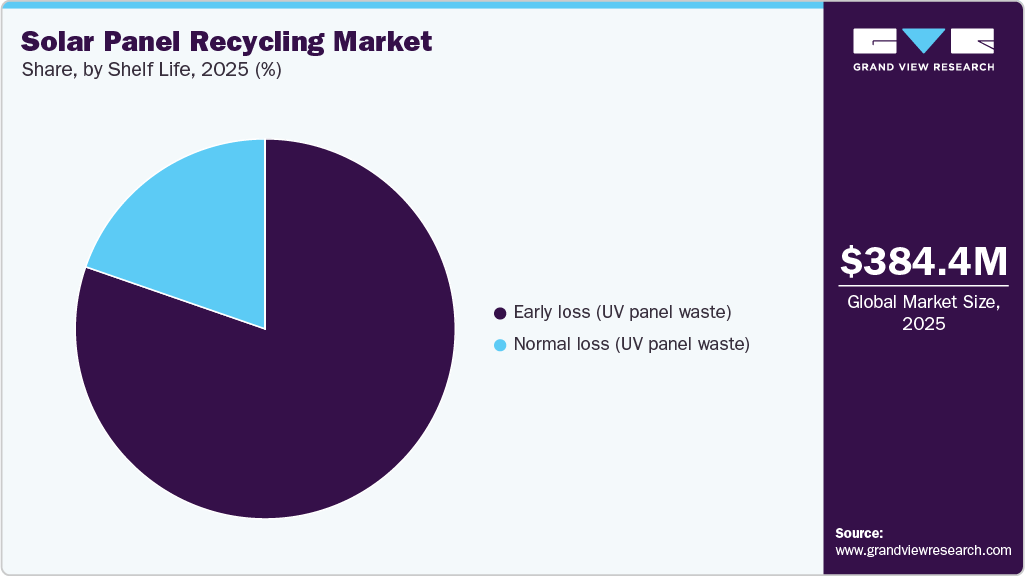
The normal-loss (UV panel waste) segment is projected to grow at the fastest CAGR during the forecast period. This segment consists of panels that reach the end of their expected operational lifespan of 25–30 years. With global solar installations continuing to expand, the volume of end-of-life panels is rising, driving demand for effective recycling solutions to recover materials such as silicon, silver, and aluminum while supporting sustainable waste management.
Regional Insights
The North America solar panel recycling market is expanding steadily, driven by the growing volume of aging photovoltaic installations, supportive environmental regulations, and increasing corporate commitments to sustainability. Large-scale solar deployments in the U.S. and Canada are beginning to reach early decommissioning stages, creating demand for structured collection and recycling systems. The presence of established recyclers and manufacturers with integrated take-back programs, along with rising awareness of circular economic practices, is strengthening regional infrastructure for photovoltaic waste management.
U.S. Solar Panel Recycling Market Trends
The U.S. solar panel recycling industry is experiencing strong momentum, driven by the rapid expansion of utility-scale and rooftop solar installations over the past decade. As early-generation panels approach the end of their operational life, demand for compliant disposal and material recovery services is increasing. Federal and state-level initiatives promoting responsible waste management, coupled with investments by major manufacturers in recycling facilities and logistics networks, are supporting the development of a more organized and scalable recycling ecosystem.
Europe Solar Panel Recycling Market Trends
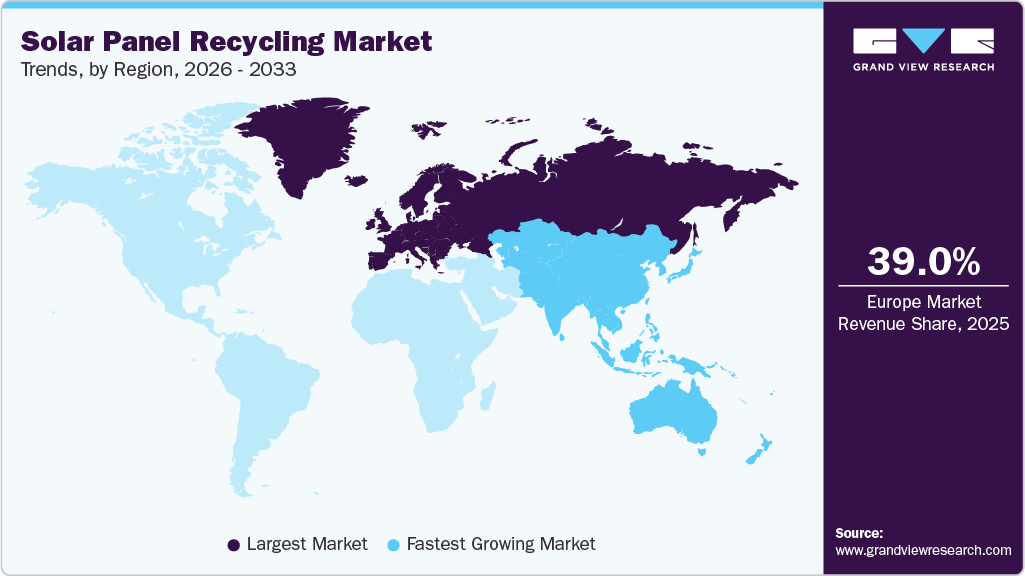
The European solar panel recycling market held the largest share of over 39.0% of the global market in 2025. Europe represents one of the most mature markets for solar panel recycling globally, supported by strict environmental regulations and extended producer responsibility frameworks. Mandatory compliance with waste electrical and electronic equipment directives has encouraged manufacturers and recyclers to invest in advanced typing technologies and high-recovery systems. Strong government oversight, well-developed collection networks, and high environmental awareness among end users continue to drive efficient photovoltaic waste recycling across major European economies.
Asia Pacific Solar Panel Recycling Market Trends
The Asia Pacific solar panel recycling industry is experiencing rapid development, driven by the region’s dominant position in global solar manufacturing and large-scale photovoltaic deployment across China, India, Japan, South Korea, and Australia. Massive installed solar capacity over the past decade is gradually translating into rising volumes of end-of-life modules, increasing the need for organized recycling and material recovery systems. Government initiatives promoting sustainable energy practices, growing investments in recycling infrastructure, and active participation by major manufacturers in take-back and recycling programs are supporting the expansion of circular economy models and strengthening the region’s long-term photovoltaic waste management capabilities.
Latin America Solar Panel Recycling Market Trends
The solar panel recycling industry in Latin America is at a developing stage, supported by the rapid growth of solar capacity in countries such as Brazil, Chile, and Mexico. While large-scale recycling infrastructure remains limited, increasing focus on renewable energy sustainability is encouraging public and private stakeholders to explore end-of-life management solutions. Regional collaborations, pilot recycling projects, and gradual regulatory development are expected to improve material recovery capabilities over the medium term.
Middle East & Africa Solar Panel Recycling Market Trends
The Middle East & Africa solar panel recycling industry is emerging alongside large investments in utility-scale solar projects and national renewable energy programs. Countries in the Gulf region, South Africa, and North Africa are expanding solar capacity to diversify energy sources, which is gradually creating future demand for recycling services. Although formal recycling frameworks are still developing, the growing emphasis on environmental compliance, resource efficiency, and circular-economy initiatives is supporting the early-stage growth of photovoltaic waste management systems in the region.
Key Solar Panel Recycling Company Insights
Some of the key players operating in the global solar panel recycling market include First Solar Inc., Aurubis AG, among others.
-
First Solar Inc., founded in 1999 and headquartered in the United States, is a leading global solar technology company with operations across North America, Europe, Asia Pacific, and the Middle East. The company operates one of the world’s largest integrated photovoltaic module recycling programs, specializing in the recovery of semiconductor materials, glass, and metals from cadmium telluride (CdTe) solar panels. First Solar is widely recognized for its closed-loop recycling model, high material recovery rates, and strong focus on sustainability, circular economy practices, and responsible end-of-life management of photovoltaic systems.
-
Aurubis AG, founded in 1866 and based in Germany, is a major global provider of non-ferrous metal typeing and recycling services, with operations spanning Europe, North America, and Asia. The company offers advanced metallurgical solutions for solar panel recycling, focusing on the recovery of copper, silver, aluminum, and other valuable metals from end-of-life photovoltaic modules and electronic waste. Aurubis is widely recognized for its expertise in complex metal recovery, environmentally responsible smelting technologies, and its strategic role in supporting circular material flows within the renewable energy value chain.
-
Reiling GmbH & Co. KG, founded in 1912 and headquartered in Germany, is a specialized recycling and waste management company with operations across Europe and selected international markets. The company provides comprehensive solar panel recycling services, including collection, logistics, mechanical typeing, and the recovery of high-purity glass from decommissioned photovoltaic modules. Reiling is widely recognized for its strong focus on high-quality material separation, compliance with European environmental regulations, and its integration of photovoltaic waste recycling into broader glass and resource recovery systems.
Key Solar Panel Recycling Companies:
The following key companies have been profiled for this study on the solar panel recycling market.
- Aurubis
- Canadian Solar
- Echo Environmental, LLC
- Envaris
- First Solar Inc.
- Hanwha Group
- Reiling GmbH & Co. KG
- SiC Typeing GmbH
- SILCONTEL LTD
- Silrec Corporation
- SunPower Corporation
- Trina Solar
- Yingli Energy Co. Ltd.
Recent Developments
-
In May 2025, Envaris GmbH developed a hybrid solar panel recycling technique combining thermal and mechanical methods to improve the efficiency of material recovery from end-of-life photovoltaic modules, increasing yields of silicon wafers and other valuable components while reducing processing costs.
-
In April 2024, Reiling GmbH & Co. KG launched its first industrial-scale solar module recycling plant in Germany, featuring enhanced solar glass recovery and integrated silicon reclamation on an industrial level, strengthening its position in high-quality photovoltaic waste processing.
-
In August 2025, First Solar Inc. announced the expansion of its global recycling capacity, reflecting continued investment in photovoltaic recycling infrastructure as part of its long-term sustainability and circular economy strategy.
Solar Panel Recycling Market Report Scope
Report Attribute
Details
Market definition
The market size is calculated by estimating the total volume of solar panels recycled and multiplying it by the average revenue earned per unit from recycling and recovering materials. These values are then aggregated across regions and major recycling companies.
Market size value in 2026
USD 404.6 million
Revenue forecast in 2033
USD 609.7 million
Growth rate
CAGR of 6.0% from 2026 to 2033
Historical data
2021 - 2024
Base Year
2025
Forecast period
2026 - 2033
Quantitative units
Revenue in USD million, volume in kilotons, and CAGR from 2026 to 2033
Report coverage
Revenue forecast, volume forecast, competitive landscape, growth factors, and trends
Segments covered
Type, technique, shelf life, region
Regional scope
North America; Europe; Asia Pacific; Latin America; Middle East & Africa
Country Scope
U.S.; Germany; Italy; UK; France; China; India; Japan
Key companies profiled
Aurubis; Canadian Solar; Echo Environmental, LLC; Envaris; First Solar Inc.; Hanwha Group; Reiling GmbH & Co. KG; SiC Typeing GmbH; SILCONTEL LTD; Silrec Corporation; SunPower Corporation; Trina Solar; Yingli Energy Co. Ltd.
Customization scope
Free report customization (equivalent up to 8 analyst’s working days) with purchase. Addition or alteration to country, regional & segment scope
Pricing and purchase options
Avail customized purchase options to meet your exact research needs. Explore purchase options
Global Solar Panel Recycling Market Report Segmentation
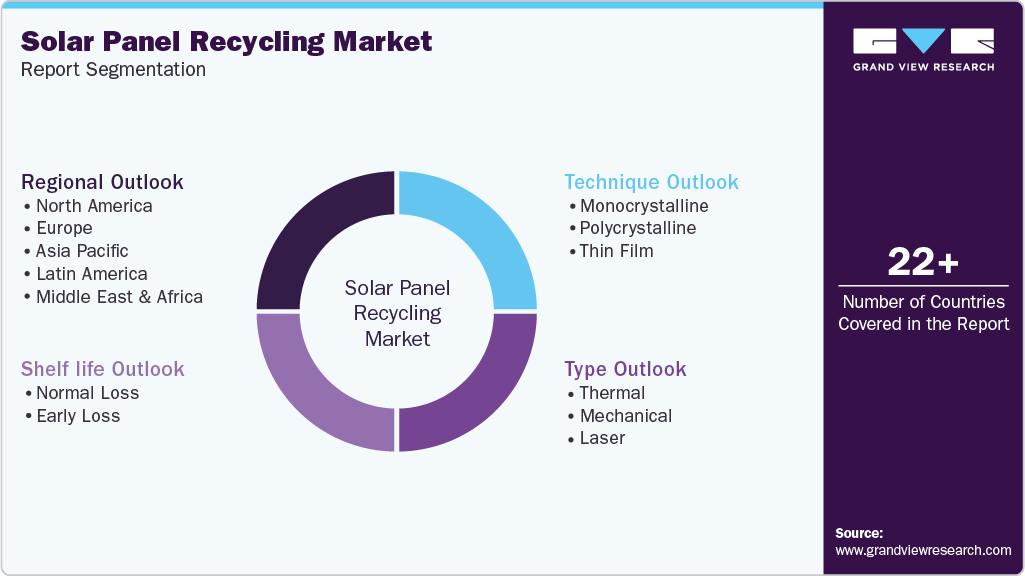
This report forecasts revenue & volume growth at the global, regional, and country levels and provides an analysis of the latest industry trends in each of the sub-segments from 2021 to 2033. For this study, Grand View Research has segmented the global solar panel recycling market report based on type, technique, shelf life, and region:
-
Type Outlook (Volume, Kilotons; Revenue, USD Million, 2021 - 2033)
-
Thermal
-
Mechanical
-
Laser
-
-
Technique Outlook (Volume, Kilotons; Revenue, USD Million, 2021 - 2033)
-
Monocrystalline
-
Polycrystalline
-
Thin Film
-
-
Shelf life Outlook (Volume, Kilotons; Revenue, USD Million, 2021 - 2033)
-
Normal Loss
-
Early Loss
-
-
Regional Outlook (Volume, Kilotons; Revenue, USD Million, 2021 - 2033)
-
North America
-
U.S.
-
-
Europe
-
Germany
-
Italy
-
UK
-
France
-
-
Asia Pacific
-
China
-
India
-
Japan
-
-
Latin America
-
Middle East & Africa
-
Frequently Asked Questions About This Report
b. The global solar panel recycling market size was estimated at USD 384.4 million in 2025 and is expected to reach USD 404.6 million in 2026.
b. The global solar panel recycling market is expected to grow at a compound annual growth rate of 6.0% from 2026 to 2033, reaching USD 609.7 million by 2033.
b. By type, the mechanical segment dominated the market, accounting for over 59.0% in 2025
b. Some of the key players operating in the global solar panel recycling market include Aurubis, Canadian Solar, Echo Environmental, LLC, Envaris, First Solar Inc., Hanwha Group, Reiling GmbH & Co. KG, SiC Typeing GmbH, SILCONTEL LTD, Silrec Corporation, SunPower Corporation, Trina Solar, Yingli Energy Co. Ltd., and others
b. The solar panel recycling market is primarily driven by the growing volume of end-of-life photovoltaic modules from expanding solar installations and stricter environmental regulations. Advances in recycling technologies and the value of recoverable materials like silicon, silver, and aluminum further boost market growth.


Share this report with your colleague or friend.
Need a Tailored Report?
Customize this report to your needs — add regions, segments, or data points, with 20% free customization.


ISO 9001:2015 & 27001:2022 Certified
We are GDPR and CCPA compliant! Your transaction & personal information is safe and secure. For more details, please read our privacy policy.
Trusted market insights - try a free sample
See how our reports are structured and why industry leaders rely on Grand View Research. Get a free sample or ask us to tailor this report to your needs.












