
- Home
- »
- Power Generation & Storage
- »
-
Small Modular Reactor Market Size, Industry Report, 2033GVR Report cover
![Small Modular Reactor Market Size, Share & Trends Report]()
Small Modular Reactor Market (2026 - 2033) Size, Share & Trends Analysis Report By Product Type (Heavy Water Reactors, Light Water Reactors, High-Temperature Reactors), By Application (Power Generation, Desalination, Industrial, Hydrogen Production), By Region, And Segment Forecasts
- Report ID: GVR-4-68040-389-3
- Number of Report Pages: 120
- Format: PDF
- Historical Range: 2021 - 2023
- Forecast Period: 2026 - 2033
- Industry: Energy & Power
- Report Summary
- Table of Contents
- Segmentation
- Methodology
- Download FREE Sample
-
 Download Sample Report
Small Modular Reactor Market Summary
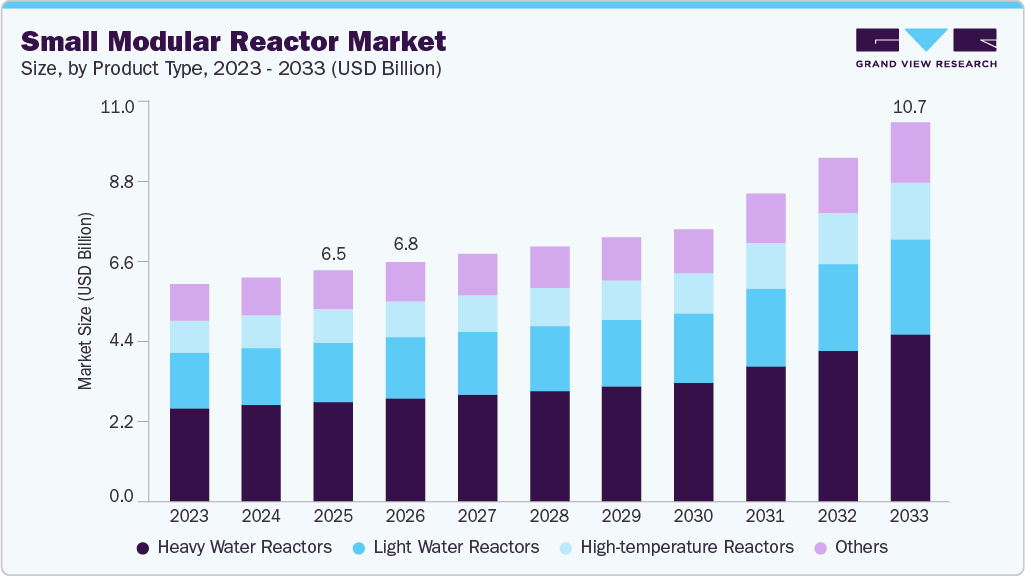
The global small modular reactor market size was valued at USD 6.54 billion in 2025 and is projected to reach USD 10.69 billion by 2033, growing at a CAGR of 6.8% from 2026 to 2033. Market growth is primarily driven by the rising demand for reliable, low-carbon, and scalable baseload power generation to support energy transition goals and growing electricity consumption.
Key Market Trends & Insights
- The Asia Pacific small modular reactor market held the largest share of 35.1% of the global market in 2025.
- The small modular reactor market in the U.S. is expected to grow significantly over the forecast period.
- By product type, the Heavy Water Reactors segment held the highest market share of 43.1% in 2025.
- Based on the application, the Power Generation segment held the highest market share in 2025.
Market Size & Forecast
- 2025 Market Size: USD 6.54 Billion
- 2033 Projected Market Size: USD 10.69 Billion
- CAGR (2026-2033): 6.8%
- Asia Pacific: Largest market in 2025
Small modular reactors (SMRs) are gaining traction due to their compact size, modular construction, enhanced safety features, and lower upfront capital requirements compared to conventional nuclear reactors. These advantages make SMRs particularly suitable for remote locations, industrial facilities, defense applications, data centers, and grid-constrained regions, where traditional large nuclear plants are economically or technically unviable.In addition, increasing concerns over grid reliability, energy security, and intermittency of renewable energy sources are accelerating interest in SMRs as a stable, dispatchable power source that can complement solar and wind generation. SMRs offer flexible deployment options, load-following capabilities, and the potential for cogeneration applications, including hydrogen production, desalination, and district heating.
Technological advancements in advanced reactor designs, passive safety systems, digital instrumentation and control (I&C), and factory-based modular manufacturing are further enhancing the commercial viability of SMRs. Ongoing innovations aimed at reducing construction timelines, improving fuel efficiency, and extending refueling cycles are expected to support long-term market adoption.
The market is also benefiting from supportive government policies, nuclear energy revival initiatives, decarbonization targets, and public-private investments across major economies. Increasing focus on energy independence, grid resilience, and clean baseload capacity, along with regulatory progress and international collaboration on SMR deployment, is expected to sustain steady market expansion over the forecast period.
Drivers, Opportunities & Restraints
The global Small Modular Reactor (SMR) market is primarily driven by the increasing demand for clean, reliable, and dispatchable baseload power to support decarbonization targets and growing electricity consumption. Governments and utilities are increasingly turning to SMRs to address challenges related to renewable energy intermittency, grid stability, and energy security, as SMRs provide consistent power with significantly lower carbon emissions. In addition, rising investments in nuclear energy revival programs, energy diversification strategies, and resilient power infrastructure, along with increasing electrification across industries, continue to support market growth.
Opportunities are expanding due to technological advancements in reactor design, modular construction techniques, passive safety systems, and digital instrumentation and control technologies, which improve operational efficiency and reduce construction risks. The growing interest in non-electric applications such as hydrogen production, district heating, desalination, and industrial process heat is further creating new revenue opportunities for SMR deployment. Increasing government funding, public-private partnerships, regulatory streamlining, and international collaboration are also enabling faster commercialization across both developed and emerging economies.
However, the market faces restraints such as high upfront capital costs, lengthy licensing and regulatory approval processes, and limited commercial operating experience at scale. Complexity associated with nuclear regulatory frameworks, supply chain readiness, and skilled workforce availability can delay project timelines. Additionally, concerns related to nuclear waste management, public acceptance, financing challenges, and long-term fuel disposal may further limit the pace of SMR adoption over the forecast period.
Product Type Insights
The Heavy Water Reactors segment held the largest revenue share of approximately 43.1% in 2025 in the global Small Modular Reactor market. This dominance is primarily driven by the proven operational reliability, high fuel efficiency, and fuel flexibility offered by heavy water reactor technology. These reactors can utilize natural uranium and alternative fuel cycles, reducing dependence on enriched uranium and enhancing fuel supply security. Additionally, their strong safety record, established regulatory frameworks, and long-standing deployment experience, particularly in countries such as Canada and India, have supported widespread adoption for both grid-connected and remote power applications.
The Heavy Water Reactors segment is also expected to register the fastest CAGR of 7.1% over the forecast period, supported by the ongoing modernization of existing reactor designs and adaptation of heavy water technology into SMR configurations. Growing interest in extending reactor lifespans, improving thermal efficiency, and deploying SMRs for industrial power generation, district heating, and energy security applications is driving further investment in this segment. In addition, government-backed nuclear programs, technology standardization, and the compatibility of heavy water reactors with modular construction approaches are expected to sustain steady growth, positioning this segment as both the largest and fastest-growing product type in the global SMR market.
Application Insights
The Power Generation segment held the largest revenue share of approximately 44% in 2025 in the global Small Modular Reactor market. This dominance is primarily driven by the increasing need for stable, low-carbon baseload electricity to complement intermittent renewable energy sources and support national decarbonization targets. SMRs are being increasingly considered for grid-connected power generation due to their scalable capacity, enhanced safety features, load-following capability, and reduced construction timelines compared to conventional nuclear plants. Growing investments in clean energy infrastructure, replacement of aging coal-fired power plants, and rising electricity demand from urbanization and digitalization are further supporting the adoption of SMRs for power generation applications.
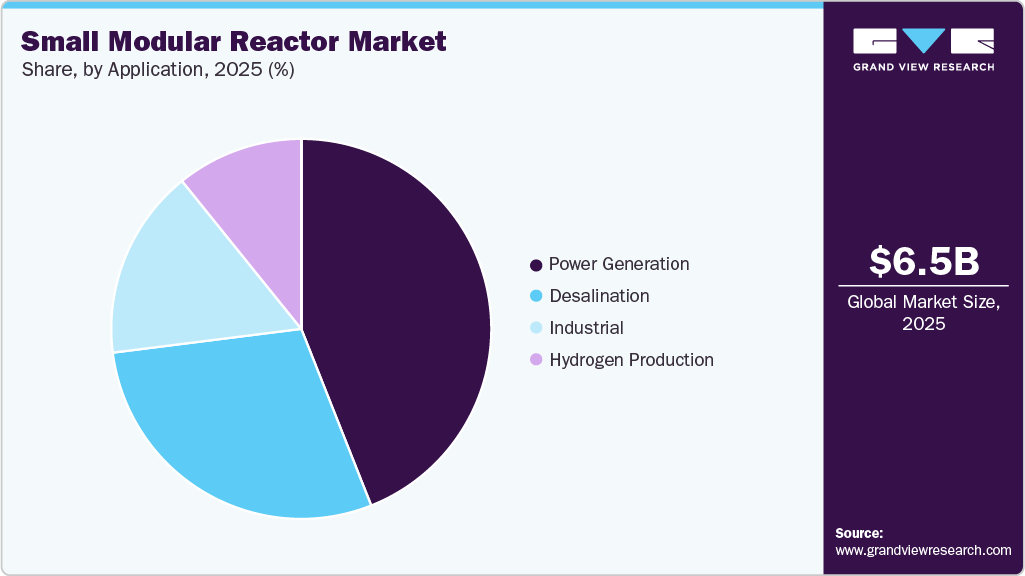
The Industrial segment is expected to register the fastest CAGR of 7.3% over the forecast period, driven by the rising demand for reliable, on-site, and low-emission energy solutions across energy-intensive industries. SMRs are gaining traction for industrial applications such as process heat, hydrogen production, desalination, refining, chemicals, and steel manufacturing, where continuous power and thermal energy are critical. Additionally, increasing corporate decarbonization commitments, energy cost volatility, and interest in captive power generation are accelerating SMR deployment in industrial settings. Supportive government policies, pilot projects, and advancements in cogeneration-capable SMR designs are expected to drive growth in this segment further.
Regional Insights
Asia Pacific accounted for approximately 35.1% of the global Small Modular Reactor market revenue in 2025, making it the largest regional market. This dominance is primarily driven by rapid industrialization, rising electricity demand, energy security concerns, and strong government support for nuclear power development across countries such as China, India, Japan, South Korea, and Russia (Asia-Pacific operations). Several countries in the region are actively pursuing SMRs to diversify energy mixes, reduce reliance on fossil fuels, and meet long-term decarbonization targets. Additionally, the suitability of SMRs for remote regions, island grids, and industrial clusters, combined with established nuclear manufacturing capabilities, continues to support regional leadership.
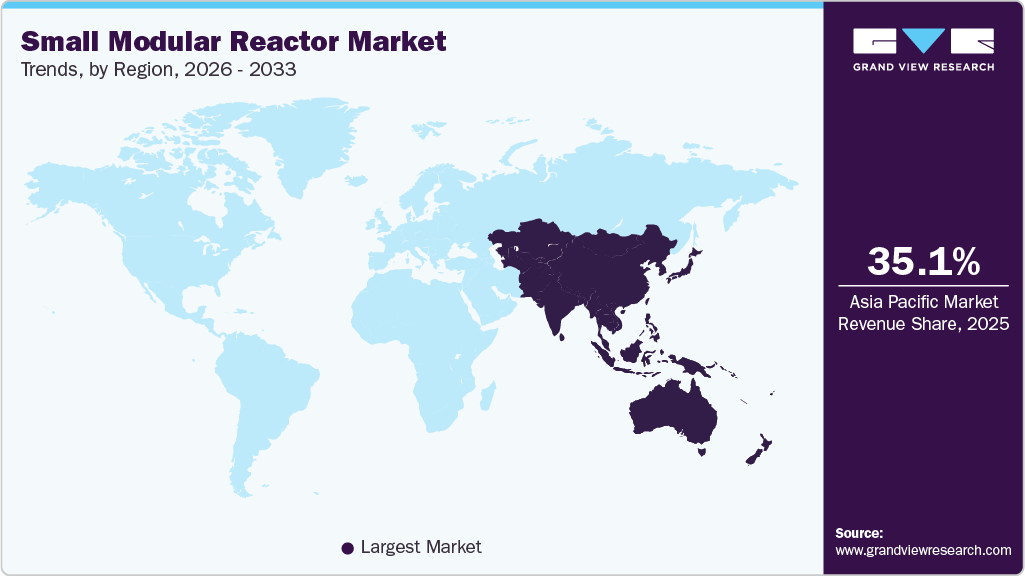
Asia Pacific is also expected to register the fastest CAGR of 7.1% over the forecast period, driven by ongoing reactor construction programs, localization of nuclear supply chains, and increasing deployment of SMRs for non-electric applications such as hydrogen production, district heating, and industrial process heat. Strong policy backing, public sector investments, and international collaborations for advanced reactor development are further accelerating SMR commercialization across the region.
U.S. Small Modular Reactor Market Trends
The U.S. remains a key contributor to the North American SMR market, driven by federal support, Department of Energy (DOE) funding initiatives, and growing utility interest in advanced nuclear technologies. SMRs are increasingly being explored for grid-scale power generation, defense installations, remote communities, and industrial decarbonization applications. Regulatory progress, demonstration projects, and partnerships between utilities, technology developers, and government agencies are positioning the U.S. as one of the most strategically important SMR markets globally.
North America Small Modular Reactor Market Trends
North America represents a significant market for small modular reactors, supported by energy transition goals, grid reliability concerns, and renewed interest in nuclear power as a clean baseload solution. The region benefits from advanced nuclear R&D capabilities, strong private-sector participation, and government funding programs aimed at accelerating SMR deployment. Increasing focus on replacing aging coal and nuclear facilities, along with rising electricity demand from data centers and electrification, is supporting market growth across North America.
Europe Small Modular Reactor Market Trends
Europe represents a steadily expanding SMR market, supported by energy security priorities, decarbonization mandates, and efforts to reduce dependence on imported fossil fuels. Several European countries are evaluating SMRs as part of long-term nuclear strategies to complement renewable energy deployment. The region is witnessing growing interest in SMRs for district heating, hydrogen production, and industrial energy supply, particularly in countries such as the UK, France, Poland, and Nordic nations. Supportive regulatory discussions and cross-border nuclear collaboration are further contributing to market development.
Latin America Small Modular Reactor Market Trends
The Latin America SMR market is at an early stage but shows moderate growth potential, driven by rising electricity demand, energy diversification efforts, and interest in clean baseload generation. Countries such as Brazil and Argentina are exploring SMR technologies to support grid stability and industrial power needs. Increasing focus on reducing carbon emissions and improving long-term energy security is expected to support SMR adoption across the region gradually.
Middle East & Africa Small Modular Reactor Market Trends
The Middle East & Africa SMR market is witnessing gradual growth, driven by rising power demand, water desalination requirements, and national energy diversification strategies. Countries such as Saudi Arabia, the UAE, Egypt, and South Africa are evaluating SMRs for applications including power generation, desalination, and industrial energy supply. Government-led nuclear initiatives, feasibility studies, and long-term clean energy planning are expected to support steady market expansion across the region.
Key Small Modular Reactor Company Insights
Some of the key players operating in the global Small Modular Reactor market include Rolls-Royce plc, Westinghouse Electric Company LLC, GE Vernova (GE Hitachi Nuclear Energy), X-energy LLC, Terrestrial Energy Inc., Moltex Energy, ULTRA SAFE NUCLEAR, General Atomics, Fluor Corporation, and Brookfield Asset Management, among others. These companies are actively investing in advanced reactor designs, modular construction technologies, passive safety systems, and next-generation nuclear fuel solutions to accelerate the commercialization and deployment of SMRs.
Their strategic focus includes reducing capital and construction costs, improving safety and operational efficiency, enhancing fuel flexibility, and expanding applications beyond electricity generation, such as hydrogen production, industrial process heat, desalination, and district heating. In addition, strong emphasis on public-private partnerships, government-funded demonstration projects, regulatory engagement, and international collaborations is helping market participants strengthen their competitive position while supporting the broader adoption of SMRs across both developed and emerging economies.
Key Small Modular Reactor Companies:
The following key companies have been profiled for this study on the small modular reactor market.
- Brookfield Asset Management
- Moltex Energy
- General Electric Company
- ULTRA SAFE NUCLEAR
- X Energy LLC
- Fluor Corporation
- Rolls-Royce plc
- Westinghouse Electric Company LLC
- Terrestrial Energy Inc.
- General Atomics
Recent Developments
-
In 2025, Rolls-Royce plc advanced its SMR program in the UK by progressing through key stages of the Generic Design Assessment (GDA) process and strengthening its supply-chain partnerships to support factory-based modular manufacturing. The company continued to focus on reducing construction timelines and capital costs while positioning its SMR design as a scalable solution for low-carbon baseload power, hydrogen production, and industrial decarbonization across the UK and Europe.
-
In 2025, GE Vernova (via GE Hitachi Nuclear Energy) continued to accelerate commercialization of its BWRX-300 Small Modular Reactor, with ongoing project development activities in North America and Europe, including utility partnerships and site evaluation milestones. The company’s focus on simplified reactor design, passive safety systems, and cost competitiveness is supporting broader adoption of SMRs for grid-scale power generation and replacement of aging fossil fuel and nuclear assets.
Small Modular Reactor Market Report Scope
Report Attribute
Details
Market Definition
The Small Modular Reactor (SMR) market represents global revenue generated from the development, manufacturing, deployment, and operation of modular nuclear reactors (≤300 MW) designed to provide scalable, low-carbon, and reliable power across grid, industrial, and remote energy applications.
Market size value in 2026
USD 6.75 billion
Revenue forecast in 2033
USD 10.69 billion
Growth rate
CAGR of 6.8% from 2026 to 2033
Base year for estimation
2025
Historical data
2021 - 2023
Forecast period
2026 - 2033
Quantitative units
Revenue in USD million, and CAGR from 2026 to 2033
Report coverage
Revenue forecast, competitive landscape, growth factors, and trends
Segments covered
Product type, application, region
Regional scope
North America; Europe; Asia Pacific; Latin America; Middle East & Africa
Country scope
U.S.; Canada; Mexico; Germany; UK; France; China; India; Japan; South Korea; Brazil; Saudi Arabia; UAE
Key companies profiled
Brookfield Asset Management; Moltex Energy; General Electric Company; ULTRA SAFE NUCLEAR; X Energy LLC; Fluor Corporation; Rolls-Royce plc; Westinghouse Electric Company LLC; Terrestrial Energy Inc.; General Atomics.
Customization scope
Free report customization (equivalent up to 8 analysts working days) with purchase. Addition or alteration to country, regional & segment scope.
Pricing and purchase options
Avail customized purchase options to meet your exact research needs. Explore purchase options
Global Small Modular Reactor Market Report Segmentation
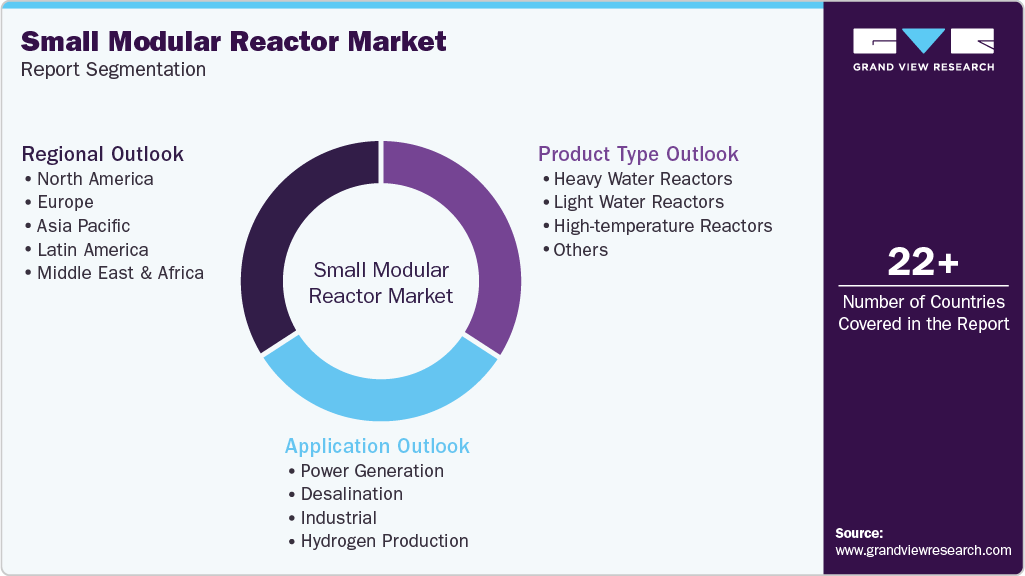
This report forecasts revenue growth at global, regional, and country levels and provides an analysis of the latest industry trends in each of the sub-segments from 2021 to 2033. For the purpose of this study, Grand View Research has segmented the global small modular reactor market report on the basis of product type, application and region.
-
Product Type Outlook (Revenue, USD Million, 2021 - 2033)
-
Heavy Water Reactors
-
Light Water Reactors
-
High-temperature Reactors
-
Others
-
-
Application Outlook (Revenue, USD Million, 2021 - 2033)
-
Power Generation
-
Desalination
-
Industrial
-
Hydrogen Production
-
-
Regional Outlook (Revenue, USD Million, 2021 - 2033)
-
North America
-
U.S.
-
Canada
-
Mexico
-
-
Europe
-
Germany
-
UK
-
France
-
-
Asia Pacific
-
China
-
India
-
Japan
-
South Korea
-
-
Latin America
-
Brazil
-
-
Middle East & Africa
-
Saudi Arabia
-
UAE
-
-
Frequently Asked Questions About This Report
b. Based on the product type segment, heavy water reactors held the largest revenue share of 43.1% in 2025.
b. Some of the key players operating in the global Small Modular Reactor market include Rolls-Royce plc, Westinghouse Electric Company LLC, GE Vernova (GE Hitachi Nuclear Energy), X-energy LLC, Terrestrial Energy Inc., Moltex Energy, ULTRA SAFE NUCLEAR, General Atomics, Fluor Corporation, and Brookfield Asset Management, among others.
b. The key factors driving the small modular reactor market include the growing demand for low-carbon, reliable, and dispatchable baseload power, increasing focus on energy security and decarbonization, and rising electricity demand from industrialization and electrification.
b. The global small modular reactor market size was estimated at USD 6.54 billion in 2025 and is expected to reach USD 6.75 billion in 2026.
b. The global small modular reactor market is expected to grow at a compound annual growth rate of 6.8% from 2026 to 2033 to reach USD 10.69 billion by 2033.


Share this report with your colleague or friend.
Need a Tailored Report?
Customize this report to your needs — add regions, segments, or data points, with 20% free customization.


ISO 9001:2015 & 27001:2022 Certified
We are GDPR and CCPA compliant! Your transaction & personal information is safe and secure. For more details, please read our privacy policy.
Trusted market insights - try a free sample
See how our reports are structured and why industry leaders rely on Grand View Research. Get a free sample or ask us to tailor this report to your needs.












