
- Home
- »
- Homecare & Decor
- »
-
Serviced Apartment Market Size, Industry Report, 2033GVR Report cover
![Serviced Apartment Market Size, Share & Trends Report]()
Serviced Apartment Market (2026 - 2033) Size, Share & Trends Analysis Report By Type (Long-Term, Short-Term), By End Use (Corporate/Business Traveler, Leisure Traveler, Expats & Relocators), By Traveler Type, By Booking Mode, By Region, And Segment Forecasts
- Report ID: GVR-4-68040-424-8
- Number of Report Pages: 110
- Format: PDF
- Historical Range: 2021 - 2025
- Forecast Period: 2026 - 2033
- Industry: Consumer Goods
- Report Summary
- Table of Contents
- Segmentation
- Methodology
- Download FREE Sample
-
 Download Sample Report
Serviced Apartment Market Summary
The global serviced apartment market size was estimated at USD 132.22 billion in 2025 and is projected to reach USD 434.04 billion by 2033, growing at a CAGR of 16.9% from 2026 to 2033. The market continues to strengthen as travelers increasingly favor flexible, long-stay accommodation formats that combine residential comfort with professional hospitality standards.
Key Market Trends & Insights
- North America accounted for a share of around 36.55% in 2025 in the global market.
- Serviced apartments for short-term stays accounted for a share of about 64.27% in 2025.
- Serviced apartments for corporate/business travelers accounted for a market share of about 49.79% in 2025.
- The domestic traveler segment led the serviced apartment industry, accounting for a share of 61.89% in 2025.
- Direct bookings accounted for around 44.87% of the market share in 2025.
Market Size & Forecast
- 2025 Market Size: USD 132.22 Billion
- 2033 Projected Market Size: USD 434.04 Billion
- CAGR (2026-2033): 16.9%
- North America: Largest market in 2025
This shift has been particularly visible across the European serviced apartment market, where demand is supported by cross-border corporate mobility, project-based employment, and extended leisure stays. According to an article published by HospitalityNet in August 2025, serviced apartments across Europe demonstrated stronger operational resilience than traditional hotels, with occupancy recovery supported by longer average lengths of stay and consistent weekday demand from corporate travelers. This resilience has translated into steady improvements in serviced apartment RevPAR, supported by stable corporate contracts and reduced exposure to short-term leisure volatility. As a result, operators in the European market continue to prioritize centrally located assets that appeal to executives, consultants, and relocating professionals seeking cost efficiency, privacy, and space.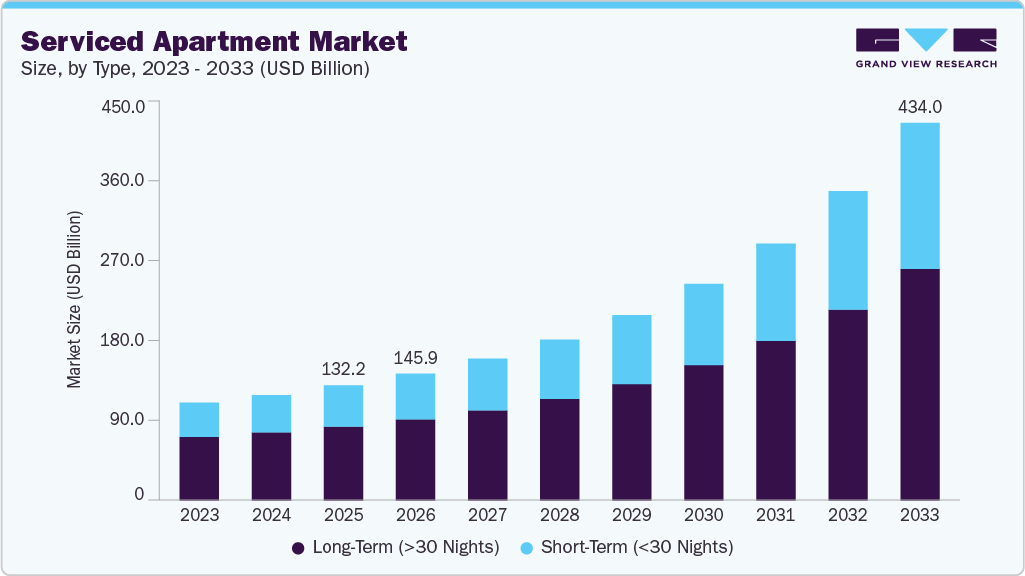
Within Europe, country-level markets are showing differentiated growth patterns. The Italy serviced apartment market has benefited from the return of international business travel alongside a rebound in long-stay leisure demand in major commercial and tourism hubs. Serviced apartments in Italy are increasingly positioned as an alternative to traditional hotels for stays exceeding one week, supporting a gradual increase in the average daily rate (ADR) for serviced apartments, particularly in urban centers with strong corporate presence. The Italy serviced apartment industry has also attracted investor interest due to lower labor intensity and more predictable operating costs compared with full-service hotels, reinforcing its appeal within diversified hospitality portfolios. These factors continue to support sustained demand and stable performance across Italy’s key serviced apartment destinations.
In North America, performance trends closely align with broader dynamics in extended-stay accommodation. According to JLL’s U.S. Select-Service and Extended-Stay Hotel Outlook 2025, extended-stay formats have outperformed traditional lodging categories, with RevPAR levels exceeding pre-pandemic benchmarks. This trend directly supports growth in the U.S. serviced apartment market, where demand is driven by corporate travel, employee relocation, project-based work, and longer assignment durations. High occupancy stability and longer stays have supported consistent serviced apartment RevPAR growth, while disciplined supply additions have helped sustain serviced apartment average daily rate (ADR) levels. The U.S. serviced apartment industry continues to benefit from its alignment with corporate housing needs and extended-stay demand, reinforcing its position as a core accommodation segment rather than a niche alternative.
In Asia Pacific, gateway markets further highlight the relevance of serviced apartments in global business hubs. The Hong Kong serviced apartment market has long been supported by financial services, consulting, and regional headquarters operations, which generate sustained long-stay demand. As cross-border business travel normalized, the Hong Kong serviced apartment industry experienced renewed occupancy momentum, particularly from expatriates and senior executives, supporting a gradual recovery in serviced apartment average daily rate (ADR). Operators continue to emphasize premium locations, service consistency, and flexible lease structures to maintain competitiveness, positioning serviced apartments as a preferred accommodation option for stays of more than one month.
Across regions, performance metrics underline the structural strength of the sector. Compared with traditional hotels, serviced apartments benefit from longer average stays, lower guest turnover, and reduced operational volatility, resulting in more stable RevPAR outcomes over time. While rate growth may be more measured than in luxury hotel segments, the consistency of serviced apartment average daily rate (ADR) and occupancy supports attractive risk-adjusted returns for owners and investors. This stability is particularly evident across the Europe and the U.S. markets, where demand is anchored by corporate travel rather than seasonal leisure fluctuations.
Brand Market Share Insights
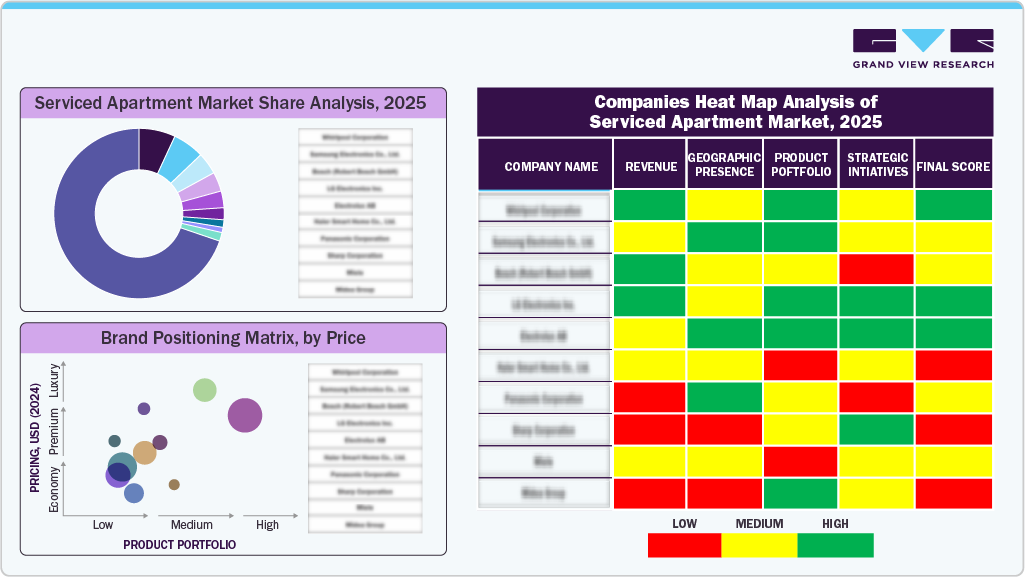
The competitive landscape of the serviced apartment industry is characterized by a diverse range of players, including global chains, regional operators, and independent providers. Major international brands such as The Ascott Limited, Frasers Hospitality, and Marriott International, Inc. lead with extensive portfolios and a strong presence in key markets worldwide. Regional operators like Adina Apartment Hotels in Europe also play a significant role, offering localized expertise and tailored services. Competition is driven by factors such as location, quality of amenities, pricing, and the ability to provide flexible, long-term accommodation solutions. Additionally, the rise of new entrants and the growing trend of property management companies expanding into the serviced apartment sector further intensify the competitive dynamics.
Consumer Insights
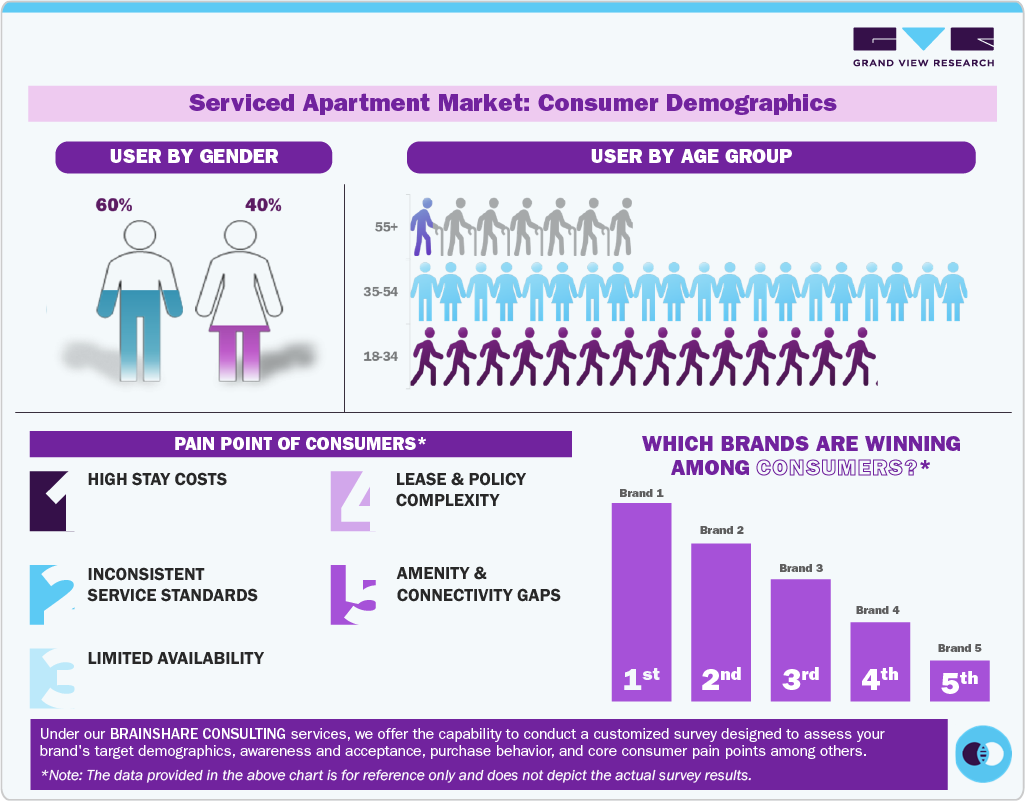
Serviced apartments are increasingly preferred by business travelers, corporate assignees, relocating professionals, and long-stay leisure guests who seek larger living spaces, privacy, and home-style amenities while maintaining access to housekeeping, security, and concierge services. Key purchase drivers include fully equipped kitchens, separate living and sleeping areas, reliable connectivity, and flexible lease durations, which together support everyday living without the rigidity of traditional hotels or long-term rentals.
Evolving travel and work patterns continue to expand the positioning of serviced apartments across multiple use cases. While corporate and relocation-driven stays remain core demand segments, serviced apartments are gaining traction among leisure travelers, digital nomads, and families seeking comfort and cost efficiency for extended stays. Operators are responding with differentiated property formats, including lifestyle-focused residences, mixed-use developments, and branded serviced apartments aligned with hospitality standards. Design and service innovations-such as modern interiors, coworking spaces, contactless access, and value-added amenities-are reinforcing serviced apartments as a versatile accommodation solution suited for business travel, temporary housing, and extended leisure stays across global urban markets.
Type Insights
Serviced apartments for short-term stays accounted for a share of about 64.27% in 2025.Serviced apartments are primarily used for short-term stays due to their flexibility, convenience, and cost-effectiveness compared to hotels. They offer the comfort of home-like amenities, making them ideal for travelers, business professionals, or temporary relocations. Additionally, serviced apartments often include housekeeping and utilities, providing a hassle-free, ready-to-live option for short-term visitors. This makes them particularly attractive for those who need a comfortable yet temporary living arrangement without the long-term commitment of traditional rentals.
The demand for long-term serviced apartments is expected to grow at a CAGR of 18.0% from 2026 to 2033. There is a growing preference for serviced apartments for long-term stays due to their combination of home-like comfort and hotel-like amenities. Serviced apartments offer more space, privacy, and flexibility than traditional hotels, with features such as fully equipped kitchens and separate living areas, making them ideal for extended stays. Additionally, they often provide cost savings for longer durations, as rates are typically more competitive than hotels, likely favoring the growth of the segment.
End Use Insights
Serviced apartments for corporate/business travelers accounted for a market share of about 49.79% in 2025. The serviced apartment market benefits from the rise of "bleisure" travel, in which professionals combine business trips with leisure time, necessitating more spacious, well-equipped accommodations. Moreover, market expansion includes the growing preference for privacy and self-contained living spaces post-pandemic, increased adoption of remote work policies allowing for extended stays, and the rising popularity of serviced apartments among employees and digital nomads seeking turnkey living solutions in new cities, driving the segment growth.
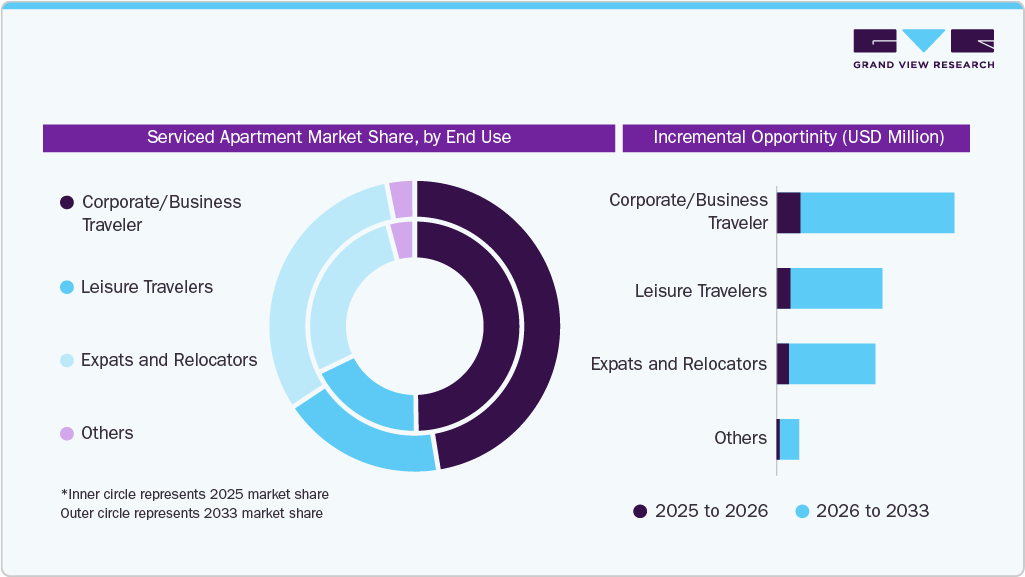
The demand for serviced apartments for expats and relocators is anticipated to grow at a CAGR of 18.4% from 2026 to 2033. These accommodations offer a seamless transition to a new location, providing a home-like environment with the convenience of hotel services. This balance is particularly appealing for those facing the challenges of settling into a foreign country. Additionally, these apartments usually come fully furnished with equipped kitchens, reducing the initial setup costs and logistical challenges for newcomers. The provision of utilities, housekeeping, and sometimes local cultural orientation services further enhances their appeal, offering a turnkey solution that simplifies the relocation process for both individuals and corporations managing employee transfers.
Traveler Type Insights
The domestic traveler segment led the serviced apartment industry, accounting for a share of 61.89% in 2025. Regular movement between cities for corporate meetings, training programs, and short-term assignments has increased demand for accommodation that supports extended stays without the rigidity of traditional hotels. Serviced apartments appeal to domestic travelers by offering residential comfort, flexible lease terms, and amenities such as kitchens and separate living areas that suit longer stays. The segment is also supported by domestic leisure travel, including family visits and temporary stays during personal transitions such as job changes or housing shifts.
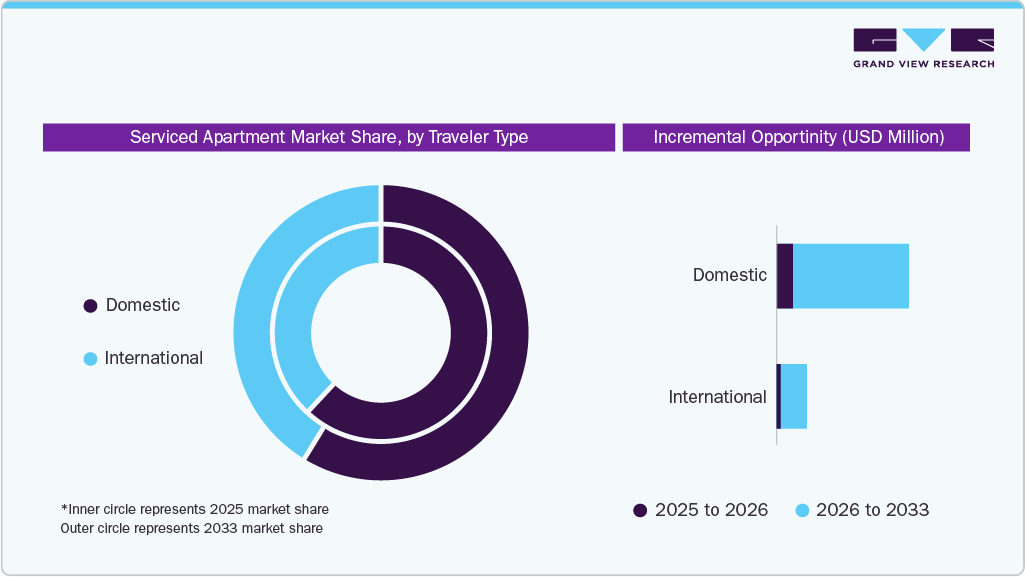
The demand for serviced apartments for international travelers is anticipated to grow at a CAGR of 18.0% from 2026 to 2033. Rising international business activity, increasing overseas assignments, and the gradual normalization of cross-border travel are expanding the pool of travelers seeking accommodation suited for longer stays. Serviced apartments meet these needs by offering flexible stay durations, self-contained living spaces, and greater cost efficiency than extended hotel stays. Growing preference for privacy, improved safety, and greater personal space, particularly in the post-pandemic environment, is further strengthening demand.
Booking Mode Insights
Direct bookings accounted for around 44.87% of the market share in 2025. This direct approach allows for more competitive pricing by eliminating intermediary commissions, thereby increasing profit margins and potentially offering more attractive rates to customers. Additionally, direct bookings facilitate more robust customer data collection, enabling personalized marketing strategies and tailored service offerings that boost customer loyalty and repeat business. The COVID-19 pandemic has further accelerated this trend, as travelers seek direct communication with property managers for up-to-date information on safety protocols and flexible cancellation policies.
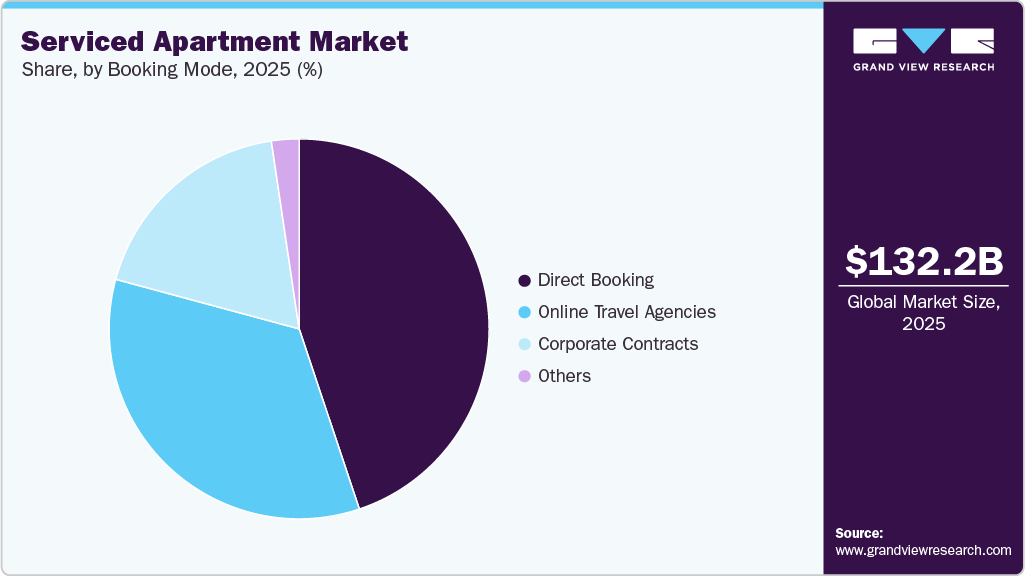
Bookings through online travel agencies are expected to grow at a CAGR of 11.7% from 2026 to 2033. OTAs enable travelers to compare serviced apartment options across locations, price points, and amenity offerings in real time, improving decision-making and encouraging trial beyond traditional hotels. Features such as flexible cancellation policies, verified reviews, loyalty rewards, and bundled travel options further strengthen their appeal. For serviced apartment operators, OTAs provide broad global visibility and access to demand from international travelers, digital nomads, and short- to medium-stay guests who rely heavily on online discovery. As mobile usage, cross-border travel, and digital payments continue to expand, OTA platforms are expected to play an increasingly central role in driving bookings and occupancy growth across the serviced apartment market.
Regional Insights
North America Service Apartment Market Trends
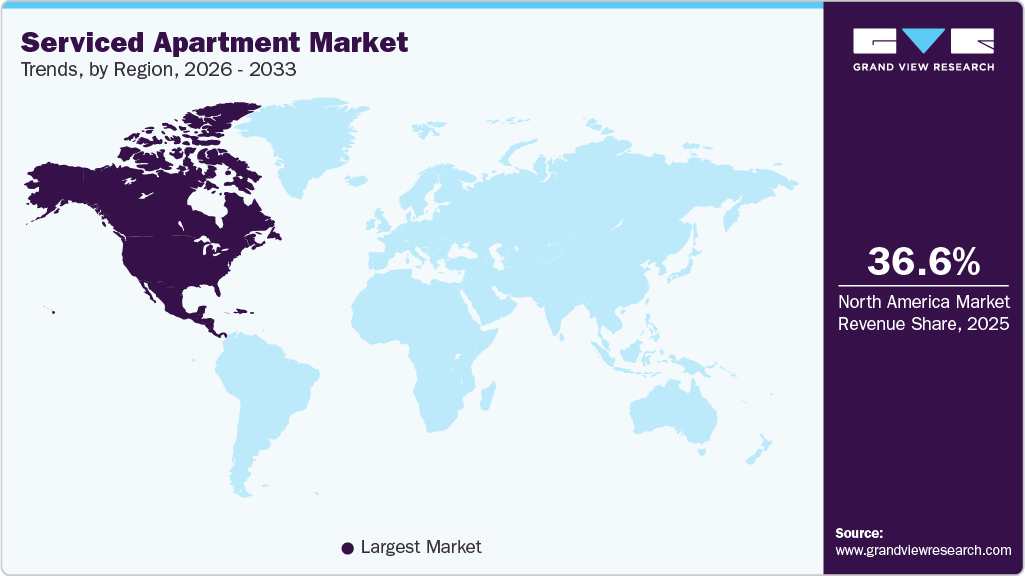
The serviced apartment industry in North America accounted for a share of around 36.55% in 2025 in the global market, supported by the region’s high frequency of domestic and cross-border business travel, strong corporate relocation activity, and well-established extended-stay culture. Large-scale consulting firms, technology companies, healthcare organizations, and government agencies generate steady demand for medium- to long-term accommodation, particularly in cities such as New York, San Francisco, Chicago, Houston, and Toronto. The region’s mature corporate housing ecosystem allows serviced apartments to integrate seamlessly into employer relocation programs and project-based travel requirements, reinforcing consistent occupancy levels.
U.S. Serviced Apartment Market Trends
The serviced apartment industry in the U.S. accounted for a share of around 80% in 2025 in the North American market. The rise of the gig economy and remote work trends has also increased demand, as professionals seek comfortable, well-equipped spaces for longer stays in various locations. Additionally, the growing millennial workforce, with its preference for experience-based living and work-life balance, finds serviced apartments an attractive option. The U.S. market also benefits from a robust tourism sector, with both domestic and international travelers seeking more spacious, home-like alternatives to traditional hotels, especially for extended vacations or family travel.
The serviced apartment market in Canada is expected to witness a CAGR of 14.7% from 2026 to 2033. Multinational companies operating in sectors such as technology, mining, and financial services frequently deploy employees to Canadian cities for medium-term assignments, creating consistent demand for accommodation that offers residential space and flexibility beyond traditional hotel rooms. At the same time, rising student mobility and international education are increasing the need for furnished, short-to-medium-term housing near universities and research institutions. The market is also benefiting from growth in medical travel and temporary healthcare assignments, where visiting specialists and traveling nurses prefer apartment-style stays with kitchens and living areas.
Europe Serviced Apartment Market Trends
The serviced apartment industry in Europe accounted for a share of around 28.46% in 2025. Europe’s highly interconnected business environment, supported by free movement of labor across multiple countries, has increased demand for accommodation that can support multi-week and multi-month stays without the constraints of traditional hotels. Serviced apartments are widely used by consultants, project teams, and professionals working on temporary assignments across major European financial and industrial centers. In addition, Europe’s dense urban structure and high hotel costs in core cities have made serviced apartments an attractive alternative for travelers seeking more space and cost efficiency.
The UK serviced apartment market accounted for a share of around 21.4% of the Europe market in 2025. The country’s position as a major global business and financial hub attracts a steady flow of corporate travelers, consultants, and project teams who often require accommodation for several weeks or months. Serviced apartments offer a practical solution for these professionals, providing larger living spaces, kitchen facilities, and flexible booking options compared with conventional hotels. Demand is further supported by the U.K.’s strong international tourism sector, where families and long-stay travelers increasingly prefer apartment-style lodging that provides greater privacy and residential comfort. In addition, the high cost of hotel accommodation in major cities has encouraged both business and leisure travelers to choose serviced apartments as a more economical option for extended stays.
The serviced apartment market in Germany is expected to witness a CAGR of 15.4% from 2026 to 2033. Strong demand from corporate travelers continues to support market growth as Germany hosts a large number of multinational companies, trade fairs, and industrial projects that require professionals to stay for extended periods. Consultants, engineers, and project managers working on manufacturing, automotive, and technology assignments often prefer serviced apartments due to their residential-style amenities and flexibility for multi-week stays. Demand is also supported by the country’s position as a major hub for international exhibitions and business events, which attract visiting professionals who require longer-term accommodation.
The France serviced apartment market is expected to witness a CAGR of 14.1% from 2026 to 2033. The market growth is driven by the country’s strong international tourism sector, which attracts millions of leisure travelers who increasingly prefer apartment-style accommodation for longer stays. Serviced apartments offer larger living spaces, kitchen facilities, and greater privacy, making them suitable for families and extended vacation travelers. Demand is also rising from corporate travelers and expatriate professionals working on temporary assignments in sectors such as finance, luxury retail, and technology. In addition, France’s active calendar of international exhibitions, cultural events, and global conferences generates a steady flow of visitors who require accommodation for several weeks, supporting the adoption of serviced apartments as a practical and flexible lodging option.
Asia Pacific Serviced Apartment Market Trends
The serviced apartment industry in Asia Pacific is expected to witness a CAGR of 18.5% from 2026 to 2033. The market growth is expected to be driven by increasing business travel, rising numbers of expatriates, and the expanding tourism sector in major countries like China, India, Japan, and Australia. Economic growth in these countries is attracting multinational corporations, which in turn is fueling demand for long-term accommodation solutions for business professionals. Additionally, the preference for flexible, home-like stays among both business and leisure travelers, coupled with the cost-effectiveness of serviced apartments compared to hotels, is further boosting demand. Urbanization and infrastructure development in cities like Shanghai, Mumbai, Tokyo, and Sydney also contribute to the sector's expansion in the region.
The serviced apartment market in China accounted for a share of around 26.7% of the Asia Pacific market in 2025. The market growth is driven by the country’s large manufacturing and technology sectors attract a steady flow of international business travelers, consultants, and expatriate professionals who often stay for extended project assignments. Serviced apartments offer these visitors residential-style amenities such as kitchens and living areas, as well as flexible stay durations, making them a practical alternative to traditional hotels. Demand is also supported by the rapid expansion of multinational companies and regional headquarters across major commercial cities, which increases the need for long-term corporate accommodation.
The India serviced apartment market is expected to witness a CAGR of 14.6% from 2026 to 2033. The growing number of domestic relocations is supporting the market growth, as professionals move between cities for new job opportunities, creating demand for temporary furnished accommodation before securing permanent housing. Serviced apartments offer a convenient solution, providing ready-to-move-in spaces with essential amenities for stays of several weeks or months. Demand is also rising from film production crews, advertising teams, and media professionals who often require accommodation for extended shooting schedules in different cities. In addition, the rapid expansion of coworking spaces and flexible workplaces has encouraged a mobile professional workforce that frequently travels for short-term projects, driving greater adoption of serviced apartments as a practical and comfortable lodging option.
The serviced apartment market in Japan is expected to witness a CAGR of 14.1% from 2026 to 2033. The growth is supported by the country’s large base of multinational corporations and regional headquarters that frequently host expatriate managers, consultants, and project specialists for medium-term assignments. These professionals often prefer serviced apartments as they provide furnished living spaces, kitchens, and flexible stay durations suited to multi-month work placements. Demand is also rising from international students, researchers, and visiting academics who require comfortable accommodation for semester-long or research-based stays.
Central & South America Serviced Apartment Market Trends
The serviced apartment industry in Central & South America is expected to witness a CAGR of 18.3% from 2026 to 2033. The growth is driven by rising business travel, the growing presence of multinational corporations, and the growing demand for long-term accommodation among expatriates and project-based professionals. Economic development and expanding commercial activity across major urban centers are driving workforce mobility, which, in turn, supports demand for flexible, fully furnished living solutions. In addition, the region’s tourism sector is evolving toward longer stays and family-oriented travel, leading to a greater preference for spacious, home-like accommodations over traditional hotels.
Middle East & Africa Serviced Apartment Market Trends
The serviced apartment industry in the Middle East & Africa is expected to witness a CAGR of 16.9% from 2026 to 2033. The growth is driven by increasing business travel, expanding private-sector activity, and rising demand for long-term accommodation solutions among professionals and relocating employees. Continued urban development and investment in commercial infrastructure are supporting workforce mobility, which in turn increases demand for flexible, fully furnished living spaces. In addition, the growing preference for privacy, self-contained accommodation, and cost efficiency for extended stays is encouraging both business and leisure travelers to opt for serviced apartments over traditional hotels.
Key Serviced Apartment Companies:
The following key companies have been profiled for this study on the serviced apartment market
- The Ascott Limited
- Frasers Hospitality
- The Serviced Apartment Company
- Staycity Ltd
- Habicus Group
- THE SQUA.RE SERVICED APARTMENTS
- adiahotels.com
- Viridian Apartments
- Adagio
- Marriott International, Inc.
Recent Developments
-
In January 2026, Hilton announced Apartment Collection by Hilton, a new lodging category that expands its portfolio into the furnished apartment segment, blending the space and comfort of fully equipped apartments with Hilton’s service standards. Developed in partnership with Placemakr, this concept will offer studio to four-bedroom furnished units in key U.S. cities like New York, Washington, D.C., and Atlanta, bookable through Hilton channels from the first half of 2026.
-
In January 2026, Mira Developments introduced a new set of fully serviced luxury apartments at Gianfranco Ferré Residences, developed in partnership with Gianfranco Ferré Home. Located on Al Marjan Island, the project offers turnkey studios to four-bedroom duplexes with Italian-inspired interiors, hotel-style services such as concierge and housekeeping, and resort amenities including pools and fitness facilities, targeting both premium end-users and investment buyers seeking branded waterfront living.
-
In August 2025, Marriott Executive Apartments expanded its footprint in Kuala Lumpur, Malaysia, with the opening of a new property in the city center aimed at international and long-stay travelers. The development features a substantial number of elegantly designed serviced apartments, from studios to three-bedroom units, that combine stylish living spaces with amenities and services tailored for comfort and extended stays, offering guests a distinctive urban retreat experience while integrating hospitality standards with the feel of a home away from home.
Serviced Apartment Market Report Scope
Report Attribute
Details
Market size value in 2025
USD 2,315.5 million
Revenue forecast in 2033
USD 7,546.2 million
Growth rate
CAGR of 13.3% from 2025 to 2033
Actual data
2021 - 2024
Forecast period
2025 - 2033
Quantitative units
Revenue in USD million/billion, and CAGR from 2025 to 2033
Report coverage
Revenue forecast, company ranking, competitive landscape, growth factors, and trends
Segments covered
Type, end-use, booking mode
Country scope
Italy
Key companies profiled
Marriott International, Inc; The Ascott Limited; Frasers Hospitality; Milan Royal Suites; Staycity Ltd.; Habicus Group; THE SQUA.RE SERVICED APARTMENTS; adiahotels.com; Viridian Apartments; Adagio
Customization
Free report customization (equivalent up to 8 analysts working days) with purchase. Addition or alteration to country, regional & segment scope.
Pricing and purchase options
Avail customized purchase options to meet your exact research needs. Explore purchase options
Global Serviced Apartment Market Report Segmentation
This report forecasts volume & revenue growth at the global, regional & country levels and provides an analysis of the latest industry trends and opportunities in each of the sub-segments from 2021 to 2033. For this study, Grand View Research has segmented the serviced apartment market report based on type, end use, booking mode, traveler type, and region.
-
Type Outlook (Volume, Number of Rooms; Revenue, USD Billion, 2021 - 2033)
-
Long-Term (>30 Nights)
-
Short-Term (<30 Nights)
-
-
End Use Outlook (Volume, Number of Rooms; Revenue, USD Billion, 2021 - 2033)
-
Corporate/Business Traveler
-
Leisure Traveler
-
Expats and Relocators
-
Others
-
-
Booking Mode Outlook (Volume, Number of Rooms; Revenue, USD Billion, 2021 - 2033)
-
Direct Booking
-
Online Travel Agencies
-
Corporate Contracts
-
Others
-
-
Traveler Type Outlook (Volume, Number of Rooms; Revenue, USD Billion, 2021 - 2033)
-
Domestic
-
International
-
-
Regional Outlook (Volume, Number of Rooms; Revenue, USD Billion, 2021 - 2033)
-
North America
-
U.S.
-
Canada
-
Mexico
-
-
Europe
-
UK
-
Germany
-
France
-
Italy
-
Spain
-
-
Asia Pacific
-
China
-
Japan
-
India
-
-
Central & South America
-
Brazil
-
Argentina
-
-
Middle East & Africa
-
South Africa
-
Saudi Arabia
-
-
Frequently Asked Questions About This Report
b. The global serviced apartment market was estimated at USD 112.42 billion in 2023 and is expected to reach USD 121.30 billion in 2024.
b. The global serviced apartment market is expected to grow at a compound annual growth rate of 12.7% from 2023 to 2030 to reach USD 248.92 billion by 2030.
b. North America dominated the serviced apartment market with a share of around 37% in 2023. The serviced apartment market in North America is driven by high demand for flexible, spacious, and home-like accommodations from business travelers, expatriates, and relocating professionals, coupled with the growth of urban centers and remote work trends.
b. Key players in the serviced apartment market are The Ascott Limited; Frasers Hospitality; The Serviced Apartment Company; Staycity Ltd.; Habicus Group; THE SQUA.RE SERVICED APARTMENTS; adiahotels.com; Viridian Apartments; Adagio; and Marriott International, Inc.
b. Key factors that are driving the serviced apartment market growth include increased demand for flexible, long-term accommodations, rising urbanization, growth in global business travel, advancements in smart technology, and a preference for home-like amenities combined with professional services.


Share this report with your colleague or friend.
Need a Tailored Report?
Customize this report to your needs — add regions, segments, or data points, with 20% free customization.


ISO 9001:2015 & 27001:2022 Certified
We are GDPR and CCPA compliant! Your transaction & personal information is safe and secure. For more details, please read our privacy policy.
Trusted market insights - try a free sample
See how our reports are structured and why industry leaders rely on Grand View Research. Get a free sample or ask us to tailor this report to your needs.












