
- Home
- »
- IT Services & Applications
- »
-
Self-hosted Cloud Platform Market, Industry Report, 2033GVR Report cover
![Self-hosted Cloud Platform Market Size, Share & Trends Report]()
Self-hosted Cloud Platform Market (2026 - 2033) Size, Share & Trends Analysis Report By Component (Software, Services), By Deployment (On-premises, Private Cloud), By Enterprise Size (Large Enterprises), By Application, By End-use, By Region, And Segment Forecasts
- Report ID: GVR-4-68040-857-4
- Number of Report Pages: 120
- Format: PDF
- Historical Range: 2021 - 2025
- Forecast Period: 2026 - 2033
- Industry: Technology
- Report Summary
- Table of Contents
- Segmentation
- Methodology
- Download FREE Sample
-
 Download Sample Report
Self-hosted Cloud Platform Market Summary
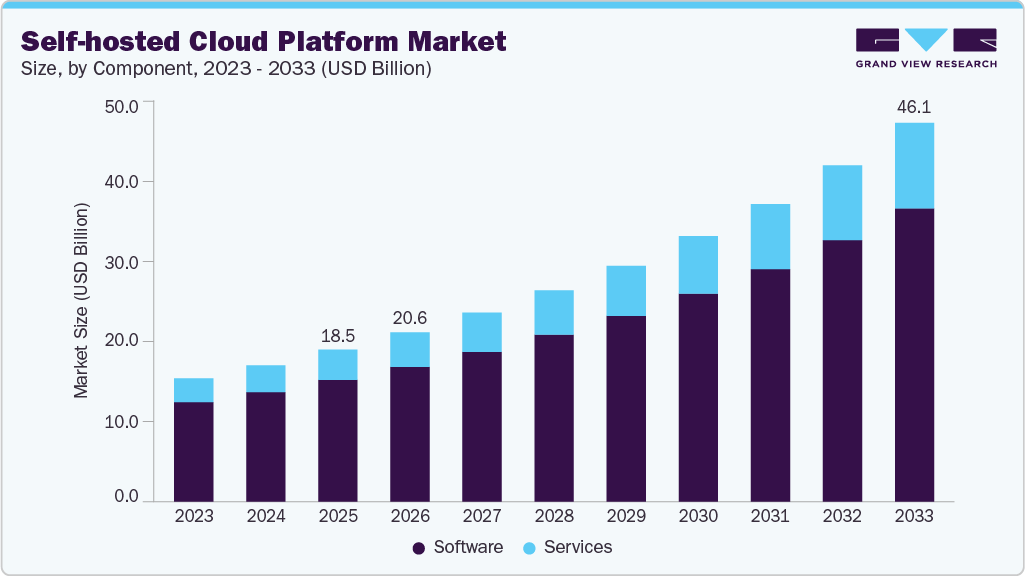
The global self-hosted cloud platform market size was estimated at USD 18.48 billion in 2025 and is projected to reach USD 46.10 billion by 2033, growing at a CAGR of 12.2% from 2026 to 2033. Rising concerns over data sovereignty, regulatory compliance, and digital trust drive the growth.
Key Market Trends & Insights
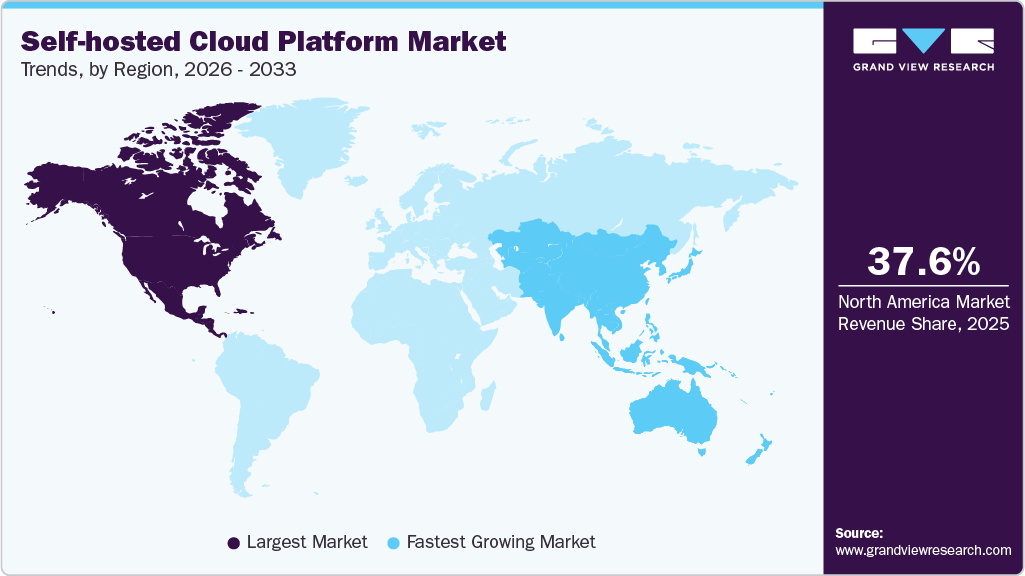
- The North America self-hosted cloud platform market held the largest global revenue share of 37.6% in 2025.
- The self-hosted cloud platform industry in the U.S. is expected to grow significantly from 2026 to 2033.
- By component, software led the market, with the largest revenue share of 79.9% in 2025.
- By enterprise size, the large enterprises segment dominated, with the largest revenue share in 2025.
- By end use, the healthcare segment is expected to grow at significant CAGR from 2026 to 2033.
Market Size & Forecast
- 2025 Market Size: USD 18.48 Billion
- 2033 Projected Market Size: USD 46.10 Billion
- CAGR (2026-2033): 12.2%
- North America: Largest market in 2025
Enterprises across highly regulated industries such as BFSI, healthcare, government, and defense are increasingly favoring self-hosted environments to retain full control over their data, infrastructure, and security protocols.Stricter data localization laws, GDPR-like regulations, and industry-specific compliance frameworks are pushing organizations to adopt on-premises or private cloud deployments that mirror public cloud functionality while ensuring jurisdictional control and auditability. This regulatory pull factor is a core structural driver of the self-hosted cloud platform industry expansion.
Moreover, the growing demand for hybrid and multi-cloud architectures that combine the scalability of cloud computing with the control of on-premises systems also contributes to the self-hosted cloud platform industry. Large enterprises and mid-sized firms are seeking flexible deployment models that allow them to run mission-critical workloads locally while leveraging cloud-native tools such as containerization, Kubernetes orchestration, and DevOps automation. Self-hosted cloud platforms enable this balance by providing cloud-like agility, automation, elastic resource management, and API-driven operations without dependency on hyperscalers for sensitive workloads. For instance, in May 2025, Taishin International Bank in Taiwan implemented Broadcom’s VMware Cloud Foundation as its private cloud platform to support the growing demand for its digital banking service, Richart. The move enables a more scalable, resilient, and container-based infrastructure while also strengthening hybrid cloud-based disaster recovery capabilities in line with regulatory requirements.
Cost optimization and performance considerations are also accelerating adoption. As cloud usage scales, many organizations are experiencing cost volatility, data egress charges, and latency challenges associated with public cloud environments. Self-hosted platforms allow firms to optimize infrastructure spending over the long term, reduce recurring subscription costs for predictable workloads, and improve application performance by keeping data closer to end users and internal systems. This is particularly relevant for industries with high data throughput, such as manufacturing, telecom, and media. In addition, the rapid maturation of open-source cloud technologies and enterprise-grade platform software is strengthening market momentum. The availability of robust tools such as OpenStack, Kubernetes-based private cloud distributions, and enterprise container platforms has lowered technical barriers to deployment while improving reliability and interoperability.
Moreover, rising cybersecurity threats, ransomware risks, and zero-trust security requirements are motivating organizations to build more controlled, isolated, and customizable cloud environments, further reinforcing demand for self-hosted cloud platforms worldwide. According to the IBM Corporation’s Cost of a Data Breach 2025 report, the average global financial impact of a data breach has reached about USD 4.4 million, with costs rising sharply in highly regulated markets such as the U.S., where incidents now average more than USD 10 million due to stricter compliance obligations and heightened legal risk.
Component Insights
The software segment dominated the self-hosted cloud platform market, accounting for a revenue share of 79.9% in 2025, driven by the increasing demand for advanced cloud orchestration, automation, and management tools that enable enterprises to build and operate private and hybrid cloud environments with the operational efficiencies of public cloud services. Organizations are investing in software solutions such as container orchestration platforms (Kubernetes), infrastructure as code (IaC) frameworks, and cloud management platforms (CMPs) to standardize deployment templates, enforce security policies, and automate lifecycle operations across distributed infrastructure.
The services segment is anticipated to grow at the fastest CAGR during the forecast period, driven by rising enterprise reliance on managed, professional, and support services to design, deploy, and operate complex private and hybrid cloud environments. As organizations adopt self-hosted architectures, they increasingly require consulting for cloud strategy, migration, system integration, and compliance alignment, along with managed services for continuous monitoring, security management, patching, and incident response.
Deployment Insights
The private cloud segment dominated the self-hosted cloud platform industry, accounting for the largest revenue share in 2025, driven by enterprises’ need for predictable performance, lower latency, and dedicated infrastructure for mission-critical workloads that cannot be fully migrated to public cloud environments. Organizations in sectors such as manufacturing, telecom, BFSI, and healthcare are increasingly adopting private cloud to keep data and applications closer to their operations, ensuring faster processing, better control over IT architecture, and reduced network dependency.
The hybrid segment is anticipated to grow at the fastest CAGR during the forecast period, driven by enterprises’ need for workload portability and strategic flexibility, enabling them to dynamically allocate applications between on-premises infrastructure and the public cloud based on cost, performance, and business priorities. Organizations are increasingly adopting hybrid models to avoid vendor lock-in, optimize spending through workload placement, and maintain business continuity through distributed environments.
Enterprise Size Insights
The large enterprises segment dominated the market, with the largest revenue share in 2025, driven by the scale and complexity of their IT estates, which require centralized governance, standardized infrastructure, and enterprise-grade risk management. These organizations are consolidating fragmented legacy systems, data centers, and application environments into controlled self-hosted cloud platforms to improve operational consistency, strengthen cybersecurity posture, and meet internal audit requirements.
The small & medium enterprises (SMEs) segment is expected to grow at a significant CAGR during the forecast period, driven by the need for cost-effective digitalization that offers greater control than public cloud while remaining more structured than ad hoc on-prem IT. SMEs are increasingly adopting lightweight, self-hosted platforms to modernize legacy applications, centralize data, and maintain operational continuity without the long-term subscription unpredictability of hyperscale clouds.
Application Insights
The data storage segment dominated the self-hosted cloud platform industry, accounting for the largest revenue share in 2025, driven by the exponential increase in structured and unstructured data generated from IoT devices, digital transactions, multimedia content, and enterprise analytics workloads, which is pushing organizations to seek scalable yet controlled storage environments. Enterprises are prioritizing self-hosted storage platforms to manage data residency requirements, ensure secure archival, and maintain long-term accessibility for compliance and audit purposes.
The collaboration tools segment is expected to grow at a significant CAGR during the forecast period, driven by the sustained shift toward hybrid and remote work models that require secure, always-available digital workspaces hosted within enterprise-controlled environments. Organizations are increasingly deploying self-hosted collaboration suites to protect sensitive communications, intellectual property, and client data while still enabling real-time document sharing, messaging, and virtual teamwork across distributed teams.
End Use Insights
The BFSI segment dominated the self-hosted cloud platform market, accounting for the largest revenue share in 2025, driven by banks, insurers, and fintech firms prioritizing operational resilience, fraud prevention, and real-time transaction reliability within tightly controlled IT environments. Financial institutions are increasingly adopting self-hosted cloud platforms to run core banking, risk analytics, and payment processing systems in low-latency, high-availability architectures that minimize downtime and systemic risk.
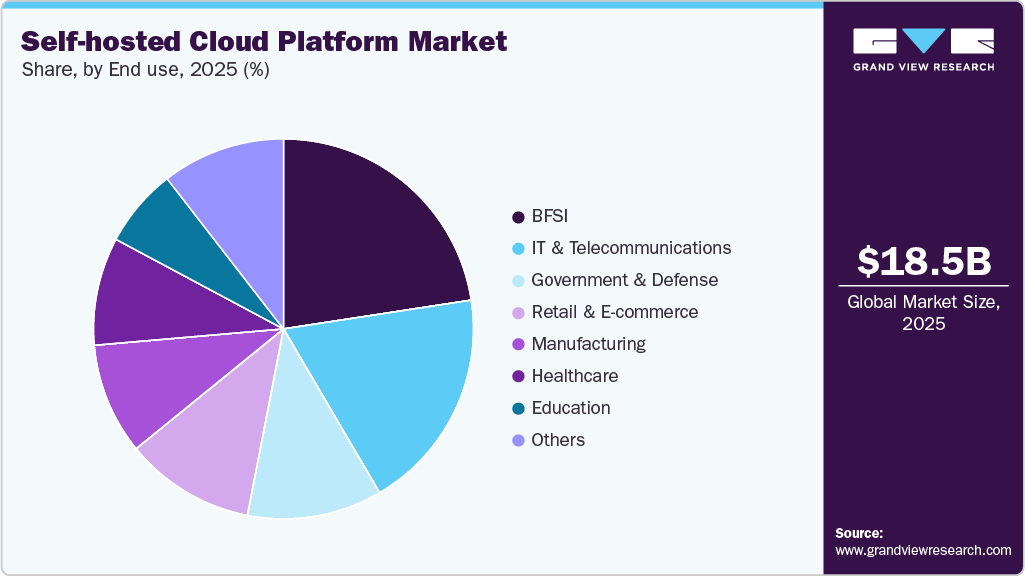
The healthcare segment is expected to grow at a significant CAGR over the forecast period, driven by the rapid digitization of clinical workflows and the expansion of data-intensive applications such as electronic health records (EHRs), medical imaging, and AI-assisted diagnostics that require secure, high-capacity local infrastructure. Hospitals, labs, and life sciences firms are increasingly turning to self-hosted cloud platforms to handle sensitive patient data while maintaining uninterrupted access to critical systems for care delivery.
Regional Insights
North America dominated the global market with the largest revenue share of 37.6% in 2025, driven byenterprise cybersecurity risk management, particularly after high-profile ransomware incidents that have pushed organizations to favor controlled, isolated cloud environments rather than fully externalized public clouds.
U.S. Self-hosted Cloud Platform Market Trends
The self-hosted cloud platform industry in the U.S. is expected to grow significantly at a CAGR of 10.7% from 2026 to 2033, driven by federal and defense supply-chain security requirements, including frameworks such as CMMC and FedRAMP-aligned practices that encourage tighter infrastructure controls among government contractors and critical infrastructure firms.
Europe Self-hosted Cloud Platform Market Trends
The self-hosted cloud platform industry in Europe is anticipated to grow significantly from 2026 to 2033, driven by the region’s strong push for digital sovereignty and strategic technological autonomy, as governments and enterprises seek to reduce dependence on non-European hyperscalers.
The UK self-hosted cloud platform market is expected to grow rapidly in the coming years, owing to the public sector digital modernization and national cybersecurity priorities following repeated cyber threats to government services and healthcare systems. UK institutions are increasingly adopting secure, domestically controlled cloud environments to balance modernization with data protection and operational continuity.
The self-hosted cloud platform market in Germany held a substantial market share in 2025 due to the country’s highly industrialized economy and its focus on Industry 4.0, where manufacturers require secure, low-latency on-premise cloud environments to run automation, robotics, and digital twin applications within factory ecosystems.
Asia Pacific Self-Hosted Cloud Platform Market Trends
The Asia Pacific self-hosted cloud platform industry held a significant revenue share in 2025, driven by rapid digital infrastructure build-out and the expansion of domestic cloud ecosystems across emerging economies, where enterprises prefer locally hosted platforms to avoid reliance on foreign cloud providers.
The Japan self-hosted cloud platform market is expected to grow rapidly in the coming years, driven by corporate conservatism toward data residency and business continuity, shaped by Japan’s strict approach to data governance and disaster resilience. Enterprises are investing in self-hosted platforms that integrate seamlessly with legacy systems while ensuring high reliability against earthquakes, power disruptions, and cyber risks.
The self-hosted cloud platform market in China held a substantial share in 2025, driven by government policies that favor domestically controlled IT infrastructure and limit reliance on foreign cloud technologies. State-owned enterprises and large tech firms are accelerating the adoption of indigenous self-hosted platforms to align with national digital security and industrial policy objectives.
Key Self-hosted Cloud Platform Company Insights
Key players operating in the self-hosted cloud platform industry are Microsoft; Broadcom Inc.; Red Hat (OpenShift); OpenStack Foundation; FileCloud; and Synology. The companies are focusing on various strategic initiatives, including new product development, partnerships & collaborations, and agreements to gain a competitive advantage over their rivals. The following are some instances of such initiatives.
-
In June 2025, Broadcom Inc. rolled out the general availability of VMware Cloud Foundation (VCF) 9.0, positioning it as an integrated platform for building and operating modern private cloud environments. The latest release is designed to provide enterprises with a unified operational framework that can be deployed across on-premises data centers, edge locations, and third-party managed cloud environments, including those offered by service providers and hyperscalers. According to the company, VCF 9.0 aims to deliver public cloud-like flexibility and scalability while retaining the security controls, performance characteristics, architectural governance, and cost efficiency typically associated with on-premises infrastructure.
-
In May 2025, Synology introduced a suite of new enterprise and consumer-focused solutions aimed at strengthening storage performance, data resilience, surveillance intelligence, and personal cloud functionality, with its flagship launch being the PAS7700 active-active NVMe all-flash system. The company’s new high-end storage platform is built on a dual-controller active-active architecture to support continuous operations for mission-critical environments, while embedding security by design and 3-2-1-1 data protection mechanisms to enhance replication, recovery, and overall data integrity across complex IT landscapes.
Key Self-hosted Cloud Platform Companies:
The following key companies have been profiled for this study on the self-hosted cloud platform market.
- Broadcom Inc.
- FileCloud
- Hewlett Packard Enterprise
- Microsoft
- Nextcloud
- OpenStack
- ownCloud
- Pydio
- Red Hat (OpenShift)
- Resilio
- Seafile
- SUSE
- Synology
- Tonido
- TrueNAS
Self-hosted Cloud Platform Market Report Scope
Report Attribute
Details
Market size in 2026
USD 20.58 billion
Revenue forecast in 2033
USD 46.10 billion
Growth rate
CAGR of 12.2% from 2026 to 2033
Actual data
2021 - 2025
Forecast period
2025 - 2033
Quantitative units
Revenue in USD billion and CAGR from 2026 to 2033
Report enterprise size
Revenue forecast, company share, competitive landscape, growth factors, and trends
Segments covered
Component, deployment, enterprise size, application, end use, region
Regional scope
North America; Europe; Asia Pacific; Latin America; MEA
Country scope
U.S.; Canada; Mexico; UK; Germany; France; China; India; Japan; Australia; South Korea; Brazil; UAE; Kingdom of Saudi Arabia; South Africa
Key companies profiled
Broadcom Inc.; FileCloud; Hewlett Packard Enterprise; Microsoft; Nextcloud; OpenStack; ownCloud; Pydio; Red Hat (OpenShift); Resilio; Seafile; SUSE; Synology; Tonido, TrueNAS
Customization scope
Free report customization (equivalent to 8 analysts working days) with purchase. Addition or alteration to country, regional & segment scope.
Pricing and purchase options
Avail customized purchase options to meet your exact research needs. Explore purchase options
Global Self-hosted Cloud Platform Market Report Segmentation
This report forecasts revenue growth at the global, regional, and country levels and provides an analysis of the latest industry trends in each of the sub-segments from 2021 to 2033. For this study, Grand View Research has segmented the global self-hosted cloud platform market report based on component, deployment, enterprise size, application, end use, and region:
-
Component Outlook (Revenue, USD Billion, 2021 - 2033)
-
Software
-
Services
-
-
Deployment Outlook (Revenue, USD Billion, 2021 - 2033)
-
On-premises
-
Hybrid
-
Private Cloud
-
-
Enterprise Size Outlook (Revenue, USD Billion, 2021 - 2033)
-
Large Enterprises
-
Small & Medium Enterprises (SMEs)
-
-
Application Outlook (Revenue, USD Billion, 2021 - 2033)
-
Data Storage
-
Backup & Recovery
-
Collaboration Tools
-
File Sharing
-
Others
-
-
End Use Outlook (Revenue, USD Billion, 2021 - 2033)
-
BFSI
-
IT & Telecommunications
-
Government & Defense
-
Healthcare
-
Manufacturing
-
Retail & E-commerce
-
Education
-
Others
-
-
Regional Outlook (Revenue, USD Billion, 2021 - 2033)
-
North America
-
U.S.
-
Canada
-
Mexico
-
-
Europe
-
UK
-
Germany
-
France
-
-
Asia Pacific
-
China
-
India
-
Japan
-
South Korea
-
Australia
-
-
Latin America
-
Brazil
-
-
Middle East & Africa
-
UAE
-
Saudi Arabia
-
South Africa
-
-
Frequently Asked Questions About This Report
b. The global self-hosted cloud platform market size was estimated at USD18.48 billion in 2025 and is expected to reach USD 20.58 billion in 2026.
b. The global self-hosted cloud platform market is expected to grow at a compound annual growth rate of 12.2% from 2026 to 2033 to reach USD 46.10 billion by 2033.
b. The software segment dominated the market and accounted for the revenue share of 79.9% in 2025, driven by the increasing demand for advanced cloud orchestration, automation, and management tools that enable enterprises to build and operate private and hybrid cloud environments with the operational efficiencies of public cloud services.
b. Some key players operating in the self-hosted cloud platform market include Broadcom Inc., FileCloud, Hewlett Packard Enterprise, Microsoft, Nextcloud, OpenStack, ownCloud, Pydio, Red Hat (OpenShift), Resilio, Seafile, SUSE, Synology, Tonido, TrueNAS
b. The global self-hosted cloud platform market is driven by the rising concerns over data sovereignty, regulatory compliance, and digital trust. Enterprises across highly regulated industries such as BFSI, healthcare, government, and defense are increasingly favoring self-hosted environments to retain full control over their data, infrastructure, and security protocols.


Share this report with your colleague or friend.
Need a Tailored Report?
Customize this report to your needs — add regions, segments, or data points, with 20% free customization.


ISO 9001:2015 & 27001:2022 Certified
We are GDPR and CCPA compliant! Your transaction & personal information is safe and secure. For more details, please read our privacy policy.
Trusted market insights - try a free sample
See how our reports are structured and why industry leaders rely on Grand View Research. Get a free sample or ask us to tailor this report to your needs.












