
- Home
- »
- Conventional Energy
- »
-
Oil & Gas Pipeline Leak Detection Market Size Report, 2033GVR Report cover
![Oil & Gas Pipeline Leak Detection Market Size, Share & Trends Report]()
Oil & Gas Pipeline Leak Detection Market (2026 - 2033) Size, Share & Trends Analysis Report By Technology (Acoustic Sensing, Fiber Optic Sensing), By Pipeline Type (Oil Pipelines, Gas Pipelines), By Application, By Region, And Segment Forecasts
- Report ID: GVR-4-68040-880-1
- Number of Report Pages: 110
- Format: PDF
- Historical Range: 2021 - 2024
- Forecast Period: 2026 - 2033
- Industry: Energy & Power
- Report Summary
- Table of Contents
- Segmentation
- Methodology
- Download FREE Sample
-
 Download Sample Report
Oil & Gas Pipeline Leak Detection Market Summary
The global oil & gas pipeline leak detection market size was estimated at USD 3,155.9 million in 2025 and is projected to reach USD 4,214.6 million by 2033, growing at a CAGR of 3.5% from 2026 to 2033. The market is witnessing steady growth as pipeline operators and energy companies increasingly prioritize infrastructure safety, environmental protection, and operational reliability across extensive oil and gas transportation networks.
Key Market Trends & Insights
- North America oil & gas pipeline leak detection market held the largest share of 31.3% of the global market in 2025.
- The oil & gas pipeline leak detection market in the U.S. is expected to grow significantly over the forecast period.
- By technology, acoustic sensing held the highest market share of 30.4% in 2025.
- By pipeline type, gas pipelines type held the largest share of 72.3% in 2025.
- By application, the distribution networks led the market in 2025, accounting for the largest share of 31.3% of total revenue globally.
Market Size & Forecast
- 2025 Market Size: USD 3,155.9 Million
- 2033 Projected Market Size: USD 4,214.6 Million
- CAGR (2026-2033): 3.5%
- North America: Largest market in 2025
- Asia Pacific: Fastest growing market
Advanced leak detection technologies enable real-time monitoring of pipeline integrity, rapid identification of leak events, and timely mitigation measures, helping operators reduce product loss, minimize environmental damage, and comply with stringent regulatory standards governing pipeline operations.Growing global demand for oil, natural gas, and refined petroleum products is driving the expansion of cross-country transmission pipelines, gathering systems, and distribution networks. As pipeline infrastructure continues to age across several regions, operators are investing in advanced monitoring solutions, such as acoustic sensors, fiber-optic monitoring, negative-pressure wave detection, and computational pipeline monitoring systems, to improve leak detection accuracy and response time. These technologies support early fault detection, reduce downtime, and enhance operational transparency across large-scale pipeline networks spanning onshore and offshore environments.
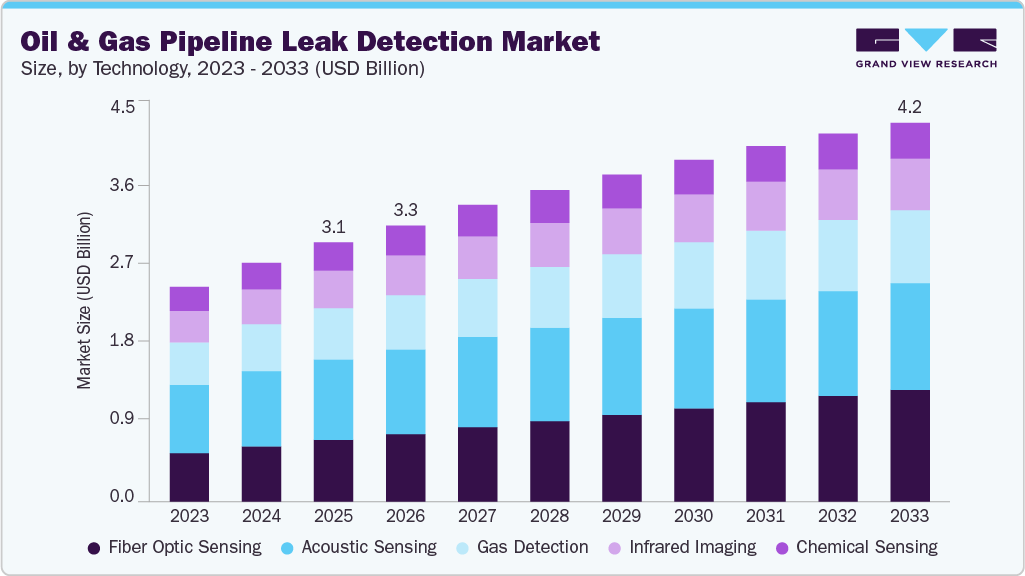
Increasing regulatory scrutiny and environmental accountability are further strengthening the adoption of sophisticated leak detection systems. Governments and regulatory bodies are implementing strict pipeline safety standards to prevent hazardous leaks that can lead to ecological damage, financial losses, and reputational risks for operators. Technology providers are integrating artificial intelligence, machine learning, and cloud-based monitoring platforms to deliver predictive maintenance capabilities and intelligent leak-detection frameworks. As global energy infrastructure continues to expand and safety compliance becomes a strategic priority, pipeline leak detection technologies are becoming essential for ensuring secure, efficient, and environmentally responsible oil and gas transportation systems.
Drivers, Opportunities & Restraints
The primary driver of the oil & gas pipeline leak detection market is the growing emphasis on pipeline safety, environmental protection, and operational reliability across global oil and gas transportation infrastructure. Expanding networks of crude oil, refined products, and natural gas pipelines require continuous monitoring to prevent leaks that can result in environmental damage, economic losses, and operational disruptions. Governments and regulatory authorities across North America, Europe, and the Asia Pacific are strengthening pipeline safety regulations and mandating advanced monitoring systems to ensure early leak detection and rapid response. In addition, aging pipeline infrastructure, rising cross-border energy transportation, and increasing offshore exploration activities are reinforcing the need for sophisticated leak-detection technologies to improve pipeline integrity management and minimize unplanned downtime.
A significant opportunity lies in the integration of advanced sensing technologies, artificial intelligence, and real-time analytics within pipeline monitoring platforms. The adoption of fiber optic sensing systems, acoustic monitoring solutions, satellite-based surveillance, and computational pipeline monitoring is enabling operators to achieve higher detection accuracy and faster incident response across long-distance pipeline networks. Emerging economies in the Middle East, Asia Pacific, and Latin America are witnessing large-scale investments in new oil and gas pipeline infrastructure to support energy demand and international trade, creating strong growth opportunities for leak detection technology providers. Additionally, digital pipeline management platforms that combine predictive maintenance, remote monitoring, and automated alert systems are gaining traction as operators seek to improve asset performance, reduce operational risks, and enhance regulatory compliance.
However, the market faces restraints related to high installation and maintenance costs associated with advanced leak detection technologies, particularly for long-distance and offshore pipelines. Integration challenges with existing pipeline monitoring infrastructure and legacy control systems can also increase deployment complexity and project timelines. Furthermore, variations in regulatory standards across regions and the need for specialized technical expertise may slow adoption among smaller pipeline operators. Despite these challenges, increasing investments in pipeline safety systems, advancements in sensing technologies, and the rising focus on environmental risk mitigation are expected to support steady market growth over the forecast period.
Technology Insights
Based on technology, the acoustic sensing segment accounted for the largest market revenue share of 30.4% in 2025, driven by its widespread adoption for real-time monitoring and early detection of leaks in oil and gas pipeline networks. Acoustic sensing systems detect leak events by identifying sound waves or vibrations generated by escaping fluids, enabling operators to quickly locate leak points across long-distance transmission pipelines. These technologies are widely deployed across crude oil, refined product, and natural gas pipelines due to their ability to provide continuous monitoring, high sensitivity, and rapid response capabilities. Increasing regulatory emphasis on pipeline safety, along with the growing need to minimize product losses and environmental risks, is encouraging pipeline operators to invest in acoustic-based leak detection systems as part of their pipeline integrity management strategies.
The fiber-optic sensing segment is projected to register the fastest CAGR of 6.2% during the forecast period, driven by the increasing deployment of distributed sensing technologies for high-precision pipeline monitoring. Fiber optic sensing systems enable continuous monitoring of temperature, vibration, and acoustic signals along the entire length of a pipeline, allowing operators to detect leaks, third-party intrusions, and structural anomalies with high accuracy. These systems are particularly valuable for long-distance pipelines, offshore infrastructure, and environmentally sensitive regions where early leak detection is critical. As oil and gas companies increasingly adopt digital pipeline monitoring solutions and advanced analytics platforms, fiber-optic sensing technologies are gaining traction for their scalability, reliability, and integration with modern pipeline surveillance and asset management systems.
Pipeline Type Insights
Based on pipeline type, the gas pipelines segment accounted for the largest market revenue share of 72.3% in 2025, driven by the extensive global network of natural gas transmission and distribution pipelines. Natural gas pipelines require continuous monitoring due to the high risk of gas leaks, which can pose safety hazards, raise environmental concerns, and cause significant economic losses. Pipeline operators are increasingly deploying advanced leak detection technologies such as acoustic sensing, fiber optic monitoring, and computational pipeline monitoring systems to ensure early leak identification and rapid response. Additionally, the rising demand for natural gas as a relatively cleaner fossil fuel for power generation, industrial operations, and residential heating is expanding global gas pipeline infrastructure, further strengthening the need for reliable leak detection solutions.
The gas pipelines segment is also projected to register the fastest CAGR of 3.6% during the forecast period, supported by increasing investments in natural gas infrastructure and cross-border pipeline projects. Many countries are expanding their natural gas transmission networks to support energy transition strategies, improve energy security, and reduce reliance on more carbon-intensive fuels. As gas pipeline networks continue to expand across North America, Europe, Asia Pacific, and the Middle East, operators are prioritizing advanced monitoring systems that enable real-time pipeline surveillance, predictive maintenance, and improved operational safety. These factors are expected to drive sustained adoption of leak detection technologies across gas pipeline infrastructure over the coming years.
Application Insights
Based on application, the distribution networks segment accounted for the largest market revenue share of 31.3% in 2025, driven by the extensive deployment of pipeline infrastructure used for transporting natural gas and refined petroleum products across regional distribution systems. Distribution pipelines form the final stage of the oil and gas supply chain, delivering fuels directly to industrial facilities, power plants, commercial establishments, and residential consumers. Due to the dense network of pipelines operating within populated areas, operators are increasingly implementing advanced leak detection systems to ensure operational safety, minimize environmental risks, and comply with stringent regulatory standards. Technologies such as acoustic monitoring, computational pipeline monitoring, and pressure-based detection systems are widely deployed across distribution networks to enable rapid leak identification and improve response time.
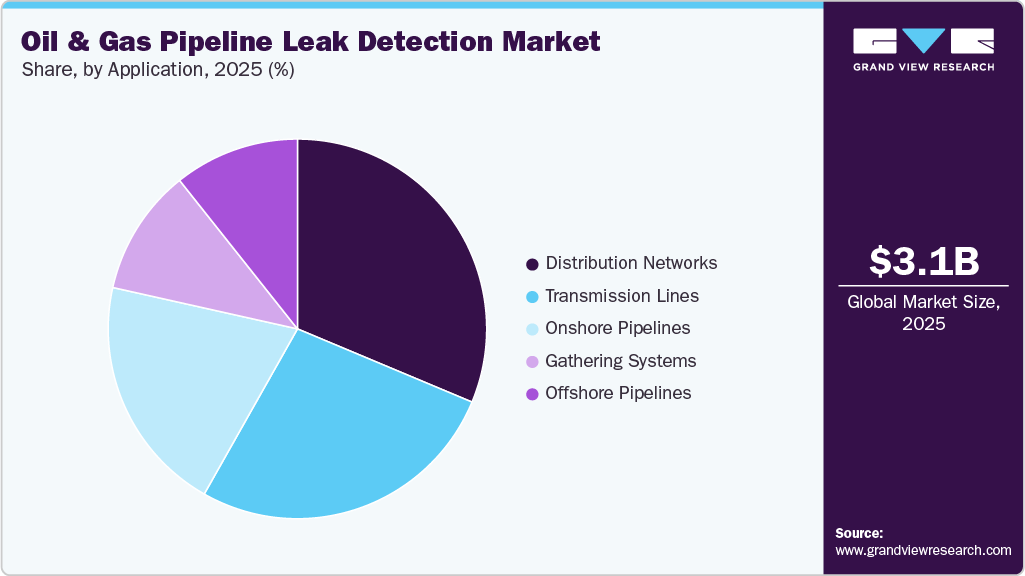
The offshore pipelines segment is projected to register the fastest CAGR of 4.3% during the forecast period, supported by rising offshore exploration and production activities across regions such as the North Sea, Gulf of Mexico, and offshore fields in the Asia Pacific and the Middle East. Offshore pipelines transport crude oil and natural gas from subsea wells to processing facilities and coastal terminals, making early leak detection critical to preventing marine environmental damage and costly operational disruptions. As offshore energy infrastructure expands and regulatory oversight becomes more stringent, operators are increasingly adopting advanced monitoring solutions such as fiber optic sensing, acoustic detection systems, and remote monitoring platforms. These technologies enable continuous surveillance of subsea pipelines, improving detection accuracy and supporting proactive pipeline integrity management.
Regional Insights
North America accounted for the largest revenue share of 31.3% in 2025, supported by the extensive network of oil and natural gas pipelines across the United States and Canada. The region has one of the most mature pipeline infrastructures globally, transporting crude oil, refined petroleum products, and natural gas across long-distance transmission and distribution networks.
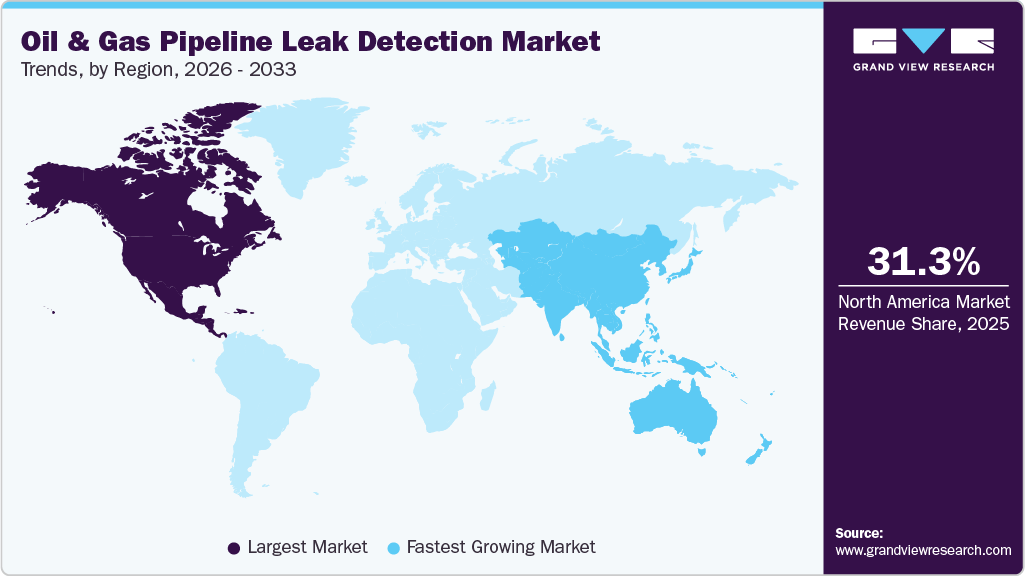
Growing regulatory emphasis on pipeline safety, environmental protection, and operational transparency is driving the adoption of advanced leak detection technologies such as acoustic sensing, fiber optic monitoring, and computational pipeline monitoring systems. In addition, increasing investments in pipeline integrity management and digital monitoring platforms are strengthening the deployment of real-time leak detection solutions across the region.
U.S. Oil & Gas Pipeline Leak Detection Market Trends
The U.S. represents the key revenue contributor within North America, driven by its vast pipeline network and stringent regulatory framework governing pipeline operations. Federal agencies such as the Pipeline and Hazardous Materials Safety Administration (PHMSA) have introduced strict safety standards requiring continuous monitoring and rapid leak detection across transmission pipelines. The country’s growing production of shale oil and natural gas, along with expanding pipeline infrastructure connecting production basins to refining and export facilities, is increasing the demand for advanced leak detection systems. In addition, pipeline operators are increasingly adopting AI-driven monitoring platforms, fiber optic sensing technologies, and remote surveillance systems to improve pipeline safety and operational efficiency.
Europe Oil & Gas Pipeline Leak Detection Market Trends
Europe is witnessing the steady adoption of pipeline leak detection technologies, supported by strong regulatory oversight and growing investments in energy transportation infrastructure. Countries across Western and Northern Europe are focusing on improving pipeline safety standards and reducing environmental risks associated with oil and gas transportation. Increasing cross-border natural gas pipeline projects and the modernization of aging pipeline networks are driving demand for advanced leak detection systems capable of providing continuous monitoring and early fault detection. In addition, the region’s strong focus on environmental protection and energy transition policies is encouraging pipeline operators to implement more sophisticated monitoring solutions to minimize leak incidents and operational disruptions.
Asia Pacific Oil & Gas Pipeline Leak Detection Market Trends
Asia Pacific is projected to register the fastest CAGR of 5.0% during the forecast period, driven by expanding oil and gas pipeline infrastructure and rising energy demand across emerging economies. Countries such as China, India, Australia, and Southeast Asian nations are investing heavily in new pipeline projects to support industrial growth, urbanization, and energy security initiatives. As pipeline networks expand across long-distance and cross-border routes, operators are increasingly deploying advanced monitoring technologies to ensure safe and efficient transportation of hydrocarbons. Government investments in energy infrastructure development and the growing need to minimize environmental risks are expected to accelerate the adoption of leak detection systems across the region.
Latin America Oil & Gas Pipeline Leak Detection Market Trends
Latin America is experiencing gradual market growth, supported by expanding oil and gas transportation infrastructure and increasing investments in energy production. Countries such as Brazil, Mexico, and Argentina are focusing on improving pipeline monitoring capabilities to reduce operational risks and environmental incidents associated with hydrocarbon transportation. The development of new pipeline projects connecting production fields with export terminals and refineries is further strengthening demand for leak detection technologies. In addition, regulatory reforms and modernization of existing pipeline networks are encouraging operators to adopt advanced monitoring and leak detection systems.
Middle East & Africa Oil & Gas Pipeline Leak Detection Market Trends
The Middle East & Africa market is expanding steadily, driven by the region’s strong presence in global oil and gas production and its extensive pipeline transportation networks. Major oil-producing countries in the Middle East rely heavily on pipeline infrastructure to transport crude oil and natural gas to refineries, export terminals, and processing facilities. Increasing focus on pipeline safety, operational reliability, and environmental risk mitigation is encouraging operators to implement advanced leak detection technologies. In Africa, ongoing investments in energy infrastructure and cross-border pipeline projects are further supporting the adoption of monitoring solutions designed to improve pipeline integrity and prevent leak-related incidents.
Key Oil & Gas Pipeline Leak Detection Company Insights
Some of the key participants in the global oil & gas pipeline leak detection market include Atmos International, Baker Hughes, Bridger Photonics Inc., ClampOn AS, Emerson Electric, Endress+Hauser, Honeywell, KROHNE, Mistras Group, OptaSense, Perma-Pipe, Schneider Electric, and Siemens. These companies continue to strengthen their competitive positioning by offering advanced sensing technologies, real-time monitoring platforms, and integrated pipeline integrity management solutions designed to detect leaks quickly and improve operational safety across oil and gas transportation networks. Their product portfolios typically include acoustic monitoring systems, fiber optic sensing technologies, computational pipeline monitoring software, and advanced flow measurement solutions aimed at enhancing leak detection accuracy and reducing response time.
Industry leaders are focusing on improving pipeline surveillance capabilities through advanced analytics platforms, distributed sensing technologies, and automated monitoring systems. Investments in fiber optic sensing infrastructure, acoustic leak detection equipment, satellite-based monitoring solutions, and AI-driven analytics are enabling pipeline operators to detect leaks more accurately and respond rapidly to potential incidents. Many technology providers are also integrating cloud-based monitoring architectures, remote diagnostics, and predictive maintenance tools to enhance pipeline integrity management while supporting regulatory compliance and environmental protection requirements.
As global pipeline infrastructure continues to expand and regulatory scrutiny around pipeline safety intensifies, vendors are accelerating innovation in intelligent monitoring solutions capable of detecting leaks across long-distance and complex pipeline networks. Strategic collaborations with oil and gas operators, expansion into emerging energy markets, and continuous advancements in sensing technologies remain central to capturing new growth opportunities. Ongoing developments in digital pipeline monitoring, automated alert systems, and data-driven asset management platforms are expected to reinforce market competitiveness and support the long-term expansion of the global oil & gas pipeline leak detection industry.
Key Oil & Gas Pipeline Leak Detection Companies:
The following key companies have been profiled for this study on the oil & gas pipeline leak detection market.
- Atmos International
- Baker Hughes
- Bridger Photonics Inc.
- ClampOn AS
- Emerson Electric
- Endress+Hauser
- Honeywell
- KROHNE
- Mistras Group
- OptaSense
- Perma-Pipe
- Schneider Electric
- Siemens
Recent Developments
-
In June 2025, Atmos International reported advancements in its pipeline monitoring and leak detection capabilities through updates to its Atmos Eclipse and Atmos 4G Sentinel systems. The upgraded systems enhanced pressure-based monitoring and analytics to detect hidden pressure anomalies and identify leak events more accurately across pipeline networks. The improvements focused on reducing false alarms, improving detection sensitivity, and supporting continuous monitoring for critical pipeline infrastructure.
-
In 2024, OptaSense continued expanding its distributed fiber-optic sensing technologies for real-time pipeline monitoring and leak detection applications. The company’s advanced sensing platforms use distributed acoustic sensing (DAS) and temperature monitoring along the entire pipeline length to identify leaks, vibrations, and operational anomalies in real time. These solutions enable pipeline operators to detect and locate leaks quickly, improving safety, operational efficiency, and environmental protection across long-distance oil and gas pipeline networks.
Oil & Gas Pipeline Leak Detection Market Report Scope
Report Attribute
Details
Market size value in 2026
USD 3,313.7 million
Revenue forecast in 2033
USD 4,214.6 million
Growth rate
CAGR of 3.5% from 2026 to 2033
Base year for estimation
2025
Historical data
2021 - 2024
Forecast period
2026 - 2033
Quantitative units
Revenue in USD Million, and CAGR from 2026 to 2033
Report coverage
Revenue forecast, competitive landscape, growth factors, and trends
Segments covered
Technology, pipeline type, application, region
Regional scope
North America; Europe; Asia Pacific; Latin America; Middle East & Africa
Country scope
U.S.; Canada; Mexico; Germany; UK; Netherlands; Italy; Norway;Romania; China; India; Singapore; Australia;Malaysia; Indonesia; Brazil; Argentina;Venezuela; Colombia; Saudi Arabia; UAE; South Africa
Key companies profiled
Atmos International; Baker Hughes; Bridger Photonics Inc.; ClampOn AS; Emerson Electric; Endress+Hauser; Honeywell; KROHNE; Mistras Group; OptaSense; Perma-Pipe; Schneider Electric; Siemens
Customization scope
Free report customization (equivalent up to 8 analysts working days) with purchase. Addition or alteration to country, regional & segment scope.
Pricing and purchase options
Avail customized purchase options to meet your exact research needs. Explore purchase options
Global Oil & Gas Pipeline Leak Detection Market Segmentation
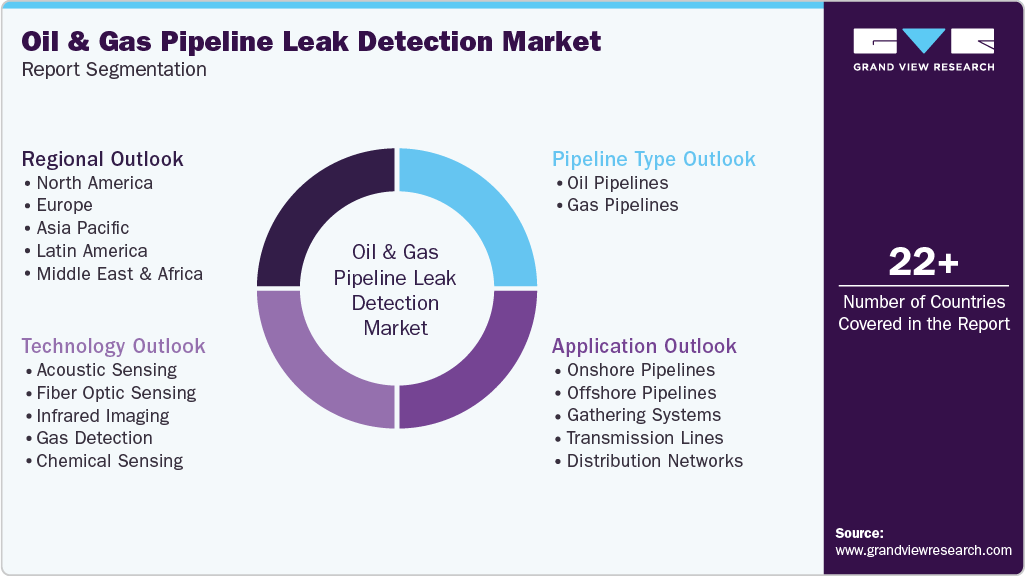
This report forecasts revenue growth at global, regional, and country levels and provides an analysis of the latest industry trends in each of the sub-segments from 2021 to 2033. For the purpose of this study, Grand View Research has segmented the global oil & gas pipeline leak detection market report on the basis of technology, pipeline type, application and region.
-
Technology Outlook (Revenue, USD Million, 2021 - 2033)
-
Acoustic Sensing
-
Fiber Optic Sensing
-
Infrared Imaging
-
Gas Detection
-
Chemical Sensing
-
-
Pipeline Type Outlook (Revenue, USD Million, 2021 - 2033)
-
Oil Pipelines
-
Gas Pipelines
-
-
Application Outlook (Revenue, USD Million, 2021 - 2033)
-
Onshore Pipelines
-
Offshore Pipelines
-
Gathering Systems
-
Transmission Lines
-
Distribution Networks
-
-
Regional Outlook (Revenue, USD Million, 2021 - 2033)
-
North America
-
U.S.
-
Canada
-
Mexico
-
-
Europe
-
Germany
-
UK
-
Netherlands
-
Italy
-
Norway
-
Romania
-
-
Asia Pacific
-
China
-
India
-
Singapore
-
Australia
-
Malaysia
-
Indonesia
-
-
Latin America
-
Brazil
-
Argentina
-
Venezuela
-
Colombia
-
-
Middle East & Africa
-
Saudi Arabia
-
UAE
-
South Africa
-
-
Frequently Asked Questions About This Report
b. The global oil & gas pipeline leak detection market was estimated at USD 3,155.9 million in 2025 and is expected to reach USD 3,313.7 million in 2026.
b. The global oil & gas pipeline leak detection market is expected to grow at a compound annual growth rate of 3.5% from 2026 to 2033 to reach USD 4,214.6 million by 2033.
b. Based on the technology segment, acoustic sensing held the largest revenue share of more than 30.4% in 2025.
b. Some of the key players operating in the global oil & gas pipeline leak detection market include Atmos International, Baker Hughes, Bridger Photonics Inc., ClampOn AS, Emerson Electric, Endress+Hauser, Honeywell, KROHNE, Mistras Group, OptaSense, Perma-Pipe, Schneider Electric, and Siemens, among others.
b. The key factors driving the growth of the oil & gas pipeline leak detection market include increasing investments in pipeline safety and integrity management, rising expansion of oil and natural gas pipeline infrastructure, growing regulatory emphasis on environmental protection and leak prevention, and the adoption of advanced monitoring technologies such as acoustic sensing, fiber optic sensing, and computational pipeline monitoring.


Share this report with your colleague or friend.
Need a Tailored Report?
Customize this report to your needs — add regions, segments, or data points, with 20% free customization.


ISO 9001:2015 & 27001:2022 Certified
We are GDPR and CCPA compliant! Your transaction & personal information is safe and secure. For more details, please read our privacy policy.
Trusted market insights - try a free sample
See how our reports are structured and why industry leaders rely on Grand View Research. Get a free sample or ask us to tailor this report to your needs.












