
- Home
- »
- Homecare & Decor
- »
-
Music Tourism Market Size, Share, Industry Report, 2033GVR Report cover
![Music Tourism Market Size, Share & Trends Report]()
Music Tourism Market (2026 - 2033) Size, Share & Trends Analysis Report By Event Type (Concert, Festival), By Age Group, By Expenditure(Event Expenditure, Travel-Related Expenditure), By Booking Mode, By Region, And Segment Forecasts
- Report ID: GVR-4-68040-557-2
- Number of Report Pages: 107
- Format: PDF
- Historical Range: 2021 - 2025
- Forecast Period: 2026 - 2033
- Industry: Consumer Goods
- Report Summary
- Table of Contents
- Interactive Charts
- Methodology
- Download FREE Sample
-
 Download Sample Report
Music Tourism Market Summary
The global music tourism market size was estimated at USD 103.68 billion in 2025 and is expected to reach USD 330.12 billion by 2033, growing at a CAGR of 15.8% from 2026 to 2033. As travel becomes a central pillar of lifestyle spending rather than a discretionary break from routine, people are building journeys that reflect personal aspirations in the same way they now curate their homes or wellness habits.
Key Market Trends & Insights
- The North America music tourism market accounted for a revenue share of 38.10% in 2025.
- By event type, concerts accounted for a revenue share of 52.55% in 2025.
- By expenditure, travel-related expenditure accounted for a revenue share of 59.93% in 2025.
- By age group, consumers aged between 18 to 34 years accounted for a revenue share of 64.37% in 2025.
- By booking mode, bookings through online travel agencies (OTAs) accounted for a revenue share of 55.83% in 2025.
Market Size & Forecast
- 2025 Market Size: USD 103.68 Billion
- 2033 Projected Market Size: USD 330.12 Billion
- CAGR (2026-2033): 15.8%
- North America: Largest market in 2025
- Asia Pacific: Fastest growing market
The rapid rise of digital fandom, fostered by music streaming platforms, has transformed how listeners engage with artists, increasingly converting online discovery into destination-led travel. As audiences build emotional attachment through Spotify, Apple Music, YouTube, and TikTok, the relationship no longer stops at listening; it evolves into a desire for physical proximity and live, shared experiences. Streaming platforms thus serve as the “first touchpoint” of fandom, while touring destinations serve as the real-world extension of that loyalty. This growing behavioral shift is now a major driver of music tourism, as fan journeys begin online but ultimately translate into flights, hotel bookings, and city visits built around live performances.The social nature of fandom communities reinforces this move from virtual engagement to physical travel. The streaming environment is not only where fans discover music, but also where they find identity through shared culture, reposting concert clips or live-streamed performances that build anticipation for in-person attendance. According to the YouTube Culture & Trends Report 2023, 70% of Gen Z say online video is their primary gateway to experiencing live performances before attending in person, illustrating how streaming is now the top-of-funnel driver of travel intent. As fandom becomes participatory, not passive, fans treat live events as moments of belonging, deciding to travel feels emotionally justified and socially validated, rather than discretionary leisure.
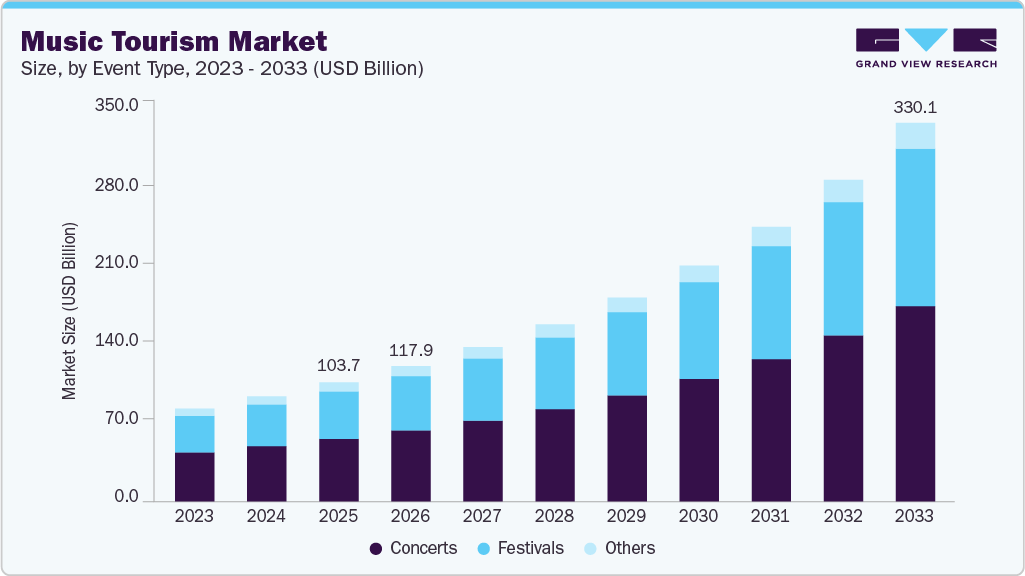
The tourism pull created by streaming-led fandom is now visible in booking behavior across travel platforms. Cities experience measurable surges in travel interest the moment a globally streamed artist announces a tour stop. According to Expedia Traveler Trends 2024, published December 2023, Taylor Swift’s Eras Tour generated triple-digit increases in hotel and flight searches following city announcements, prompting the company to label 2024 “the year of Taylor Swift tourism”.
Furthermore, the surge in concert-led travel reflects a structural shift in how consumers make tourism decisions, with the live event now serving as the primary motivation for the trip. Instead of choosing a destination first and building entertainment around it, travelers increasingly reverse the sequence: they choose the artist or performance first and the destination second. This shift is driven by emotional proximity and the cultural value of “being present” at a live moment that cannot be replicated digitally. According to the Live Nation Annual Report in February 2024, international concert attendance rose by more than 20% year-on-year, underscoring how live performances are now causing fans to cross borders specifically to see artists they follow closely, rather than to pursue a destination itself.
This behavior is especially visible when headline tours or limited-run shows create urgency. When a major tour stop is exclusive or city-limited, fans travel because there is no alternative local access. This dynamic was evident during the Eras Tour, where concert announcements triggered immediate spikes in flight and hotel interest; according to Expedia Traveler Trends in December 2023, Taylor Swift tour date releases led to triple-digit jumps in destination searches within hours.
Brand Market Share Insights
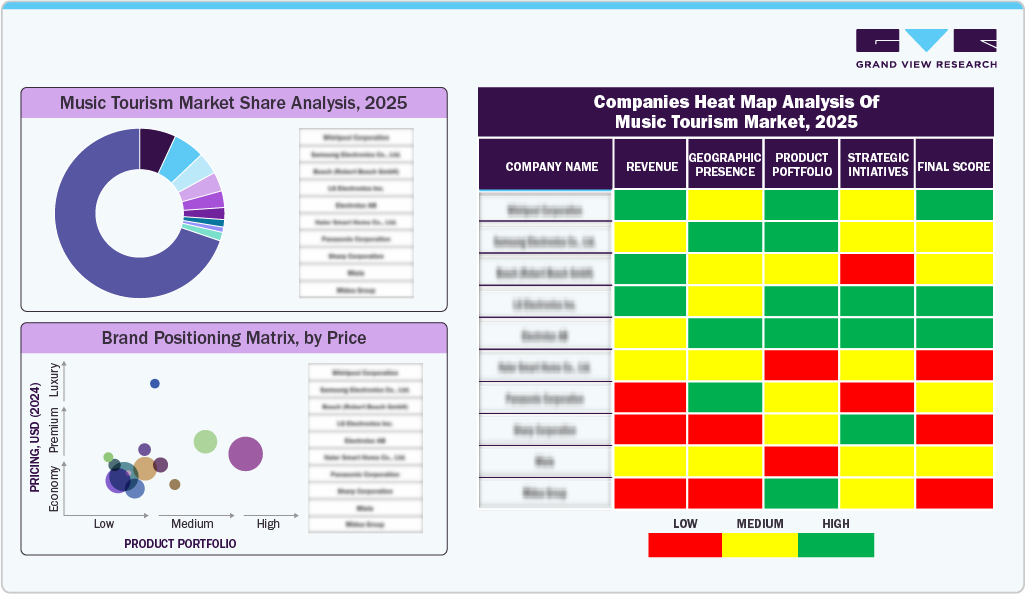
The global music tourism market is characterized by the presence of well-established festival organizers, concert promoters, destination marketers, and hospitality partners alongside a growing base of emerging experiential travel players. Market participants are actively pursuing strategic initiatives to align with evolving traveler expectations around immersive entertainment, cultural authenticity, and premium event access. Product development is increasingly focused on curated travel packages that bundle live performances with accommodation, transportation, VIP seating, and exclusive backstage or artist-led experiences, enhancing convenience and perceived value for high-spending music travelers. Digital transformation is also reshaping music tourism strategies, with organizers investing in mobile ticketing ecosystems, personalized event discovery platforms, dynamic pricing models, and social-media-led destination branding. Partnerships between tourism boards, airlines, and event promoters are further strengthening market reach, positioning music tourism as a rapidly evolving segment within the global experiential travel economy.
Consumer Insights
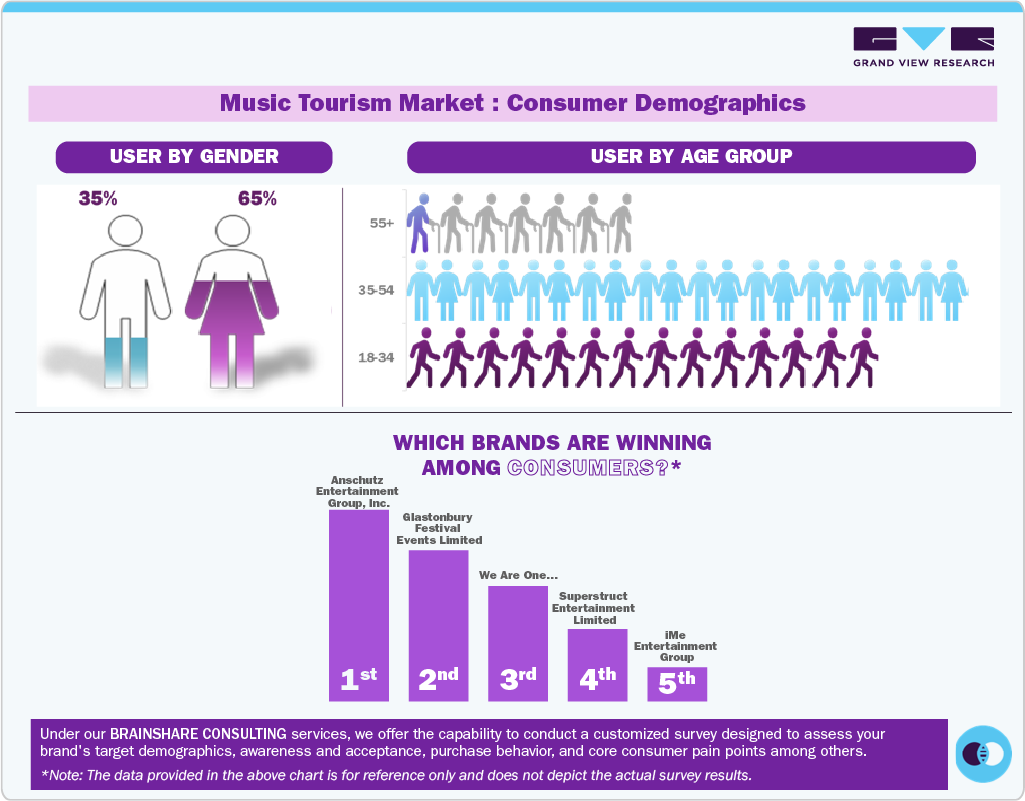
Gen Z is the most travel-active and experience-driven group in music tourism, using live events as both a social and cultural expression. According to Bread Financial and AAA data, 65% of Gen Z have already traveled or plan to travel more than 50 miles for a live event, the highest among all generations, and 52% plan to attend a music event within the next year. They are also the most likely to fly for a concert (53%) and twice as likely as Baby Boomers to travel over 1,500 miles (18% vs. 9%). Their approach reflects a high level of urgency and spontaneity in experience-seeking. Notably, 72% of Gen Z travelers extend their trips to include additional destination time, indicating that live performances are central to their travel planning and a key part of their social identity.
Millennials represent the financial backbone of the music tourism industry. While slightly less impulsive than Gen Z, 58% have recently traveled to a live event or plan to, and 39% spend between USD 500 and USD 5,000+ on tickets alone. This group demonstrates a strong willingness to invest in premium experiences, 42% use savings to fund trips, and many are open to international travel for better value or unique performances. Around 68% extend their trips into short vacations, indicating that music events serve both entertainment and recreational purposes.
According to UN Tourism’s World Tourism Barometer in January 2025, global arrivals surpassed 2019 levels through 2024 and continued to rise into early 2025, confirming that long-haul discretionary cultural tourism has fully normalized. At the same time, IATA’s World Air Transport Statistics Update in July 2024 reported the highest global average load factor on record, indicating strong consumer willingness to allocate travel budgets to experience-centric motivations. This broader travel recovery is not simply a backdrop; it is the enabling condition that is allowing music tourism volumes to scale again at pace.
Live music has moved from being a secondary activity to becoming a primary reason for travel. For instance, Australia’s state of Victoria reported that among 89 contemporary music festivals held in regional zones, more than half (51%) of the 405,380 attendees in 2019 came from outside those host communities, underscoring that travelling specifically for a music event is increasingly part of the trip design. This shift suggests travelers are choosing the performance first and then building the larger itinerary around it, a pattern likely to ripple through other established music destinations.
Music travel spending is increasingly concentrated around major tours, flagship venues, and destination festivals rather than spread evenly throughout the year. According to UK Music’s Hometown Glory 2024 report, large-scale touring activity in 2023-2024 attracted around 23.5 million music tourists and generated USD 3.2 billion in direct economic impact.
Event Type Insights
Concerts held the largest share of the music tourism market, accounting for 52.55% in 2025. Demand is rising as audiences increasingly travel across cities and countries to attend major arena shows, international tours, and headline concert events that offer emotional connection, cultural excitement, and one-of-a-kind experiences. High-spending music travelers are particularly drawn to premium concert formats such as VIP seating, exclusive hospitality zones, multi-night show packages, and bundled travel services that enhance convenience and elevate the overall event experience. Travelers increasingly expect seamless digital ticketing, personalized recommendations, secure booking platforms, and integrated accommodation and transport options when planning concert trips.
The festivals segment is anticipated to grow at a CAGR of 16.4% from 2026 to 2033, driven by rising consumer demand for immersive, multi-day live entertainment experiences that combine music, travel, and cultural exploration. Festivals attract both domestic and international visitors by offering large-scale artist lineups, destination-based settings, and community-driven atmospheres that extend beyond a single performance. Demand is particularly strong among younger travelers and experience-focused audiences who view festival attendance as a lifestyle activity tied to social connection, personal identity, and memorable travel moments. Major events such as Glastonbury, Coachella, Tomorrowland, and Primavera Sound continue to draw global crowds, reinforcing festivals as a core pillar of growth in music tourism.
Age-Group Insights
The 18 to 34 year olds segment held the largest share of the music tourism market, accounting for a share of around 64.37% in 2025. Generation Z and Millennials are reshaping music festival attendance through their strong preference for travel and nature-infused experiences. According to a study by AAA and Bread Financial, 65% of Gen Z and 58% of Millennials plan to travel more than 50 miles for live events in the next year, compared to only 43% of Gen X and 27% of Baby Boomers. Similarly, 53% of Gen Z attendees are willing to fly to attend a music festival, showing how festivals have evolved into key travel experiences.
This is further supported by regional data: 64% of those under 24 are willing to take a flight to see their favorite artist live, particularly strong among Italians, where 46% are ready to take a short flight, and 15% would fly across the world for a show. Moreover, 69% of festival-goers, and an even higher 75% among those aged 21-35, prefer nature-based festivals that allow them to immerse themselves in scenic outdoor settings.
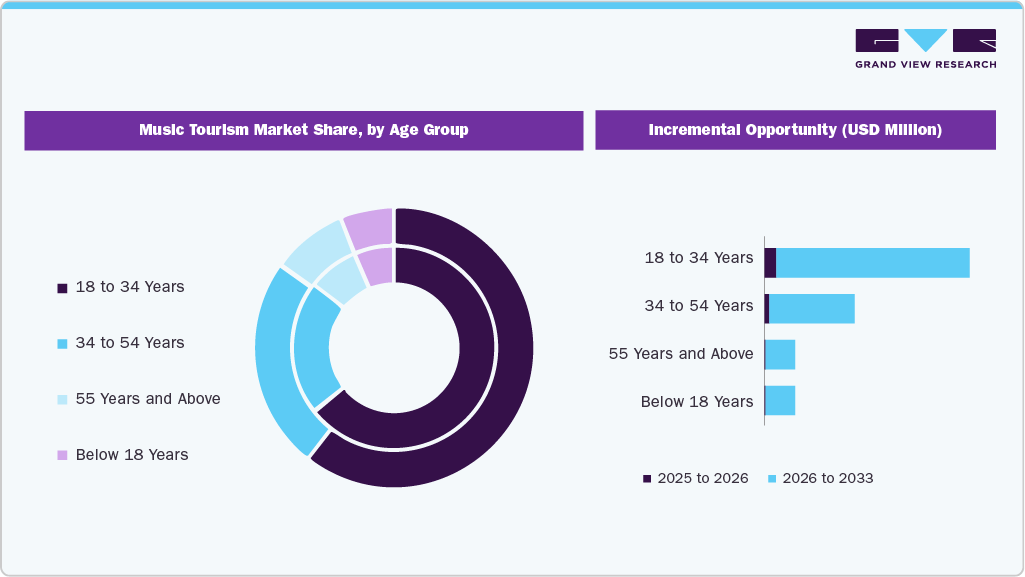
The 34 to 54-year-olds segment is anticipated to grow at a CAGR of 17.9% from 2026 to 2033. Adults aged 34 to 54 are often drawn to music festivals and concerts because these events help them reconnect with the music of their past. Many in this group grew up during the golden eras of the 1980s, 1990s, and early 2000s, when iconic artists and genres defined popular culture. Attending concerts featuring these artists triggers nostalgia and emotional connection, allowing them to relive memories associated with their youth and personal milestones.
Expenditure Insights
Travel-related expenditure dominated the music tourism industry, accounting for a share of around 59.93% in 2025. Consumers consider distance from home, airfare, hotel rates, and the convenience of reaching the venue before committing to attend. When travel expenses rise, potential festivalgoers may limit attendance at nearby events or reduce the number of festivals they attend each year. This is especially true for younger audiences or budget-conscious travelers who balance the desire for unique experiences with financial constraints. At the same time, well-planned travel can enhance the overall festival experience. Many consumers consider music festivals short vacations, combining them with sightseeing or local cultural exploration.
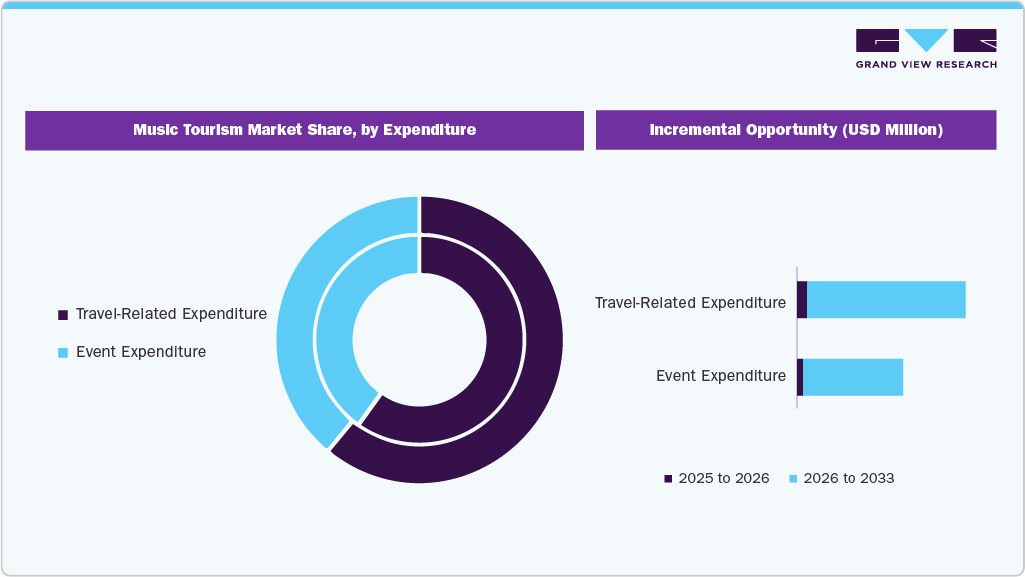
Event expenditure is expected to grow at a CAGR of 15.5% from 2026 to 2033. For most attendees, event-related expenses, including ticket prices, food and beverages, merchandise, parking, and accommodations near the venue, represent a substantial portion of their total spending. Consumers carefully assess whether the experience justifies the cost. A 2024 survey shows that 44% of festival-goers are attending fewer festivals due to rising ticket prices, and 49% of respondents refuse to pay more than USD 270 for a festival ticket. This highlights consumers' sensitivity to pricing and its impact on their participation decisions. For example, a higher ticket price may be acceptable if it offers better amenities, such as VIP seating, exclusive artist access, or premium sound quality. On the other hand, hidden costs or overpriced food and merchandise can negatively impact perceptions of value.
Booking Mode Insights
Online travel agencies held the largest share of the music tourism market, accounting for a share of around 55.83% in 2025. Online travel agencies (OTAs) provide unmatched convenience by bringing together all essential travel services, such as event tickets, accommodation, flights, and local transport, on a single platform. This eliminates the need to visit multiple websites or coordinate separate bookings, which can be time-consuming and confusing, especially for large events. Using OTAs like Trip.com, Expedia, or Booking.com, festivalgoers can plan their entire trip in a single seamless transaction. These platforms have also begun offering specialized festival or concert packages, making it easier for domestic and international travelers to plan their itineraries.
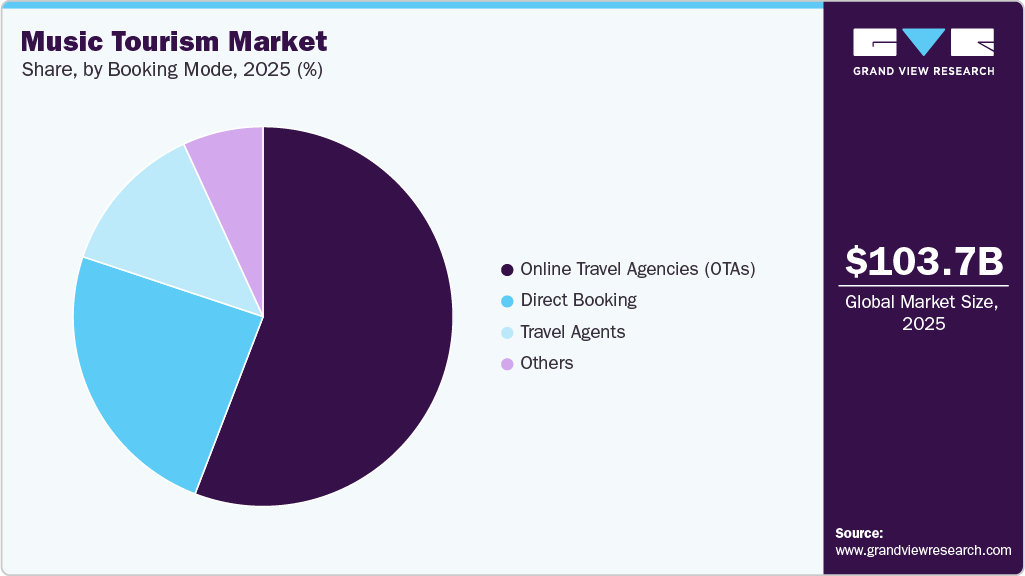
The travel agents segment is anticipated to grow at a CAGR of 15.9% from 2026 to 2033. Travel agents bring valuable expertise and local knowledge to music festival and concert travel. Their familiarity with event venues, transportation systems, and nearby attractions enables them to craft smooth, enjoyable itineraries for travelers. They guide consumers on the best routes, local customs, safety precautions, and the ideal time to arrive at the festival grounds. For international attendees unfamiliar with a destination’s logistics or language, this expertise ensures a hassle-free experience. It allows them to focus on enjoying the music and atmosphere rather than worrying about planning details.
Regional Insights
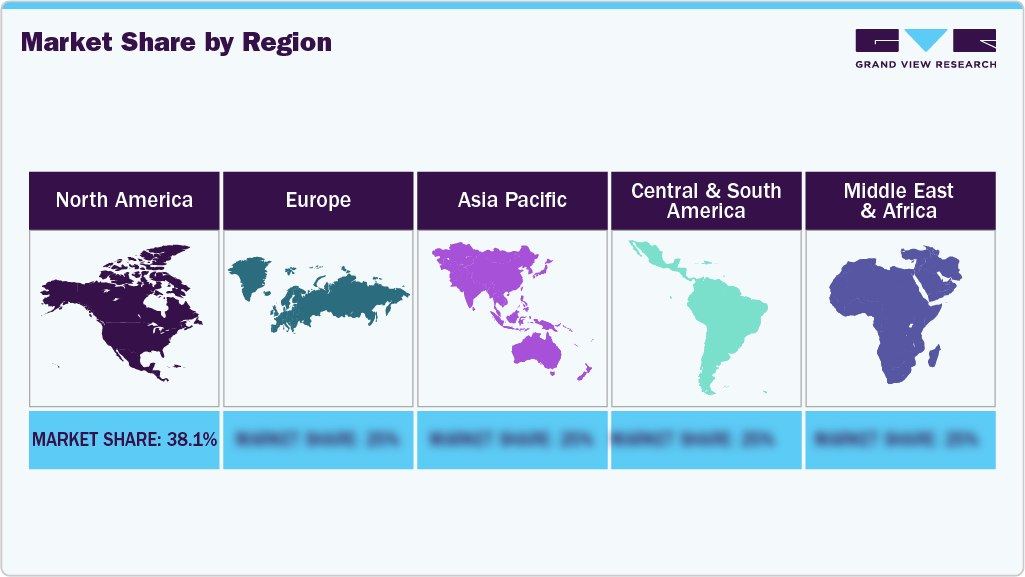
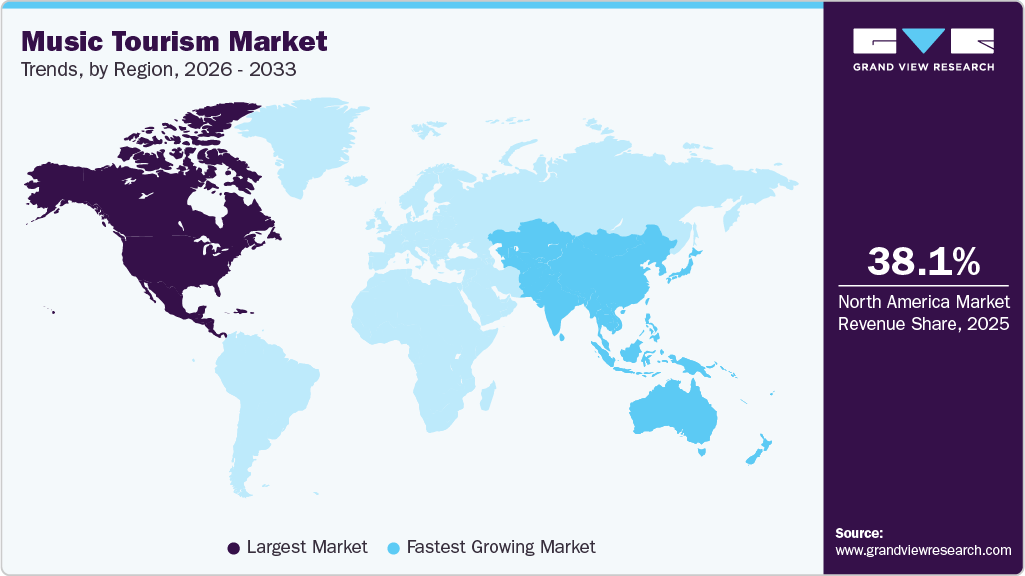
The North America music tourism market accounted for a share of around 38.10% in 2025, fueled by a vibrant live entertainment culture, strong consumer spending power, and a growing preference for experience-driven travel. Iconic festivals such as Coachella, Lollapalooza, and Bonnaroo attract domestic and international visitors seeking immersive cultural and musical experiences. This surge is further supported by Americans’ willingness to invest in premium event experiences; many are prepared to pay extra for better seats, exclusive access, and merchandise.
U.S. Music Tourism Market Trends
The music tourism industry in the U.S. dominated North America in 2025, accounting for a revenue share of 81.23%. The U.S. hosts over 800 music festivals each year, appealing to diverse musical interests and attracting large audiences nationwide. With approximately 54% of American adults having attended at least one festival, it's clear that music tourism is becoming an increasingly popular and influential part of the travel landscape. According to a survey by Momentum Ventures, an online travel agency that interviewed 2,000 U.S. adults, 76% would travel domestically or internationally for a concert or music festival if tickets were more accessible. On average, respondents were willing to spend about USD 1,800 (not including ticket costs) when traveling for such events.
Europe Music Tourism Market Trends
The music tourism industry in Europe is expected to grow at a CAGR of 15.2% from 2026 to 2033. Across Europe, the live music landscape is being reshaped by audiences seeking deeper, more meaningful, and experience-driven events. Rather than attending multiple small festivals, fans prioritize fewer, higher-quality experiences that combine music, atmosphere, and destination appeal.
Festivals now compete not only through their lineups but also through immersive production, location design, and side attractions such as art installations, wellness zones, and curated food markets. This shift reflects a broader consumer trend toward experiential spending, where emotional connection and memorable moments outweigh price sensitivity. As a result, major festivals are positioning themselves as cultural destinations, integrating music, travel, and lifestyle to attract local and international audiences.
Asia Pacific Music Tourism Market Trends
The Asia Pacific music tourism industry is expected to grow at the fastest CAGR of 18.1% from 2026 to 2033. The rise of regional pop, indie talent, and localized live event lineups is reshaping the Asia-Pacific music landscape. Genres like K-pop, J-pop, C-pop, Mandopop, and Thai pop are gaining strong traction across markets like Australia, New Zealand, and Southeast Asia, reflecting a growing cultural shift toward regionally inspired sounds and diverse audience preferences. According to a 2025 Mumbrella study, 90% of Asia-Pop fans actively engage with these genres. Notably, 98% listen to music in languages other than English, with over 60% stating they prefer non-English music despite English being the primary language spoken at home. The study also highlights that one in three fans consumes over 15 hours of Asian pop per week, and that 35% of the Asia-Pop audience falls within the 27-48 age group, showing that the trend extends well beyond Gen Z.
Central & South America Music Tourism Market Trends
The Central & South America music tourism industry is expected to grow at a CAGR of 16.9% from 2026 to 2033. In 2025, Central and South America are witnessing a significant surge in live-music activity, with cities such as Bogotá, Mexico City, Buenos Aires, and São Paulo emerging as regional concert capitals. According to a 2025 El País article, Bogotá has “consolidated itself as a new epicenter of concerts in Latin America,” driven by improved infrastructure, large-scale venues, and greater engagement from international promoters. Major global festival brands such as Lollapalooza and Ultra continue to expand into Latin markets, signaling the region’s importance in the worldwide touring ecosystem. Audiences across Latin America have shown a post-pandemic appetite for live events, pushing attendance numbers into the tens of thousands and making the live-entertainment sector one of the fastest-growing cultural industries in the region.
Middle East & Africa Music Tourism Market Trends
The Middle East and Africa music tourism industry is expected to grow at a CAGR of 16.1% from 2026 to 2033. Across Sub-Saharan Africa, live music and festivals are experiencing a strong post-pandemic revival, supported by rapid urbanization, a growing middle class, and an increasingly vibrant youth demographic. As local promoters and international brands recognize the continent's untapped potential for large-scale events, major markets such as Nigeria, Kenya, South Africa, and Ghana are leading this resurgence. According to the survey, rising disposable income, improved digital connectivity, and the popularity of Afrobeat and Amapiano have fueled demand for live performances and festivals. Cities like Lagos, Nairobi, and Johannesburg are transforming into regional music hubs, hosting high-profile events such as Afro Nation Ghana and Ultra South Africa.
Key Music Tourism Companies:
The following key companies have been profiled for this study on the music tourism market.
- Anschutz Entertainment Group, Inc.
- Glastonbury Festival Events Limited
- We Are One World BV
- Superstruct Entertainment Limited
- iMe Entertainment Group
- CTS EVENTIM AG & Co. KGaA
- Live Nation Entertainment
- HYBE Co., Ltd.
- MSG Entertainment Holdings, LLC
- DF Concerts Limited
- TEG Dainty
Recent Developments
-
In March 2025, KQ Entertainment, the South Korean label behind rising K-pop powerhouse ATEEZ, entered into a multi-year strategic partnership with global live entertainment giant AEG Presents. The deal grants AEG Presents full oversight of ATEEZ’s worldwide tour production following their highly successful North American and European legs, including sold‑out stadium shows at Citi Field, BMO Stadium, Globe Life Field, and a milestone performance at Paris’s La Défense Arena. This collaboration aims to deepen K-pop’s global reach, pairing KQ’s artist development strengths with AEG’s production and promotional expertise.
-
In November 2024, ADA, the independent music distribution and artist-services arm of Warner Music Group, strengthened its team and sealed strategic deals across Southeast Asia. It appointed Rasti Sryantoro as Head of ADA Indonesia and Arisa Maruekatat as Head of ADA Thailand. The company also signed new deals with major regional labels, including GMM Music in Thailand. It extended its partnership with Indonesia’s DPM to boost the reach of local artists internationally.
Music Tourism Market Report Scope
Report Attribute
Details
Market size value in 2026
USD 117.92 billion
Revenue forecast in 2033
USD 330.12 billion
Growth rate
CAGR of 15.8% from 2026 to 2033
Actuals
2021 - 2025
Forecast period
2026 - 2033
Quantitative units
Revenue in USD million/billion, and CAGR from 2026 to 2033
Report coverage
Revenue forecast, company ranking, competitive landscape, growth factors, and trends
Segments covered
Event type, age group, expenditure, booking mode, region
Regional scope
North America; Europe; Asia Pacific; Central & South America; Middle East & Africa
Country scope
U.S.; Canada; Mexico; Germany; UK; France; Italy; Spain; China; Japan; India; Australia & New Zealand; South Korea; Brazil; South Africa; UAE
Key companies profiled
Anschutz Entertainment Group, Inc.; Glastonbury Festival Events Limited; We Are One World BV; Superstruct Entertainment Limited; iMe Entertainment Group; CTS EVENTIM AG & Co. KGaA; Live Nation Entertainment; HYBE Co., Ltd.; MSG Entertainment Holdings, LLC; DF Concerts Limited; TEG Dainty
Customization scope
Free report customization (equivalent up to 8 analysts working days) with purchase. Addition or alteration to country, regional & segment scope.
Pricing and purchase options
Avail customized purchase options to meet your exact research needs. Explore purchase options
Global Music Tourism Market Report Segmentation
This report forecasts revenue growth at the global, regional, and country levels and provides an analysis of the latest industry trends and opportunities in each of the sub-segments from 2021 to 2033. For this study, Grand View Research has segmented the global music tourism market report based on event type, expenditure, age group, booking mode, and region:
-
Event Type Outlook (Revenue, USD Million, 2021 - 2033)
-
Concerts
-
Festivals
-
Others
-
-
Expenditure Outlook (Revenue, USD Million, 2021 - 2033)
-
Event Expenditure
-
Travel-Related Expenditure
-
-
Age Group Outlook (Revenue, USD Million, 2021 - 2033)
-
Below 18 Years
-
18 to 34 Years
-
34 to 54 Years
-
55 Years and Above
-
-
Booking Mode Outlook (Revenue, USD Million, 2021 - 2033)
-
Direct Booking
-
Travel Agents
-
Online Travel Agencies (OTAs)
-
Others
-
-
Regional Outlook (Revenue, USD Million, 2021 - 2033)
-
North America
-
U.S.
-
Canada
-
Mexico
-
-
Europe
-
Germany
-
UK
-
France
-
Italy
-
Spain
-
-
Asia Pacific
-
China
-
Japan
-
India
-
South Korea
-
Australia & New Zealand
-
-
Central & South America
-
Brazil
-
-
Middle East & Africa
-
South Africa
-
UAE
-
-
Frequently Asked Questions About This Report
b. Some of the key players operating in the music tourism market include Coachella Valley Music and Arts Festival, Glastonbury Festival, Tomorrowland, Lollapalooza, AEG Presents, Ticketmaster, Live Nation Entertainment, Royal Albert Hall, Madison Square Garden, and Fuji Rock Festival.
b. The global demand for music tourism is rising due to consumers’ increasing preference for immersive cultural experiences that combine travel with live music events. Enhanced global connectivity, digital engagement, and the commercialization of large-scale festivals have further accelerated this trend.
b. The global music tourism market was estimated at USD 103.68 billion in 2025 and is expected to reach USD 117.92 billion in 2025.
b. The global music tourism market is expected to grow at a compound annual growth rate of 15.8% from 2026 to 2033, reaching USD 330.12 billion by 2033.
b. North America dominated the music tourism market with a share of 38.10% in 2025. The industry thrives on iconic festivals and venues, drawing tourists who boost local economies through travel and accommodation spending. This impact occurs even without substantial fiscal incentives, showcasing the sector’s resilience and cultural appeal.


Share this report with your colleague or friend.
Need a Tailored Report?
Customize this report to your needs — add regions, segments, or data points, with 20% free customization.


ISO 9001:2015 & 27001:2022 Certified
We are GDPR and CCPA compliant! Your transaction & personal information is safe and secure. For more details, please read our privacy policy.
Trusted market insights - try a free sample
See how our reports are structured and why industry leaders rely on Grand View Research. Get a free sample or ask us to tailor this report to your needs.












