
- Home
- »
- Clothing, Footwear & Accessories
- »
-
Middle East Watches Market Size, Industry Report, 2033GVR Report cover
![Middle East Watches Market Size, Share & Trends Report]()
Middle East Watches Market (2025 - 2033) Size, Share & Trends Analysis Report By Type (Analog, Digital), By Price Range (Economy, Premium), By End Use, By Distribution Channel, By Country, And Segment Forecasts
- Report ID: GVR-4-68040-823-3
- Number of Report Pages: 80
- Format: PDF
- Historical Range: 2021 - 2024
- Forecast Period: 2025 - 2033
- Industry: Consumer Goods
- Report Summary
- Table of Contents
- Segmentation
- Methodology
- Download FREE Sample
-
 Download Sample Report
Middle East Watches Market Summary
The Middle East watches market size was estimated at USD 2.18 billion in 2024 and is projected to reach USD 3.06 billion by 2033, growing at a CAGR of 3.9% from 2025 to 2033. Growth in the industry is supported by a stable base of fashion-watch buyers, a cultural affinity for gifting, and consistent demand for mechanical and quartz models across both mid-range and premium segments.
Key Market Trends & Insights
- By type, analog watches segment led the market with a share of 92.69% in 2024.
- By end use, men segment led the market and accounted for a share of 76.80% in 2024.
- By distribution channel, the offline sales segment held the largest market share of 72.44% in 2024.
- In terms of country, the UAE held a market share of 36.02% in 2024.
Market Size & Forecast
- 2024 Market Size: USD 2.18 Billion
- 2033 Projected Market Size: USD 3.06 Billion
- CAGR (2025-2033): 3.9%
A key trend in the watch market in the Middle East is the shift of buyers from pure luxury boutiques to multi-brand lifestyle retailers, as consumers increasingly mix premium Swiss pieces with accessible fashion and micro-brand watches, driving stronger turnover for hybrid retail formats in malls.One key driver of market growth is the steady influx of tourists from regional countries and around the world into hubs like Dubai, Abu Dhabi, and Doha, where watches remain a high-frequency purchase. Tourist-heavy zones, such as Dubai Duty Free, The Dubai Mall, and Hamad International Airport, consistently convert visitors into buyers because watches make excellent gifts and are tax-efficient luxury items. This recurring tourist demand provides the market with a reliable, year-round sales engine that supports both mid-range and premium traditional watch segments.
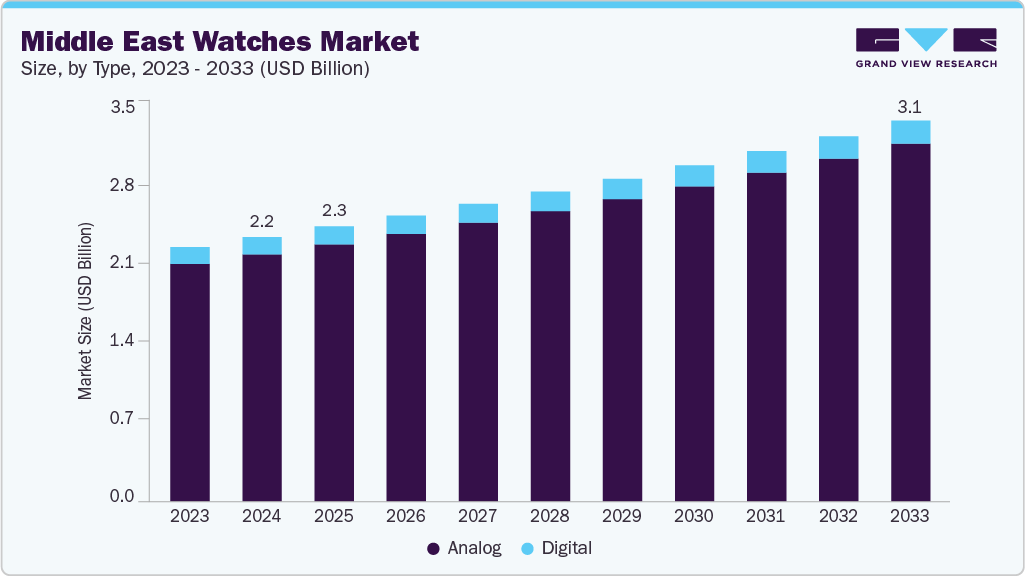
Another driver strengthening the market is the rapid improvement of the after-sales ecosystem across the Middle East. Retailers such as Ahmed Seddiqi & Sons, Al Majed Jewellery, and Damas have expanded their certified service capabilities, while brands like Rolex, Omega, and Seiko are increasing the number of authorised service centres in Dubai, Riyadh, and Jeddah. Faster repairs, genuine parts availability, and dependable warranty processes have made traditional watch ownership far more reassuring encouraging customers to repair, upgrade, and repurchase with greater confidence.
Furthermore, the rising cultural interest in mechanical craftsmanship, especially among younger Middle Eastern consumers, is propelling the market forward. Communities like the Dubai Watch Club, events such as Dubai Watch Week, and the growing visibility of Arabic-numeral or Gulf-inspired limited editions have sparked enthusiasm for horology beyond traditional luxury buyers. This shift is boosting demand not only for high-end Swiss pieces but also for accessible mechanical models from brands such as Oris and Seiko, expanding the market base and contributing to sustained growth in the watches market in the Middle East.
Consumer Insights
Traditional watches in the Middle East remain noticeably male-led, regardless of price tier.
-
Men form the dominant majority of traditional watch buyers, driven by the region’s strong cultural link between watches, status, personal presentation, and gifting-across everything from affordable fashion watches to high-end Swiss models.
-
Women represent a smaller yet steadily growing segment, increasingly purchasing traditional watches as style accessories, premium gifts, and everyday wear pieces, particularly in cosmopolitan markets like the UAE, Qatar, and Kuwait, where fashion adoption is fast evolving.
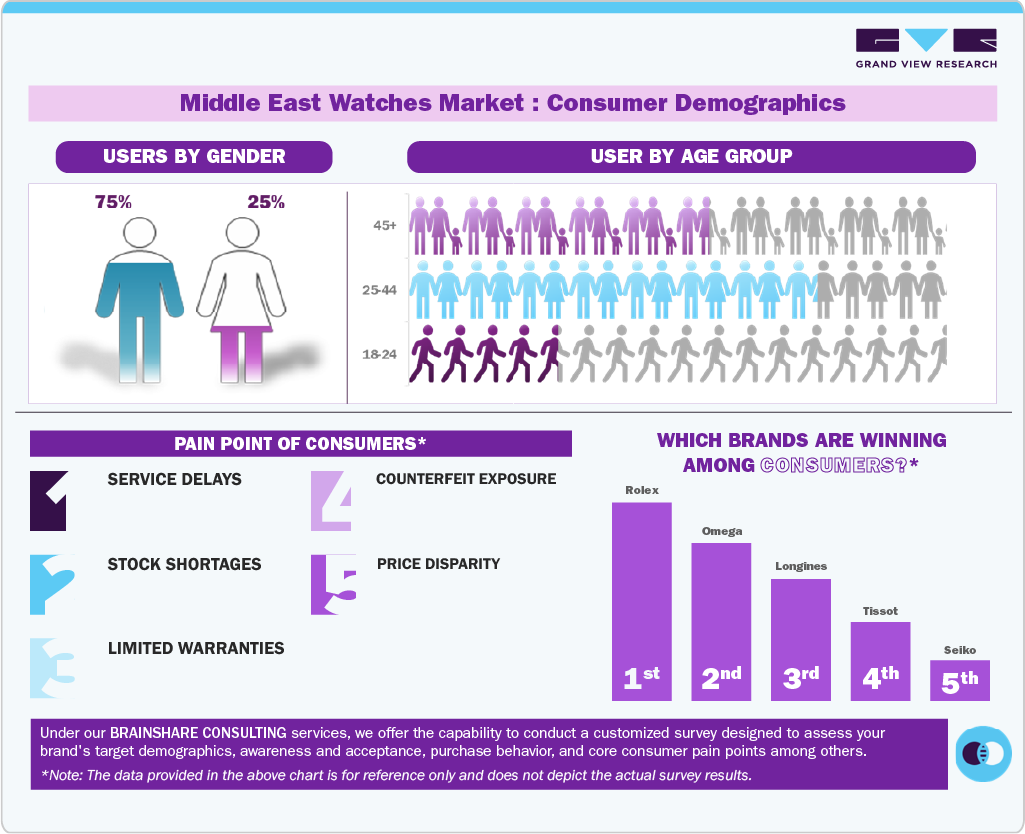
Age groups continue to play a decisive role in purchasing patterns across the traditional watch spectrum.
-
The 25-44 age group remains the largest buyer base, combining strong spending power with high brand awareness and lifestyle-driven shopping habits. They purchase across categories from entry-level fashion brands to mid-range Swiss quartz and mechanical models.
-
The 45+ segment ranks second, representing mature buyers who favor well-known Swiss heritage brands and often purchase for gifting within families and social circles.
-
The 18-24 cohort sits third, but is influential in creating early demand for affordable quartz and fashion watches, driven by social media trends, mall culture, and strong exposure to global brands.
Consumers in the Middle East watches market encounter specific, recurring pain points across price categories.
-
Service delays and stock shortages continue to frustrate buyers, especially for popular mid-range and premium models.
-
Limited warranties on fashion and mid-tier watches, along with price disparities compared to Europe or online channels, reduce purchase confidence.
-
In addition, counterfeit exposure particularly for affordable and mid-range watches pushes consumers toward trusted retailers and mall-based stores, which dominate the region’s buying behavior.
Across the Middle East, top-performing traditional watch brands include Rolex, Omega, Longines, Tissot, and Seiko, each catering to distinct income bands and buyer profiles.
Insight: Consumers in the Middle East are brand-conscious, gifting-driven, and highly trust-oriented, valuing authenticity, style relevance, and reliable retail experiences-making traditional watches a blend of personal identity, social signaling, and cultural gifting tradition across all price ranges.
Type Insights
Analog watches held a market share of 92.69% in 2024, as consumers in the Middle East prefer classic dial designs and traditional styling, particularly for gift-giving occasions such as Eid, weddings, and corporate events. These watches dominate both mall showrooms and airport duty-free outlets, where shoppers can physically inspect designs and movements, creating trust and reinforcing the appeal of analog craftsmanship.
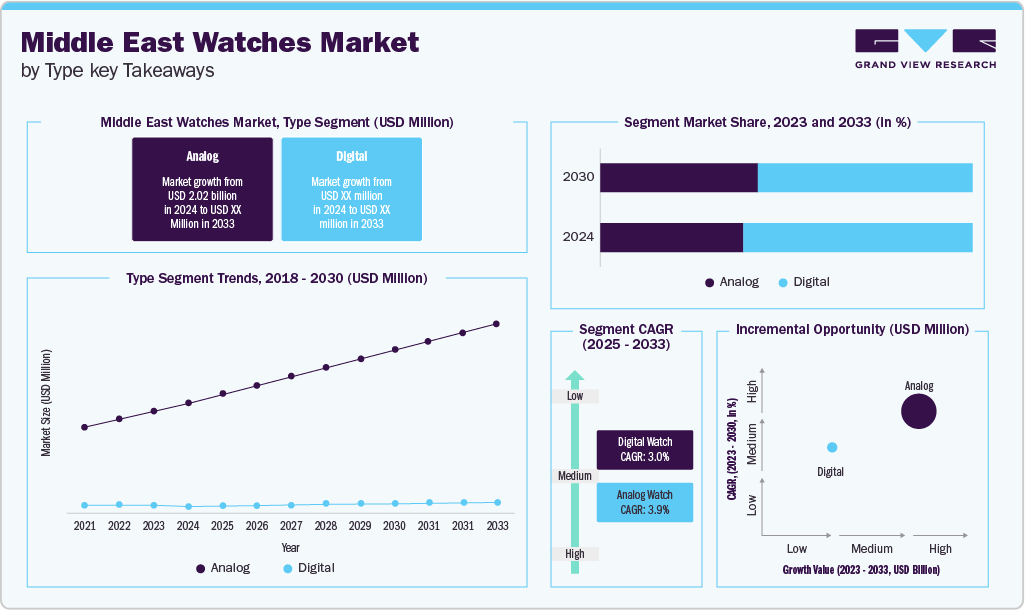
The digital watch segment is anticipated to witness a CAGR of 3.0% from 2025 to 2033, as younger buyers and expatriate workers increasingly seek practical, everyday timepieces for sports, fitness, and casual wear. Growth is evident through online platforms, pop-up tech stores, and lifestyle sections in malls, where customers can easily compare features such as timers, alarms, and hybrid connectivity, catering to both convenience and affordability.
Price Range Insights
Premium watches accounted for 35.80% of the Middle East market revenue share in 2024, supported by mid-to-upper mid-priced Swiss and Japanese models such as Rado, Frederique Constant, Citizen, Seiko Presage, and Casio Edifice, which resonate with the UAE and Saudi Arabia’s middle-income and expatriate populations. Retailers such as Bateel, Level Shoes concept stores, and Ahmed Seddiqi & Sons stock these brands in malls and duty-free outlets, making them popular for gifting and everyday wear, without entering the ultra-luxury segment.
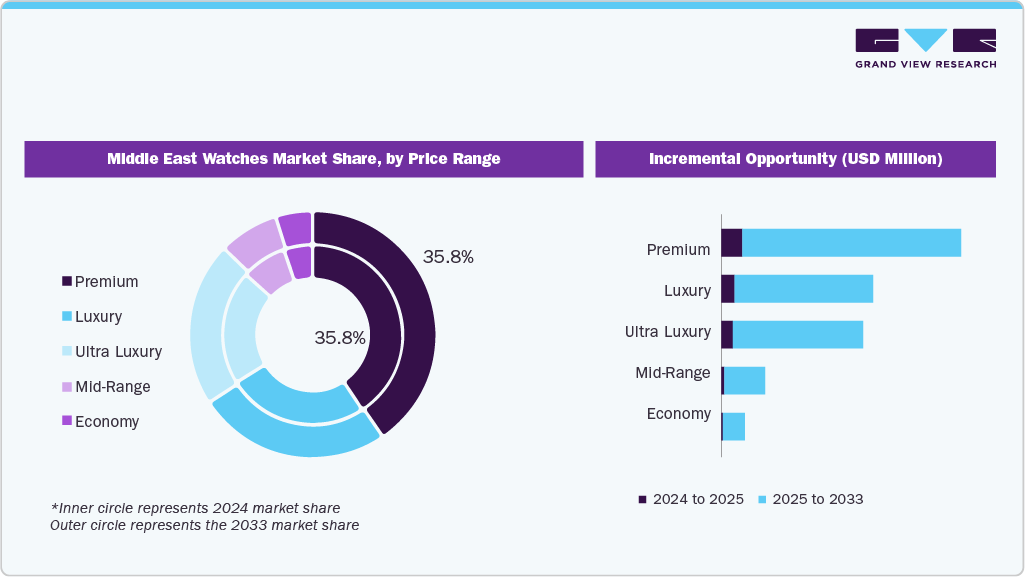
Luxury watches are anticipated to grow at a CAGR of 4.3% from 2025 to 2033, fueled by high-net-worth buyers investing in brands like Hublot, Panerai, Vacheron Constantin, IWC, and Jaeger-LeCoultre. Growth is supported by luxury destinations such as The Galleria in Abu Dhabi, Riyadh Park Mall, and The Pearl in Doha, as well as region-exclusive limited editions and bespoke pieces that appeal to collectors and affluent consumers in the Middle East.
End Use Insights
Watches for men accounted for 76.80% share in 2024, due to cultural norms that position watches as a key male accessory, higher male participation in gifting cycles, and the strong appeal of mechanical craftsmanship, engineering aesthetics, and status-driven ownership among men in the region.
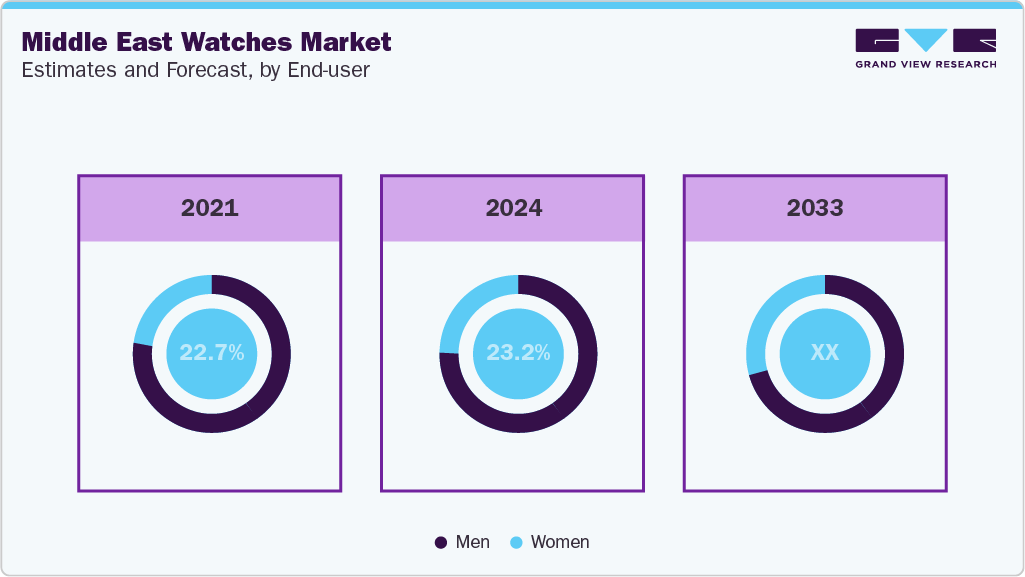
Watches for women are anticipated to witness a CAGR of 4.5% from 2025 to 2033, driven by brands expanding their female-focused lines, such as Michael Kors, Fossil, Longines, Casio Sheen, and Tissot Lady, which offer stylish, every day, and premium options. Rising female workforce participation in the UAE and Saudi Arabia, along with a mall-based gifting culture, drives the adoption of these watches as both fashion accessories and status symbols.
Distribution Channel Insights
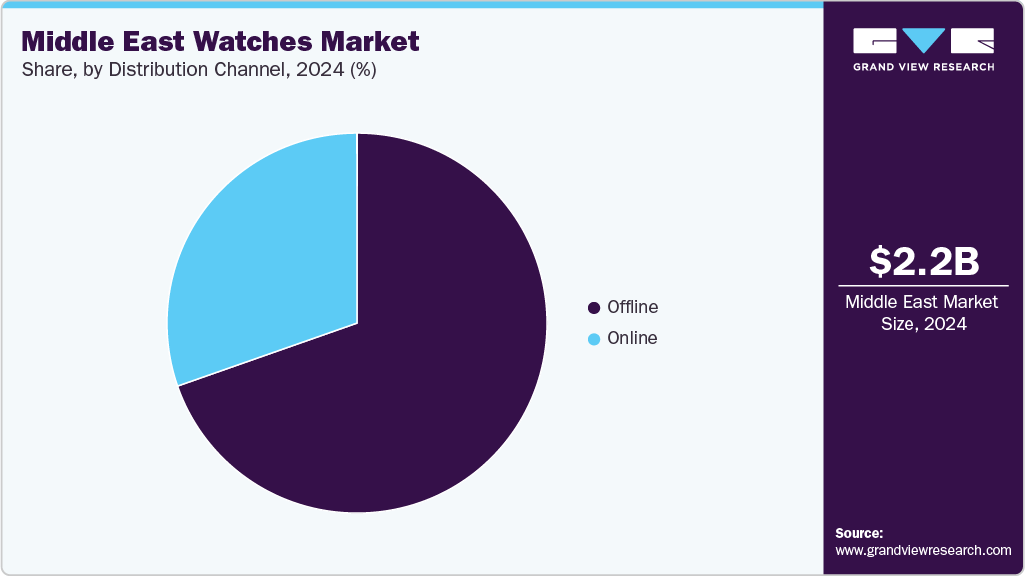
The sale of watches through offline channels accounted for 72.44% of the market share in 2024. This can be attributed to Middle Eastern consumers heavily relying on mall-based retail, multi-brand boutiques, and authorised dealers for authenticity assurance, gifting purchases, and hands-on evaluation making physical retail the dominant format across segments.
For instance, in February 2025, Nomadic Watches partnered with Perpétuel Gallery in Dubai a major move, as it marks the brand’s first retail presence in the UAE leveraging Perpétuel’s reputation as a curated, collector-focused space to showcase Nomadic’s industrial-heritage designs in the Middle East.
The sale of watches through the online channel is expected to grow at a CAGR of 5.2% from 2025 to 2033, as trust in e-commerce improves, brands expand direct-to-consumer stores, and younger buyers shift to online research and purchasing, especially for mid-range and fashion watches, where price comparison and convenience matter.
For instance, brands like Seddiqi & Sons, Damas, Casio, Fossil, and Tissot offer verified online stores, while younger buyers use Namshi, Ounass, and Amazon.ae for research, price comparison, and convenient mid-range watch purchases.
Country Insights
The UAE watches industry accounted for a share of 36.02% of the Middle East market in 2024. The large share stems from its role as the Middle East’s retail capital, boosted by tourism, luxury mall density, duty-free dominance, expatriate-driven mid-range demand, and strong presence of top Swiss and Japanese watch brands.
The Dubai Mall, Mall of the Emirates, and Dubai Duty Free attract tourists and locals alike, offering high footfall for luxury brands. The large expatriate population also drives mid-range watch sales, while luxury boutiques and multi-brand retailers, such as Ahmed Seddiqi & Sons and Damas, strengthen the UAE’s dominance in the regional market.
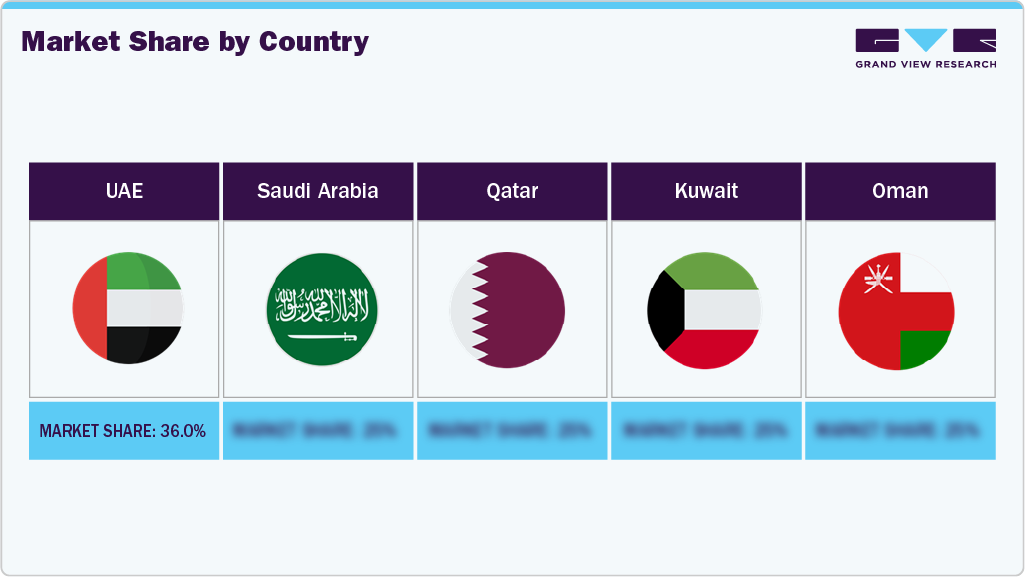
The Saudi Arabia watches industry is expected to observe a CAGR of 4.2% from 2025 to 2033, supported by factors such as rising incomes and Vision 2030-led retail growth, exemplified by expansions in Riyadh Park Mall and Red Sea Mall. Increasing female workforce participation drives demand for women’s watches, while luxury brands are expanding into Tier-2 cities, such as Dammam and Khobar. The young population is also embracing mid-range and premium watches through retailers such as Damas and Ahmed Seddiqi & Sons, thereby boosting overall sales.
Key Middle East Watches Company Insights
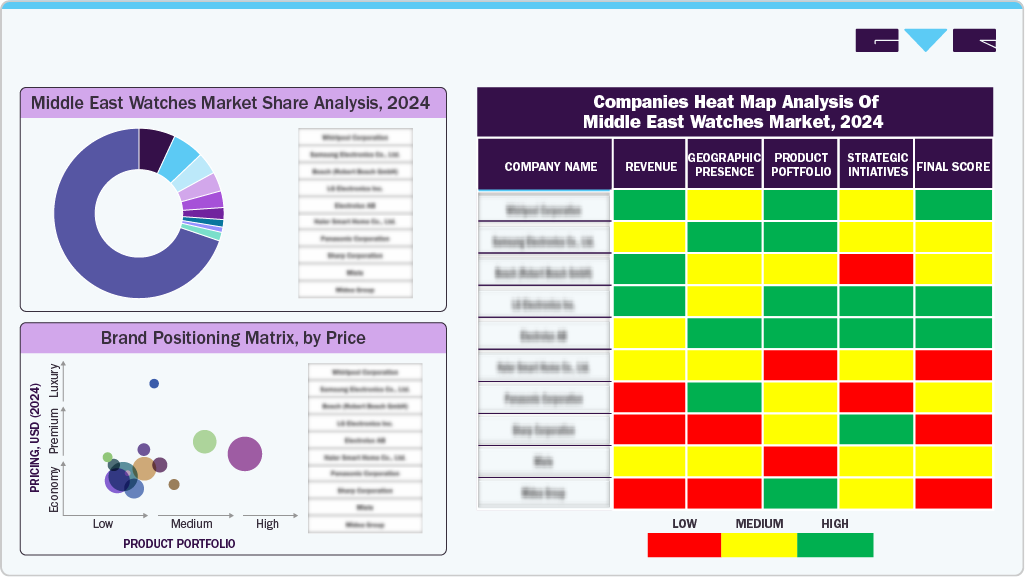
The Middle East market comprises global heritage brands, luxury houses, and regional players serving distinct segments. Swiss and Japanese brands dominate the premium and mid-range tiers, leveraging craftsmanship, design, and brand prestige to attract collectors, gifting buyers, and style-conscious consumers.
Luxury-focused labels target affluent buyers in the UAE, Saudi Arabia, and Qatar, with growth supported by tourism, the expansion of luxury malls, and exclusive regional editions.
Regional and local players cater to value-conscious consumers, offering affordable mechanical and quartz models to expatriate populations and emerging urban markets, thereby collectively sustaining a balanced and diversified market ecosystem.
Key Middle East Watches Companies:
- Rolex
- Omega
- Patek Philippe
- Audemars Piguet
- Longines
- Tissot
- Seiko
- Casio
- Citizen
- Tag Heuer
Recent Developments
-
In November 2025, Zenith unveiled two new models at Dubai Watch Week: the Chronomaster Revival Daisuke Jigen Edition, a 37 mm titanium watch inspired by the El Primero A384 from Lupin III and powered by the El Primero 400 calibre, and the Defy Extreme Lapis Lazuli, a limited-edition chronograph of just 50 pieces featuring a lapis lazuli dial and the advanced El Primero 9004 twin-escapement movement.
-
In November 2025, Dubai Watch Week held its seventh edition at Burj Park, Dubai Mall, bringing together over 90 watch brands to showcase their latest creations. Highlights included TAG Heuer’s laser-welded Monaco chronograph, Armin Strom’s skeletonised rose-gold One Week, Gerald Charles’ tiger-eye dial Maestro, Daniel Roth’s platinum tourbillon, and the collaborative “Freak” model by Ulysse Nardin and Urwerk.
-
In November 2024, Tissot added a new 25 mm quartz model to its PRX collection. This watch combines the brand’s 1970s integrated-bracelet design with a modern touch. The watch features a Swiss quartz movement with an End-of-Life indicator and is water-resistant to 100 meters. Available in several finishes, including carnation-gold PVD, this timepiece appeals to those seeking an elegant, vintage-inspired piece that is also compact and durable.
-
In May 2024, Audemars Piguet introduced a set of three compact Royal Oak models powered by quartz, each featuring a petite 23mm diameter.
Middle East Watches Market Report Scope
Report Attribute
Details
Market size value in 2025
USD 2.26 billion
Revenue forecast in 2033
USD 3.06 billion
Growth rate (revenue)
CAGR of 3.9 % from 2025 to 2033
Actuals
2021 - 2024
Forecast period
2025 - 2033
Quantitative units
Revenue in USD million/ billion and CAGR from 2025 to 2033
Report coverage
Revenue forecast, company ranking, competitive landscape, growth factors, and trends
Segments covered
Type, price range, end use, distribution channel, country
Country scope
Saudi Arabia; Oman; UAE; Qatar; Kuwait
Key companies profiled
Rolex; Omega; Patek Philippe; Audemars Piguet; Longines; Tissot; Seiko; Casio; Citizen; Tag Heuer
Customization scope
Free report customization (equivalent up to 8 analysts working days) with purchase. Addition or alteration to country, regional & segment scope.
Pricing and purchase options
Avail customized purchase options to meet your exact research needs. Explore purchase options
Middle East Watches Market Report Segmentation
This report forecasts revenue growth at the country levels and provides an analysis of the latest industry trends and opportunities in each of the sub-segments from 2021 to 2033. For the purpose of this study, Grand View Research has segmented the Middle East watches market report on the basis of type, price range, end use, distribution channel, and country.
-
Type Outlook (Revenue, USD Million, 2021 - 2033)
-
Analog
-
Mechanical
-
Quartz
-
-
Digital
-
-
Price Range Outlook (Revenue, USD Million, 2021 - 2033)
-
Economy
-
Mid-range
-
Premium
-
Luxury
-
Ultra Luxury
-
-
End Use Outlook (Revenue, USD Million, 2021 - 2033)
-
Men
-
Women
-
-
Distribution Channel (Revenue, USD Million, 2021 - 2033)
-
Online
-
Offline
-
-
Country Outlook (Revenue, USD Million, 2021 - 2033)
-
Saudi Arabia
-
Oman
-
UAE
-
Qatar
-
Kuwait
-
Frequently Asked Questions About This Report
b. The Middle East watches market size was estimated at USD 2.18 billion in 2024 and is expected to reach USD 2.26 billion in 2025.
b. The Middle East watches market is expected to grow at a compound annual growth rate (CAGR) of 3.9 % from 2025 to 2033 to reach USD 3.06 billion by 2033.
b. Analog watches held a market share of 92.69% in 2024, as consumers in the Middle East prefer classic dial designs and traditional styling, especially for gifting during occasions like Eid, weddings, and corporate events.
b. Some key players in the Middle East watches market include Rolex, Omega, Patek Philippe, Audemars Piguet, Longines, Tissot, Seiko, Casio, Citizen, Tag Heuer
b. Growth in traditional watches in the Middle East is supported by a stable base of fashion-watch buyers, a cultural affinity for gifting, and consistent demand for mechanical and quartz models across both mid-range and premium segments.


Share this report with your colleague or friend.
Need a Tailored Report?
Customize this report to your needs — add regions, segments, or data points, with 20% free customization.


ISO 9001:2015 & 27001:2022 Certified
We are GDPR and CCPA compliant! Your transaction & personal information is safe and secure. For more details, please read our privacy policy.
Trusted market insights - try a free sample
See how our reports are structured and why industry leaders rely on Grand View Research. Get a free sample or ask us to tailor this report to your needs.












