Middle East Warehouse Management System Market Summary
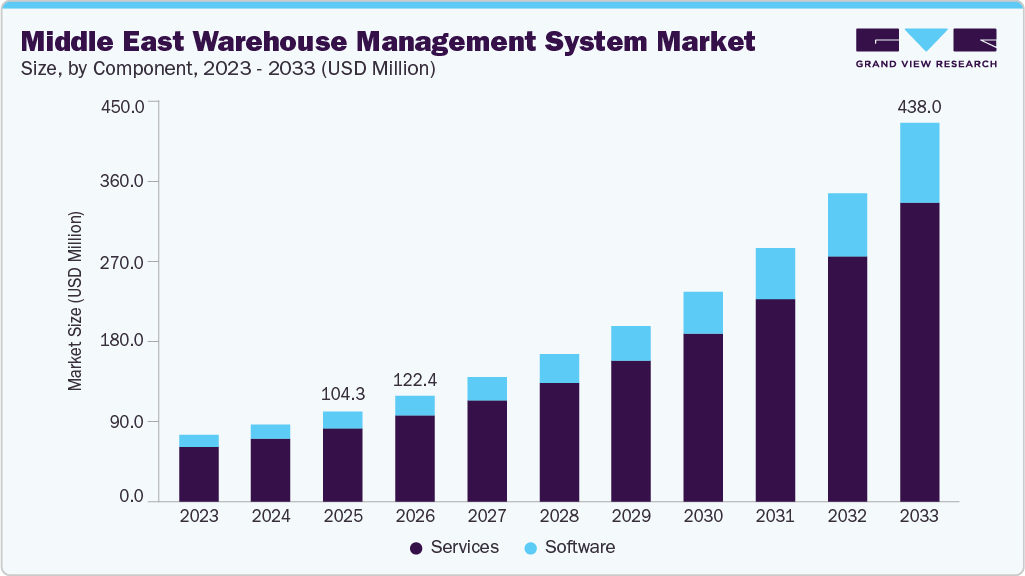
The Middle East warehouse management system market size was estimated at USD 104.3 million in 2025 and is projected to reach USD 438.0 million by 2033, growing at a CAGR of 20.0% from 2026 to 2033. The expansion of e-commerce and omnichannel fulfillment is driving the growth of the Middle East warehouse management system (WMS) market.
Key Market Trends & Insights
- Saudi Arabia dominated the Middle East warehouse management system industry and accounted for a share of 55.0% in 2025.
- By deployment, cloud segment held the largest revenue share in 2025.
- By function, the analytics & optimization segment is expected to emerge as the fastest-growing segment.
- By application, the transportation & logistics segment is expected to emerge as the fastest-growing segment.
Market Size & Forecast
- 2025 Market Size: USD 104.3 Million
- 2033 Projected Market Size: USD 438.0 Million
- CAGR (2026-2033): 20.0%
- Saudi Arabia: Largest market in 2025
Rising online order volumes, increasing SKU proliferation, and heightened expectations for rapid and accurate deliveries have compelled warehouse operators to deploy advanced WMS solutions that enable real-time inventory visibility, efficient picking strategies, and streamlined returns management. The development of logistics hubs and national transformation initiatives has significantly facilitated the adoption of WMS across the region. Governments in key Middle Eastern economies have prioritized logistics and industrial modernization to strengthen their position as global and regional trade gateways. These initiatives have encouraged enterprises, manufacturers, and third-party logistics providers to invest in digital supply chain technologies, thereby expanding demand for warehouse management systems.
Adoption of warehouse automation and smart warehousing technologies has further driven the market. The increased deployment of conveyors, sortation systems, autonomous mobile robots, and automated storage solutions has created a need for centralized software platforms that can orchestrate both manual and automated workflows. Warehouse management systems have been increasingly implemented to improve throughput, optimize labor utilization, and enhance order accuracy.
The growth of third-party logistics providers and free zone warehousing has played an important role in market expansion. The increasing reliance on outsourced logistics, coupled with the development of port-centric and free zone ecosystems, has driven demand for WMS solutions that can efficiently manage multi-client operations, complex billing structures, and cross-border inventory flows.
High upfront investment and total cost of ownership are restraining the growth of the warehouse management system (WMS) market in the Middle East. The deployment of WMS platforms typically requires substantial expenditures on software licensing or subscriptions, customization, system integration, infrastructure modernization, and user training. Additional costs related to ongoing maintenance, upgrades, and technical support further increase the long-term financial burden. These high capital and operational requirements have reduced affordability for small and mid-sized warehouse operators, leading to delayed decision-making and slower adoption rates across cost-sensitive segments of the market.
Component Insights
The services segment dominated the market in 2025 and accounted for the largest share of 81.8%. The increasing need for managed services and post-implementation support is fueling the growth of the segment. Organizations have increasingly outsourced system monitoring, upgrades, performance optimization, and troubleshooting to third-party service providers to reduce internal IT workload. This trend has been particularly strong among companies operating multi-site warehouse networks that require consistent system performance and uptime.
The software segment is expected to grow at the fastest CAGR over the forecast period. The rising demand for configurable and scalable WMS software platforms is supporting the growth of the segment in the market. Warehouses across the region have increasingly required flexible solutions that can be customized to support diverse storage types, order profiles, and industry-specific workflows. Modern WMS software has been adopted to enable real-time inventory visibility, advanced picking strategies, and analytics-driven decision-making, thereby improving operational efficiency and accuracy.
Deployment Insights
The cloud segment held the largest market in 2025. The growing preference for rapid deployment and scalability is driving the growth of cloud-based warehouse management systems in the Middle East. Organizations have increasingly selected cloud deployments to support faster go-live timelines, elastic capacity during seasonal demand peaks, and centralized control across multiple warehouse locations. Cloud-based WMS solutions have also enabled easier integration with e-commerce platforms and last-mile partners, strengthening their appeal among retailers and third-party logistics providers.
The on-premise segment is expected to grow at a significant CAGR of 19.1% during the forecast period. Strong demand for data control, security, and regulatory compliance is fueling the growth of the segment. Enterprises handling sensitive inventory, trade documentation, or regulated goods have preferred on-premise systems to maintain full control over data storage and system access. This deployment model has remained relevant for organizations operating under strict internal governance or sector-specific compliance requirements.
Function Insights
The systems integration & maintenance segment dominated the market in 2025. The increasing complexity of warehouse IT ecosystems is driving the growth of systems integration and maintenance services in the Middle East warehouse management system market. Warehouses have increasingly operated with interconnected platforms, including ERP, transportation management systems, order management systems, automation equipment, and e-commerce interfaces. This complexity has elevated demand for specialized integration services to ensure seamless data flow, system reliability, and uninterrupted warehouse operations over the lifecycle of the WMS.
The analytics & optimization segment is expected to grow at the fastest CAGR during the forecast period. Growing emphasis on real-time visibility and performance monitoring is driving the adoption of analytics and optimization functions within WMS deployments. Warehouse operators have increasingly relied on analytics tools to track inventory accuracy, labor productivity, order fulfillment rates, and equipment utilization. These insights have supported data-driven decision-making and continuous improvement initiatives, thereby accelerating demand for advanced analytics capabilities.
Application Insights
The manufacturing segment dominated the market in 2025. The expansion of manufacturing capacity and industrial diversification initiatives is driving the adoption of WMS within the manufacturing segment in the Middle East. Regional efforts to strengthen local production across various sectors, including food processing, chemicals, metals, and industrial goods, have increased the need for structured inventory control and synchronized material flows. Warehouse management systems have been increasingly implemented to support raw material tracking, work-in-progress visibility, and finished goods management, all of which are aligned with production schedules.
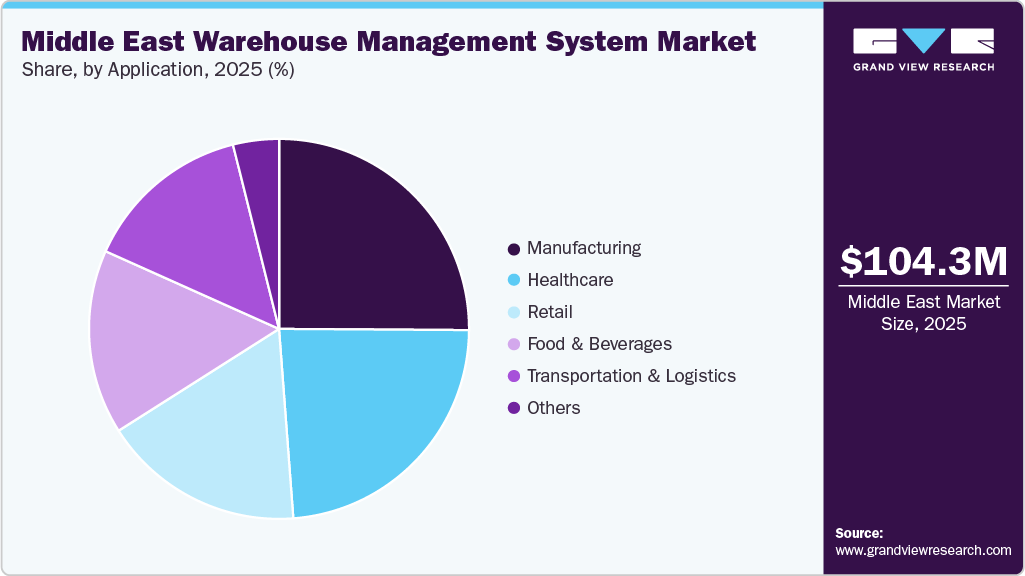
The transportation & logistics segment is expected to witness the fastest CAGR over the forecast period. The rapid expansion of third-party logistics providers and contract logistics services is driving the adoption of WMS within the transportation and logistics sector. The increasing outsourcing of warehousing and distribution activities has necessitated that logistics service providers deploy advanced WMS solutions capable of efficiently managing multi-client operations, service-level agreements, and complex billing structures.
Country Insights
Saudi Arabia Warehouse Management System Market Trends
Saudi Arabia dominated the Middle East warehouse management system industry and accounted for a share of 55.0% in 2025.Large-scale logistics and economic diversification initiatives are driving the growth of the market. National programs aimed at strengthening logistics, manufacturing, and non-oil sectors have accelerated investments in industrial zones, logistics parks, and distribution hubs. These developments have increased demand for advanced WMS platforms to manage higher warehouse throughput, improve inventory accuracy, and support integrated supply chain operations.
UAE Warehouse Management System Market Trends
The UAE warehouse management system market is expected to grow at a significant CAGR of 18.7% during the forecast period. The high penetration of automation and smart warehousing initiatives has significantly contributed to the growth of WMS market in the UAE. Warehouses in the country have increasingly deployed automation technologies, including robotics, sortation systems, and automated storage solutions. These investments have necessitated advanced WMS platforms to orchestrate both automated and manual processes, driving sustained demand for sophisticated warehouse management software.
Key Middle East Warehouse Management System Company Insights
Some of the key companies in the Middle East warehouse management system industry include Oracle, Infor, Mad4net, Epicor Software Corporation, among others. The market participants are focusing on several strategies to gain a higher market share. Mergers, acquisitions, partnerships, and other contractual agreements are being announced by them to emerge as the top warehouse management system company. Moreover, these players are investing in research and development activities to bring new services to the market.
-
Mad4net is a global company formed to support the growing demands of both large and small logistics companies with a cost-efficient suite of products designed to address different parts of the value chain. The company provides a strong all-in-one application suite built on an exclusive platform based on Microsoft technology. The solution is a web-based product that can run on multiple browsers and provide on-premises and cloud deployment options. Beyond the Middle East, the company maintains a global footprint across North America, Europe, and Asia.
-
Epicor Software Corporation develops industry-specific enterprise software solutions for businesses operating in manufacturing, distribution, retail, and services, among other industries and industry verticals. The company's product offerings include Supply Chain Management (SCM) software, Customer Relationship Management (CRM) software, Enterprise Resource Planning (ERP) systems, Human Capital Management (HCM) solutions, and Retail Management System (RMS) solutions.
Key Middle East Warehouse Management System Companies:
- SAP SE
- Oracle
- Blue Yonder Group, Inc.
- Infor
- SSI SCHAEFER Group
- Körber AG
- Dematic
- Epicor Software Corporation
- Made4net
- Softeon
Recent Developments
- In July 2025, Dematic, a provider of automation technology, has opened a new office in Saudi Arabia to strengthen its presence in the Middle East and support growth in the GCC, following successes in its Dubai, UAE hub. The Riyadh facility serves as a hub for operations, sales, customer service, and project management, delivering tailored warehouse automation, AutoStore-powered solutions, and logistics innovations amid Saudi Vision 2030's infrastructure boom under Saudi Vision 2030.
Middle East Warehouse Management System Market Report Scope
|
Report Attribute
|
Details
|
|
Market size value in 2026
|
USD 122.4 million
|
|
Revenue forecast in 2033
|
USD 438.0 million
|
|
Growth rate
|
CAGR of 20.0% from 2026 to 2033
|
|
Base year for estimation
|
2025
|
|
Historical data
|
2021 - 2024
|
|
Forecast period
|
2026 - 2033
|
|
Quantitative units
|
Revenue in USD million and CAGR from 2026 to 2033
|
|
Report coverage
|
Revenue forecast, company ranking, competitive landscape, growth factors, and trends
|
|
Segments covered
|
Component, deployment, function, application, region
|
|
Regional scope
|
Middle East
|
|
Country scope
|
KSA; UAE; Qatar; Kuwait; Oman
|
|
Key companies profiled
|
SAP SE; Oracle; Blue Yonder Group, Inc.; Infor; SSI SCHAEFER Group; Körber AG; Dematic; Epicor Software Corporation; Made4net; Softeon
|
|
Customization scope
|
Free report customization (equivalent up to 8 analysts working days) with purchase. Addition or alteration to country, regional & segment scope.
|
|
Pricing and purchase options
|
Avail customized purchase options to meet your exact research needs. Explore purchase options
|
Middle East Warehouse Management System Market Report Segmentation
This report forecasts revenue growth at regional and country levels and provides an analysis of the latest industry trends in each of the sub-segments from 2021 to 2033. For this study, Grand View Research has segmented the Middle East warehouse management system market report based on component, deployment, function, application, and country.
-
Component Outlook (Revenue, USD Million, 2021 - 2033)
-
Deployment Outlook (Revenue, USD Million, 2021 - 2033)
-
Function Outlook (Revenue, USD Million, 2021 - 2033)
-
Application Outlook (Revenue, USD Million, 2021 - 2033)
-
Country Outlook (Revenue, USD Million, 2021 - 2033)
-
Middle East (ME)
-
KSA
-
UAE
-
Qatar
-
Kuwait
-
Oman
Frequently Asked Questions About This Report
b. The Middle East warehouse management system market size was estimated at USD 104.3 million in 2025 and is expected to reach USD 122.4 million in 2026.
b. The Middle East warehouse management system market is expected to grow at a compound annual growth rate of 20.0% from 2026 to 2033 to reach USD 438.0 million by 2033.
b. Saudi Arabia dominated the Middle East logistics automation industry, accounting for a 55.0% share in 2025. Large-scale logistics and economic diversification initiatives are driving the growth of the warehouse management system (WMS) market in Saudi Arabia.
b. Some key players operating in the Middle East warehouse management system market include SAP SE; Oracle; Blue Yonder Group, Inc.; Infor; SSI SCHAEFER Group; Körber AG; Dematic; Epicor Software Corporation; Made4net; Softeon.
b. The expansion of e-commerce and omnichannel fulfillment is driving the growth of the Middle East warehouse management system (WMS) market.

 Download Sample Report














