
- Home
- »
- Plastics, Polymers & Resins
- »
-
Middle East Recycled Plastics Market Size Report, 2033GVR Report cover
![Middle East Recycled Plastics Market Size, Share & Trends Report]()
Middle East Recycled Plastics Market (2025 - 2033) Size, Share & Trends Analysis Report By Product (PE, PET, PP, PVC, PS), By Source (Plastic Bottles, Plastic Films), By Application (Building & Construction, Packaging), By Country, And Segment Forecasts
- Report ID: GVR-4-68040-711-8
- Number of Report Pages: 120
- Format: PDF
- Historical Range: 2021 - 2024
- Forecast Period: 2025 - 2033
- Industry: Bulk Chemicals
- Report Summary
- Table of Contents
- Segmentation
- Methodology
- Download FREE Sample
-
 Download Sample Report
Middle East Recycled Plastics Market Summary
The Middle East recycled plastics market size was estimated at USD 1.02 billion in 2024 and is projected to reach USD 2.02 billion by 2033, growing at a CAGR of 8.0% from 2025 to 2033. Growing demand from packaging and construction industries is driving the market growth, as companies increasingly choose recycled plastics to meet sustainability targets.
Key Market Trends & Insights
- Saudi Arabia dominated the Middle East recycled plastics industry with the largest revenue share of 65.37% in 2024.
- The Middle East recycled plastics industry in Saudi Arabia is expected to grow at a substantial CAGR of 8.3% from 2025 to 2033.
- By product, the polypropylene segment is expected to grow at a considerable CAGR of 8.8% from 2025 to 2033 in terms of revenue.
- By source, the plastic bottles segment is expected to grow at a considerable CAGR of 8.1% from 2025 to 2033 in terms of revenue.
- By application, the electrical & electronics segment is expected to grow at a considerable CAGR of 8.4% from 2025 to 2033 in terms of revenue.
Market Size & Forecast
- 2024 Market Size: USD 1.02 billion
- 2033 Projected Market Size: USD 2.02 billion
- CAGR (2025-2033): 8.0%
- Saudi Arabia: Largest market in 2024
This shift is also supported by consumer preference for eco-friendly products in the region. The Middle East recycled plastics industry is witnessing a shift toward advanced mechanical and chemical recycling methods, enabling higher-quality outputs suitable for packaging, construction, and automotive applications. Governments and large manufacturers are increasingly integrating circular economy frameworks into corporate strategies, which is driving demand for post-consumer and post-industrial plastic recovery.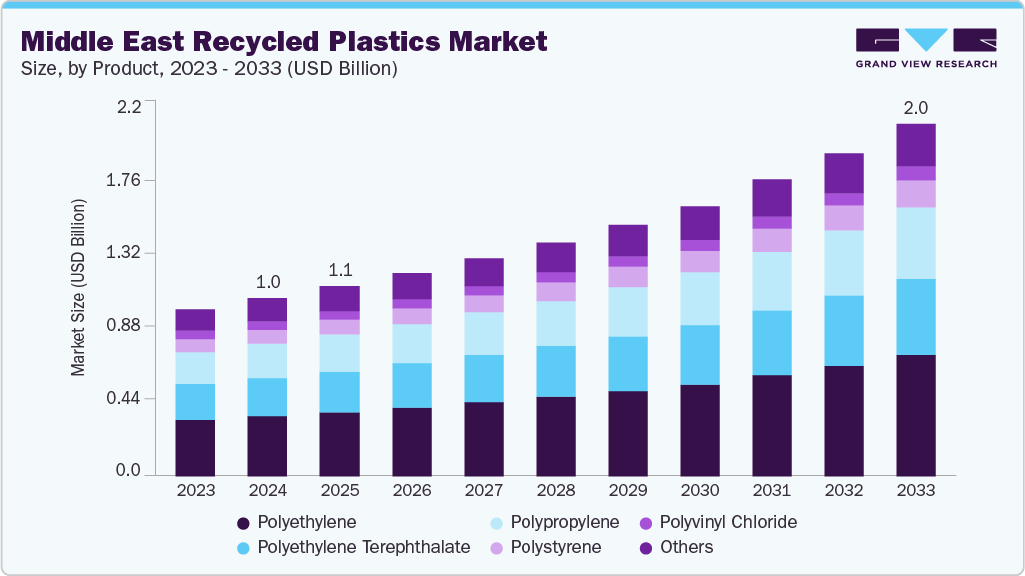
In addition, rising collaboration between petrochemical companies and recycling technology providers is improving scalability and product consistency, fostering greater trust in recycled materials among end users.
Drivers, Opportunities & Restraints
A key driver for the market growth is the increasing regulatory emphasis on sustainable waste management and reduced landfill dependency. Countries in the Gulf Cooperation Council are implementing stricter plastic disposal guidelines and incentivizing private sector participation in waste segregation and recycling initiatives. These policies, combined with infrastructure investments in material recovery facilities, are enabling a reliable supply chain for recycled plastic feedstock, supporting industrial adoption across packaging, textiles, and construction sectors.
There is a significant opportunity in developing high-value recycled plastic products for premium applications, such as food-grade packaging, specialty films, and automotive interior components. Advancements in sorting and decontamination technologies allow for the production of recycled resins that meet stringent quality standards, creating new revenue streams for recyclers. As regional consumer brands align with global sustainability commitments, suppliers capable of delivering consistent, high-performance recycled materials will be positioned to capture long-term supply agreements.
One of the primary restraints is the fragmented collection and processing network, which results in inconsistent feedstock quality and supply reliability. Informal waste collection practices in some regions, combined with limited consumer participation in recycling programs, create challenges for achieving uniform product standards.
Market Concentration & Characteristics
The market growth stage of the recycled plastics market in the Middle East is medium, at an accelerating pace. The market exhibits consolidation, with key players dominating the industry landscape. Major companies such as SAN Recycling LLC, Napco National, Al Rabee Al Motatawer Plastic Factory Co., Al Ramz Plastic Factory, Alwashim Polymers Industrial Factory, Masab Plastic Factory Co., Middle East Plastic Industries (MEPICO), and others play a significant role in shaping the market dynamics. These leading players often drive innovation within the market, introducing new products, technologies, and applications to meet evolving industry demands.
The threat from product substitutes in the market largely comes from bio-based and biodegradable materials, which are gaining attention as alternatives for packaging and consumer goods. While these materials appeal to sustainability-driven buyers, their higher cost, limited production capacity, and performance constraints in certain applications limit large-scale replacement of recycled plastics. However, as technology advances and production scales up, they could exert greater competitive pressure in niche markets.
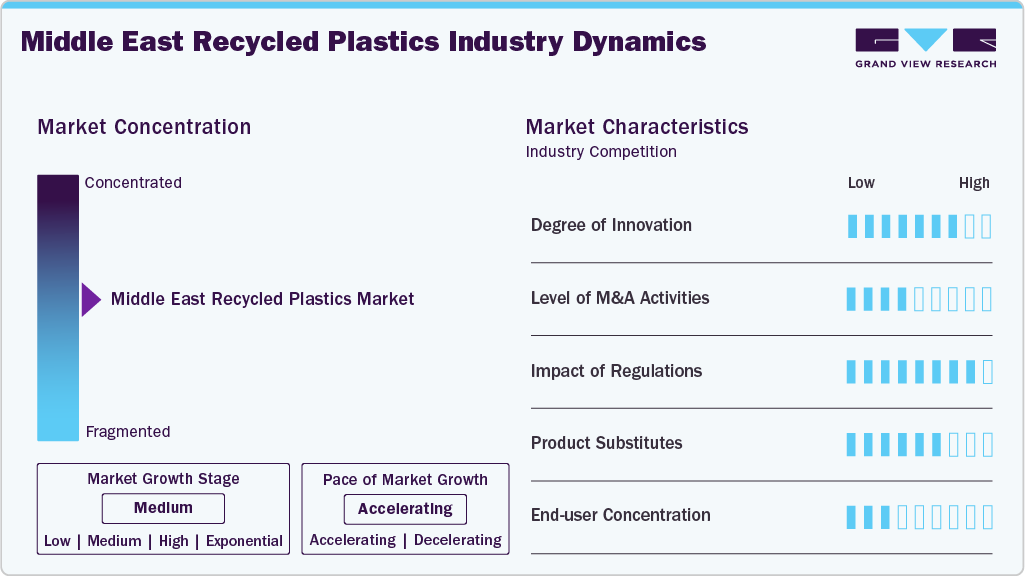
Regulatory frameworks are playing a decisive role in shaping the Middle East recycled plastics industry, with several countries introducing mandatory recycled content requirements and stricter landfill restrictions. Government-led initiatives, such as extended producer responsibility schemes and waste segregation mandates, are accelerating investments in recycling infrastructure. These policies not only expand feedstock availability but also incentivize manufacturers to integrate recycled materials, reinforcing market stability and long-term growth potential.
Product Insights
Polyethylene dominated the market across the product segmentation in terms of revenue, accounting for a market share of 33.75% in 2024 and is forecasted to grow at 8.3% CAGR from 2025 to 2033, owing to its versatility across packaging films, pipes, and geomembranes, making it a preferred choice for both industrial and consumer applications.
Recent investments in advanced film-grade recycling facilities have enhanced resin purity, enabling higher-value end uses. Its strong compatibility with the region’s growing infrastructure and agricultural sectors continues to secure steady demand for recycled polyethylene resins.
The polypropylene segment is anticipated to grow at the fastest CAGR of 8.8% over the forecast period. Recycled polypropylene is experiencing rapid growth due to its rising use in automotive parts, rigid packaging, and consumer goods manufacturing.
Regional automakers and appliance manufacturers are increasingly substituting virgin PP with recycled grades to align with lightweighting and sustainability goals. Improvements in sorting technologies, particularly for post-consumer rigid plastics, are making high-quality recycled PP more commercially viable, accelerating its market penetration.
Source Insights
Plastic bottles dominated the market across the source segmentation in terms of revenue, accounting for a market share of 74.00% in 2024, and is anticipated to grow at 8.1% CAGR over the forecast period. Plastic bottles remain the leading feedstock source for recycled plastics in the Middle East, driven by established PET and HDPE bottle collection networks in urban areas.
Beverage and FMCG companies are expanding bottle-to-bottle recycling initiatives, supported by brand commitments to integrate higher recycled content. The availability of well-sorted, high-volume bottle waste streams ensures a consistent supply for recyclers, making it a reliable segment for scaling production.
The polymer foam, in terms of volume, is anticipated to grow at a significant CAGR of 5.9% through the forecast period. Recycled polymer foam is emerging as a niche but promising source material, particularly in the furniture, insulation, and protective packaging industries.
Specialized processing technologies are enabling the recovery of foams such as expanded polystyrene (EPS) and polyurethane for reuse in construction and cushioning products. The growing demand for thermal insulation in Middle Eastern construction projects is expected to further support recycled foam utilization.
Application Insights
Packaging dominated the market across the application segmentation in terms of revenue, accounting for a market share of 31.40% in 2024, and is anticipated to grow at an 8.4% CAGR over the forecast period. This is fueled by regional shifts toward sustainable supply chains and government-backed recycling targets.
Food, beverage, and personal care companies are prioritizing recycled plastic integration to appeal to eco-conscious consumers and comply with import/export sustainability requirements. This segment benefits from continuous innovation in recycled resins that match the clarity, strength, and performance of virgin materials.
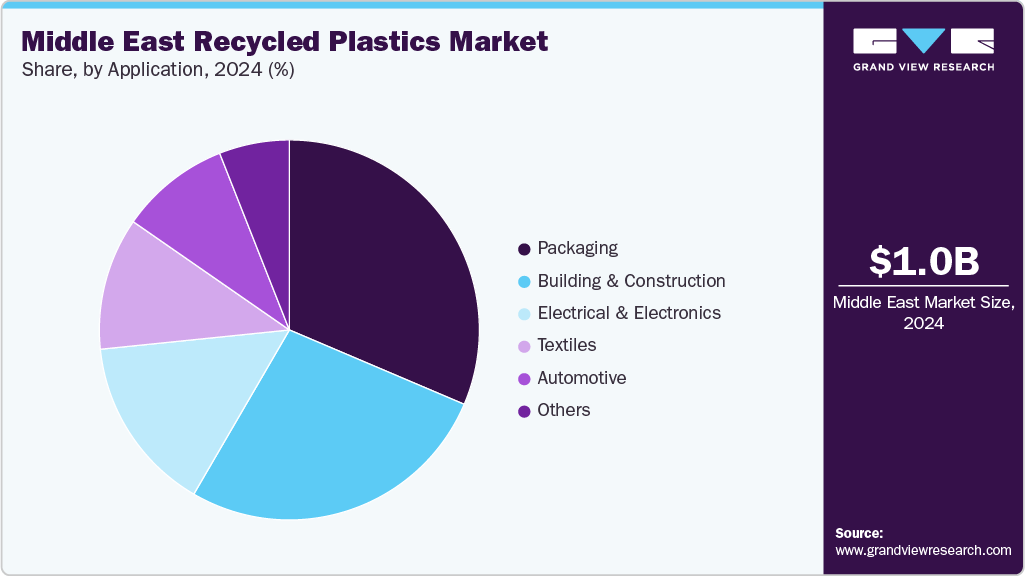
The electrical & electronics segment is expected to grow at a substantial CAGR of 8.4% throughout the forecast period,driven by the region’s expanding manufacturing base for consumer electronics, appliances, and electrical components.
Manufacturers are leveraging recycled engineering plastics to meet both cost efficiency and environmental compliance targets, particularly under extended producer responsibility frameworks. High-performance recycled polymers are increasingly used for housings, casings, and connectors without compromising durability or safety standards.
Country Insights
Saudi Arabia recycled plastics industry held the largest share of 65.37% in terms of revenue in the Middle East region in 2024 and is expected to grow at the fastest CAGR over the forecast period. The Saudi Arabian market is driven by the government’s Vision 2030 sustainability objectives, which prioritize circular economy adoption and waste reduction across industrial sectors. The country is investing heavily in large-scale material recovery facilities and advanced recycling technologies, supported by collaborations between petrochemical giants and waste management firms. Demand is further boosted by major packaging and construction players integrating recycled resins into product lines to meet both domestic regulatory expectations and international trade requirements.
Turkey’s recycled plastic market growth is propelled by its strong export-oriented manufacturing sector, which faces increasing pressure from European buyers to comply with stringent recycled content standards. The country’s well-established plastics processing industry is expanding capacity for high-grade recycled resins, especially for packaging and textiles, to maintain global competitiveness. In addition, government-backed initiatives to formalize waste collection systems are improving feedstock quality, enabling local producers to meet both domestic and export market specifications.
Key Middle East Recycled Plastics Company Insights
The recycled plastics market in the Middle East is highly competitive, with several key players dominating the landscape. Major companies include SAN Recycling LLC, Napco National, Al Rabee Al Motatawer Plastic Factory Co., and others. The market is characterized by a competitive landscape with several key players driving innovation and market growth. Major companies in this sector are investing heavily in research and development to enhance the performance, cost-effectiveness, and sustainability of their types.
Key Middle East Recycled Plastics Companies:
- SAN Recycling LLC
- Napco National
- Al Rabee Al Motatawer Plastic Factory Co.
- Al Ramz Plastic Factory
- Alwashim Polymers Industrial Factory
- Masab Plastic Factory Co.
- Middle East Plastic Industries (MEPICO)
Recent Developments
-
In August 2025, Majid Al Futtaim, Coca-Cola Middle East, and UAE-based cleantech company Sparklo partnered to enhance recycling efforts at Carrefour stores in the UAE through Reverse Vending Machines (RVMs).
-
In August 2025, Napco National, through its Dubai-based subsidiary Napco Investment LLC, acquired Arabian Flexible Packaging. The acquisition aimed to strengthen Napco National’s manufacturing footprint, expand its packaging portfolio, and support its regional growth aligned with the UAE’s In-Country Value localization framework.
-
In December 2023, the Alliance to End Plastic Waste signed a Memorandum of Understanding with the Saudi Investment Recycling Company (SIRC) at COP28 in Dubai to support Saudi Arabia's goal of diverting 94% of landfill waste by 2035 and building a circular economy. The partnership focused on improving the collection, sorting, and recycling of plastic waste in the Kingdom.
Middle East Recycled Plastics Market Report Scope
Report Attribute
Details
Market size value in 2025
USD 1.09 billion
Revenue forecast in 2033
USD 2.02 billion
Growth rate
CAGR of 8.0% from 2025 to 2033
Actual data
2021 - 2024
Forecast period
2025 - 2033
Quantitative units
Revenue in USD million/billion, Volume in Kilotons, and CAGR from 2025 to 2033
Report coverage
Revenue forecast, competitive landscape, growth factors, and trends
Global Transparent Plastic Market Report Segmentation
Product, source, application, region
Regional scope
Middle East
Country Scope
Saudi Arabia; UAE; Oman; Kuwait; Qatar; Bahrain; Israel; Turkey
Key companies profiled
SAN Recycling LLC; Napco National; Al Rabee Al Motatawer Plastic Factory Co.; Al Ramz Plastic Factory; Alwashim Polymers Industrial Factory; Masab Plastic Factory Co.; Middle East Plastic Industries (MEPICO)
Customization scope
Free report customization (equivalent up to 8 analyst’s working days) with purchase. Addition or alteration to country, regional & segment scope
Pricing and purchase options
Avail customized purchase options to meet your exact research needs. Explore purchase options
Middle East Recycled Plastics Market Report Segmentation
This report forecasts revenue growth at the regional and country levels and provides an analysis of the latest industry trends in each of the sub-segments from 2021 to 2033. For this study, Grand View Research has segmented the Middle East recycled plastics market report based on product, source, application, and region:
-
Product Outlook (Volume, Kilotons; Revenue, USD Million, 2021 - 2033)
-
Polyethylene
-
Polyethylene Terephthalate
-
Polypropylene
-
Polyvinyl Chloride
-
Polystyrene
-
Others
-
-
Source Outlook (Volume, Kilotons; Revenue, USD Million, 2021 - 2033)
-
Plastic Bottles
-
Plastic Films
-
Polymer Foam
-
Other Sources
-
-
Application Outlook (Volume, Kilotons; Revenue, USD Million, 2021 - 2033)
-
Building & Construction
-
Packaging
-
Electrical & Electronics
-
Textiles
-
Automotive
-
Others
-
-
Country Outlook (Volume, Kilotons; Revenue, USD Million, 2021 - 2033)
-
Middle East
-
Saudi Arabia
-
UAE
-
Oman
-
Kuwait
-
Qatar
-
Bahrain
-
Israel
-
Turkey
-
-
Frequently Asked Questions About This Report
b. The Middle East recycled plastics market size was estimated at USD 1.02 billion in 2024 and is expected to reach USD 1.09 billion in 2025.
b. The Middle East recycled plastics market is expected to grow at a compound annual growth rate of 8.0% from 2025 to 2033 to reach USD 2.02 billion by 2033.
b. Polyethylene dominated the Middle East recycled plastics market across the product segmentation in terms of revenue, accounting for a market share of 33.75% in 2024 and is forecasted to grow at 8.3% CAGR from 2025 to 2033, owing to its versatility across packaging films, pipes, and geomembranes, making it a preferred choice for both industrial and consumer applications.
b. Some key players operating in the transparent plastics market include SAN Recycling LLC, Napco National, Al Rabee Al Motatawer Plastic Factory Co., Al Ramz Plastic Factory, Alwashim Polymers Industrial Factory, Masab Plastic Factory Co., and Middle East Plastic Industries (MEPICO).
b. Growing demand from packaging and construction industries is driving the market, as companies increasingly choose recycled plastics to meet sustainability targets. This shift is also supported by consumer preference for eco-friendly products in the region.


Share this report with your colleague or friend.
Need a Tailored Report?
Customize this report to your needs — add regions, segments, or data points, with 20% free customization.


ISO 9001:2015 & 27001:2022 Certified
We are GDPR and CCPA compliant! Your transaction & personal information is safe and secure. For more details, please read our privacy policy.
Trusted market insights - try a free sample
See how our reports are structured and why industry leaders rely on Grand View Research. Get a free sample or ask us to tailor this report to your needs.












