
- Home
- »
- Plastics, Polymers & Resins
- »
-
Middle East Plastic Waste Management Market Report, 2033GVR Report cover
![Middle East Plastic Waste Management Market Size, Share & Trends Report]()
Middle East Plastic Waste Management Market (2025 - 2033) Size, Share & Trends Analysis Report By Service (Collection, Recycling, Incineration), By Polymer Type (Polypropylene (PP), Low-density polyethylene (LDPE)), By Source, By Country, And Segment Forecasts
- Report ID: GVR-4-68040-727-7
- Number of Report Pages: 100
- Format: PDF
- Historical Range: 2021 - 2023
- Forecast Period: 2025 - 2033
- Industry: Bulk Chemicals
- Report Summary
- Table of Contents
- Segmentation
- Methodology
- Download FREE Sample
-
 Download Sample Report
Middle East Plastic Waste Management Market Summary
The Middle East plastic waste management market size was estimated at USD 1,933.6 million in 2024 and is projected to reach USD 2,676.4 million by 2033, growing at a CAGR of 3.8% from 2025 to 2033. The Middle East plastic waste management market is being driven by rising environmental awareness and stricter government regulations aimed at reducing plastic pollution.
Key Market Trends & Insights
- The plastic waste management market in Israel is expected to grow at a substantial CAGR of 6.3% from 2025 to 2033.
- By service, recycling segment is expected to grow at a considerable CAGR of 6.0% from 2025 to 2033 in terms of revenue.
- By polymer type, polystyrene segment is expected to grow at a considerable CAGR of 5.0% from 2025 to 2033 in terms of revenue.
- By source, plastic bags segment is expected to grow at a considerable CAGR of 4.5% from 2025 to 2033 in terms of revenue.
Market Size & Forecast
- 2024 Market Size: USD 1,933.6 Million
- 2033 Projected Market Size: USD 2,676.4 Million
- CAGR (2025-2033): 3.8%
Countries in the region are increasingly implementing waste segregation, recycling mandates, and bans on single-use plastics, pushing industries toward sustainable practices. Growing public campaigns and educational initiatives are also encouraging proper waste disposal.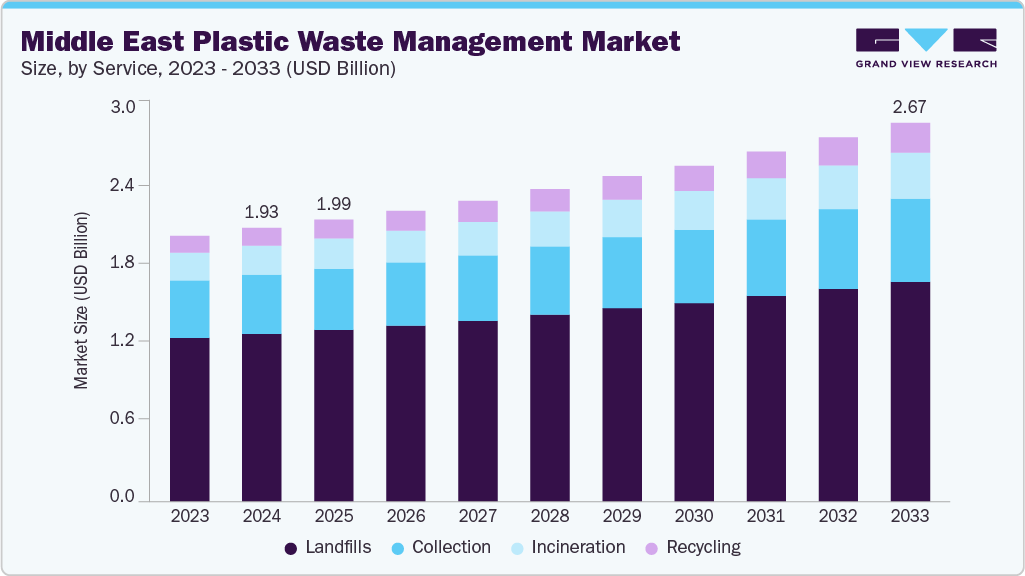
Rapid urbanization and industrial growth are further boosting plastic waste generation, creating demand for efficient waste management solutions. Investments in waste-to-energy projects and modern recycling infrastructure are increasing across Gulf countries. In addition, partnerships between public and private sectors are enhancing collection, sorting, and recycling capabilities. The rising focus on circular economy models is positioning the market for long-term growth.
Market Concentration & Characteristics
The Middle East plastic waste management market is fragmented, with a few major players and large small and medium players operating in the industry with key operations such as collection, recycling, and waste-to-energy conversion. Large companies benefit from strong government ties, advanced infrastructure, and long-term contracts, giving them a competitive edge. However, smaller local firms are active in niche services such as plastic sorting and community-level recycling.
The Middle East waste management market is witnessing steady innovation, particularly in recycling technologies, waste-to-energy solutions, and smart waste collection systems. The UAE and Saudi Arabia governments are investing in AI-based sorting facilities and digital tracking platforms to improve efficiency. Startups and technology providers are introducing solutions tailored to desert climates and high-density urban areas. These innovations aim to reduce landfill use and meet ambitious sustainability targets.
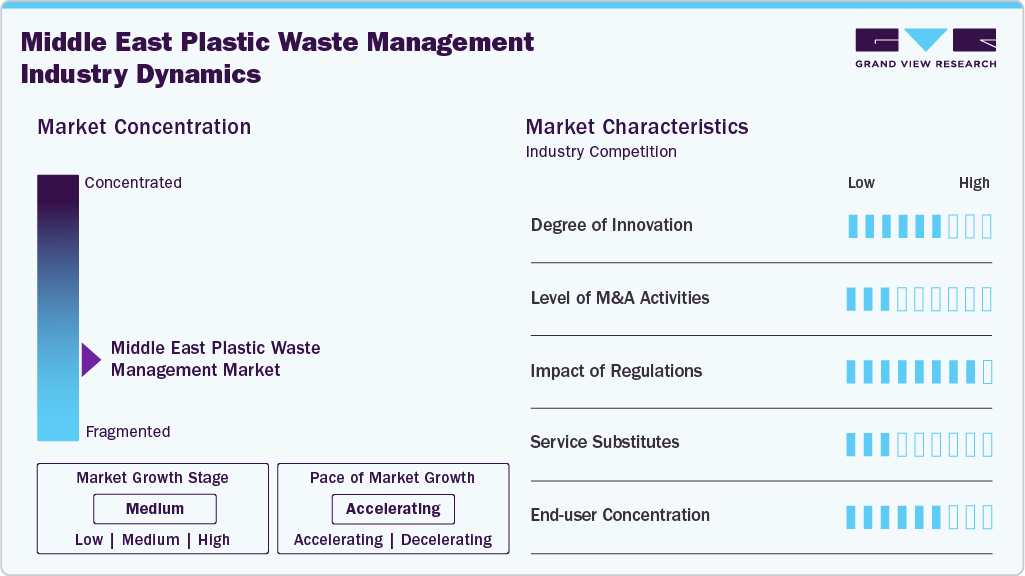
Mergers and acquisitions in the region are moderate, driven by the need to consolidate resources, expand service portfolios, and integrate advanced technologies. Large players are acquiring specialized recycling and treatment companies to enhance hazardous waste, e-waste, and organic waste processing capabilities. Cross-border acquisitions, especially involving GCC nations, are also increasing to create regional waste management networks.
Regulations significantly impact the Middle East waste management market, with governments implementing strict landfill restrictions and mandatory recycling targets. Policies such as Saudi Arabia’s National Waste Management Strategy and the UAE’s zero-waste goals shape industry practices. Compliance requirements push companies to adopt advanced treatment methods and sustainable disposal solutions. These regulations also create opportunities for private sector participation through tenders and public-private partnerships.
Drivers, Opportunities & Restraints
Rising environmental concerns and strict government policies targeting plastic reduction drive the Middle East plastic waste management market. Rapid urbanization and high consumption rates increase plastic waste volumes, creating demand for efficient management systems. Public awareness campaigns are promoting recycling and sustainable practices. In addition, investments in advanced recycling infrastructure are accelerating regional market growth.
Significant opportunities lie in the development of waste-to-energy projects and chemical recycling facilities. Partnerships between governments and private companies can expand collection networks and processing capacity. Adoption of smart waste management technologies can further optimize operations and reduce costs. The growing push for circular economy models presents new business prospects for recycling and sustainable packaging solutions.
The market faces challenges such as limited recycling infrastructure in some countries and high operational costs for advanced technologies. Low public participation in waste segregation slows recycling efficiency. Dependence on imported machinery and technology increases project costs and implementation time. Furthermore, inconsistent regulatory enforcement across the region can hinder uniform market development.
Service Insights
Landfills remain the dominant service segment in the Middle East plastic waste management market and accounted for 61.2% share in 2024, due to the region’s reliance on traditional waste disposal methods. Many countries still have limited recycling infrastructure, making landfilling the most accessible option. Lower operational costs and available land in certain areas further support its continued use. However, growing environmental concerns are prompting gradual shifts toward alternative solutions.
Recycling is the fastest-growing service segment, driven by government mandates to reduce landfill use and promote sustainability. Rising investments in material recovery facilities and advanced sorting technologies improve recycling efficiency. Public awareness and corporate sustainability initiatives are also fueling demand for recycled plastics. This trend aligns with regional goals to transition toward a circular economy.
Polymer Type Insights
Polypropylene (PP) dominates the Middle East plastic waste management market and accounted for 22.9% share in 2024, due to its wide use in packaging, automotive components, and consumer goods. Its durability, versatility, and cost-effectiveness make it a preferred material across industries. The high consumption of PP results in substantial waste generation, driving demand for its collection and recycling. Established recycling processes for PP also support its leading position in the market.
Polystyrene is expected to be the fastest-growing polymer type in the Middle East plastic waste management market. The surge is driven by its widespread use in packaging, food containers, and consumer goods, which generates significant waste volumes. Growing awareness about recycling potential and the development of advanced collection and processing systems are further supporting its recovery. Moreover, regulatory measures aimed at reducing landfill disposal and promoting circular economy practices are accelerating demand for polystyrene waste management solutions.
Source Insights
Plastic bags dominate the Middle East plastic waste stream and accounted for 21.5% share, due to their widespread use in retail, groceries, and packaging. Their low cost and convenience have led to high regional consumption rates. However, improper disposal contributes significantly to environmental pollution, making it a primary focus for waste management efforts. Government bans and levies are being introduced, but their prevalence still keeps them the largest waste source.
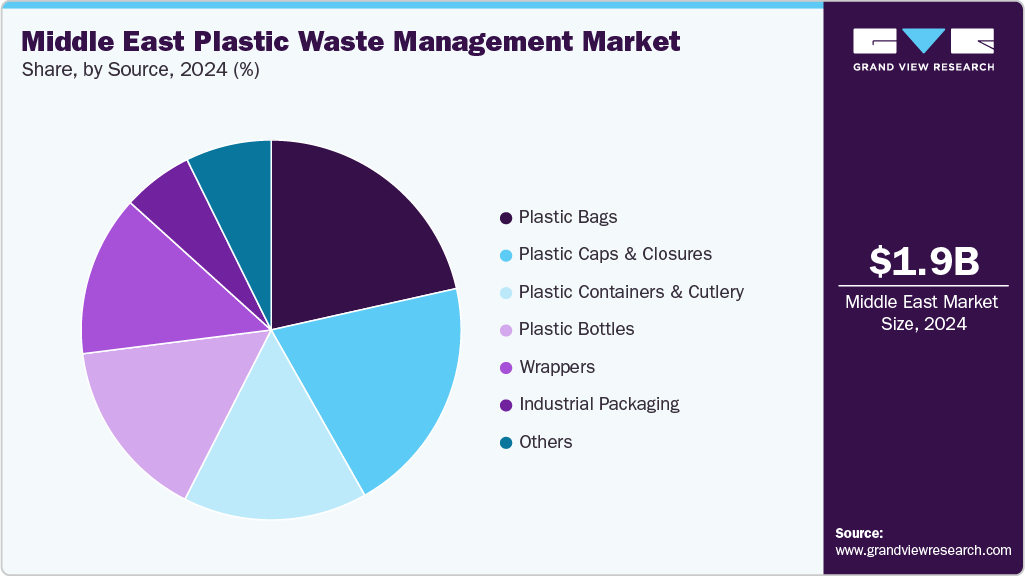
Plastic containers and cutlery are witnessing significant growth in the Middle East plastic waste stream due to rising consumption of packaged food, beverages, and takeaway services. The expansion of quick-service restaurants and e-commerce deliveries has further fueled single-use plastic demand. Growing urban populations and lifestyle changes are contributing to higher waste generation from this segment.
Country Insights
Saudi Arabia dominates the Middle East plastic waste management market and accounted for 30.3% share, due to its large-scale plastic consumption and high waste generation from industrial, commercial, and residential sectors. The government’s initiatives under Vision 2030, focusing on sustainability and circular economy, are strengthening the market. Significant investments in recycling infrastructure and partnerships with global waste management firms are also driving leadership.
Israel is the fastest-growing market in the region, supported by its advanced recycling technologies and strict environmental regulations. The country has been actively implementing innovative solutions such as waste-to-energy and chemical recycling. Strong government policies promoting sustainable waste practices and public awareness campaigns are accelerating adoption. Furthermore, Israel’s focus on innovation and R&D in plastic recycling is positioning it as a key growth hub in the Middle East.
Key Middle East Plastic Waste Management Company Insights
Some of the key players operating in the market include Veolia, SUEZ Environments Company, BEEAH Group
-
Veolia operates extensively in the Middle East plastic waste management sector, offering advanced recycling, waste-to-energy, and material recovery solutions. The company manages large-scale collection systems and sorting facilities tailored to regional waste compositions. It leverages cutting-edge technologies such as automated sorting, chemical recycling, and energy recovery to optimize efficiency. Veolia is also involved in public-private partnerships, supporting national sustainability and landfill diversion goals. Its projects often integrate circular economy principles to maximize resource recovery from plastic waste streams.
-
SUEZ plays a key role in the Middle East by providing specialized plastic waste treatment, recycling, and recovery services. The company deploys innovative technologies for sorting and reprocessing different polymer types, including challenging waste streams. It is engaged in infrastructure development projects in partnership with governments, such as material recovery facilities and waste-to-energy plants. SUEZ emphasizes local capacity building through training and knowledge transfer to enhance waste management efficiency. Its initiatives support regional targets for reducing landfill dependency and increasing recycling rates.
Key Middle East Plastic Waste Management Companies:
- Veolia
- SUEZ Environments Company
- BEEAH Group
- Tadweer.
- SIRC.
- Averda
- Dulsco.
- Basel Convention
- Seashore Group.
- Imdaad LLC.
Recent Developments
-
In January 2025, BEEAH and Masdar are expanding the Sharjah Waste-to-Energy plant, increasing capacity from 30 MW to nearly 60 MW. The upgraded facility will process around 600,000 tonnes of non-recyclable waste each year, generating power for roughly 60,000 homes and reducing annual CO₂ emissions by about one million tonnes.
-
In April 2025, SUEZ and CNRS have entered a five-year strategic partnership to drive innovation in sustainable water and waste management. Building on over 30 joint projects and 14 shared patents, the collaboration will advance technologies such as hydrothermal gasification to convert sewage sludge into renewable gas and recover minerals. It will also target PFAS reduction, seawater desalination, AI-powered waste processes, and industrial decarbonization.
-
In July 2025, Tadweer Group has acquired Masdar’s stake in the Sharjah Waste-to-Energy plant and formed a joint venture with BEEAH to manage operations. Opened in 2022, the facility transforms non-recyclable waste into electricity, with plans to double capacity from 30 MW to 60 MW and expand processing capabilities. The initiative is designed to increase landfill diversion and reduce emissions.
Middle East Plastic Waste Management Market Report Scope
Report Attribute
Details
Market size value in 2025
USD 1,991.7 million
Revenue forecast in 2033
USD 2,676.4 million
Growth rate
CAGR of 3.8% from 2025 to 2033
Historical data
2021 - 2023
Forecast period
2025 - 2033
Quantitative units
Revenue in USD million and CAGR from 2025 to 2033
Report coverage
Revenue forecast, company ranking, competitive landscape, growth factors, and trends
Segments covered
Service, polymer type, source and country.
Regional scope
Middle East
Country scope
Saudi Arabia; Oman; UAE; Qatar; Israel; Kuwait
Key companies profiled
Veolia; SUEZ Environments Company; BEEAH Group; Tadweer.; SIRC.; Averda; Dulsco.; Basel Convention; Seashore Group.; Imdaad LLC.
Customization scope
Free report customization (equivalent up to 8 analysts working days) with purchase. Addition or alteration to country, regional & segment scope.
Pricing and purchase options
Avail customized purchase options to meet your exact research needs. Explore purchase options
Middle East Plastic Waste Management Market Report Segmentation
This report forecasts revenue growth at country levels and provides an analysis of the latest industry trends in each of the sub-segments from 2021 to 2033. For this study, Grand View Research has segmented the Middle East plastic waste management market report based on service,polymer type, source and country.
-
Service Outlook (Revenue, USD Million, 2021 - 2033)
-
Collection
-
Recycling
-
Incineration
-
Landfills
-
-
Polymer Type Outlook (Revenue, USD Million, 2021 - 2033)
-
Polypropylene (PP)
-
Low-density polyethylene (LDPE)
-
High-density polyethylene (HDPE)
-
Polyvinyl chloride (PVC)
-
Polyurethane (PUR)
-
Terephthalate (PET)
-
Polystyrene
-
Others
-
-
Source Outlook (Revenue, USD Million, 2021 - 2033)
-
Plastic Bags
-
Plastic Bottles
-
Plastic Containers & Cutlery
-
Wrappers
-
Plastic Caps & Closures
-
Industrial Packaging
-
Others
-
-
Country Outlook (Revenue, USD Million, 2021 - 2033)
-
Saudi Arabia
-
UAE
-
Oman
-
Qatar
-
Israel
-
Kuwait
-
Frequently Asked Questions About This Report
b. The Middle East plastic waste management market size was estimated at USD 1,933.6 million in 2024 and is expected to be USD 1,991.7 million in 2025.
b. The Middle East plastic waste management market, in terms of revenue, is expected to grow at a compound annual growth rate of 3.8% from 2025 to 2033 to reach USD 2,676.4 million by 2033.
b. Landfills remain the dominant service segment in the Middle East plastic waste management market and accounted for 61.2% share in 2024, due to the region’s reliance on traditional waste disposal methods. Many countries still have limited recycling infrastructure, making landfilling the most accessible option. Lower operational costs and available land in certain areas further support its continued use.
b. Some of the key players operating in the Middle East plastic waste management market include Veolia; SUEZ Environments Company; BEEAH Group; Tadweer.; SIRC.; Averda; Dulsco.; Basel Convention; Seashore Group.; Imdaad LLC.
b. The Middle East plastic waste management market is driven by stricter environmental regulations, rising awareness of plastic pollution, and growing waste volumes from urbanization and industrialization. Government initiatives promoting recycling and circular economy practices are boosting demand for advanced waste solutions. Increased investments in infrastructure and technology are further accelerating market growth.


Share this report with your colleague or friend.
Need a Tailored Report?
Customize this report to your needs — add regions, segments, or data points, with 20% free customization.


ISO 9001:2015 & 27001:2022 Certified
We are GDPR and CCPA compliant! Your transaction & personal information is safe and secure. For more details, please read our privacy policy.
Trusted market insights - try a free sample
See how our reports are structured and why industry leaders rely on Grand View Research. Get a free sample or ask us to tailor this report to your needs.












