
- Home
- »
- Conventional Energy
- »
-
Middle East Liquefied Natural Gas Market Size Report, 2033GVR Report cover
![Middle East Liquefied Natural Gas Market Size, Share & Trends Report]()
Middle East Liquefied Natural Gas Market (2025 - 2033) Size, Share & Trends Analysis Report By Application (Transportation Fuel, Power Generation), By Country (UAE, Algeria, Egypt, Oman, Qatar), And Segment Forecasts
- Report ID: GVR-4-68040-704-2
- Number of Report Pages: 120
- Format: PDF
- Historical Range: 2021 - 2023
- Forecast Period: 2025 - 2033
- Industry: Energy & Power
- Report Summary
- Table of Contents
- Segmentation
- Methodology
- Download FREE Sample
-
 Download Sample Report
Middle East Liquefied Natural Gas Market Summary
The Middle East liquefied natural gas market size was estimated at USD 1.41 billion in 2024 and is projected to reach USD 3.97 billion by 2033, growing at a CAGR of 12.9% from 2025 to 2033. The Liquefied Natural Gas (LNG) market encompasses natural gas production, liquefaction, storage, transportation, and regasification for domestic use and global exports.
Key Market Trends & Insights
- Qatar Liquefied Natural Gas (LNG) market held the largest share of 70.26 % of the Middle East LNG market in 2024.
- The Middle East Liquefied Natural Gas (LNG) industry is expected to grow significantly over the forecast period.
- By application, the power generation segment held the highest market share of 59.97% in 2024.
Market Size & Forecast
- 2024 Market Size: USD 1.41 Billion
- 2033 Projected Market Size: USD 3.97 Billion
- CAGR (2025-2033): 12.9%
- Qatar: Largest market in 2024
- Algeria: Fastest growing market
Key countries, including Qatar, the UAE, and Oman, are expanding LNG infrastructure to capitalize on the growing global demand for cleaner-burning fuels amid energy security concerns and decarbonization goals. Qatar remains a global LNG powerhouse with its North Field expansion aiming to increase capacity from 77 million tons per annum (MTPA) to 126 MTPA by the end of the decade. This strategic expansion is reinforced by long-term supply contracts with key Asian and European buyers seeking diversification from Russian gas.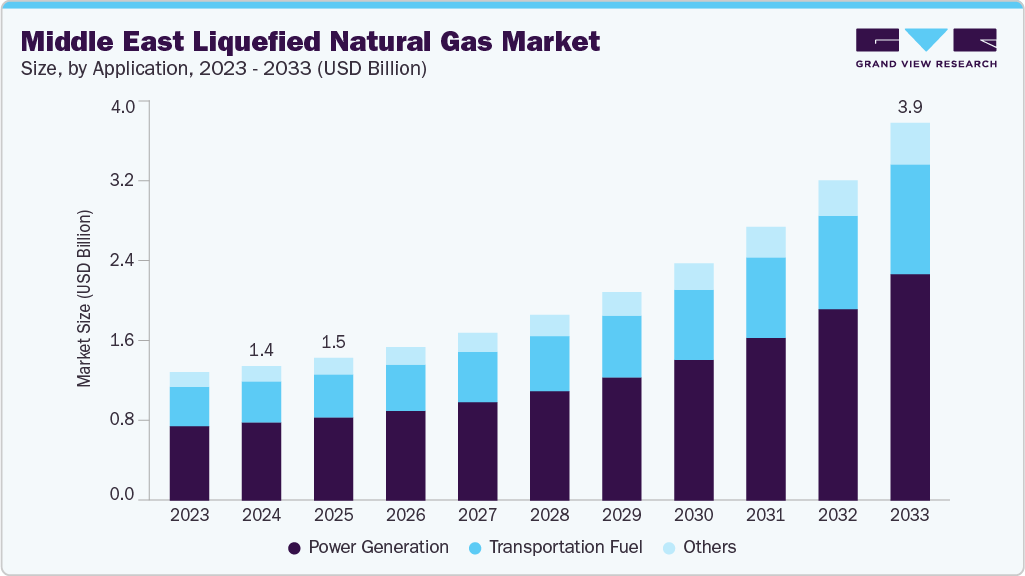
The growth of the Middle East LNG industry is further supported by rising investments in liquefaction trains, floating storage and regasification units (FSRUs), and port terminal upgrades. LNG is pivotal in bridging the transition to renewable energy, providing dispatchable power while reducing greenhouse gas emissions related to coal and oil. Emerging markets like Iraq and Jordan are exploring LNG imports to meet fluctuating energy demand, while countries like the UAE are leveraging LNG for domestic consumption and trading purposes. Technological advancements in cryogenic storage, small-scale LNG, and carbon capture improve operational efficiency and environmental performance. Strategic collaborations with global energy majors, favorable regulatory reforms, and integration with hydrogen and ammonia value chains are unlocking new market potential. With leading players such as QatarEnergy, ADNOC, Shell, and TotalEnergies spearheading development, the Middle East LNG market is poised for resilient growth and a central role in global energy transition strategies.
Drivers, Opportunities & Restraints
The Middle East liquefied natural gas market’s growth is driven by robust global demand for cleaner energy sources, vast natural gas reserves, and strong export infrastructure, particularly in Qatar and the UAE. Geopolitical shifts, including Europe's pivot away from Russian gas, have further elevated the strategic importance of Middle Eastern LNG in global energy security. Government-backed investments in expanding liquefaction capacity, long-term supply agreements, and competitive production costs bolster the region's dominance in the global LNG trade. Additionally, growing domestic demand for gas in power generation, desalination, and industrial applications drives new LNG regasification projects and storage infrastructure, particularly in energy-importing countries such as Jordan and Pakistan.
Opportunities lie in small- and mid-scale LNG for off-grid applications, LNG bunkering to support maritime decarbonization, and floating LNG solutions that reduce the need for large onshore infrastructure. Advancements in carbon capture and storage (CCS), methane leak detection, and digital twin technologies are improving LNG value chains' environmental footprint and operational efficiency. Strategic partnerships with Asia, Europe, and emerging African economies are opening new trade corridors and diversifying customer bases. However, the market faces restraints including high capital intensity of liquefaction and export facilities, potential delays in project execution due to global supply chain bottlenecks, and rising competition from the U.S. and Australia. Additionally, mounting pressure to decarbonize the LNG value chain and uncertainty over long-term demand amid the global energy transition pose risks to investment timelines and infrastructure utilization rates across the Middle East.
Application Insights
Power generation held the largest revenue share of over 59.97% in 2024. The power generation segment dominated the Middle East liquefied natural gas market with the largest revenue share of over 59.97% in 2024 and is projected to maintain its lead through to 2033. This dominance is driven by the region's increasing reliance on natural gas as a transitional fuel to meet surging electricity demand while curbing carbon emissions from oil-based generation. Countries such as Qatar, Egypt, UAE, and Oman invest heavily in gas-fired combined cycle power plants, leveraging abundant LNG supply to ensure grid stability, improve generation efficiency, and integrate with intermittent renewable energy sources like solar and wind. LNG's flexibility and cleaner-burning properties make it a preferred choice for meeting peak loads, supporting industrial zones, and powering urban expansion across the Gulf and North Africa.
The rising electrification of desalination, industrial processes, and residential developments further fuels LNG's role in the regional energy mix. Egypt and the UAE are expanding their LNG regasification infrastructure to support power sector diversification, while nations like Jordan and Morocco increasingly rely on LNG imports for energy security. Government-led reforms aimed at phasing out oil-based generation and aligning with emission reduction targets under national visions and climate pledges amplify LNG demand. As regional grids become more interconnected, LNG-based power generation is also expected to play a pivotal role in cross-border electricity trade. Over the forecast period, long-term fuel supply agreements and infrastructure modernization will likely reinforce power generation as the anchor application for LNG consumption in the Middle East.
Country Insights
Qatar held over 70.26% revenue share of the Middle East LNG market. Qatar led the Middle East LNG market with the largest revenue share of over 70.26% in 2024, underpinned by its position as the world’s leading LNG exporter and its vast reserves in the North Field. QatarEnergy’s ambitious North Field Expansion projects are set to boost LNG production capacity from 77 million to 126 million tons per annum by 2027, reinforcing the country’s dominance in global LNG supply chains. These expansions include advanced liquefaction trains and strategic partnerships with international energy majors, ensuring competitive costs and reliable deliveries.
Qatar’s LNG infrastructure, including the Ras Laffan Transportation Fuel City and a modern fleet of LNG carriers, provides unmatched scale and efficiency. The country’s focus on maintaining long-term contracts with key Asian and European importers secures revenue stability amid market volatility. As global demand grows for cleaner-burning fuels to support energy transition goals, Qatar is positioning itself to meet increasing needs with flexible LNG supply agreements. Continued investment in low-carbon LNG, carbon capture technologies, and sustainability certifications further strengthens Qatar’s leadership in the Middle East liquefied natural gas market.
Oman Liquefied Natural Gas Market Trends
Oman maintains a significant share of the Middle East liquefied natural gas industry, supported by its established LNG infrastructure and exports from Oman LNG and Qalhat LNG plants. The country produces around 10.4 million tons of LNG annually, primarily supplying Asian and European markets. Oman’s LNG strategy aligns with Oman Vision 2040, which seeks to balance hydrocarbon revenues with sustainability goals by optimizing existing gas resources and investing in operational efficiency.
Oman’s location at the crossroads of major shipping lanes and its flexible LNG contracts enhance its competitive advantage in regional and international markets. Ongoing efforts to reduce methane emissions, upgrade liquefaction facilities, and explore carbon-neutral LNG opportunities demonstrate Oman’s commitment to maintaining its relevance in the evolving global gas landscape. New exploration and production agreements aim to secure feed gas for future LNG exports, ensuring long-term supply security.
UAE Liquefied Natural Gas Market Trends
The UAE is witnessing growth in the Middle East liquefied natural gas industry, primarily through Abu Dhabi National Oil Company’s (ADNOC) integrated gas strategy. The country is expanding LNG export capacity with the Ruwais LNG project, which is expected to add 9.6 million tons annually upon completion. This investment aligns with the UAE’s broader gas self-sufficiency and export diversification ambitions under its 2030 Integrated Gas Strategy.
The UAE leverages its LNG production to supply domestic power generation and regional demand, enhancing energy security while contributing to economic diversification. Strategic partnerships and long-term contracts with Asian and European buyers strengthen the country’s LNG market position. Additionally, the UAE’s commitment to low-emission LNG production, supported by carbon capture initiatives, aligns with its climate goals and bolsters competitiveness in global LNG markets.
Egypt Liquefied Natural Gas Market Trends
Egypt’s LNG market share is bolstered by its strategic location, well-developed liquefaction infrastructure at Idku and Damietta, and recent discoveries in the Eastern Mediterranean, such as the Zohr gas field. Egypt’s LNG exports have surged since 2021, driven by rising European demand amid geopolitical disruptions. The government’s Integrated Sustainable Energy Strategy supports maximizing natural gas monetization, positioning Egypt as a regional LNG hub.
Egypt’s proximity to European and Asian markets allows flexible, competitive delivery options. The country is actively pursuing agreements with regional partners to re-export LNG, enhancing its role as a bridge between African, Middle Eastern, and European gas markets. Modernizing existing LNG terminals and investing in digital solutions for plant optimization are key to sustaining growth and market share in the Middle East LNG landscape.
Algeria Liquefied Natural Gas Market Trends
Algeria retains a notable share of the Middle East LNG market, supported by its long-established LNG industry and proven gas reserves in the Hassi R’Mel basin. Sonatrach’s LNG facilities in Arzew and Skikda allow Algeria to export around 12 million tons annually, mainly to Europe, reinforcing its position as a reliable supplier amid rising European energy security concerns.
Algeria’s strategic focus includes enhancing LNG plant efficiency, reducing flaring, and adopting low-carbon technologies to maintain competitiveness. Renewed exploration and upstream investments aim to offset production declines and secure long-term LNG feed gas. As Europe seeks diversified gas supplies, Algeria’s geographic proximity and flexible LNG volumes strengthen its relevance in regional and global markets. However, modernization of aging infrastructure and regulatory reforms are crucial for sustaining market share over the coming decade.
Key Middle East LNG Company Insights
The key players operating in the Middle East LNG industry are actively engaged in upstream gas extraction, liquefaction, and export infrastructure across major LNG-producing countries such as Qatar, the UAE, Oman, and Algeria.
Key Middle East LNG Companies:
- QatarEnergy
- Oman LNG LLC
- ADNOC LNG
- Kuwait Petroleum Corporation (KPC)
- Saudi Aramco
- Dolphin Energy Limited
- Shell
- TotalEnergies
- Mubadala Energy
- BP
Recent Developments
-
In March 2025, QatarEnergy announced the commissioning of the North Field Expansion Phase 1, a key milestone in the Middle East LNG market that adds 32 million tons per annum (MTPA) of LNG production capacity. Located in Ras Laffan Industrial City, the project is designed to meet rising global demand while supporting long-term energy security across Asia and Europe.
Middle East Liquefied Natural Gas Market Report Scope
Report Attribute
Details
Market size value in 2025
USD 1.50 billion
Revenue forecast in 2033
USD 3.97 billion
Growth rate
CAGR of 12.9% from 2025 to 2033
Base year for estimation
2024
Historical data
2021 - 2023
Forecast period
2025 - 2033
Quantitative units
Volume in thousand tons, revenue in USD million/billion, and CAGR from 2025 to 2033
Report coverage
Volume forecast, revenue forecast, competitive landscape, growth factors, and trends
Segments covered
Application, country
Country scope
Qatar; Oman; UAE; Egypt; Algeria
Key companies profiled
QatarEnergy; Oman LNG LLC; ADNOC LNG; Kuwait Petroleum Corporation (KPC); Saudi Aramco; Dolphin Energy Limited; Shell; TotalEnergies; Mubadala Energy; BP
Customization scope
Free report customization (equivalent up to 8 analysts working days) with purchase. Addition or alteration to country, regional & segment scope.
Pricing and purchase options
Avail customized purchase options to meet your exact research needs. Explore purchase options
Middle East Liquefied Natural Gas Market Report Segmentation
This report forecasts volume & revenue growth at country levels and provides an analysis of the latest industry trends in each of the sub-segments from 2021 to 2033. For this study, Grand View Research has segmented the Middle East liquefied natural gas market report based on application and country:
-
Application Outlook (Volume, Thousand Tons; Revenue, USD Million, 2021 - 2033)
-
Transportation Fuel
-
Power Generation
-
Others
-
-
Country Outlook (Volume, Thousand Tons; Revenue, USD Million, 2021 - 2033)
-
Middle East
-
UAE
-
Algeria
-
Egypt
-
Oman
-
Qatar
-
-
Frequently Asked Questions About This Report
b. The Middle East liquefied natural gas market size was estimated at USD 1.41 billion in 2024 and is expected to reach USD 1.50 billion in 2025.
b. The Middle East liquefied natural gas market is expected to grow at a compound annual growth rate of 12.9% from 2025 to 2033 to reach USD 3.97 billion by 2033.
b. Based on the application segment, power generation accounted for the largest revenue share of 59.97% in the Middle East LNG market in 2024, reflecting the region’s reliance on natural gas to meet growing electricity demand and support grid stability. As economies expand and urban populations surge, countries like Qatar, the UAE, and Egypt are investing heavily in gas-fired power plants that offer lower carbon emissions compared to oil-based generation.
b. Some of the key vendors operating in the Middle East LNG market include QatarEnergy, ADNOC LNG, Oman LNG LLC, Kuwait Petroleum Corporation (KPC), and Saudi Aramco, among others.
b. The key factors driving the Middle East LNG market include rising electricity demand, the region’s push for cleaner energy sources, and abundant natural gas reserves. Countries like Qatar and Oman are ramping up LNG production and exports to monetize their gas resources while meeting both domestic and international energy needs.


Share this report with your colleague or friend.
Need a Tailored Report?
Customize this report to your needs — add regions, segments, or data points, with 20% free customization.


ISO 9001:2015 & 27001:2022 Certified
We are GDPR and CCPA compliant! Your transaction & personal information is safe and secure. For more details, please read our privacy policy.
Trusted market insights - try a free sample
See how our reports are structured and why industry leaders rely on Grand View Research. Get a free sample or ask us to tailor this report to your needs.












