Middle East Green Chemicals Market Summary
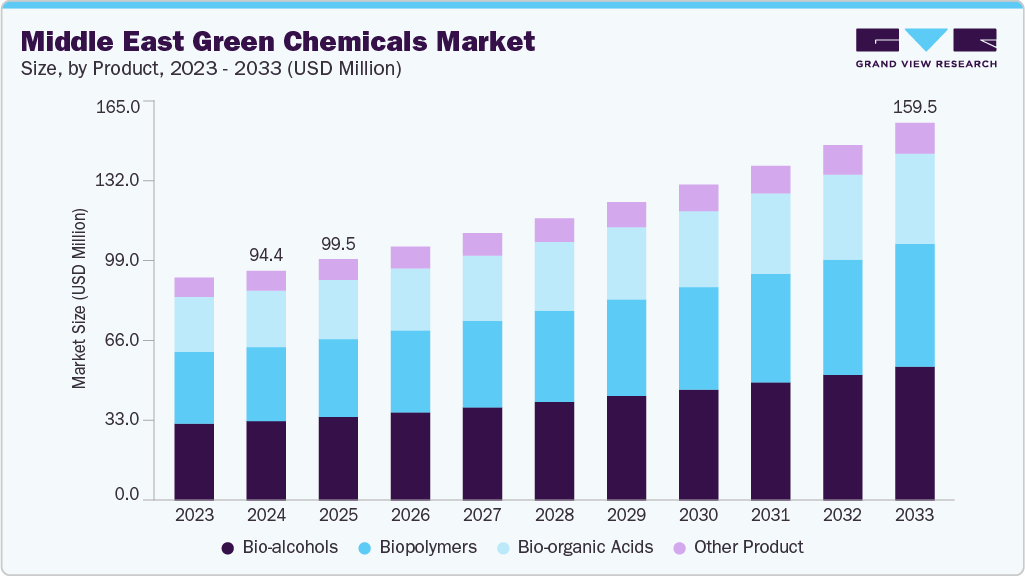
The Middle East green chemicals market size was estimated at USD 94.4 million in 2024 and is projected to reach USD 159.5 million by 2033, growing at a CAGR of 6.1% from 2025 to 2033. The market is driven by increasing governmental emphasis on sustainability and circular economy initiatives, supported by national strategies aimed at diversifying economies beyond hydrocarbons.
Key Market Trends & Insights
- By product, the bio-alcohols segment is expected to grow at the fastest CAGR of 6.4% from 2025 to 2033 in terms of revenue.
- By product, the bio-alcohols segment dominated the market with the largest revenue share of 34.8% in 2024.
- By application, construction segment captured the largest revenue share of 26.6% in 2024.
- By application, the automotive segment is expected to witness the fastest growth of 6.9% from 2025 to 2033.
Market Size & Forecasts
- 2024 Market Size: USD 94.4 Million
- 2033 Projected Market Size: USD 159.5 Million
- CAGR (2025-2033): 6.1%
Rising demand from end use industries such as construction, packaging, and automotive is fueled by growing consumer preference for eco-friendly products and compliance with stringent environmental regulations. Abundant regional biomass resources, coupled with investments in renewable energy and bio-based manufacturing infrastructure are enhancing production capabilities. The partnerships between global chemical players and local stakeholders are accelerating technology transfer and market penetration, positioning the region as an emerging hub for bio-based solutions.
The market presents significant opportunities through the development of bio-based industrial clusters, leveraging the region’s abundant agricultural byproducts and renewable energy resources to lower production costs. Rapid urbanization and infrastructure expansion create sustained demand for sustainable materials in construction, packaging, and automotive applications. Government-backed incentives, such as subsidies for bio-based projects and favorable trade agreements, enhance market entry potential for both domestic and international players. The region’s strategic geographic position offers strong export potential to Europe, Africa, and Asia, particularly as global markets tighten sustainability standards.
Despite strong growth prospects, the market faces challenges including high initial investment requirements for bio-based production facilities and limited existing manufacturing infrastructure. Dependence on imported technologies and specialized feedstocks can increase operational costs and supply chain vulnerability. Regulatory inconsistencies across Middle Eastern countries may slow project execution, while fluctuating crude oil prices can reduce the competitiveness of bio-based alternatives. Additionally, limited consumer awareness and market readiness for premium-priced green products could hinder large-scale adoption without targeted education and marketing efforts.
Market Concentration & Characteristics
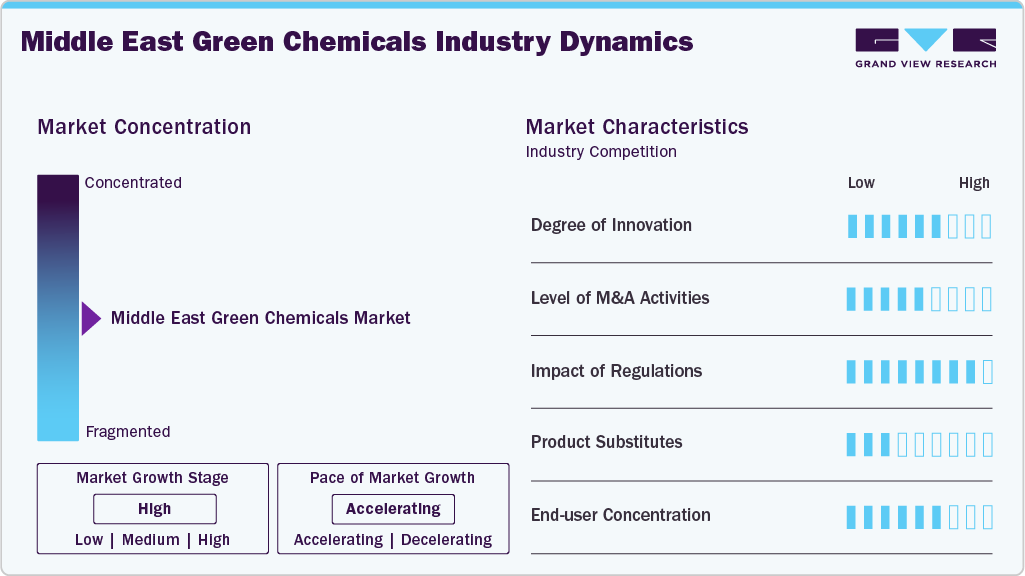
The Middle East green chemicals market is moderately fragmented, with leadership held by several large, vertically integrated chemical manufacturers. These major players capitalize on economies of scale, internal sourcing of bio-based raw materials such as natural oils, sugars, bio-based acids, and expansive global distribution networks to sustain their competitive edge. Their integration across the green chemical value chain from feedstock processing to the production of bio-alcohols, biopolymers, and bio-based solvents, allows for improved cost efficiency, product consistency, and dependable supply.
Leading players in the market are adopting multi-pronged strategies to strengthen their market position. Key approaches include strategic joint ventures and partnerships with regional petrochemical and renewable energy companies to establish local manufacturing hubs and secure reliable feedstock supply. Vertical integration is increasingly pursued to control the value chain from raw material source to downstream product development, ensuring cost efficiency and quality consistency. Companies are also investing in R&D and technology transfer to adapt advanced bio-based production technologies to local climatic and feedstock conditions. Market diversification into high-growth segments such as sustainable packaging, bio-based construction materials, and automotive composites enabling players to capture broader demand.
Product Insights
The bio-alcohols segment accounted for the largest revenue share of 34.8% in 2024 in the Middle East green chemicals market, primarily due to its extensive use as a biofuel and a key industrial solvent across multiple end-use sectors. Rising regional adoption of bioethanol and bio-butanol in transportation fuels, driven by decarbonization targets and blending mandates, has significantly boosted demand. Additionally, bio-alcohols serve as crucial intermediates in the production of bio-based plastics, pharmaceuticals, and personal care products, benefiting from the region’s growing focus on import substitution and local value addition. The segment’s growth is further supported by strategic partnerships between international biofuel technology providers and regional energy companies, enabling technology transfer and the establishment of localized production facilities.
Other product categories, including bio-organic acids, biopolymers, and miscellaneous green chemicals, are also witnessing strong momentum, albeit from a smaller base. Bio-organic acids are gaining traction in the food & beverage, pharmaceutical, and chemical industries as sustainable alternatives to petrochemical-derived acids, while biopolymers are increasingly adopted in packaging and automotive applications due to rising regulatory pressures to reduce plastic waste. The “Other Product” segment, comprising specialty bio-based chemicals and composites, presents niche opportunities in high-value markets such as specialty coatings and construction additives. Collectively, these segments are benefiting from expanding R&D activities, increased availability of renewable feedstocks, and supportive government policies aimed at fostering a circular and low-carbon economy in the Middle East. The bio-organic acids and biopolymers segments are also witnessing strong growth momentum due to rising demand across food, packaging, and pharmaceutical applications. Bio-organic acids such as lactic, succinic, and citric acids are increasingly used as preservatives, acidulants, and monomers for biodegradable plastics. Meanwhile, biopolymers are rapidly gaining traction in sustainable packaging and textile industries, with growing adoption of PLA (polylactic acid) and PHA (polyhydroxyalkanoates).
Application Insights
The construction segment held the largest revenue share of 26.6% in 2024 in the Middle East green chemicals market, driven by the region’s rapid infrastructure development and growing integration of sustainable building materials. Government-backed initiatives such as green building certification programs, energy efficiency regulations, and urban sustainability projects have accelerated the adoption of bio-based products in insulation, adhesives, sealants, and coatings. The segment also benefits from mega infrastructure projects across the GCC, including smart cities and renewable energy complexes, where sustainable materials are prioritized to meet environmental performance standards. Additionally, the rising focus on carbon footprint reduction in construction supply chains has prompted contractors and developers to incorporate green chemicals into both residential and commercial projects.
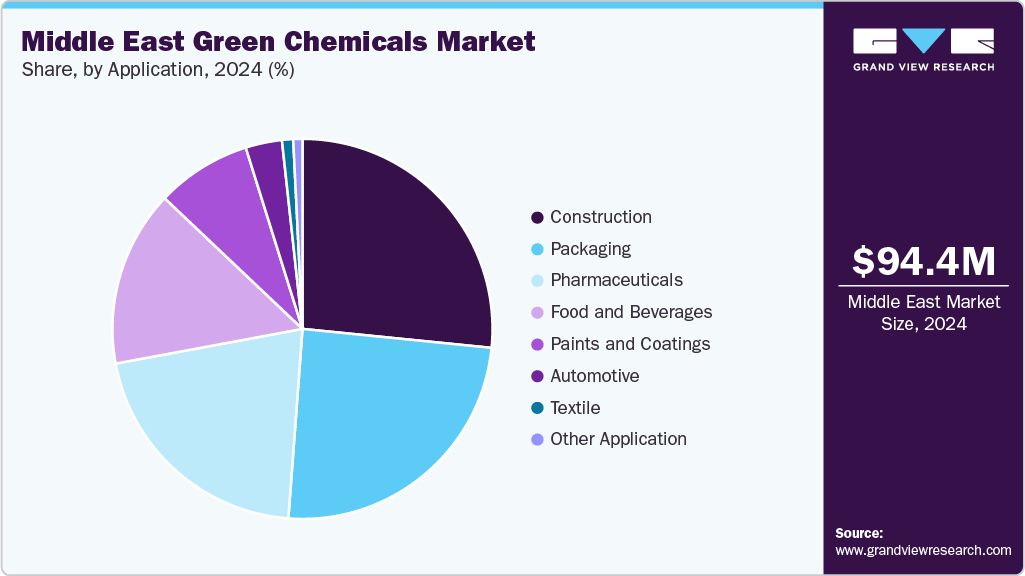
Other key application segments are also contributing significantly to market growth. The pharmaceuticals segment is witnessing robust demand for bio-based excipients and solvents, while packaging is rapidly expanding due to the shift toward biodegradable and compostable materials, particularly in food and e-commerce industries. Food and beverages is leveraging bio-based preservatives, acids, and additives to align with clean-label and health-conscious consumer trends. Paints and coatings are increasingly adopting bio-based binders and pigments to comply with VOC regulations, and automotive applications are integrating biopolymers and bio-composites for lightweighting and sustainability purposes. The textile industry is gradually transitioning to bio-based fibers and dyes to meet global fashion sustainability targets, and the “other applications” category, which includes electronics, personal care, and specialty manufacturing, is opening niche growth avenues for innovative green chemical solutions.
Regional Insights
The Middle East green chemicals market is poised for steady growth, supported by ambitious national sustainability agendas, diversification strategies, and large-scale infrastructure projects across the GCC. Abundant renewable energy resources, strategic access to global trade routes, and growing investments in bio-based manufacturing hubs position the region as an emerging center for sustainable chemical production. Key markets such as Saudi Arabia, the UAE, and Qatar are actively promoting green building standards, renewable energy integration, and circular economy practices, driving demand across construction, packaging, automotive, and industrial applications.
Saudi Arabia Green Chemicals Market Trends
Saudi Arabia represents one of the most dynamic markets for green chemicals in the Middle East, driven by its Vision 2030 agenda, which prioritizes economic diversification, environmental sustainability, and the development of advanced manufacturing industries. The Kingdom is investing heavily in renewable energy and bio-based industrial clusters to reduce reliance on petrochemicals while enhancing local value creation. Demand is being fueled by large-scale infrastructure projects, such as NEOM and The Red Sea Project, which integrate sustainable construction materials and green building standards. Strategic collaborations between Saudi chemical producers, research institutions, and global technology providers are fostering innovation in bio-alcohols, biopolymers, and specialty green chemicals, positioning the country as a regional leader in sustainable chemical production and export.
Key Middle East Green Chemicals Company Insights
Some of the key players operating in the Middle East Green Chemicals market include BASF SE, Arkema S.A. and Evonik Industries AG.
-
BASF SE is one of the world’s largest chemical producers and a key player in the global green chemicals market, with an expanding footprint in the Middle East through strategic partnerships and regional supply agreements. The company leverages its extensive R&D capabilities and integrated production facilities to deliver a broad portfolio of bio-based and sustainable solutions, including biopolymers, bio-alcohols, and bio-based coatings. BASF’s Middle East strategy focuses on serving high-growth sectors such as construction, packaging, and automotive by aligning with regional sustainability targets and supporting customers in reducing their environmental impact. Through collaborations with local industry stakeholders and investments in innovative technologies, BASF is strengthening its role in advancing the transition toward a circular, low-carbon economy in the region.
Key Middle East Green Chemicals Companies:
- Evonik Industries AG
- BASF SE
- Arkema S.A.
- DuPont
- Braskem S.A.
- Vertec BioSolvents Inc.
- CD BioSciences-GreenChemistry
- Viridis Chemical Company
- Corbion N.V.
- GENEDGE
Middle East Green Chemicals Market Report Scope
|
Report Attribute
|
Details
|
|
Market size value in 2025
|
USD 99.5 million
|
|
Revenue forecast in 2033
|
USD 159.5 million
|
|
Growth rate
|
CAGR of 6.1% from 2025 to 2033
|
|
Base year for estimation
|
2024
|
|
Historical data
|
2018 - 2023
|
|
Forecast period
|
2025 - 2033
|
|
Quantitative units
|
Revenue in USD million/billion, Volume in Kilotons, and CAGR from 2025 to 2033
|
|
Report coverage
|
Revenue forecast, company ranking, competitive landscape, growth factors, and trends
|
|
Segments covered
|
Product, application, country
|
|
Country scope
|
Oman; Kuwait; Saudi Arabia; UAE; Qatar; Bahrain; Isael; Rest of Middle East
|
|
Key companies profiled
|
Evonik Industries AG; BASF SE; Arkema S.A.; DuPont; Braskem S.A.; Vertec BioSolvents Inc.; CD BioSciences-GreenChemistry; Viridis Chemical Company; Corbion N.V.; GENEDGE
|
|
Customization scope
|
Free report customization (equivalent to up to 8 analysts’ working days) with purchase. Addition or alteration to country, regional & segment scope.
|
|
Pricing and purchase options
|
Avail customized purchase options to meet your exact research needs. Explore purchase options
|
Middle East Green Chemicals Market Report Segmentation
This report forecasts revenue growth at global, regional, and country levels and provides an analysis of the latest industry trends in each of the sub-segments from 2018 to 2033. For this study, Grand View Research has segmented the Middle East Green Chemicals Market report based on product, application, and country:
-
Product Outlook (Revenue, USD Billion; Volume, Kilotons, 2018 - 2033)
-
Bio-alcohols
-
Bio-organic acids
-
Biopolymers
-
Other Products
-
Application Outlook (Revenue, USD Billion; Volume, Kilotons, 2018 - 2033)
-
Construction
-
Pharmaceuticals
-
Packaging
-
Food and Beverages
-
Paints and Coatings
-
Automotive
-
Textile
-
Other Applications
-
Country Outlook (Revenue, USD Billion; Volume, Kilotons, 2018 - 2033)
-
Oman
-
Kuwait
-
Saudi Arabia
-
UAE
-
Qatar
-
Bahrain
-
Israel
-
Rest of Middle East
Frequently Asked Questions About This Report
b. The Middle East green chemicals market size was estimated at USD 94.4 million in 2024 and is expected to reach USD 99.5 million in 2025.
b. The Middle East green chemicals market is expected to grow at a compound annual growth rate of 6.1% from 2025 to 2033 to reach USD 159.5 million by 2033.
b. The bio-alcohols segment led the market in 2024 due to its widespread use as a sustainable fuel additive and industrial solvent, supported by rising biofuel blending mandates and growing demand from pharmaceuticals, personal care, and bio-based plastics industries in the Middle East. Strategic collaborations between global technology providers and regional energy companies further boosted localized production and market penetration.
b. Some of the key players operating in the Middle East green chemicals market include Evonik Industries AG, BASF SE, Arkema S.A., DuPont, Braskem S.A., Vertec BioSolvents Inc., CD BioSciences-GreenChemistry, Viridis Chemical Company, Corbion N.V., GENEDG.
b. The Middle East green chemicals market is driven by government-led sustainability initiatives, rising demand for eco-friendly materials across construction, packaging, and automotive sectors, and increasing investments in bio-based production technologies to reduce carbon emissions and enhance regional manufacturing capabilities.

 Download Sample Report














