Middle East Christmas Decorative Products Market Summary
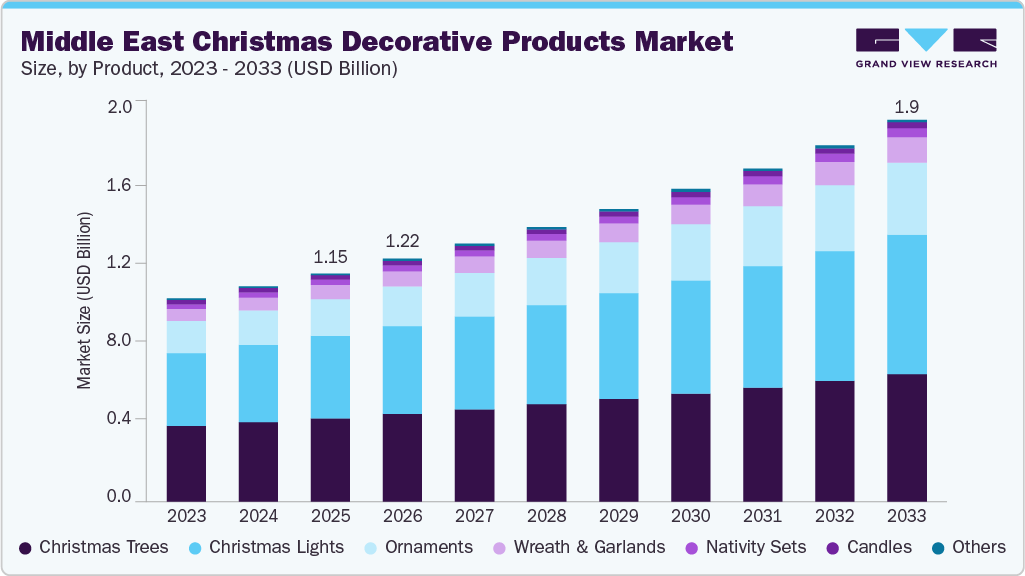
The Middle East Christmas decorative products market size was valued at USD 1.15 billion in 2025 and is projected to reach USD 1.93 billion by 2033, growing at a CAGR of 6.7% from 2026 to 2033. Several cultural and economic factors are driving market growth.
Key Market Trends & Insights
- By product, the Christmas trees segment held the largest revenue share of 36.5% in 2025.
- The ornaments segment is expected to grow at the fastest CAGR of 8.6% in the forecast period.
- By distribution channel, the offline segment dominated the market with a revenue share of 73.6% in 2025.
- By end use, the residential segment dominated the Middle East Christmas decorative products market with a revenue share of 70.1% in 2025.
Key Market Trends & Insights
- 2025 Market Size: USD 1.15 Billion
- 2033 Projected Market Size: USD 1.93 Billion
- CAGR (2026-2033): 6.7%
Although Christmas is not a traditional religious holiday throughout the region, demand for festive decorations is strongest in areas with large expatriate communities, high tourism, and growing Western influence, especially in commercial centers such as the UAE and Saudi Arabia. Market growth is driven by sustained high investment in the tourism and hospitality sectors, where lavish holiday decorations are a necessity to attract international visitors during the winter season. The expansion of the middle and affluent classes, which provides consumers with higher disposable incomes to spend on aspirational, themed, and personalized home décor also supports the demand. The rise of modern retail infrastructure and digital platforms has significantly improved product accessibility. The growing influence of global social media trends and western culture exposure encourages both commercial and residential consumers to adopt more elaborate and frequent seasonal decorating practices, fueling demand for modern and customizable products.
Consumer Insights
In the Middle East, especially in GCC countries like the UAE and Saudi Arabia, consumers prefer large, eye-catching decorative lighting and high-quality products. These items are often used in public exhibitions, shopping malls, hotels, and homes. For instance, Dubai Mall saw 111 million visitors in 2024, up from 105 million the year before. This increase in visitors is expected to boost the market for Christmas decorations in the region by raising demand for seasonal products in commercial spaces. The commercial sector is likely to grow as businesses invest more in festive displays, leading to higher sales through bulk purchases and creative setups.
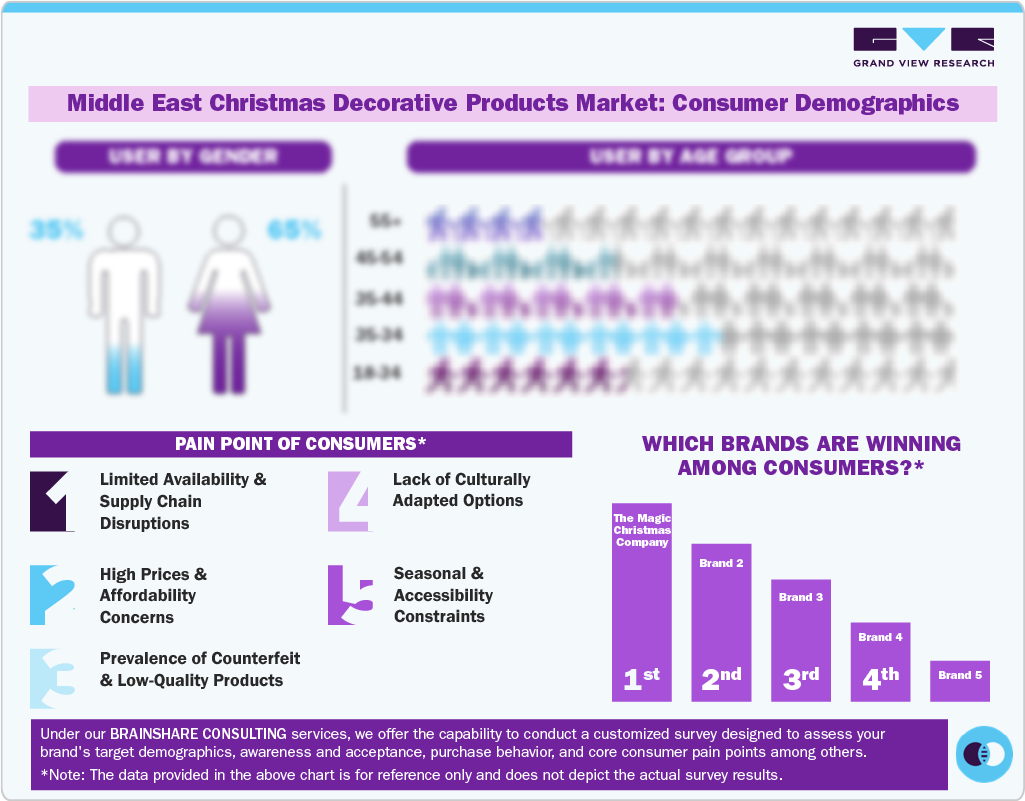
E-commerce is playing a key role in how people in the Middle East buy decorative products, making it easier to find a wide range of specialized and international items that might not be available locally. More shoppers are turning to online platforms to discover and buy products. At the same time, there is a growing interest in personalization, with people looking for unique ornaments and DIY options to create their own holiday themes. Social media trends that highlight creative festive setups are also encouraging people to update their decorations more often. To meet these changing needs, businesses can focus on offering local product choices, energy-efficient technology, and strong online shopping options for both commercial and residential customers.
Product Insights
The Christmas trees segment held the largest market revenue share of 36.5% in 2025. This growth comes from their role as the main feature in both homes and, especially, commercial spaces. For instance, in December 2024, Mandarin Oriental Jumeira, showcased a sapphire-inspired Christmas tree with golden branches, large baubles, and a ribbon of light by Garrard. Considering climate and logistics, most of the market depends on high-quality artificial trees. Buyers prefer realistic, durable, and pre-lit models for convenience. In the GCC countries, such as Saudi Arabia and the UAE, large and impressive trees are popular in luxury hotels, malls, and office lobbies to draw visitors and create a festive atmosphere. As people have more disposable income, this product segment remains popular by offering both convenience and style across the region.
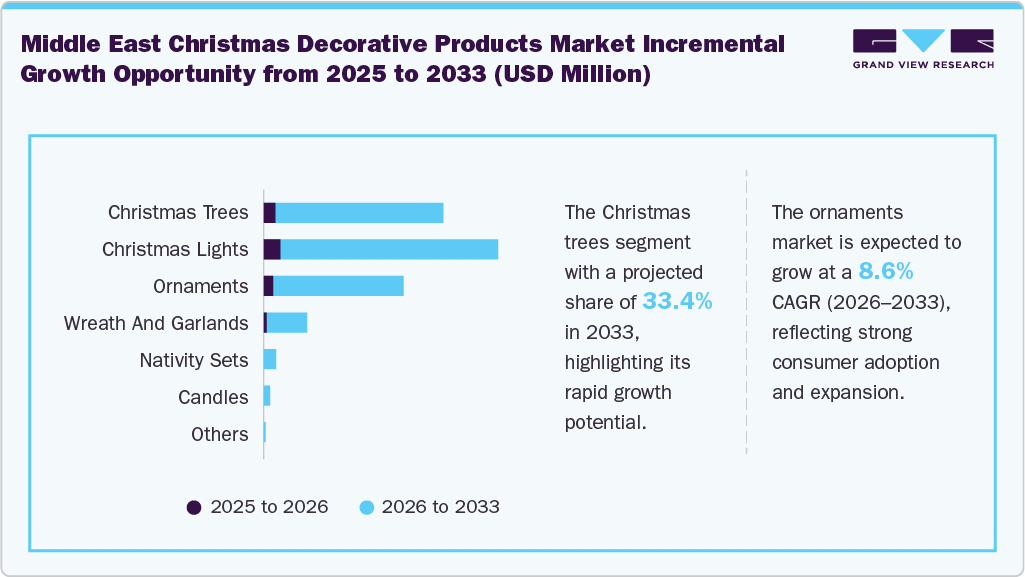
The ornaments segment is expected to grow at the fastest CAGR of 8.6% over the forecast period. Their frequent replacement and the higher profit on custom items drive strong value growth. Younger, digitally active consumers in the region are using ornaments for self-expression, looking for unique, handcrafted, or personalized pieces to make their holiday décor stand out each year. This makes ornaments an important area for retail growth. This growth is closely linked to the impact of e-commerce and social media, which encourages people to try new styles and update their home décor more often. Ornaments, as affordable accessories, make it easy for consumers to experiment with seasonal looks and embrace DIY culture. The segment boosts its sales by providing curated collections, limited-edition themes, and unique, high-quality artisanal products.
End Use Insights
The residential segment held the largest revenue share in 2025, driven by personal traditions and the large number of expatriate communities who keep strong cultural connections to the holiday. Most sales come from regular purchases of key items such as ornaments, festive tableware, and home lighting. Global trends, especially the interest in eco-friendly and personalized decorations, strongly shape consumer choices in this segment. Convenience and variety are the main factors driving purchases in the residential segment. Many residential buyers are also price-conscious, often looking for seasonal discounts and deals online.
The commercial segment is expected to grow at the fastest CAGR over the forecast period, driven by competition among retailers, hotels, and public venues to create memorable experiences that attract visitors and boost brand awareness. In GCC countries, businesses are spending more on large-scale decorations like facade lighting and themed displays during busy shopping seasons, turning malls and hotels into seasonal attractions. This growth is supported by increasing tourism and more visitors, as businesses see decor as a way to increase revenue by encouraging people to stay longer and share their experiences on social media. According to Dubai Department of Economy and Tourism, Dubai welcomed approximately 18.72 million international visitors from January to December 2024, reflecting a 9% increase over the previous year. This surge in tourism is expected to positively influence the commercial segment of the Middle East Christmas decorative products market.
Distribution Channel Insights
The offline segment made up the largest share of revenue at 73.6% in 2025. Hypermarkets, specialty stores, and busy mall kiosks lead this segment, offering a wide range of products from lights to wreaths. Many stores also provide in-store demonstrations to help customers decide what to buy. In popular locations including Dubai Mall and Al Nakheel Mall, these retailers use seasonal pop-up shops to create festive settings that attract shoppers looking for a real holiday experience. Their strong supply chains, which rely on buying in bulk from local wholesalers, help keep costs down and make it easy to restock quickly during the busy November and December months.
According to Saifee Rupawala, CEO of Lulu Retail, reported that around 690,000 daily visitors shop at Lulu’s and approximately 259 stores as of July 2025. This significant foot traffic is expected to boost the offline segment of the Middle East Christmas decorative products market by increasing demand for festive decorative products.
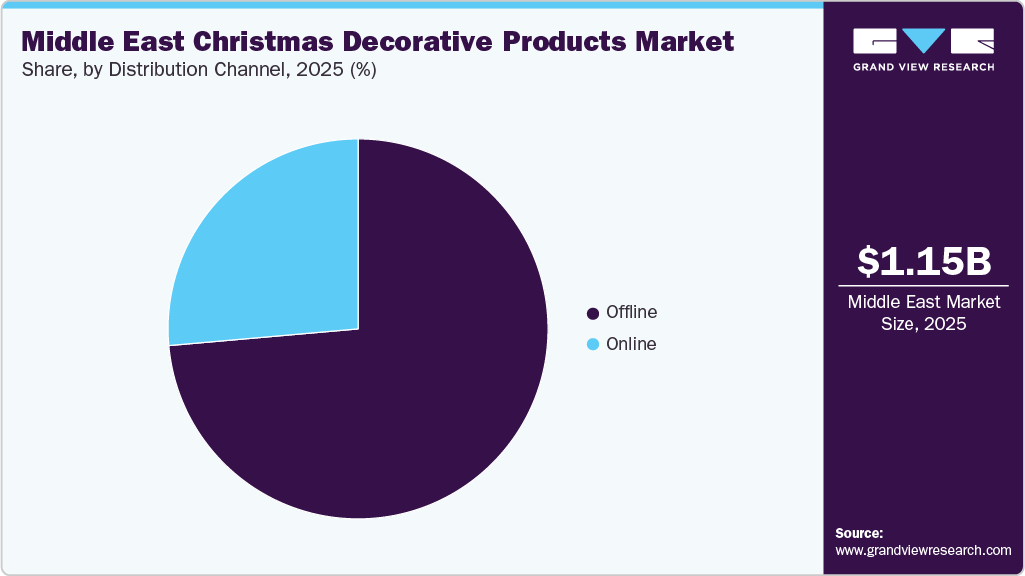
The online segment is expected to grow at the fastest CAGR of 8.3% over the forecast period, as more people are using digital services and enjoy the convenience of home delivery in cities and towns. E-commerce sites like Amazon.ae, Noon.com, and Jumia make it easy to browse a wide range of products, from LED light trees to personalized ornaments. These platforms attract tech-savvy millennials and busy professionals who want variety and good prices. Growth is also supported by strong digital marketing and easy-to-use apps with virtual previews, which help reach expatriate communities and remote buyers in places like the Gulf. According to the Telecommunications and Digital Government Regulatory Authority, the UAE saw about 569 million app downloads in 2023, up 16.4% from the previous year. This increase in app use is likely to boost the online Christmas decor market by making festive products more accessible.
Regional Insights
The Christmas decorations market in the Middle East is vibrant, driven by a mix of cultures, a festive atmosphere, and strong tourism. It caters to expatriates, affluent locals, and tourists in cities like Dubai, Abu Dhabi, and Riyadh. Shoppers can choose from handmade ornaments, LED garlands, artificial trees, and tableware with gold accents or desert-inspired designs, blending traditional holiday styles with local flair. Luxury hotels, shopping malls, and upscale homes all look for eye-catching, high-quality decorations, keeping demand strong. As more expatriates arrive and festive celebrations grow in popularity, the market keeps expanding. Seasonal events in major cities also boost demand. Both brick-and-mortar and online stores are growing, and local artisans are working with international brands to offer unique, sustainable, and premium products for the region’s diverse customers.
Key Middle East Christmas Decorative Products Company Insights
Key players undertake several strategic initiatives, such as mergers and acquisitions, and partnerships with other major companies.
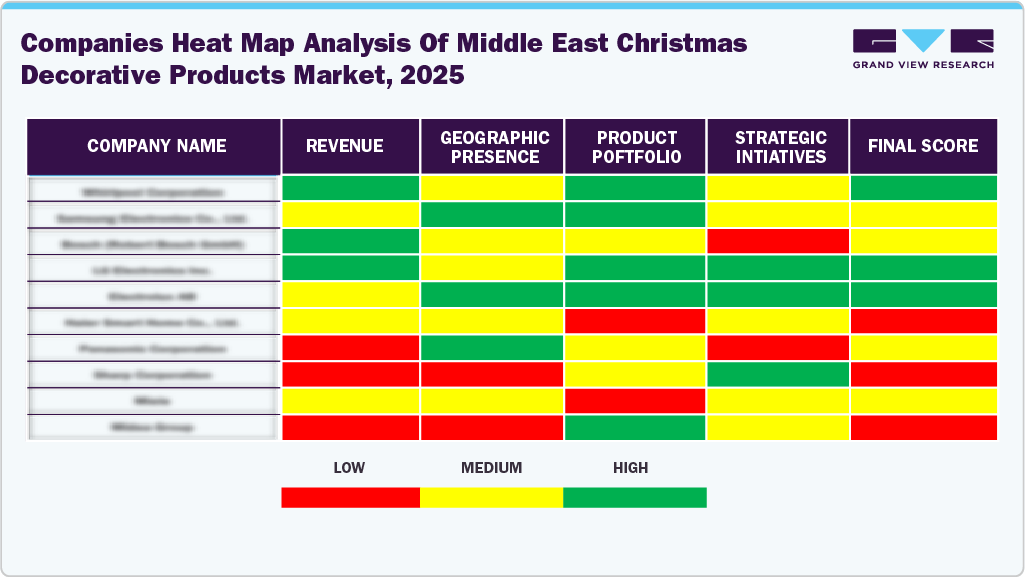
-
Shrih M is a festival decor manufacturing company offering a wide range of seasonal and festive decor products, including Christmas trees, ornaments, lighting, and gift items. Its focus on product variety, reliable sourcing, and timely delivery positions it as a competitive player in the regional market.
-
Ironyhome is a luxury home décor and lifestyle brand offering a wide range of premium festive decorations, home accessories, and custom design solutions. Its key focus is on combining timeless design, craftsmanship, and sustainability to create distinctive and high-quality decorative experiences.
Key Middle East Christmas Decorative Products Companies:
- Bethlehem Baubles
- Shrih M
- ironyhome
- Hope Plants
- Homekode
- Williams-Sonoma Inc.
Recent Developments
-
In October 2025, Irony Home, one of the leading UAE-based luxury seasonal decor brands, launched its exclusive Christmas Pop-Up at Mall of the Emirates, presenting elegant festive trees and decor pieces. The pop-up offers visitors an experience of design excellence and craftsmanship, reflecting the brand’s strong presence in premium holiday decor.
-
In November 2024, Emirates introduced its Christmas collection at its retail stores, featuring items such as Christmas jumpers, t-shirts, table runners, and reversible table mats. This launch is expected to enhance the Christmas decorative products market by increasing demand for branded, aviation-themed festive merchandise among travelers and expatriates.
Middle East Christmas Decorative Products Market Report Scope
|
Report Attribute
|
Details
|
|
Market size value in 2026
|
USD 1.22 billion
|
|
Revenue forecast in 2033
|
USD 1.93 billion
|
|
Growth rate
|
CAGR of 6.7% from 2026 to 2033
|
|
Base year for estimation
|
2025
|
|
Actuals
|
2021 - 2024
|
|
Forecast period
|
2026 - 2033
|
|
Quantitative units
|
Revenue in USD million and CAGR from 2026 to 2033
|
|
Report coverage
|
Revenue forecast, company ranking, competitive landscape, growth factors, trends
|
|
Segments covered
|
Product, end use, distribution channel, region
|
|
Regional scope
|
Middle East
|
|
Country scope
|
Saudi Arabia, UAE, Oman, Qatar
|
|
Key company profiled
|
Bethlehem Baubles, Shrih M, ironyhome, Hope Plants, Homekode, Williams-Sonoma Inc.
|
|
Customization scope
|
Free report customization (equivalent to 8 analysts working days) with purchase. Addition or alteration to country, regional & segment scope.
|
|
Pricing and purchase options
|
Avail customized purchase options to meet your exact research needs. Explore purchase options
|
Middle East Christmas Decorative Products Market Report Segmentation
This report forecasts revenue growth at the regional, and country levels and provides an analysis of the latest industry trends and opportunities in each of sub-segments from 2021 to 2033. For the purpose of this study, Grand View Research has segmented the Middle East Christmas decorative products market report on the basis of product, end use, distribution channel, and region:
-
Product Outlook (Revenue, USD Million, 2021 - 2033)
-
Christmas Trees
-
Christmas Lights
-
Ornaments
-
Wreaths and Garlands
-
Nativity Sets
-
Candles
-
Others
-
End Use Outlook (Revenue, USD Million, 2021 - 2033)
-
Residential
-
Commercial
-
Restaurants & Hotels
-
Malls
-
Corporate Offices
-
Others
-
Distribution Channel Outlook (Revenue, USD Million, 2021 - 2033)
-
Regional Outlook (Revenue, USD Million, 2021 - 2033)
-
Middle East
-
Saudi Arabia
-
UAE
-
Oman
-
Qatar
Frequently Asked Questions About This Report
b. The Middle East Christmas decorative products market was estimated at USD 1.15 billion in 2025 and is expected to reach USD 1.22 billion in 2026.
b. The Middle East Christmas decorative products market is expected to grow at a compound annual growth rate of 6.7% from 2026 to 2033 to reach USD 1.93 billion by 2033.
b. The Christmas trees segment held the largest market revenue share of 36.5% in 2025. This growth comes from their role as the main feature in both homes and, especially, commercial spaces.
b. The key players operating in the Middle East Christmas decorative products market are Bethlehem Baubles, Shrih M, ironyhome, Hope Plants, Homekode, and Williams-Sonoma Inc.
b. Several cultural and economic factors are driving market growth. Although Christmas is not a traditional religious holiday throughout the region, demand for festive decorations is strongest in areas with large expatriate communities, high tourism, and growing Western influence, especially in commercial centers such as the UAE and Saudi Arabia.

 Download Sample Report














