
- Home
- »
- Clothing, Footwear & Accessories
- »
-
Middle East Baby High Chair Market, Industry Report, 2033GVR Report cover
![Middle East Baby High Chair Market Size, Share & Trends Report]()
Middle East Baby High Chair Market (2025 - 2033) Size, Share & Trends Analysis Report By Product (Traditional, Convertible), By Material (Plastic, Metal/Mixed), By Price Tier (Economy, Premium), By Distribution Channel, By Country, And Segment Forecasts
- Report ID: GVR-4-68040-811-4
- Number of Report Pages: 100
- Format: PDF
- Historical Range: 2021 - 2024
- Forecast Period: 2025 - 2033
- Industry: Consumer Goods
- Report Summary
- Table of Contents
- Segmentation
- Methodology
- Download FREE Sample
-
 Download Sample Report
Market Size & Trends
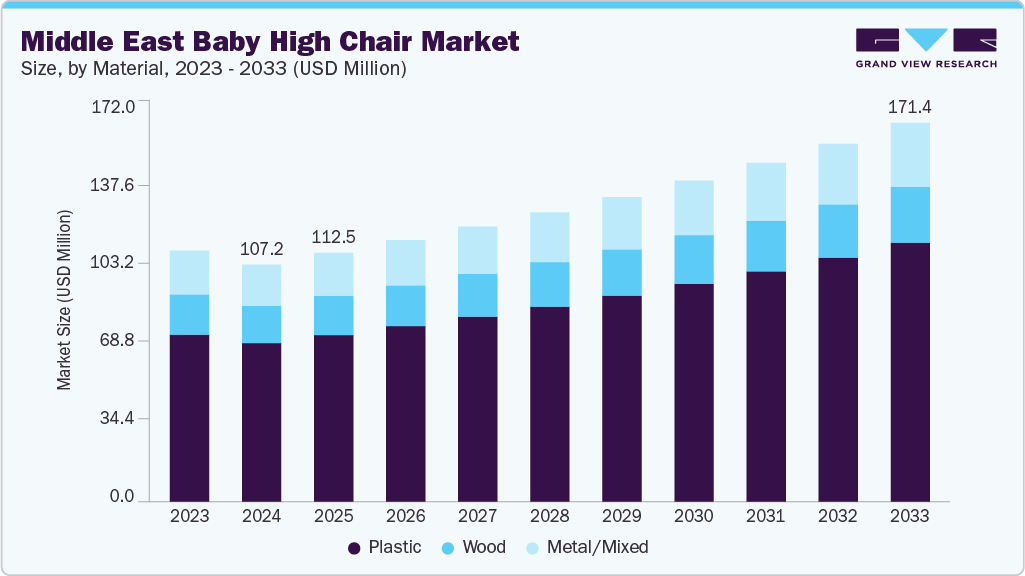
The Middle East baby high chair market size was valued at USD 107.2 million in 2024 and is expected to reach USD 171.4 million by 2033, growing at a CAGR of 5.4% from 2025 to 2033. Growth in the industry is driven by rising birth rates, increasing urbanization, which fuel demand for convenient, premium baby products.
Key Market Trends & Insights
- By product, traditional baby high chairs led the market with a share of 43.96% in 2024.
- By material, plastic led the market and accounted for a share of 66.74% in 2024.
- By price tier, the economy segment held the highest market share of 59.35% in 2024.
- By distribution channel, the offline sales accounted for a market share of 84.16% in 2024.
- By Country, Saudi Arabia held a market share of 39.42% in 2024.
Market Size & Forecast
- 2024 Market Size: USD 107.2 Million
- 2033 Projected Market Size: USD 171.4 Million
- CAGR (2025-2033): 5.4%
Expanding modern retail channels and growing brand awareness among young parents further support market expansion. A key ongoing trend in the industry is the rising preference for multifunctional and aesthetically designed models that complement modern home interiors. Parents, especially in urban and affluent households, are increasingly opting for convertible and foldable high chairs that combine safety, style, and space efficiency. This shift reflects growing exposure to global parenting brands through e-commerce and social media, along with a willingness to invest in durable, long-term baby gear that adapts to a child’s growth stages.The industry is benefiting from a steady rise in birth rates and the growing number of dual-income households, particularly in countries such as Saudi Arabia and the UAE. As more parents balance work and family life, there is a higher inclination toward functional baby products that simplify daily routines. This demand is further amplified by an expanding young population, higher spending on childcare essentials, and greater awareness of baby safety and ergonomics.
Another major driver is the growing penetration of international baby care brands and premium retail chains across the region. Global players are increasingly entering the market through partnerships with large retail stores and regional e-commerce platforms, bringing advanced design and safety standards. Local consumers are becoming more brand-conscious, seeking trusted products that align with Western design aesthetics and quality benchmarks, which is driving the shift from low-cost to mid- and high-end offerings.
In addition, the rapid expansion of digital retail and social media marketing has significantly influenced purchasing behavior. Platforms like Instagram and YouTube, along with parenting influencers, have created strong awareness around stylish and practical baby furniture. This visibility, coupled with convenient online purchasing options, has made branded high chairs more accessible to middle- and upper-income consumers, reinforcing long-term market growth in the Middle East.
Consumer Insights
The Middle East baby high chair industry reflects a dual consumer structure shaped by income disparity and lifestyle trends. A large proportion-around 65-70% of buyers-are value or mass consumers, primarily young families in countries like Saudi Arabia, Egypt, and the UAE’s mid-income expatriate population. These parents seek practical, safe, and affordable chairs suited for smaller living spaces, often opting for foldable or plastic models available through hypermarkets and online marketplaces. The premium or aspirational segment, accounting for 30-35%, is concentrated among affluent local households and Western expatriates in the Gulf region. This group prioritizes international brands with elegant design, multifunctionality, and safety certifications, viewing baby products as lifestyle extensions rather than purely functional necessities.
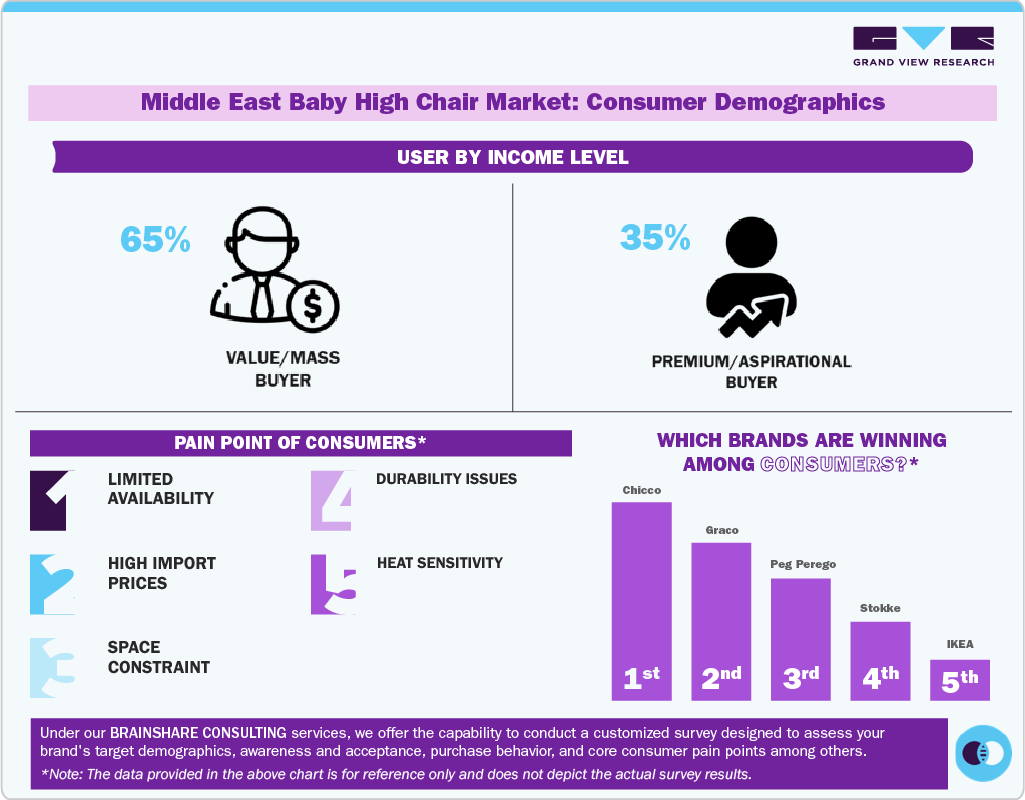
Key consumer pain points in the region include limited availability of branded options in physical stores, import dependency leading to high prices, space constraints in urban apartments, durability concerns with low-cost imports, and heat sensitivity of plastic materials that warp or degrade faster in regional climates. Additionally, some parents express frustration with inconsistent after-sales service and the lack of easy-to-clean materials suitable for local weather and dust conditions.
Among brands, Chicco and Graco maintain strong consumer trust for their durable and safety-certified models widely available through retailers like Babyshop and Mumzworld. Peg Perego and Stokke appeal to affluent urban parents seeking stylish, convertible, and ergonomic options, particularly in the UAE and Qatar. IKEA continues to dominate the mass segment through its affordable and minimalist Antilop chair, which aligns with regional demand for simplicity, hygiene, and value-for-money. These brands collectively shape the region’s competitive mix, balancing affordability with aspirational lifestyle appeal.
Product Insights
Traditional baby high chairs held a market share of 43.96% in 2024. The segment’s strength comes from consumer preference for sturdy, simple, and reliable products that withstand frequent use. Families in Saudi Arabia, the UAE, and Egypt often choose traditional models due to their stability and long-term usability, particularly for multi-child households. Their affordability and wide presence in offline baby stores and hypermarkets such as Babyshop and Carrefour have helped sustain their dominance in the region.
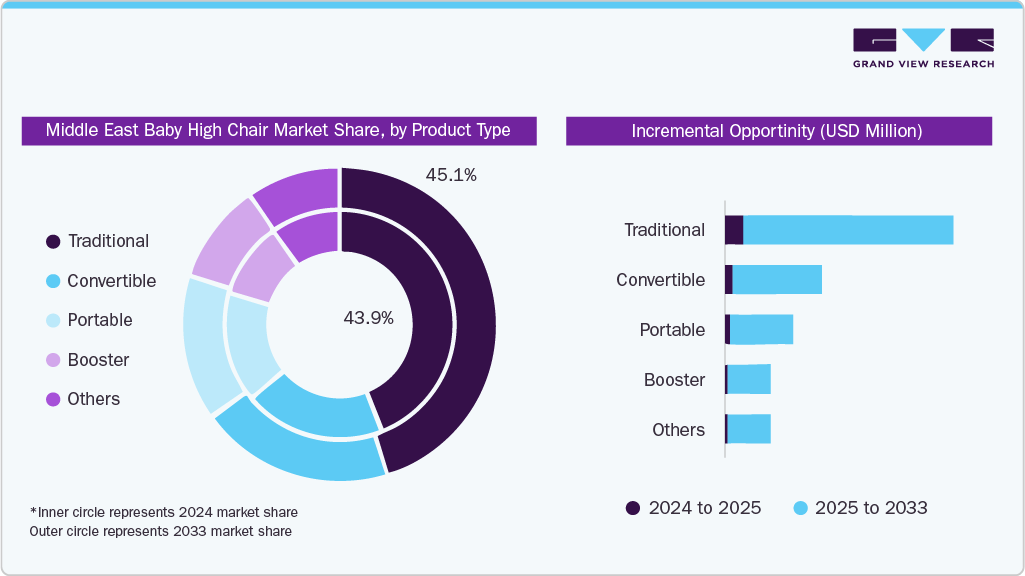
The convertible segment is anticipated to witness a CAGR of 5.4% from 2025 to 2033, driven by the rising popularity of multifunctional baby furniture among affluent families in urban Gulf markets. Parents in the UAE and Qatar, in particular, value adjustable and space-saving high chairs that can evolve with a child’s growth. Growing awareness of European safety standards and an increasing focus on long-term value over single-use functionality are boosting demand for brands like Stokke and Peg Perego that specialize in adaptable, premium products.
Material Insights
Plastic baby high chairs accounted for a revenue share of 66.74% in 2024, reflecting consumer focus on practicality, affordability, and hygiene. The hot and dry climate makes lightweight, easy-to-clean plastic models more appealing for daily use. Regional buyers favor brands such as IKEA and Graco for their durable, BPA-free, and UV-resistant materials. The prevalence of imported plastic models from Europe and Asia also keeps pricing competitive in the mid- and mass-market segments.
Metal/Mixed baby high chairs are anticipated to grow at a CAGR of 5.1% from 2025 to 2033, supported by increasing interest in durable, high-end designs among upper-middle-class families in the Gulf. Consumers in the UAE, Kuwait, and Qatar often view these products as part of home décor, preferring sleek, minimalist styles that fit modern interiors. Brands offering metal-wood combinations and Scandinavian-inspired designs, such as Stokke and Joovy, are particularly well-received in premium retail stores and online boutiques.
Price Tier Insights
Economy baby high chairs accounted for over 59.35% revenue share in 2024, reflecting the large base of price-sensitive consumers, including expatriate families and middle-income households across Saudi Arabia, Egypt, and Oman. These buyers prioritize basic safety and practicality at an affordable cost. The category benefits from the availability of locally distributed brands and imported models from Asia through retailers like Lulu Hypermarket and Mumzworld, offering low-cost, certified options.
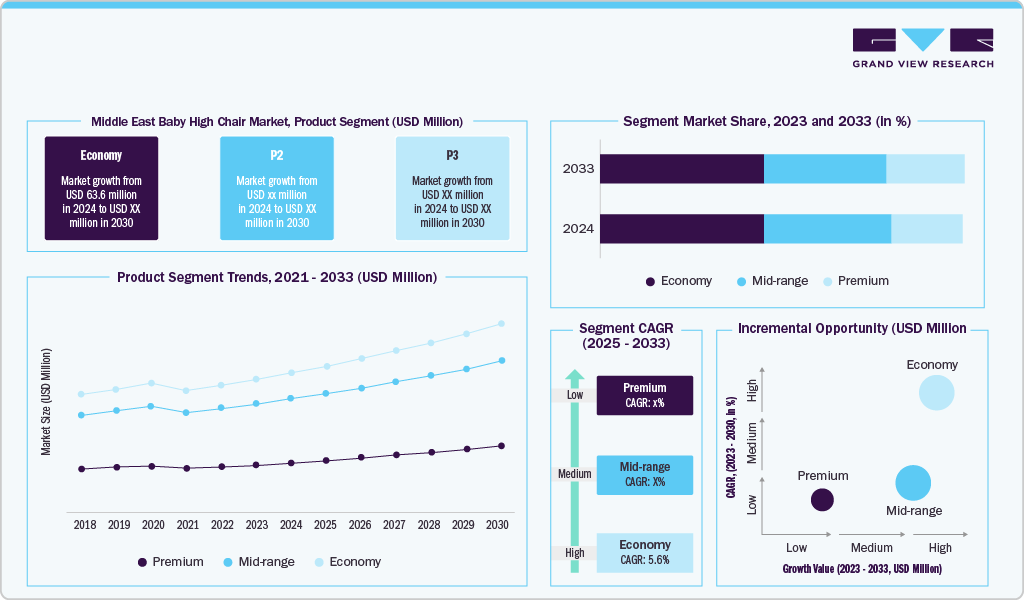
The mid-range high chair segment is anticipated to grow at a CAGR of 5.3% from 2025 to 2033, as working parents in urban areas opt for better comfort, design, and brand reliability without entering the luxury price bracket. This segment appeals to young professional couples and higher-income expatriates in the UAE and Saudi Arabia who seek value-added features like adjustable trays, reclining seats, and compact folding. Retailers are increasingly promoting mid-tier international brands such as Chicco and Graco to meet this rising demand.
Distribution Channel Insights
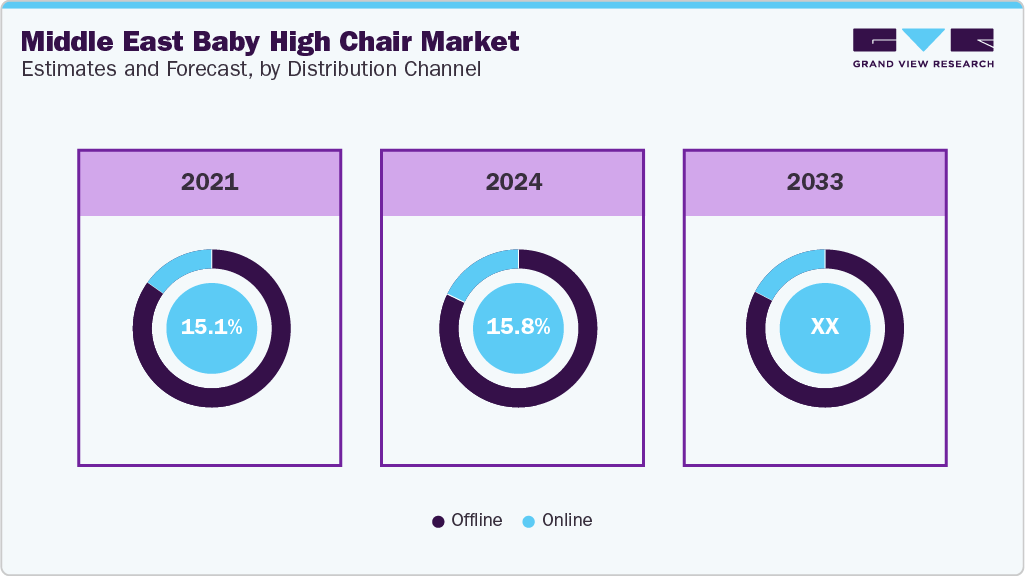
The sale of baby high chair through offline channels accounted for 84.16% of the market. Parents prefer visiting physical stores to assess safety, sturdiness, and comfort before purchasing, especially for higher-ticket items. Baby specialty stores like Babyshop, Mothercare, and Toys “R” Us, along with hypermarkets such as Carrefour and Lulu, dominate sales. Strong customer trust, easy product returns, and installment options continue to make in-store purchases the preferred choice.
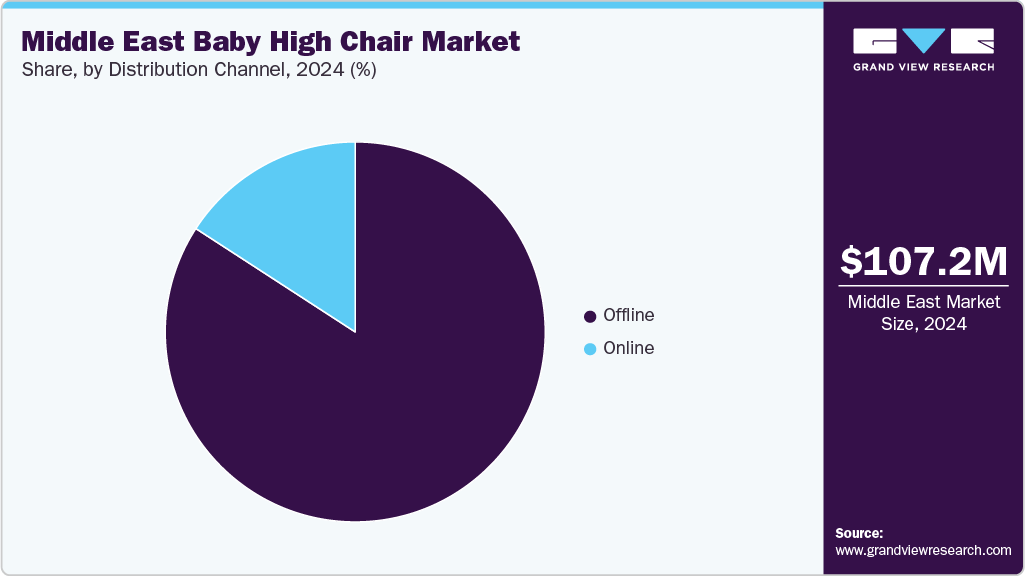
The sale of baby high chair through the online channel is expected to grow at a CAGR of 6.9% from 2025 to 2033, led by expanding e-commerce adoption in the UAE and Saudi Arabia. Platforms like Mumzworld, Amazon.ae, and FirstCry Middle East are rapidly gaining traction, offering a wide product variety and doorstep convenience. Rising smartphone usage, influencer-driven marketing, and increasing comfort with online payments have accelerated digital adoption, especially among millennial parents. Premium international brands are also leveraging DTC websites to reach affluent consumers across the region.
Country Insights
The Saudi Arabia baby high chair market held a revenue share of 39.42%, making it the largest market in the region. The strong performance stems from the country’s high birth rate, expanding middle-income population, and growing focus on baby safety and comfort. Saudi families typically prefer traditional and plastic high chairs due to their durability and affordability, but urban consumers in Riyadh and Jeddah are increasingly shifting toward convertible and premium models with enhanced features. The market is supported by widespread availability through established offline channels such as Babyshop, Mothercare, and hypermarkets, coupled with the growing influence of online retail platforms like Noon and Amazon.sa.
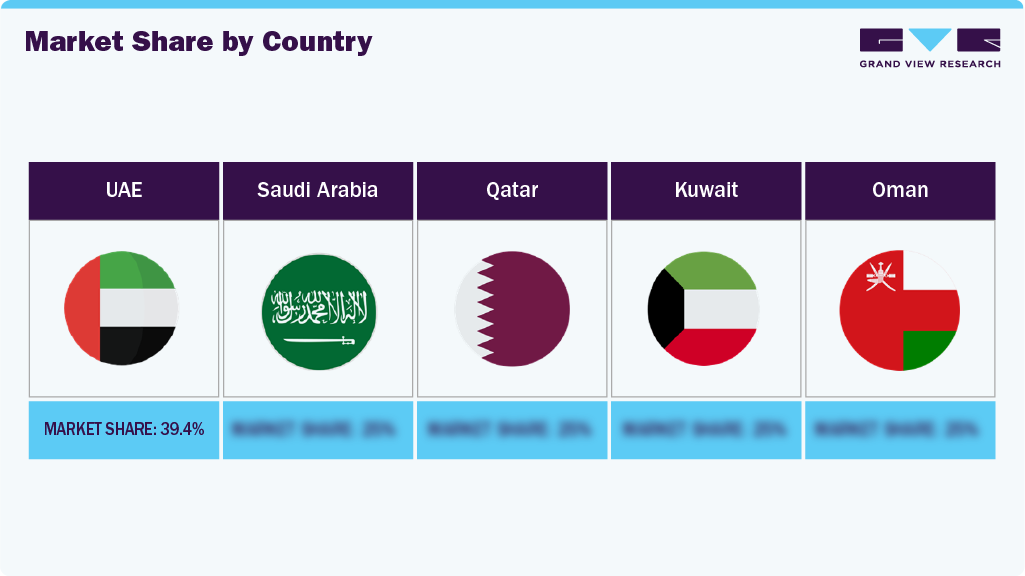
The Oman baby high chair market is anticipated to witness a CAGR of 6.7% from 2025 to 2033, driven by rising disposable incomes and increasing awareness of global baby care standards. Demand is particularly strong among younger families in Muscat and emerging urban centers, where modern lifestyles are encouraging the adoption of multifunctional and space-saving baby products. Growth is further supported by the expansion of e-commerce and brand partnerships with regional distributors, making international brands like Chicco and IKEA more accessible. As consumer preferences evolve toward convenience, safety, and design aesthetics, the market is expected to maintain steady momentum throughout the forecast period.
Key Middle East Baby High Chair Company Insights
The Middle East baby high chair market is characterized by a mix of international premium brands, regional distributors, and value-oriented players catering to the diverse needs of a consumer base across various income levels. Global names such as Chicco, Graco, and Peg Perego maintain strong visibility through established retail partners like Babyshop, Mothercare, and Toys “R” Us, appealing to affluent and middle-income families who prioritize quality, comfort, and international safety certifications. Their dominance is reinforced by the rising number of expatriate families and growing brand familiarity among young parents in Gulf Cooperation Council (GCC) countries.
Premium European and design-focused brands, such as Stokke, Nuna, and Joie, have carved out a niche among urban, aspirational buyers in Saudi Arabia, the UAE, and Qatar, where modern homes and luxury-oriented lifestyles drive a preference for ergonomic, space-saving, and aesthetically refined high chairs. These brands benefit from premium retail visibility in malls and baby boutiques as well as increasing digital exposure through influencer-led marketing and parenting communities.
At the same time, regional and Asian-origin brands such as Babyshop’s in-house lines, Farlin, and Apramo are expanding their footprint by offering safe, affordable alternatives suited for value-driven families. Their products are gaining traction in secondary cities and among young couples seeking functionality without high import costs. This layered market structure-combining luxury imports, mid-range global players, and cost-effective regional brands-continues to define competition and consumer segmentation across the industry.
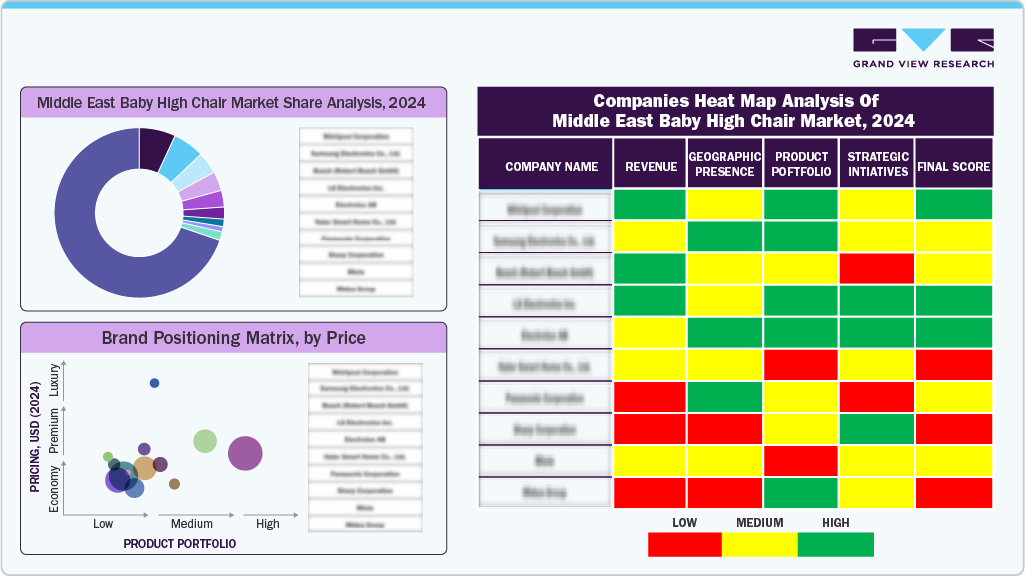
Key Middle East Baby High Chair Companies:
- Artsana Group (Chicco)
- Newell Brands (Graco)
- IKEA
- Peg Perego S.p.A.
- Evenflo Company, Inc.
- Joie International
- Nuna International B.V.
- Stokke AS
- Fisher-Price (Mattel Inc.)
- Hauck GmbH & Co. KG
Recent Developments
-
In May 2024, Babyshop launched its “Destination of Choice” initiative across the Middle East, reinforcing its position as the region’s leading retailer for baby and maternity products. The campaign highlighted Babyshop’s extensive store network, expanding online platform, and curated range of trusted global brands such as Cybex, Joie, and Nuna, while emphasizing enhanced in-store experiences like mother’s rooms and personalized shopping support to meet the evolving needs of modern parents.
Middle East Baby High Chair Market Report Scope
Report Attribute
Details
Market size value in 2025
USD 112.5 million
Revenue forecast in 2033
USD 171.4 million
Growth rate (revenue)
CAGR of 5.4% from 2025 to 2033
Actuals
2021 - 2024
Forecast period
2025 - 2033
Quantitative units
Revenue in USD million/billion, and CAGR from 2025 to 2033
Report coverage
Revenue forecast, company ranking, competitive landscape, growth factors, and trends
Segments covered
Product, price tier, material, distribution channel, country
Country scope
Saudi Arabia; Oman; UAE; Kuwait; Qatar
Key companies profiled
Artsana Group (Chicco); Newell Brands (Graco); IKEA; Peg Perego S.p.A.; Evenflo Company, Inc.; Joie International; Nuna International B.V.; Stokke AS; Fisher-Price (Mattel Inc.); Hauck GmbH & Co. KG
Customization scope
Free report customization (equivalent up to 8 analysts working days) with purchase. Addition or alteration to country, regional & segment scope.
Pricing and purchase options
Avail customized purchase options to meet your exact research needs. Explore purchase options
Middle East Baby High Chair Market Report Segmentation
This report forecasts revenue growth at the regional and country levels and provides an analysis of the latest industry trends and opportunities in each of the sub-segments from 2021 to 2033. For this study, Grand View Research has segmented the Middle East baby high chair market report on the basis of product, material, price tier, distribution channel, and country.
-
Product Outlook (Revenue, USD Million, 2021 - 2033)
-
Traditional
-
Convertible
-
Portable
-
Booster
-
Others
-
-
Price Tier Outlook (Revenue, USD Million, 2021 - 2033)
-
Economy
-
Mid-range
-
Premium
-
-
Material Outlook (Revenue, USD Million, 2021 - 2033)
-
Plastic
-
Wood
-
Metal/Mixed
-
-
Distribution Channel (Revenue, USD Million, 2021 - 2033)
-
Online
-
E-commerce marketplaces
-
Brand/DTC sites
-
-
Offline
-
Baby specialty stores
-
Hypermarkets/Supermarkets
-
Furniture stores
-
-
-
Country Outlook (Revenue, USD Million, 2021 - 2033)
-
Saudi Arabia
-
Oman
-
UAE
-
Qatar
-
Kuwait
-
Frequently Asked Questions About This Report
b. The Middle East baby high chair market is expected to grow at a compound annual growth rate (CAGR) of 5.4% from 2025 to 2033 to reach USD 171.4 million by 2033.
b. The Middle East baby high chair market size was estimated at 107.2 million in 2024 and is expected to reach USD 112.5 million in 2025.
b. Traditional baby high chair held a market share of 43.96% in 2024. The segment’s share can be attributed to consumer preference for sturdy, simple, and reliable products that withstand frequent use.
b. Some key players in the Middle East baby high chair market include Artsana Group (Chicco); Newell Brands (Graco); IKEA; Peg Perego S.p.A.; Evenflo Company, Inc.; Joie International; Nuna International B.V.; Stokke AS; Fisher-Price (Mattel Inc.); Hauck GmbH & Co. KG
b. The Middle East baby high chair market is rising birth rates, increasing urbanization that fuels demand for convenient, premium baby products. Expanding modern retail channels and growing brand awareness among young parents further support market expansion.


Share this report with your colleague or friend.
Need a Tailored Report?
Customize this report to your needs — add regions, segments, or data points, with 20% free customization.


ISO 9001:2015 & 27001:2022 Certified
We are GDPR and CCPA compliant! Your transaction & personal information is safe and secure. For more details, please read our privacy policy.
Trusted market insights - try a free sample
See how our reports are structured and why industry leaders rely on Grand View Research. Get a free sample or ask us to tailor this report to your needs.












