Love Hotels Market Summary
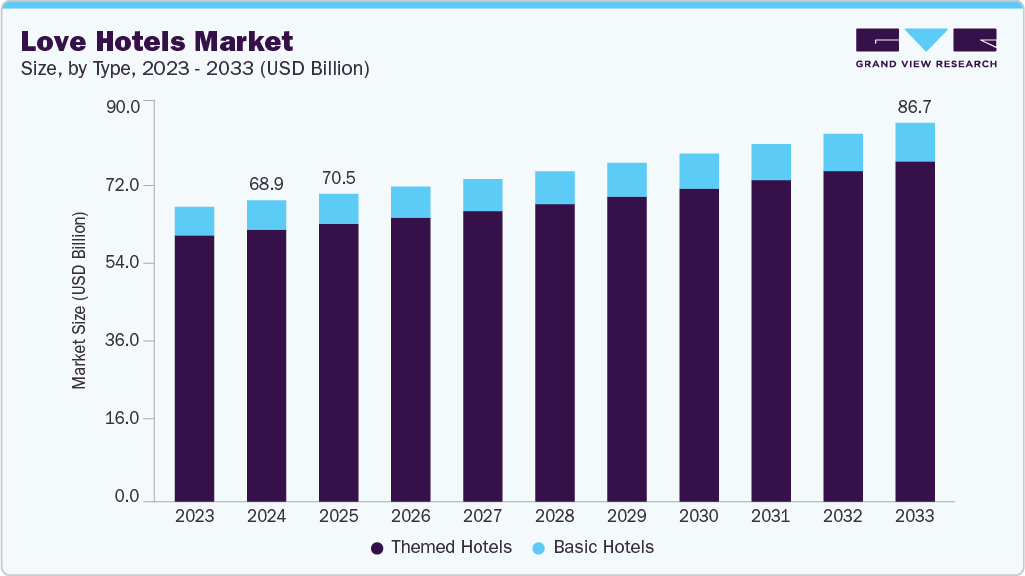
The global love hotels market size was valued at USD 70.48 billion in 2025 and is projected to reach USD 86.75 billion by 2033, growing at a CAGR of 2.7% from 2026 to 2033. The global love hotels market is primarily driven by the growing demand for privacy and anonymity, changing social attitudes toward personal relationships, rising disposable incomes, increased tourism and travel, and the surging demand for luxurious and personalized stay experiences.
Key Market Trends & Insights
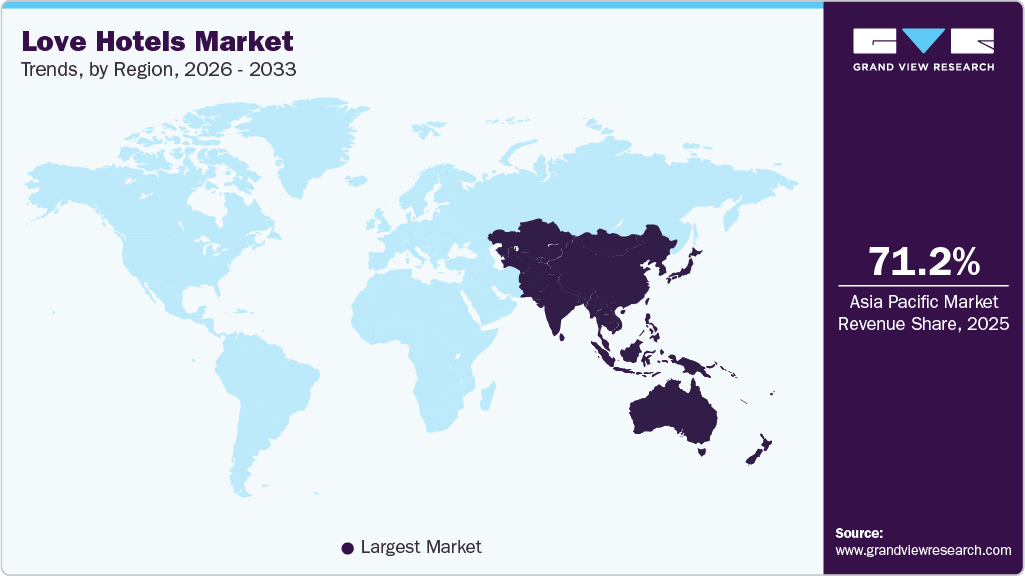
- Asia Pacific held the largest share of 71.2% in the global love hotels market in 2025.
- Japan dominates the APAC region in the love hotels market.
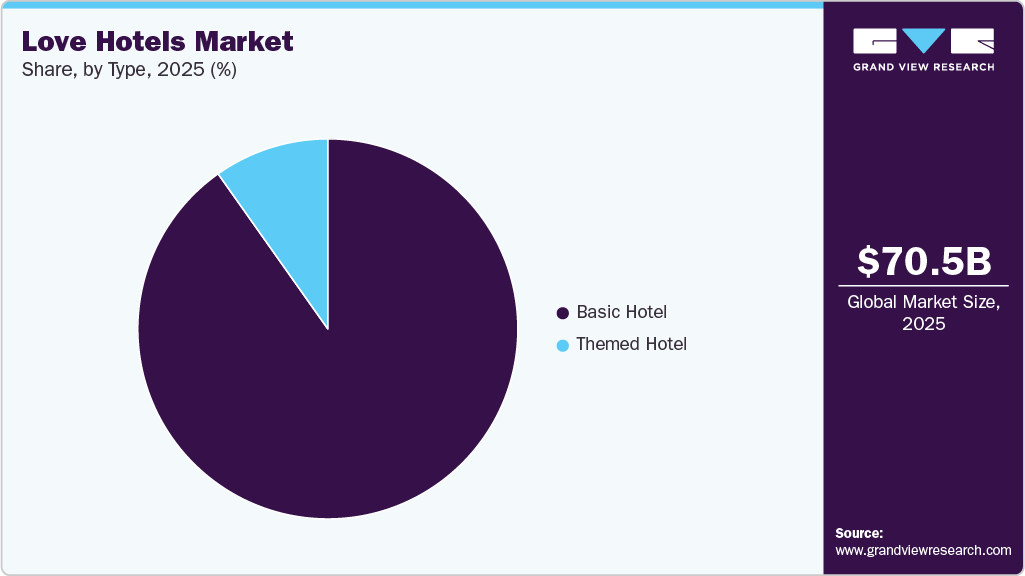
- By type, the basic hotel segment held the largest market share of 90.2% in 2025.
- The themed hotel segment is expected to grow with the highest CAGR from 2026 to 2033.
Market Size & Forecast
- 2025 Market Size: USD 70.48 Billion
- 2033 Projected Market Size: USD 86.75 Billion
- CAGR (2026-2033): 2.7%
- Asia Pacific: Largest market in 2025
As consumer spending power increases and travel-conscious populations grow, the demand for short stays and boutique hotels continues to rise. In addition, there is a growing emphasis on sustainable and experiential tourism. Travelers are increasingly demanding personalized, private, and themed lodging options that offer more than just ordinary stays. These trends, along with the influence of online booking and quick payment methods, are reshaping the global love hotels market and driving its ongoing evolution.
The global love hotel market is driven by a combination of rising consumer demand for luxury and themed hotels, along with rapid technological advancements. Innovations such as unique themed rooms, virtual reality gaming suites, wellness retreats, and romantic art deco-inspired accommodations that cater to diverse fantasies and not just romantic stays, are drawing interest from consumers seeking experimental lodging. For instance, the Hotel Festa Qugiela in Okayama is a love hotel uniquely designed to resemble a huge pink concrete whale that stands ready to swallow guests inside its mouth, which serves as the hotel's entrance. They offer private stays, often featuring unique, elaborate, or fantastical room themes that provide an escape from daily life.
Consumer Insights
The younger generation is comparatively open with respect to expressing their appeals, and hence, concepts such as love hotels are gaining popularity among young consumers. Most of the younger urban population in developing countries live either with their parents/ siblings or roommates in shared living. The need for private, safe, and judgment-free spaces has promoted recognition of love hotels among couples seeking anonymity. Love hotels often provide intimate spaces and desirable experiences for a short time at a fraction of the room tariffs. Consequently, safety, experience, and affordability are the major factors encouraging the expansion of the love hotel business models.
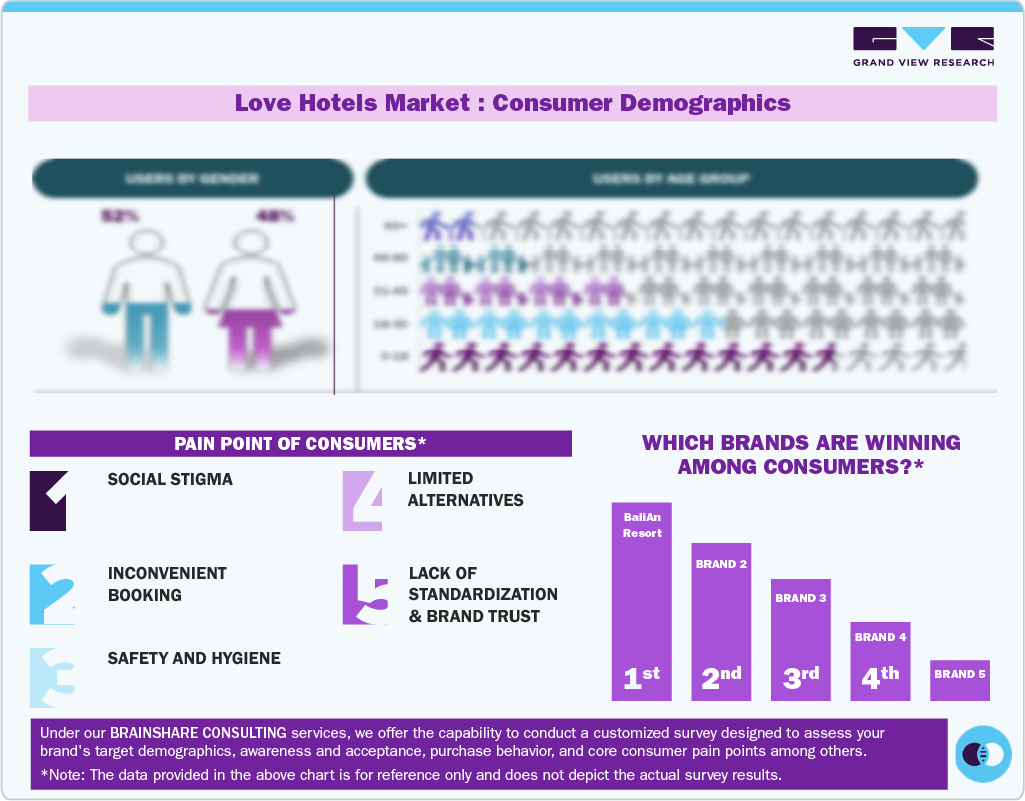
Digitization and social media are also playing a vital role in reducing the social stigma about love hotels among consumers. Travel and tourism booking platforms are increasingly providing booking facilities for local love hotels for hourly or day-use pricing. This helps consumers to procure services with full anonymity. Other features such as contactless check-ins, in-room facilities, and themed experiences are also key factors boosting the demand for love hotels. Additionally, hotels are also promoting themselves as fun and an experience place which will encourage consumers to enjoy their time and promote their experience on social media. Although the social stigma is still restraining the consumer’s perception.
Type Insights
The basic hotel segment accounted for the largest revenue share of 90.2% in 2025. Basic love hotels are simple, no-frills rooms meant for privacy and short stays. These hotels are designed to include basic facilities, including a clean bed, bathroom, television unit, and essential toiletries. Such properties compete on price, ease of booking, and location, which is particularly close to transport hubs or city centers. There is a surging demand for low-cost, short-stay, basic lodging and hotels, as solo travelers and young travelers primarily look for affordable and private options.
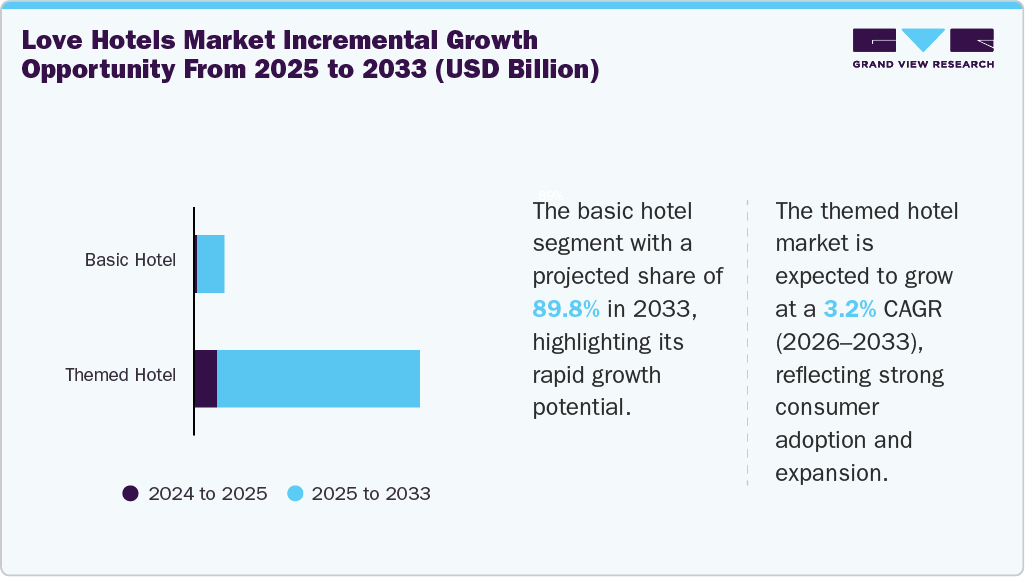
The growth of the themed segment is influenced by increasing disposable income, rising demand for luxury accommodations, and growing travel and tourism, particularly among honeymoon couples who require privacy and personal space. Themed love hotels consist of rooms with distinct concepts, such as VR gaming suites, wellness rooms, art deco romance sets, or fantasy or movie-themed interiors. Themed rooms cater to guests who seek an experience. In recent years, hotels have been investing in creative, Instagram-friendly rooms and interactive features to stand out. BnA Art Hotel is an art hotel with locations in Tokyo and Kyoto. The hotel showcases rooms with unique and immersive art installations created by local artists. The hotel operates on a socially conscious model, sharing a portion of each booking's revenue directly with the artist to support the local creative community.
Regional Insights
The North America love hotels market held a significant market share in 2025. Demand for short-stay love hotels in North America is driven by the need for low-cost, low-interaction lodging, often located near highways or airports, for travelers seeking short-term stays. Factors such as rising domestic and business travel and the innovation of online platforms that facilitate hourly and daily bookings also contribute to market growth. Overall market growth is shifting toward conversion-led expansion, with a clear distinction between high-growth luxury and standard economy hotel segments.
U.S. Love Hotels Market Trends
The U.S. love hotel market is expected to grow significantly over the forecast period, with a notable surge in domestic and business travel. The recovery of the U.S. lodging market following the COVID-19 pandemic and substantial growth in the short-term rental segment have prompted operators to experiment with flexible stays, day-use rooms, and the rebranding of economy motels. Regulatory local zoning and stigma for anything resembling adult-only use limit the explicit love hotel model; however, the micro-stay and day-use segments are growing at a significant rate. The market is further expected to grow through tech-enabled online bookings, airport or city-center day rooms, and the repurposing of lower-tier hotels into hourly-stay options, capturing the growing demand.
Europe Love Hotels Market Trends
The love hotels market in Europe is projected to grow at a considerable growth rate from 2026 to 2033. Europe's love hotels market is driven by rising international tourist arrivals, strong demand for authentic, localized boutique experiences, and the growth of the leisure travel industry. Europe’s short-stay market is expanding rapidly through short-term rentals and day-use offerings, driven by a rise in international tourists and city events. Cultural stigma toward “love hotels” is higher in Europe compared to East Asia; therefore, most operators in the region position themselves as boutique motels, design hotels, or day-use rooms rather than love hotels. Local boutique groups, short-term rental platforms, and the increasing use of online booking services are contributing to the growth of the love hotels market in this region.
Asia Pacific Love Hotels Market Trends
Asia Pacific led the love hotels market, accounting for the largest market share of 71.2% in 2025. The Asia Pacific region is renowned as the historical home of the love hotel model, having witnessed a fundamental evolution of the short-stay concept. The region is driven by rapid growth of the middle-class population, an increase in disposable income, rising domestic and international tourism (especially intra-regional travel), and demand for unique, experiential accommodations. Online booking and tech platforms collectively contribute to the growth of this market. Significant investments in the development of new properties and conversions by major international chains, particularly in high-end/luxury segments, are favoring the market growth in this region. Emergence of branded hotels is further expected to contribute to the growth of the love hotels market in this region.
Japan Love Hotels Market Trends
Japan dominates the APAC region in the love hotels market. Japan is the traditional home of the "love hotel" (Rabu Hoteru), where the concept is deeply embedded in the culture for privacy and themed escapism. The key factors contributing to the market growth in Japan are high demand for private, short-term hourly or nightly stays, driven by small apartment sizes, a desire for privacy from family, and a strong cultural appreciation for fantasy and themed environments. Increasing tourism inflows from other countries are also driving demand for stays offering a unique experience. In recent years, many older love hotels have undergone renovations, rebranding, or been repositioned as themed boutique stays to attract both local couples and novelty-seeking tourists. Stigma is declining as operators modernize and target mainstream guests.
Key Love Hotels Company Insights
Many brands in the love hotels market have recognized untapped opportunities within their services and are actively working to capitalize on these gaps. This includes launching innovative designer themes, expanding customization options, and tailoring marketing strategies to align with evolving customer needs and cultural trends. By addressing niche segments and emerging preferences, these brands aim to increase their market share and strengthen their competitive positioning worldwide.
Key Love Hotels Companies:
The following key companies have been profiled for this study on the love hotels market.
- BaliAn Resort
- SARA Kinshicho
- Yanolja Co. Ltd.
- Drops Moteis
- Zaya Motel Premium
- Ohya Boutique Motel
- MoonArea Business Leisure Motel
- Beppu Hotspring Terrace Midobaru
- The Atta Terrace Club Towers
- Hotel Festa Qugiela
- Wyndham Hotels & Resorts Inc.
- Choice Hotels International
Recent Developments
-
In November 2025, Yanolja Co. Ltd., originally a platform focused on short-stay bookings, including love hotels in South Korea, announced its plan to rebrand and expand its travel and hospitality offerings globally, following the launch of its “Yanolja Go Global” brand. It signals that companies rooted in the love hotels and short-stay model are seeking to diversify and globalize, rather than staying in the niche.
-
In March 2025, in Brazil’s city of Belém, ahead of the huge COP30 climate summit, some love hotel-style accommodations were used in creative ways to address lodging shortfalls. This shows how lodging assets normally outside the mainstream (motel/love-hotel style) can gain demand and relevance when hotel supply is tight for major events.
Love Hotels Market Report Scope
|
Report Attribute
|
Details
|
|
Market value size in 2026
|
USD 72.09 billion
|
|
Revenue forecast in 2033
|
USD 86.75 billion
|
|
Growth Rate (Revenue)
|
CAGR of 2.7% from 2026 to 2033
|
|
Actuals
|
2021 - 2025
|
|
Forecast period
|
2026 - 2033
|
|
Quantitative (Revenue) units
|
Revenue in USD million/billion, and CAGR from 2026 to 2033
|
|
Report coverage
|
Revenue forecast, company ranking, competitive landscape, growth factors, and trends
|
|
Segments covered
|
Type, region
|
|
Regional scope
|
North America, Europe, Asia-Pacific, Central & South America, Middle East & Africa
|
|
Country scope
|
U.S., Canada, Mexico, Germany, U.K., France, Italy, Spain, China, India, Japan, Australia & New Zealand, South Korea, Brazil, Argentina
|
|
Key companies profiled
|
BaliAn Resort, SARA Kinshicho, Yanolja Co. Ltd., Drops Moteis, Zaya Motel Premium, Ohya Boutique Motel, MoonArea Business Leisure Motel, Beppu Hotspring Terrace Midobaru, The Atta Terrace Club Towers, Hotel Festa Qugiela, Wyndham Hotels & Resorts Inc., Choice Hotels International.
|
|
Customization scope
|
Free report customization (equivalent up to 8 analysts’ working days) with purchase. Addition or alteration to country, regional & segment scope.
|
|
Pricing and purchase options
|
Avail customized purchase options to meet your exact research needs. Explore purchase options
|
Global Love Hotels Market Report Segmentation
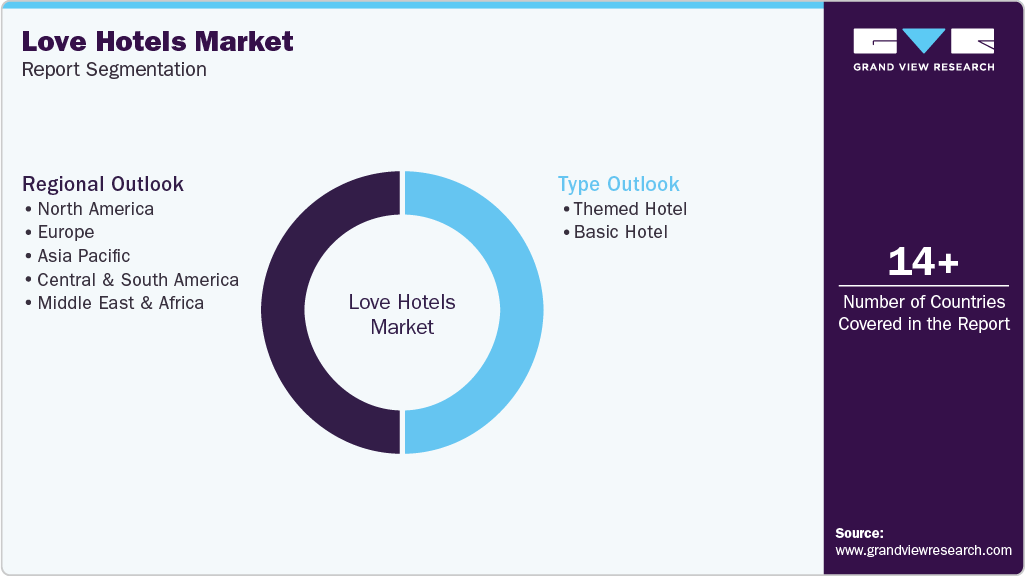
This report forecasts revenue growth at the global, regional and country levels and provides an analysis of the latest industry trends and opportunities in each of the sub-segments from 2021 to 2033. For the purpose of this study, Grand View Research has segmented the global love hotels market report on the basis of type and region.
-
Type Outlook (Revenue, USD Million, 2021 - 2033)
-
Regional Outlook (Revenue, USD Million, 2021 - 2033)
-
North America
-
Europe
-
Germany
-
U.K.
-
France
-
Italy
-
Spain
-
Asia Pacific
-
China
-
India
-
Japan
-
South Korea
-
Australia & New Zealand
-
Central & South America
-
Middle East & Africa

 Download Sample Report














