
- Home
- »
- Clothing, Footwear & Accessories
- »
-
Loafers Market Size, Share & Trends, Industry Report, 2033GVR Report cover
![Loafers Market Size, Share & Trends Report]()
Loafers Market (2026 - 2033) Size, Share & Trends Analysis Report By Product (Leather, Fabric), By End Use (Men, Women, Kids), By Distribution Channel (Specialty Footwear Retailers, Supermarkets/Hypermarkets, Online), By Region, Segment Forecasts
- Report ID: GVR-3-68038-519-9
- Number of Report Pages: 110
- Format: PDF
- Historical Range: 2021 - 2024
- Forecast Period: 2026 - 2033
- Industry: Consumer Goods
- Report Summary
- Table of Contents
- Segmentation
- Methodology
- Download FREE Sample
-
 Download Sample Report
Loafers Market Summary
The global loafers market size was estimated at USD 35.82 billion in 2025 and is projected to reach USD 49.11 billion by 2033, growing at a CAGR of 4.1% from 2026 to 2033. The global loafers industry is experiencing steady growth, driven by evolving workplace fashion norms and rising consumer demand for versatile, comfort-driven footwear.
Key Market Trends & Insights
- Asia Pacific dominated the global loafers market with the largest revenue share of 40.31% in 2025.
- By product type, the leather loafers segment led the market with the largest revenue share of 47.18% in 2025.
- By end use, the men segment led the market with the largest revenue share of 51.49% in 2025.
- By distribution channel, the specialty footwear retailers segment led the market with the largest revenue share of 45.64% in 2025.
Market Size & Forecast
- 2025 Market Size: USD 35.82 Billion
- 2033 Projected Market Size: USD 49.11 Billion
- CAGR (2026-2033): 4.1%
- Asia Pacific: Largest market in 2025
Loafers have increasingly transitioned from being a formal wardrobe staple to a hybrid footwear category suitable for both professional and leisure environments. The growing acceptance of smart-casual office dressing has significantly supported this shift. According to Esquire UK's fashion coverage, designers and footwear brands are redefining loafers with experimental silhouettes, chunkier soles, and unconventional detailing, reflecting how consumers are embracing relaxed yet expressive professional attire. This transformation is particularly visible among urban professionals who seek footwear that seamlessly transitions between office settings, social gatherings, and travel usage, contributing to the rising influence of the chunky loafers industry within the broader category.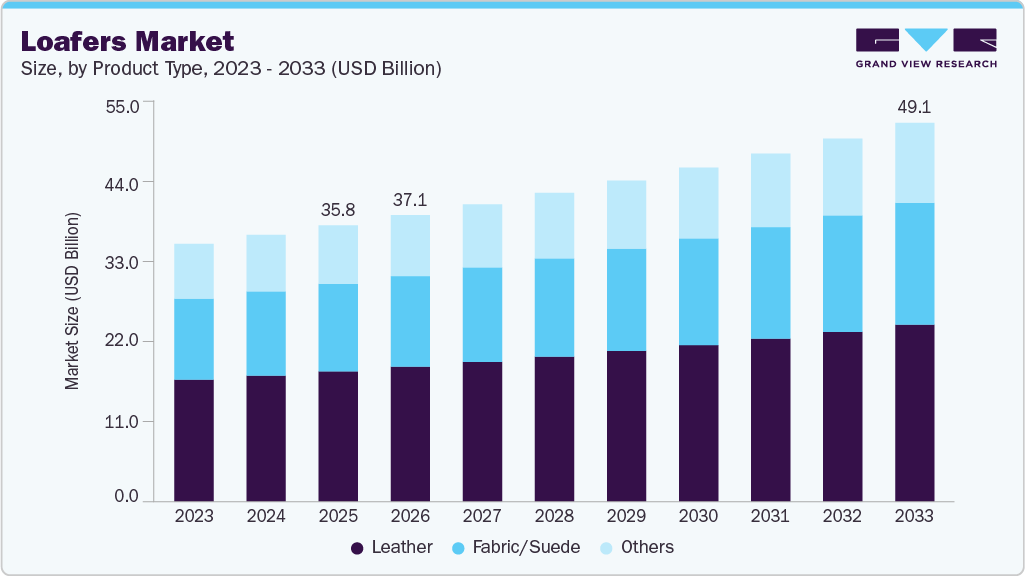
Changing consumer fashion preferences, especially among millennials and Gen Z buyers, are further reshaping product design and material usage. A Bloomberg article published in May 2024 highlighted the rising popularity of bold, non-traditional loafers, which include colorful suede variants, woven textures, and decorative elements that deviate from conventional black or brown leather styles. The article specifically showcases brands introducing adventurous summer loafers with bright color palettes, breathable materials, and lightweight constructions for warm-weather use. Such product diversification reflects how loafers are evolving into fashion-forward lifestyle footwear rather than purely formal accessories. The growing consumer inclination toward statement footwear continues to strengthen premiumization trends, further supporting demand across the chunky loafers industry as buyers increasingly gravitate toward platform-inspired and design-led footwear styles.
Technological and manufacturing advancements are strengthening product differentiation across the market. Footwear manufacturers are integrating cushioned insoles, ergonomic footbeds, flexible rubber outsoles, and breathable linings to improve long-duration comfort. Premium leather remains dominant in the luxury and professional segments due to its durability and aesthetic appeal; however, brands are increasingly introducing suede, knit fabrics, and hybrid sneaker-loafer constructions to attract younger buyers. Sustainability is also gaining traction as manufacturers adopt responsibly sourced leather, recycled textile uppers, and lower-emission production techniques, aligning with growing global consumer demand for environmentally responsible fashion products.
The expanding middle-class population and rising fashion spending across developing economies such as India and China continue to strengthen global loafers demand. Growing disposable income and increasing corporate employment in urban centers are encouraging consumers to invest in premium yet versatile footwear. Established brands such as Woodland and Hush Puppies have expanded their loafer portfolios by introducing tassel loafers, penny loafers, velvet slip-ons, suede casual loafers, and foldable travel-friendly leather variants. In addition, companies are increasing investments in digital marketing campaigns, fashion collaborations, and influencer-driven promotions to expand brand visibility and attract younger consumers seeking stylish, comfortable, and multipurpose footwear solutions.
For instance, in August 2025, Dr. Martens introduced a new marketing campaign featuring influencer, actress, and digital creator Nailea Devora to spotlight its Adrian Rub-Off Tassel Loafer, aiming to strengthen its appeal among younger, style-driven consumers. The campaign highlights Devora’s personal connection with the brand and positions the loafer as a modern reinterpretation of one of Dr. Martens’ classic silhouettes. The footwear is crafted from Arcadia leather designed to reveal different tones as it ages, reinforcing the brand’s emphasis on durability and evolving aesthetics.
Brand Market Share Insights
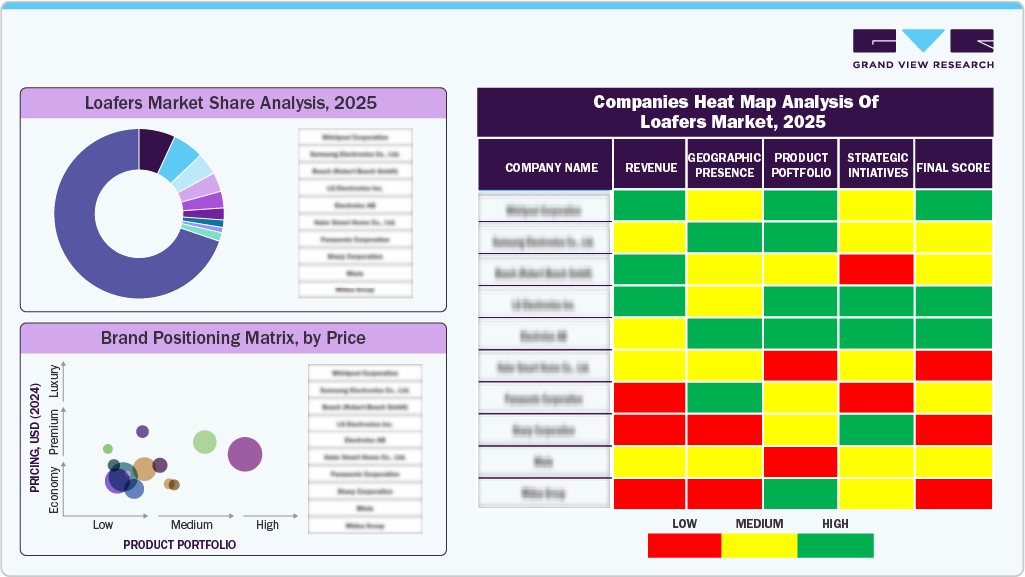
The global loafers industry is characterized by the presence of established premium footwear manufacturers alongside emerging fashion-driven and comfort-focused brands, all competing to address evolving consumer expectations around style versatility, comfort, and functional convenience. Manufacturers are increasingly developing loafers that integrate ergonomic and performance-inspired features, such as cushioned footbeds, lightweight construction, breathable linings, and flexible outsoles, into footwear designed for both professional and casual usage. This evolution enables consumers to seamlessly transition between workplace environments, travel, and social occasions, reinforcing loafers as a multi-purpose footwear category rather than strictly a formal footwear category.
Leading players, including luxury and heritage footwear brands as well as mass-premium manufacturers, are expanding their product portfolios by introducing innovative material blends and advanced construction techniques into loafer collections such as penny loafers, tassel loafers, suede slip-ons, and contemporary platform variants. At the same time, sustainability has emerged as a key strategic focus, with brands increasingly adopting responsibly sourced leather, recycled textile uppers, plant-based tanning processes, and low-emission manufacturing practices in response to growing consumer demand for environmentally responsible footwear.
Consumer Insights
The global loafers industry is being shaped by rising consumer demand for footwear that delivers refined styling while supporting daily usability across multiple social and professional environments. Loafers are widely preferred for their polished appearance without compromising comfort, making them a popular choice among office-goers, business travelers, and consumers seeking sophisticated yet convenient footwear. The slip-on design remains a major purchasing driver, enabling quick wearability while maintaining a structured, elegant aesthetic. In addition, consumers increasingly look for loafers that offer balanced weight distribution, a soft inner lining, and flexible outsoles to support extended daily use.
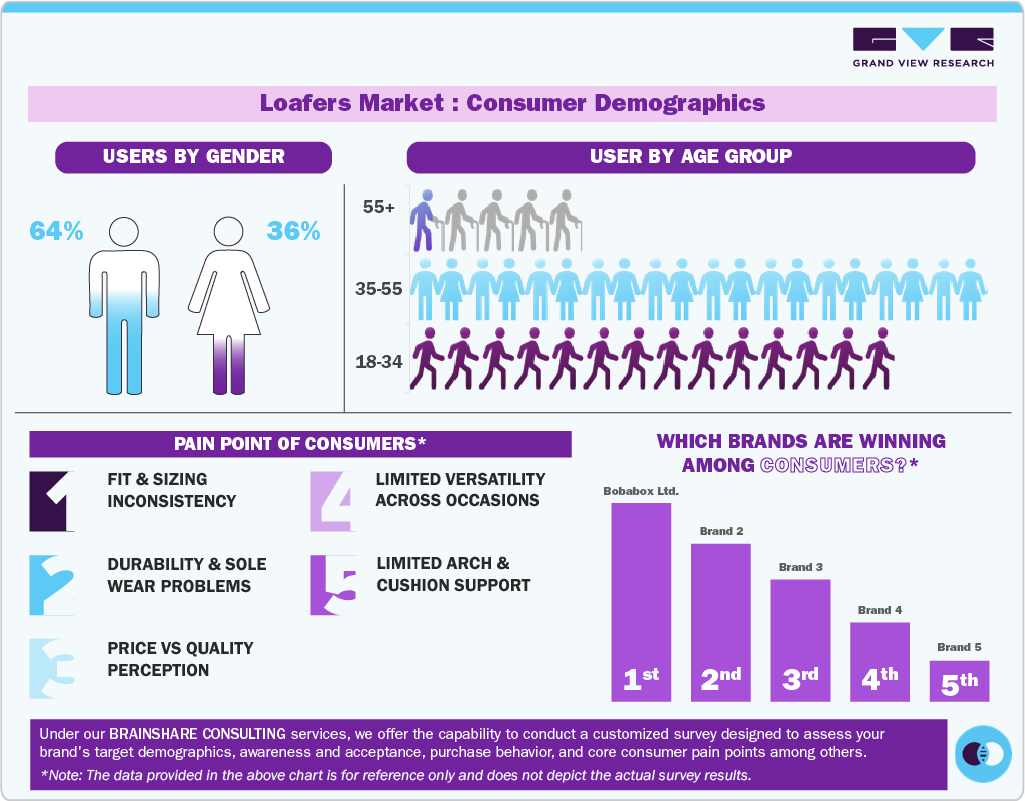
Evolving fashion preferences continue to expand the design landscape of loafers, encouraging manufacturers to introduce diverse styles suited for different occasions and consumer segments. Traditional penny-and-tassel loafers remain widely adopted in corporate and formal settings, while suede slip-ons, textured leather variants, and hardware-based designs are gaining traction in lifestyle and fashion categories. Seasonal styling trends are also influencing product development, with lighter materials, softer finishes, and color variations supporting casual and semi-formal dressing requirements. These ongoing design innovations are positioning loafers as a staple footwear option suitable for workplace settings, social gatherings, travel, and event wear.
Product Type Insights
The leather segment led the market with the largest revenue share of 47.18% in 2025. These loafers remain widely adopted across professional and formal dress segments due to their structured finish, long-lasting wear, and ability to adapt to the shape of the foot over time, enhancing comfort. Leading footwear brands such as Clarks, Hush Puppies, Cole Haan, and Gucci continue to expand their leather loafer collections through diversified offerings, including penny loafers, tassel loafers, horsebit loafers, and driving loafers, while integrating comfort-focused features such as cushioned insoles, flexible outsoles, and breathable inner linings.
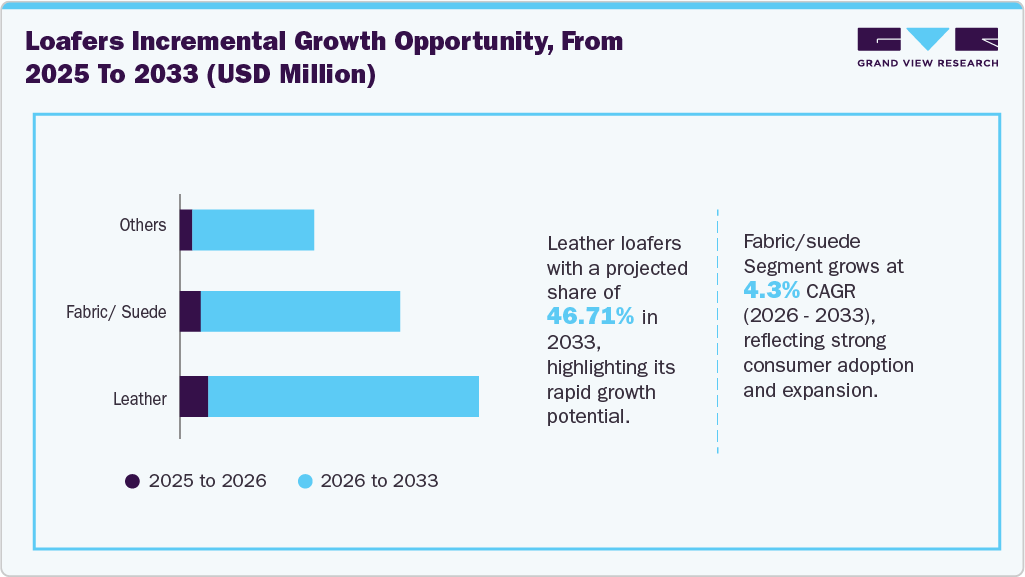
The fabric/suede segment is projected to grow at the fastest CAGR of 4.3% from 2026 to 2033, driven by rising consumer preference for lightweight, breathable, and comfort-oriented footwear. These loafers are gaining popularity among younger consumers and urban professionals for their soft texture, flexible construction, and suitability for casual and smart-casual attire. Fabric and suede materials provide enhanced ventilation, making them particularly attractive in warmer climates and for extended daily wear.
End Use Insights
The men segment led the market with the largest revenue share of 51.49% in 2025. The segment benefits from increasing adoption of business-casual dressing and the growing need for footwear that can be worn across office environments, social occasions, and travel settings. Slip-on construction and lightweight designs make loafers particularly attractive to male consumers seeking convenience and refined styling without the formality of traditional lace-up shoes. Strong product availability across entry-level, mid-range, and luxury price segments further supports consumer accessibility and repeat purchases.
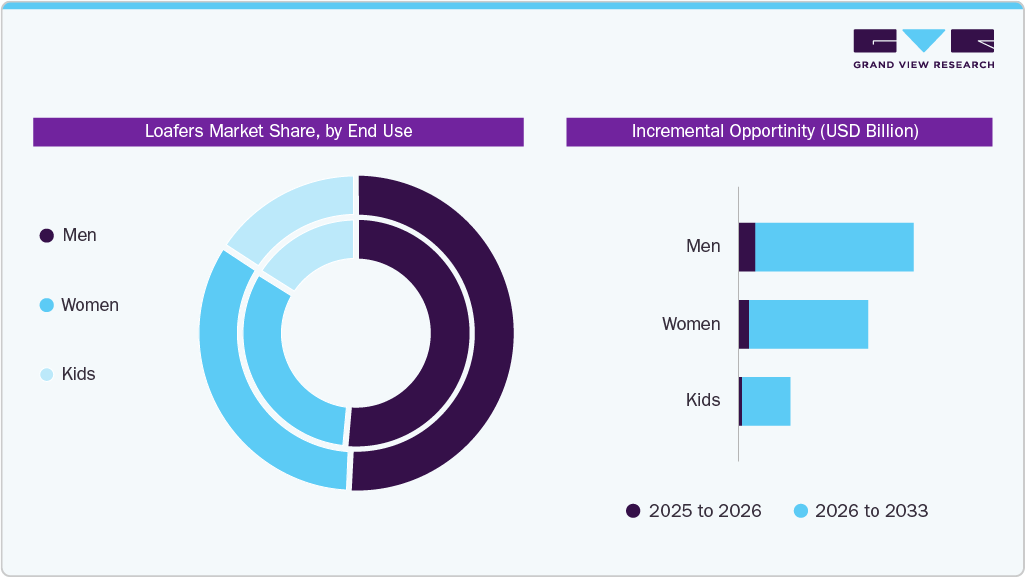
The women segment is projected to grow at the fastest CAGR of 4.5% from 2026 to 2033. The increased participation of women in corporate environments and the growing preference for smart-casual fashion are driving the adoption of loafers as a versatile alternative to heels and traditional formal shoes. Footwear brands such as Clarks, Hush Puppies, Aldo, and Gucci are expanding their women’s loafer portfolios through diverse designs that blend classic craftsmanship with modern fashion elements. In addition, women consumers increasingly prefer loafers available in varied color palettes, ranging from neutral shades such as beige, tan, and black to pastel tones and bold statement colors that complement both professional and casual wardrobes.
Distribution Channel Insights
The specialty footwear retailers segment led the market with the largest revenue share of 45.64% in 2025. Specialty retailers support sales growth by maintaining strong brand collaborations and launching exclusive in-store collections that attract both loyal customers and fashion-focused buyers. Many stores regularly update their assortments in response to seasonal trends, workplace fashion shifts, and emerging design preferences, ensuring continued product relevance. In addition, these outlets often provide value-added services such as product customization, maintenance guidance, and after-sales support, which enhance customer retention and strengthen brand trust.
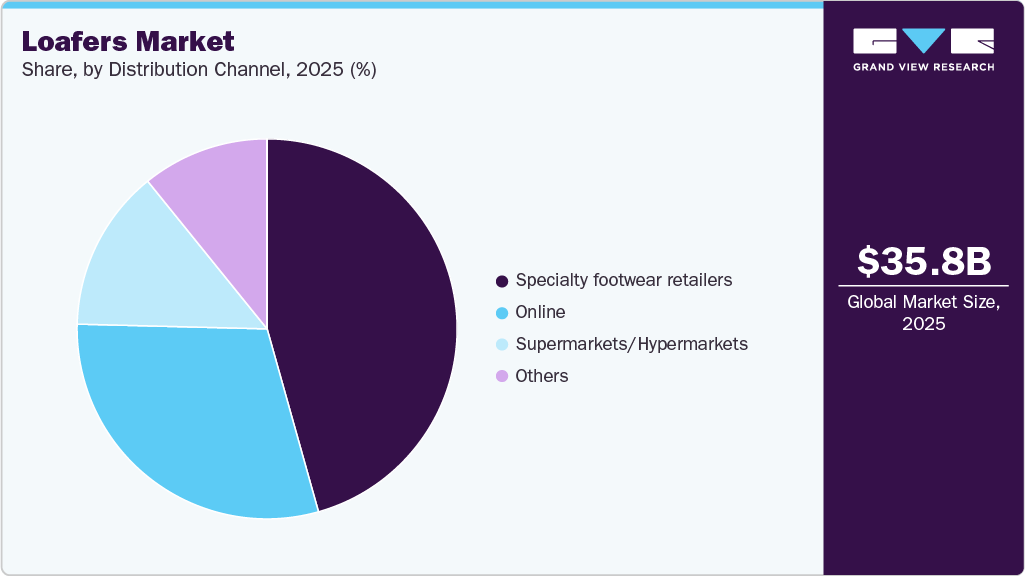
The online segment is projected to grow at the fastest CAGR of 4.7% from 2026 to 2033. Consumers are increasingly purchasing loafers online because it offers the convenience of accessing a broad assortment of brands, designs, and price ranges without visiting physical retail outlets. Online channels allow shoppers to easily compare product specifications, materials, customer reviews, and pricing, which supports more informed purchase decisions. The availability of detailed size guides, virtual try-on tools, and flexible return and exchange policies is further improving consumer confidence in purchasing footwear online.
Regional Insights
The loafers market in North America held a significant share in 2025, driven by strong consumer preference for versatile footwear that aligns with the region’s business-casual and lifestyle-oriented fashion culture. Consumers across the U.S. and Canada increasingly adopt loafers as everyday footwear suitable for workplace settings, social occasions, and travel, reflecting the growing acceptance of relaxed professional dress codes. Demand remains particularly strong for premium leather loafers, suede slip-ons, and contemporary platform styles that balance comfort with refined styling. The region also demonstrates high consumer interest in heritage-inspired footwear designs and luxury loafer collections, positioning loafers as both a functional and fashion-forward footwear category.
U.S. Loafers Market Trends
The loafers market in the U.S. is growing rapidly as the country benefits from a well-established footwear retail ecosystem, including specialty footwear stores, premium department stores, brand flagship outlets, and a strong direct-to-consumer online presence, all of which support broad product availability. Seasonal product launches, designer collaborations, and limited-edition fashion collections continue to stimulate repeat purchases and strengthen brand engagement, particularly among urban professionals and style-conscious consumers.
The Canada loafers market is projected to grow at a substantial CAGR of 4.1% from 2026 to 2033.Canadian consumers increasingly prefer loafers as practical everyday footwear for professional environments, social occasions, and travel, reflecting the country’s growing adoption of smart-casual dressing. Demand is particularly strong for leather and suede loafers that offer durability and adaptability to seasonal weather, while lightweight slip-on designs remain popular among urban consumers seeking convenience and refined styling.
Europe Loafers Market Trends
The loafers market in Europe is projected to grow at a significant CAGR of 4.2% from 2026 to 2033. European consumers consistently prefer premium leather loafers, suede slip-ons, and heritage-inspired styles that combine traditional craftsmanship with modern design aesthetics. Frequent seasonal product refreshes, including updated textures, decorative detailing, and contemporary sole constructions, continue to stimulate demand across both luxury and mid-range segments. Consumers in the region typically prioritize durability, material quality, and timeless styling over low-cost alternatives, encouraging footwear manufacturers and luxury fashion houses to integrate comfort-enhancing features such as cushioned insoles, flexible outsoles, and breathable lining materials.
The UK loafers market accounted for a significant revenue share of 22.67% in Europe in 2025. Consumers in the UK increasingly favor loafers that offer durability, comfort, and refined design, driving consistent demand across formal office wear, business-casual dressing, and lifestyle usage. Premium leather loafers, suede slip-ons, and contemporary platform designs are widely adopted across multiple price segments, as consumers seek footwear that complements both professional and social wardrobes. The growing influence of smart-casual fashion and flexible workplace dress codes continues to strengthen product adoption among working professionals and urban consumers.
The loafers market in Germany is projected to grow at a significant CAGR of 6.0% from 2026 to 2033. German consumers increasingly adopt loafers as a preferred alternative to traditional formal shoes, particularly in corporate and semi-formal settings where practicality and understated elegance are valued. Demand is expanding across both classic and contemporary loafer styles, including streamlined leather office loafers, soft suede lifestyle variants, and modern platform-inspired designs that cater to younger buyers seeking subtle fashion differentiation.
Asia Pacific Loafers Market Trends
Asia Pacific dominated the global loafers market with the largest revenue share of 40.31% in 2025 and is projected to grow at the fastest CAGR during the forecast period, supported by frequent product launches from both international and regional footwear brands that cater to diverse style preferences and climatic conditions. Premium leather loafers remain popular in formal and corporate environments, while suede and lightweight fabric loafers are gaining traction in lifestyle and casual wear segments. In addition, strong fashion influence from digital media, celebrity endorsements, and regional fashion trends is encouraging younger consumers to adopt contemporary loafer designs, including platform and statement styles.
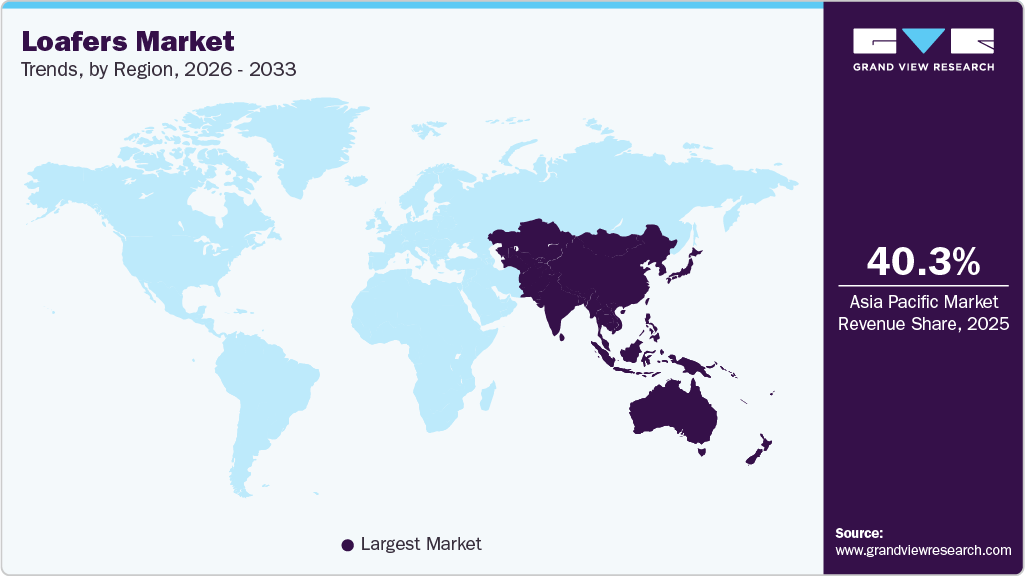
The loafers market in China accounted for the largest market revenue share in the Asia Pacific in 2025. The increasing adoption of semi-formal and smart-casual dress in corporate environments has significantly strengthened demand for loafers as an alternative to traditional lace-up formal footwear. Chinese consumers, particularly young professionals and middle-income office workers, are increasingly selecting loafers for their clean styling and ease of wear, making them suitable for long commuting hours and multi-purpose daily use. The rising popularity of fashion-conscious workplace attire is encouraging both premium and affordable loafer purchases across urban regions.
The India loafers marketis projected to grow at a significant CAGR of 6.2% from 2026 to 2033. Rising exposure to global fashion trends through social media platforms, celebrity endorsements, and international brand presence is encouraging Indian consumers to adopt contemporary loafer styles, including suede casual slip-ons, modern leather office loafers, and fashion-oriented statement designs. The growing acceptance of smart-casual attire across corporate environments, start-up culture, and service industries is further strengthening demand, as consumers seek footwear that blends professional styling with everyday comfort.
Central and South America Loafers Market Trends
The loafers market in Central and South America is projected to grow at a lucrative CAGR of 2.9% from 2026 to 2033. The development of shopping malls, specialty footwear retailers, and multi-brand fashion outlets is strengthening consumer access to both regional and international loafer brands, while growing acceptance of business-casual dressing is encouraging adoption of loafers for professional and social use. The steady rise of e-commerce platforms is further enhancing product accessibility by enabling consumers to browse a wider assortment of styles, materials, and price points, particularly in semi-urban areas.
Middle East & Africa Loafers Market Trends
The loafers market in the Middle East & Africa is projected to grow at a substantial CAGR of 3.7% from 2026 to 2033, supported by expanding luxury retail developments and rising consumer brand consciousness, particularly in metropolitan cities such as Dubai, Riyadh, and Johannesburg. International and regional footwear brands are strengthening their presence by introducing collections tailored to local fashion preferences, including lightweight construction and flexible sole designs suited for extended indoor and outdoor usage.
Key Loafers Company Insight
The global loafers industry is intensely competitive. Some of the key companies include Cole Haan, Tod’s, Salvatore Ferragamo, Allen Edmonds, and more. These organizations have increasingly focused on increasing their customer base to gain a competitive edge in the industry. Key market participants have undertaken several strategic initiatives, including mergers and acquisitions and partnerships with other major companies. In addition, new product launches in terms of canvas loafers in developing economies, including China and India, targeting the growing millennial population, are expected to open new avenues over the next few years.
Key Loafers Companies:
The following key companies have been profiled for this study on the loafers market.
- Cole Haan
- Tod's
- Salvatore Ferragamo S.P.A.
- Church & Co Ltd.
- Gucci
- Allen Edmonds Corporation.
- CLARKS RELIANCE FOOTWEAR PRIVATE LIMITED
- ABC Rockport LLC.
- Sebago.com
- Johnston & Murphy
Recent Developments
-
In March 2025,Italian luxury menswear label Cesare Attolini entered the footwear segment with the introduction of a loafer-focused collection, marking its first expansion beyond apparel. The brand planned the launch of three variations of its “Leisuretime Loafer” for the Fall/Winter 2025 season, drawing on its traditional Neapolitan craftsmanship and relaxed yet refined design philosophy. The collection was developed to complement Attolini’s premium tailoring portfolio, strengthening its lifestyle positioning by offering coordinated, high-end footwear.
-
In January 2025, Cole Haan announced the opening of its newest New York City retail location in the historic Flatiron District as part of its broader global expansion strategy. The store, situated at the corner of Fifth Avenue and 19th Street inside a 1904 neo-Renaissance landmark building, spans about 1,622 square feet and is designed to deliver an immersive shopping experience showcasing the brand’s footwear, accessories, and lifestyle collections across sport, dress, and casual segments.
Loafers Market Report Scope
Report Attribute
Details
Market size value in 2026
USD 37.13 billion
Revenue Forecast in 2033
USD 49.11 billion
Growth rate
CAGR of 4.1% from 2026 to 2033
Base year for estimation
2025
Historical data
2021 - 2024
Forecast period
2026 - 2033
Quantitative units
Revenue in USD million/billion, and CAGR from 2026 to 2033
Report coverage
Revenue forecast, company ranking, competitive landscape, growth factors, and trends
Segments covered
Product, end use, distribution channel, region
Regional scope
North America; Europe; Asia Pacific; Central & South America; Middle East & Africa
Country scope
U.S.; Canada; Mexico; Germany; UK; France; Italy; Spain: China; Japan; India; South Korea; Australia & New Zealand; Brazil; South Africa
Key companies profiled
Cole Haan; Tod's; Salvatore Ferragamo S.P.A.; Church & Co Ltd.; Gucci; Allen Edmonds Corporation.; CLARKS RELIANCE FOOTWEAR PRIVATE LIMITED; ABC Rockport LLC.; Sebago.com; Johnston & Murphy
Customization scope
Free report customization (equivalent up to 8 analysts’ working days) with purchase. Addition or alteration to country, regional & segment scope.
Pricing and purchase options
Avail customized purchase options to meet your exact research needs. Explore purchase options
Global Loafers Market Report Segmentation
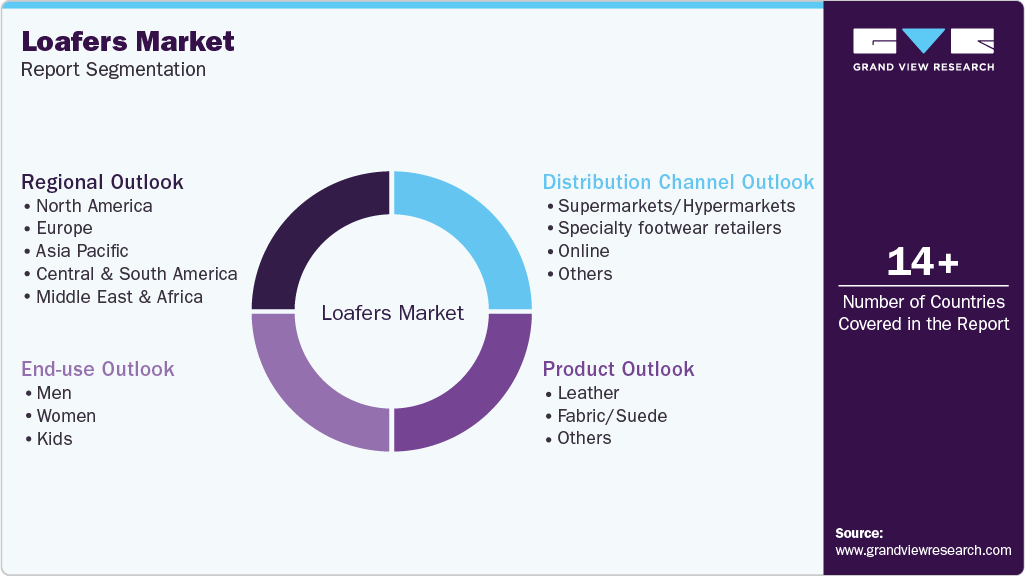
This report forecasts revenue growth at global, regional & country levels and provides an analysis of the latest trends and opportunities in each of the sub-segment from 2021 to 2033. For this study, Grand View Research has segmented the global loafers market report based on the product, end use, distribution channel, and region.
-
Product Outlook (Revenue, USD Million, 2021 - 2033)
-
Leather
-
Fabric/Suede
-
Others
-
-
End Use Outlook (Revenue, USD Million, 2021 - 2033)
-
Men
-
Women
-
Kids
-
-
Distribution Channel Outlook (Revenue, USD Million, 2021 - 2033)
-
Supermarkets/Hypermarkets
-
Specialty footwear retailers
-
Online
-
Others
-
-
Regional Outlook (Revenue, USD Million, 2021 - 2033)
-
North America
-
U.S.
-
Canada
-
Mexico
-
-
Europe
-
Germany
-
UK
-
France
-
Italy
-
Spain
-
-
Asia Pacific
-
China
-
Japan
-
India
-
South Korea
-
Australia & New Zealand
-
-
Central & South America
-
Brazil
-
-
Middle East & Africa
-
South Africa
-
-
Frequently Asked Questions About This Report
b. The global loafers market size was estimated at USD 35.82 billion in 2025 and is expected to reach USD 37.13 billion in 2026.
b. Some key players operating in the loafers market include The Rockport Group, Wolf and Shepherd, Clark International, Lee Cooper, Hush Puppies, PUMA, WOODLAND, Relaxo Footwears Limited, BACCA BUCCI FASHIONS PVT. LTD., and Allen Edmonds Corporation.
b. Key factors that are driving the loafers market growth include rapidly evolving fashion trends and the increasing demand for vegan footwear worldwide.
b. The global loafers market is expected to grow at a compound annual growth rate of 4.1% from 2026 to 2033 to reach USD 49.11 billion by 2033.
b. Asia Pacific dominated the loafers market with a share of 40.31% in 2025, supported by rising demand for premium and branded footwear across urban consumer segments. Growth in discretionary spending, increasing workplace formalization, and strong fashion influence in key Asia Pacific economies are driving higher adoption of loafers across both men’s and women’s categories.


Share this report with your colleague or friend.
Need a Tailored Report?
Customize this report to your needs — add regions, segments, or data points, with 20% free customization.


ISO 9001:2015 & 27001:2022 Certified
We are GDPR and CCPA compliant! Your transaction & personal information is safe and secure. For more details, please read our privacy policy.
Trusted market insights - try a free sample
See how our reports are structured and why industry leaders rely on Grand View Research. Get a free sample or ask us to tailor this report to your needs.












