
- Home
- »
- Power Generation & Storage
- »
-
Lithium Iron Phosphate Battery Market, Industry Report, 2033GVR Report cover
![Lithium Iron Phosphate Battery Market Size, Share & Trends Report]()
Lithium Iron Phosphate Battery Market (2026 - 2033) Size, Share & Trends Analysis Report By End-use (Automotive, Power, Industrial), By Application (Portable, Stationary), By Region (North America, Europe, Asia Pacific, Latin America), And Segment Forecasts
- Report ID: GVR-1-68038-468-0
- Number of Report Pages: 110
- Format: PDF
- Historical Range: 2021 - 2024
- Forecast Period: 2026 - 2033
- Industry: Energy & Power
- Report Summary
- Table of Contents
- Segmentation
- Methodology
- Download FREE Sample
-
 Download Sample Report
Lithium Iron Phosphate Battery Market Summary
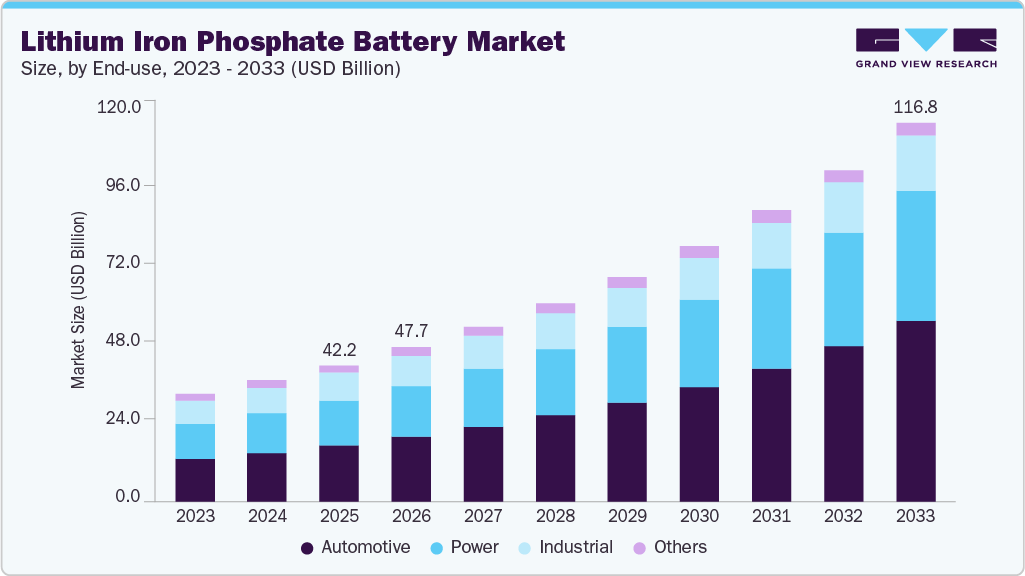
The global lithium iron phosphate battery market size was estimated at USD 42.2 billion in 2025 and is projected to reach USD 116.8 billion by 2033, growing at a CAGR of 13.6% from 2026 to 2033. The industry is primarily driven by the growing demand for electric vehicles (EVs), especially in cost-sensitive segments.
Key Market Trends & Insights
- Asia Pacific lithium iron phosphate battery market held the largest share of 51.6% of the global market in 2025.
- China’s lithium iron phosphate (LFP) battery market is experiencing rapid expansion, primarily driven by the electrification of transport and large-scale energy storage deployment.
- By end-use, the automotive segment accounted for the largest market share of 41.3% in 2025.
- By application, the portable segment accounted for the largest market share of 52.6% in 2025.
Market Size & Forecast
- 2025 Market Size: USD 42.2 Billion
- 2033 Projected Market Size: USD 116.8 Billion
- CAGR (2026-2033): 13.6%
- Asia Pacific: Largest market in 2025
- North America: Fastest growing market
LFP batteries are preferred in EVs because they are more affordable, safer, and have a longer lifecycle compared to other lithium-ion chemistries. Automakers are adopting LFP batteries for entry-level and mid-range electric cars, as well as for buses and commercial vehicles, helping reduce overall vehicle costs and improve safety.The increasing demand for energy storage systems is a major factor supporting the growth of the LFP battery market, especially with the expansion of renewable energy sources such as solar and wind. As these energy sources are intermittent, there is a need for efficient storage solutions to store excess energy and supply it when required. LFP batteries are well-suited for such applications due to their long life, high safety, and stable performance, making them ideal for grid storage, residential energy systems, and backup power.
A strong focus on cost reduction and supply chain stability is also contributing to market growth. LFP batteries do not rely on expensive materials like cobalt and nickel, which helps in lowering overall battery costs and reducing dependency on volatile raw material markets. This makes them an attractive option for large-scale applications where affordability and consistent supply are important considerations.
Supportive government policies and initiatives are further accelerating the adoption of LFP batteries. Many countries are promoting clean energy, electric mobility, and local battery manufacturing through incentives and regulations. These efforts are encouraging the use of LFP batteries across various sectors such as transportation, renewable energy storage, telecom infrastructure, and industrial applications, thereby driving overall market expansion.
Drivers, Opportunities & Restraints
The industry is driven by the increasing focus on safety and reliability across energy and transportation applications. LFP batteries offer better thermal stability and are less prone to overheating or fire risks compared to other lithium-ion chemistries, making them highly suitable for electric vehicles, energy storage systems, and industrial applications. As safety standards become more stringent, especially in EVs and large-scale storage projects, manufacturers and end users are increasingly preferring LFP batteries. This growing emphasis on safe and durable battery solutions is significantly contributing to the wider adoption of LFP technology across global markets.
The industry presents strong opportunities with the rising expansion of renewable energy and the need for efficient energy storage solutions. Increasing investments in solar and wind power are creating demand for reliable battery storage systems, where LFP batteries play a key role. Furthermore, the growing focus on localized battery manufacturing and supply chain diversification, especially in regions like North America and Europe, is opening new growth avenues. Emerging applications such as electric buses, energy storage for EV charging infrastructure, and large-scale grid storage projects are also expected to create significant opportunities for market expansion.
Despite strong growth, the LFP battery industry faces certain challenges, including lower energy density compared to other lithium-ion batteries such as NMC and NCA. This limitation can affect performance in applications requiring long driving ranges or compact battery sizes. Additionally, intense competition from alternative battery chemistries and rapid technological advancements may impact market positioning. Supply chain constraints related to lithium availability and initial investment requirements for setting up manufacturing facilities can also act as barriers to market growth.
End-use Insights
Based on end-use, the automotive segment accounted for the largest market share of 41.3% in 2025, driven by the rapid growth of electric vehicles and increasing adoption of LFP batteries in passenger cars, buses, and commercial vehicles. Automakers are increasingly using LFP batteries due to their lower cost, enhanced safety, and longer lifecycle, making them suitable for both entry-level and mid-range EV models. Additionally, rising government support for electric mobility, expansion of EV charging infrastructure, and growing demand for cost-efficient battery solutions are further contributing to the dominance of the automotive segment in the global LFP battery industry.
The power segment is projected to register the fastest CAGR of 15.1% during the forecast period, driven by the increasing deployment of energy storage systems to support renewable energy integration and grid stability. As solar and wind power generation continue to expand, there is a growing need for reliable storage solutions to manage intermittent energy supply, where LFP batteries are widely preferred due to their long cycle life, safety, and cost-effectiveness. Additionally, rising investments in grid-scale storage projects, residential energy storage systems, and backup power solutions are further accelerating the growth of the power segment in the LFP battery market.
Application Insights
Based on application, the portable segment accounted for the largest market share of 52.6% in 2025, driven by the widespread use of LFP batteries in consumer electronics and small-scale energy storage devices. Applications such as smartphones, laptops, tablets, medical devices, and portable power systems contribute significantly to this segment due to their high volume demand. In addition, the growing adoption of residential battery solutions and portable backup systems is further supporting segment growth, as LFP batteries offer enhanced safety, longer lifespan, and stable performance for everyday use.
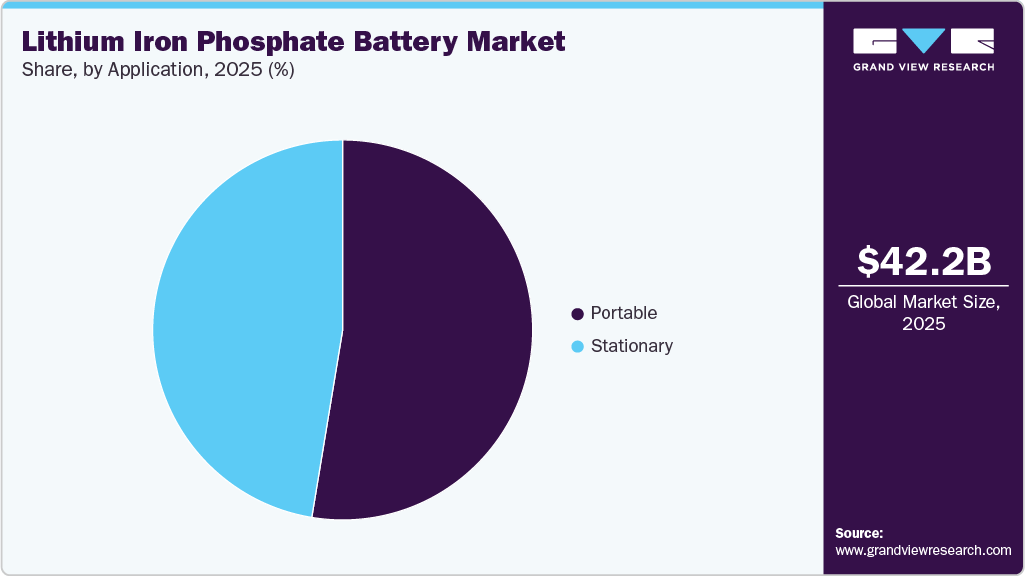
The stationary segment is projected to register the fastest CAGR of 15.1% during the forecast period, driven by the increasing deployment of energy storage systems to support renewable energy integration and grid reliability. As the adoption of solar and wind power continues to rise, there is a growing need for efficient storage solutions to manage intermittent energy generation, where LFP batteries are widely preferred due to their long lifespan, safety, and cost-effectiveness. Additionally, rising investments in grid-scale storage projects, residential energy storage systems, and backup power applications are further accelerating the growth of the stationary segment in the market.
Regional Insights
Asia Pacific lithium iron phosphate battery market held the largest share of 51.6% of the global market in 2025. The lithium iron phosphate battery market in Asia Pacific is characterized by strong dominance in both production and consumption, supported by the presence of major battery manufacturers and a well-established supply chain ecosystem. Countries such as China, Japan, and South Korea lead the market due to large-scale manufacturing capabilities and continuous investments in research and development. The region acts as the global hub for LFP batteries, driven by high demand from electric vehicles and energy storage systems.
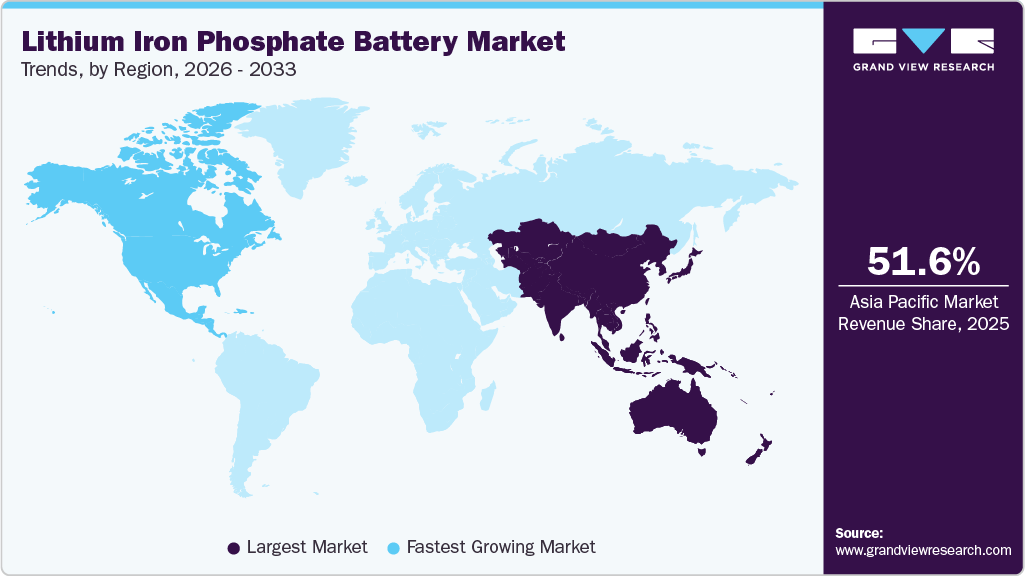
Another important trend is the decline in battery costs and technological advancements, which are making LFP batteries more competitive globally. Continuous improvements in battery performance, fast-charging capabilities, and battery management systems are enhancing adoption across multiple applications. At the same time, strong government support for clean energy, electrification, and domestic manufacturing is accelerating market growth, positioning Asia Pacific as the fastest-growing and most influential region in the global LFP battery market.
China Lithium Iron Phosphate Battery Market Trends
China’s lithium iron phosphate (LFP) battery market is experiencing rapid expansion, primarily driven by the electrification of transport and large-scale energy storage deployment. The electric vehicle (EV) sector is the dominant growth engine, with LFP batteries accounting for over 80% of China’s EV battery installations in 2025, supported by their lower cost, longer cycle life, and superior safety compared to nickel-based chemistries. Strong domestic EV demand, rising exports of Chinese EVs, and government support for clean mobility are accelerating production, with LFP output and installations growing at double-digit to high double-digit rates annually.
North America Lithium Iron Phosphate Battery Market Trends
The North America lithium iron phosphate battery market is witnessing strong growth driven by increasing adoption of energy storage systems and electric vehicles, along with a clear shift toward domestic manufacturing and supply chain localization. The region is seeing rising investments in grid-scale battery storage to support renewable energy integration, with energy storage demand gaining a larger share of total battery usage in recent years. At the same time, government policies such as incentives for clean energy and local battery production are encouraging companies to expand LFP manufacturing capacity within the U.S. and across North America.
The U.S. lithium iron phosphate battery market is witnessing a notable transformation, driven by a strong shift toward energy storage applications and domestic manufacturing expansion. A key trend is the increasing use of LFP batteries in grid-scale and stationary energy storage, as demand for reliable backup power and renewable energy integration continues to rise. In fact, battery manufacturers are reallocating production capacity from electric vehicles to energy storage systems due to higher demand in this segment.
Additionally, the market is benefiting from declining battery costs and increasing preference for LFP chemistry due to its affordability and safety advantages. Falling lithium-ion battery prices and the shift toward lower-cost LFP technology are making energy storage more accessible and scalable across the U.S. However, adoption in EVs is still evolving, influenced by trade policies and supply chain dependencies, which are shaping the pace of LFP penetration in the automotive sector.
Europe Lithium Iron Phosphate Battery Market Trends
The lithium iron phosphate battery market in Europe is witnessing strong growth driven by the rapid expansion of the electric vehicle sector and increasing focus on affordable battery technologies. Automakers across Europe are increasingly shifting toward LFP chemistry to reduce costs and minimize dependence on expensive materials like nickel and cobalt, especially for entry-level EV models. The adoption of LFP batteries is rising significantly, with expectations that they could account for a substantial share of the EV battery market in the region over the coming years.
Another key trend is the growing demand for energy storage systems, particularly for renewable energy integration. Countries across Europe are investing heavily in grid-scale and residential energy storage solutions to support solar and wind power, where LFP batteries are preferred due to their safety, long cycle life, and cost-effectiveness. Battery shipments and installations are increasing rapidly, supported by favorable regulatory frameworks and sustainability targets.
Latin America Lithium Iron Phosphate Battery Market Trends
The lithium iron phosphate battery market in Latin America is witnessing steady growth, driven by increasing adoption of electric vehicles and expanding renewable energy projects across countries such as Brazil, Mexico, and Chile. The region is seeing rising penetration of affordable EVs, particularly from Asian manufacturers, which is supporting demand for cost-effective battery chemistries like LFP. At the same time, growing investments in solar and wind energy are creating demand for energy storage systems, where LFP batteries are preferred due to their safety, long cycle life, and lower cost.
Middle East & Africa Lithium Iron Phosphate Battery Market Trends
The lithium iron phosphate battery market in the Middle East & Africa is witnessing gradual but strong growth, driven primarily by increasing investments in renewable energy and energy storage systems across the region. Countries in the Middle East, particularly within the Gulf Cooperation Council (GCC), are actively deploying large-scale solar projects and grid storage systems to diversify their energy mix, while sub-Saharan Africa is focusing on mini-grids and off-grid electrification. LFP batteries are widely preferred in these applications due to their safety, long cycle life, and cost-effectiveness, making them suitable for harsh operating environments and long-duration storage needs.
Key Lithium Iron Phosphate Battery Company Insights
The global lithium iron phosphate battery market is characterized by the presence of several established battery manufacturers, automotive OEMs, and energy storage solution providers that are actively expanding their production capacities and technological capabilities. Key participants such as Contemporary Amperex Technology Co. Limited (CATL), BYD Company Ltd., LG Energy Solution, and Tesla, Inc. play a significant role in the market by offering LFP-based battery solutions for electric vehicles and energy storage systems. These companies leverage large-scale manufacturing capabilities, strong supply chain networks, and continuous investments in research and development to improve battery performance, reduce costs, and support mass adoption across automotive and stationary applications.
In addition, several other players such as Gotion High-Tech, EVE Energy Co., Ltd., SVOLT Energy Technology, A123 Systems, Saft Groupe S.A., and CALB (China Aviation Lithium Battery) are contributing to market growth through advancements in LFP chemistry, expansion of production facilities, and strategic partnerships with automakers and energy companies. The market is highly competitive, with companies focusing on capacity expansion, vertical integration, and cost optimization strategies to strengthen their global presence and meet the rising demand for LFP batteries in electric vehicles, grid-scale storage, and industrial applications.
Key Lithium Iron Phosphate Battery Companies:
The following key companies have been profiled for this study on the lithium iron phosphate battery market.
- CATL
- BYD Company Ltd.
- Gotion High-Tech
- EVE Energy Co., Ltd.
- SVOLT Energy Technology
- CALB (China Aviation Lithium Battery)
- LG Energy Solution
- A123 Systems
- Samsung SDI
- Envision AESC
Recent Developments
-
In March 2026, BYD Company Ltd. launched its second-generation Blade LFP battery with fast-charging capability, enhancing charging speed and performance for EV applications.
-
In March 2026, Tesla, Inc. and LG Energy Solution announced a USD 4.3 billion investment to build an LFP battery manufacturing plant in Michigan (U.S.), focused on energy storage systems.
Lithium Iron Phosphate Battery Market Report Scope
Report Attribute
Details
Market Definition
The lithium iron phosphate battery market represents the total revenue generated from the sales of LFP batteries within a defined period (typically a year). This includes revenue from battery cells, modules, and packs used across applications such as electric vehicles, energy storage systems, industrial equipment, and consumer devices.
Market size value in 2026
USD 47.67 billion
Revenue forecast in 2033
USD 116.8 billion
Growth rate
CAGR of 13.6% from 2026 to 2033
Base year for estimation
2025
Historical data
2021 - 2024
Forecast period
2026 - 2033
Quantitative units
Revenue in USD million/billion and CAGR from 2026 to 2033
Report coverage
Revenue forecast, competitive landscape, growth factors, and trends
Segments covered
End-use, application, region
Regional scope
North America; Europe; Asia Pacific; Latin America; Middle East & Africa
Country scope
U.S.; Canada; Mexico; Germany; UK; France; Italy; Spain; Russia; China; India; Japan; Australia; Brazil; Argentina; Saudi Arabia; UAE; South Africa
Key companies profiled
CATL; BYD Company Ltd.; Gotion High-Tech; EVE Energy Co., Ltd.; SVOLT Energy Technology; CALB (China Aviation Lithium Battery); LG Energy Solution; A123 Systems; Samsung SDI; Envision AESC.
Customization scope
Free report customization (equivalent up to 8 analysts working days) with purchase. Addition or alteration to country, regional & segment scope.
Pricing and purchase options
Avail customized purchase options to meet your exact research needs. Explore purchase options
Global Lithium Iron Phosphate Battery Market Report Segmentation
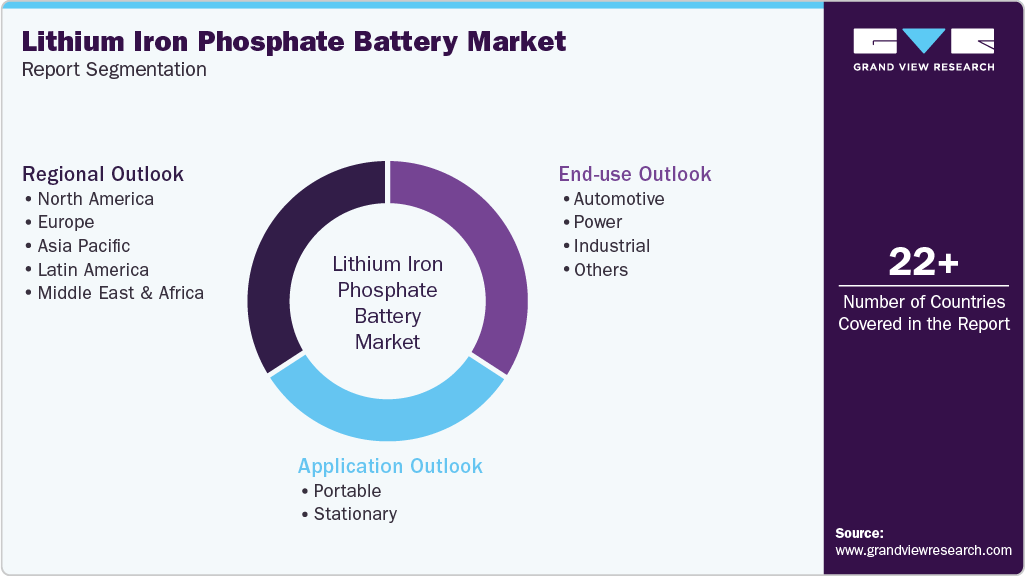
This report forecasts revenue growth at global, regional, and country levels and provides an analysis of the latest industry trends in each of the sub-segments from 2021 to 2033. For this study, Grand View Research has segmented the global lithium iron phosphate battery market report on the basis of end-use, application, and region:
-
End-use Outlook (Revenue in USD Million, 2021 - 2033)
-
Automotive
-
Power
-
Industrial
-
Others
-
-
Application Outlook (Revenue in USD Million, 2021 - 2033)
-
Portable
-
Stationary
-
-
Regional Outlook (Revenue in USD Million, 2021 - 2033)
-
North America
-
U.S.
-
Canada
-
Mexico
-
-
Europe
-
Germany
-
UK
-
France
-
Italy
-
Spain
-
Russia
-
-
Asia Pacific
-
China
-
India
-
Japan
-
Australia
-
-
Latin America
-
Brazil
-
Argentina
-
-
Middle East & Africa
-
Saudi Arabia
-
UAE
-
South Africa
-
-
Frequently Asked Questions About This Report
b. The global lithium iron phosphate battery market was estimated at USD 42.2 billion in 2025 and is expected to reach USD 47.67 billion in 2026.
b. Based on the End-use segment, automotive segment held the largest revenue share of more than 41% in 2025.
b. Some of the key players operating in the global lithium iron phosphate (LiFePO4) battery market include Contemporary Amperex Technology Co. Limited (CATL), BYD Company Ltd., Gotion High-Tech, EVE Energy Co., Ltd., SVOLT Energy Technology, CALB, among others.
b. The key factors driving the growth of the lithium iron phosphate battery market include the increasing adoption of electric vehicles, rising demand for energy storage systems, and the need for cost-effective and safe battery technologies.
b. The global lithium iron phosphate battery market is expected to grow at a compound annual growth rate of 13.6% from 2026 to 2033 to reach USD 116.8 billion by 2033.


Share this report with your colleague or friend.
Need a Tailored Report?
Customize this report to your needs — add regions, segments, or data points, with 20% free customization.


ISO 9001:2015 & 27001:2022 Certified
We are GDPR and CCPA compliant! Your transaction & personal information is safe and secure. For more details, please read our privacy policy.
Trusted market insights - try a free sample
See how our reports are structured and why industry leaders rely on Grand View Research. Get a free sample or ask us to tailor this report to your needs.












