
- Home
- »
- Power Generation & Storage
- »
-
Iron Air Battery Market Size & Share, Industry Report, 2033GVR Report cover
![Iron Air Battery Market Size, Share & Trends Report]()
Iron Air Battery Market (2026 - 2033) Size, Share & Trends Analysis Report By Type (Rechargeable Iron Air Batteries, Primary (Single-Use) Iron Air Batteries, Hybrid / Flow-Based Iron Systems), By Application, By Region, And Segment Forecasts
- Report ID: GVR-4-68040-804-2
- Number of Report Pages: 120
- Format: PDF
- Historical Range: 2021 - 2024
- Forecast Period: 2026 - 2033
- Industry: Energy & Power
- Report Summary
- Table of Contents
- Segmentation
- Methodology
- Download FREE Sample
-
 Download Sample Report
Iron Air Battery Market Summary
The global iron air battery market size was estimated at USD 59.1 million in 2025 and is projected to reach USD 221.9 million by 2033, growing at a CAGR of 17.9% from 2026 to 2033. Growth is being driven by the increasing need for long-duration energy storage to support the integration of renewable power, the electrification of power systems, and the global push toward net-zero carbon goals.
Key Market Trends & Insights
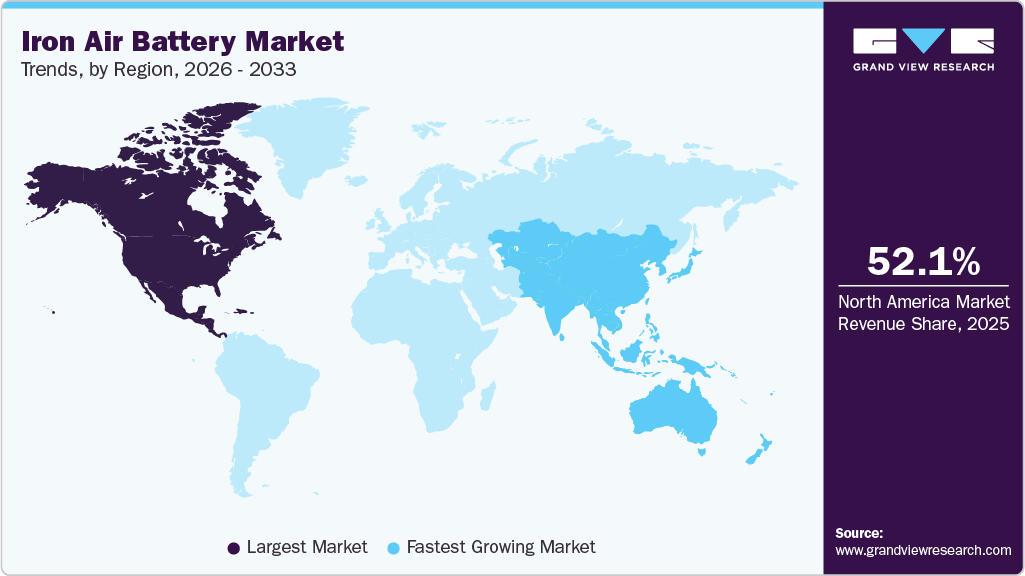
- North America dominated the global iron air battery market with the largest revenue share of 52.1% in 2025.
- The iron air battery industry in the U.S. accounted for the largest market revenue share in North America in 2025.
- By type, the primary (single-use) iron-air batteries segment led the market with the largest revenue share of 49.7% in 2025.
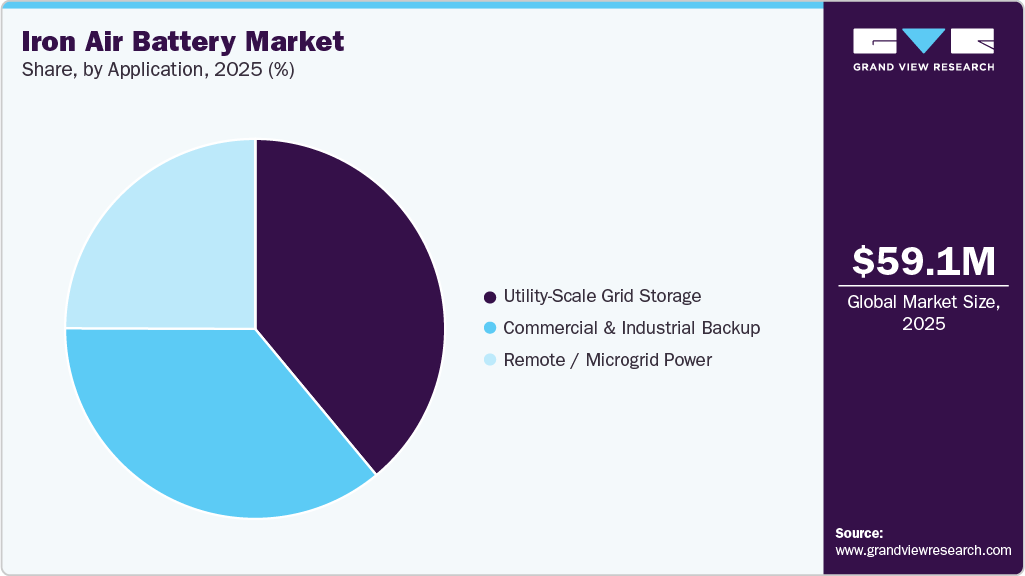
- Based on the application, the commercial & industrial backup segment accounted for the largest market revenue share in 2025.
Market Size & Forecast
- 2025 Market Size: USD 59.1 Million
- 2033 Projected Market Size: USD 221.9 Million
- CAGR (2026-2033): 17.9%
- North America: Largest market in 2025
- Asia Pacific: Fastest growing market
Supportive policy incentives that promote grid resilience and storage deployment, along with rising capital investments in sustainable energy infrastructure, are accelerating the adoption of iron air systems. In addition, advancements in metal-air electrochemistry, reductions in system costs, and the scaling of pilot and demonstration projects into commercial utility deployments are strengthening the market outlook. The growing focus on renewable energy firming, microgrid stability, and low-cost bulk storage continues to position iron-air batteries as a critical solution for 8-100+ hour energy-discharge applications, enabling long-term, economically viable decarbonization of power networks.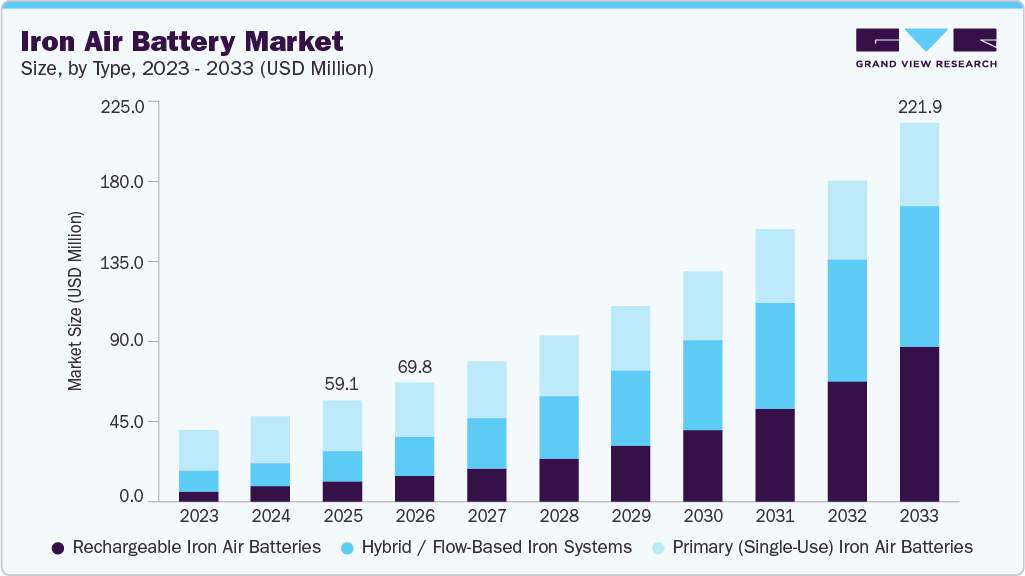
In North America, market growth is supported by strong federal clean energy targets, state-level renewable portfolio standards, and grid modernization initiatives. The U.S. leads deployment, driven by investments in long-duration storage for utility-scale solar and wind integration, as well as the increasing need to replace natural gas peaker plants. Federal tax incentives, Department of Energy (DOE) demonstration funding, and state-level mechanisms, such as capacity market incentives and resilience procurement programs, are accelerating the commercial adoption of these technologies.
Corporate decarbonization commitments across data centers, industrial facilities, and logistics infrastructure are further boosting demand. Canada is also emerging as a meaningful participant, supported by provincial clean-grid mandates and remote/off-grid community electrification initiatives aimed at reducing diesel dependency.
Europe represents another significant market, supported by aggressive decarbonization pathways, the expansion of renewable energy, and coordinated energy storage policy frameworks. Countries such as Germany, the United Kingdom, Spain, and the Netherlands are actively supporting long-duration energy storage technology pilots as part of their broader strategies to integrate renewables and enhance grid stability. European Union directives promoting clean energy financing, cross-border electricity market integration, and the displacement of fossil fuels are key enabling factors.
Collaboration among utilities, technology developers, and public research institutions is accelerating commercialization, while industrial decarbonization targets and rising demand for flexible grid-balancing capacity further strengthen the region’s growth trajectory. As several nations transition away from coal- and natural gas-based generation, iron-air storage solutions are increasingly positioned as strategic assets to maintain reliability and ensure the continuity of clean energy.
Drivers, Opportunities & Restraints
The global iron air battery industry is placing increasing emphasis on grid decarbonization, renewable energy integration, and the demand for long-duration energy storage solutions, primarily driving the Air Battery market. As utilities transition from fossil-fuel-based power generation to solar and wind, the need for storage that can discharge over multi-hour to multi-day durations has become essential. Iron-air batteries offer a cost-effective, scalable alternative to lithium-ion systems for bulk energy storage, especially in utility-scale and remote power applications.
Government incentives supporting grid modernization, carbon reduction mandates, and funding for long-duration energy storage demonstration projects, particularly in the U.S. and Europe, are strengthening commercialization. Growing investment from energy developers, industrial users, and data center operators seeking improved energy resilience and reduced operating costs further accelerates market adoption. In addition, iron-air systems benefit from the availability of abundant raw materials, simpler supply chains, and a lower environmental footprint compared to conventional battery chemistries.
Opportunities in the iron-air battery industry are expanding as power systems increasingly require durable, cost-efficient storage to manage renewable intermittency and maintain grid stability. Iron-air batteries are well-positioned to address energy shortages during peak demand and seasonal variability, particularly in regions undergoing rapid expansion of solar and wind energy. The technology also presents strong potential across remote microgrids, island grids, mining operations, and critical infrastructure, where reliability and diesel displacement are priorities. The development of hybrid and flow-based iron systems, integration with hydrogen storage, and co-location with renewable plants present new pathways for system optimization and energy cost reduction. Partnerships among utility companies, renewable project developers, and long-duration storage technology firms are expected to accelerate commercial-scale deployments over the forecast period.
However, the iron air battery industry faces several restraints, including challenges associated with early-stage commercialization and the need to scale manufacturing capacity. High initial project financing requirements, uncertainty in long-term performance data compared to mature lithium-ion systems, and extended payback periods may limit near-term adoption. Regulatory gaps in long-duration storage procurement frameworks and complexities in grid interconnection approvals also create challenges for deployment. Technical considerations such as system efficiency, round-trip energy losses, and electrolyte management remain areas of ongoing development.
In addition, competition from alternative long-duration storage technologies, such as pumped hydro, thermal storage, flow batteries, and hydrogen-based systems, may influence market positioning. Continued policy support, standardization, financing mechanisms, and technological innovation will be essential to accelerate market growth and unlock the full potential of iron-air batteries in global energy transition strategies.
Type Insights
The primary (single use) iron air batteries segment led the market with the largest revenue share of 49.7%, in 2025. This dominance is primarily due to the simple cell design, low material cost, and high energy density of single-use iron-air systems, which make them suitable for a wide range of low-power, remote, and backup applications. These batteries are particularly favored in sectors such as industrial monitoring equipment, remote sensing devices, military field operations, and emergency power supplies, where long shelf life and reliability are critical. In addition, the use of iron, an abundant and inexpensive raw material, supports lower production costs than lithium-ion and other metal-air chemistries.
Growing interest in sustainable, environmentally friendly energy storage solutions has further strengthened demand for primary iron-air batteries, which offer a reduced carbon footprint, a non-toxic materials profile, and simplified end-of-life handling. While rechargeable and hybrid/flow-based iron systems are gaining momentum in grid-scale and commercial storage applications, they remain in earlier stages of commercialization. As a result, primary systems continue to play a foundational role in market revenue.
However, with ongoing advancements in rechargeable, long-duration iron-air technologies, the share of primary batteries is expected to decline gradually over the forecast period, as utility-scale deployments and renewable energy integration increasingly favor rechargeable and flow-based iron systems for multi-hour and multi-day storage performance.
Application Insights
The commercial & industrial (C&I) backup segment led the market with the largest revenue share of 38.9%, in 2025. The rising need for reliable, long-duration backup power in manufacturing facilities, data centers, logistics hubs, and large commercial buildings drives this dominance. As businesses transition to more electrified operations and digital infrastructure expands, the demand for energy resilience and protection against grid outages has grown significantly. Iron air batteries provide a cost-effective and sustainable alternative to diesel generators and lithium-based backup systems, offering multi-hour to multi-day energy delivery with lower lifecycle emissions and reduced operating costs.
Supportive energy resilience incentives, microgrid development programs, and corporate sustainability commitments have accelerated the adoption of iron-air storage in the commercial and industrial (C&I) sector. Companies pursuing net-zero targets are increasingly evaluating clean backup power systems to reduce dependence on fossil fuels and improve grid stability. In addition, the integration of iron-air systems with onsite solar PV, energy management systems, and distributed generation solutions is enhancing operational efficiency and reducing peak demand charges.
Looking ahead, the segment is expected to benefit from the expanding applications in critical infrastructure, including hospitals, transportation hubs, defense facilities, and telecommunications networks. As iron-air technology progresses toward larger-scale and more standardized system deployments, the C&I segment will continue to play a pivotal role in driving market revenue and establishing iron-air batteries as a mainstream solution for long-duration, sustainable backup energy storage.
Regional Insights
North America dominated the global iron air battery market with the largest revenue share of 52.1% in 2025, driven by strong federal and state-level clean energy policies, accelerating investments in long-duration energy storage, and increasing deployment of renewable power assets. The region is prioritizing solutions that enhance grid reliability and support decarbonization, particularly as solar and wind capacity expand. The U.S. leads the region, supported by the Department of Energy (DOE) demonstration funding, tax incentives for standalone energy storage, and state procurement programs that encourage utilities to adopt long-duration energy storage technologies. Growing adoption of storage for commercial, industrial, and data center backup power systems has further strengthened demand. In addition, rising corporate sustainability commitments and microgrid development at remote, resilience-critical sites are positioning North America as a primary hub for the commercialization and scale-up of iron-air batteries.
U.S. Iron Air Battery Market Trends
The iron air battery market in the U.S. accounted for the largest market revenue share in North America in 2025, supported by strong momentum in renewable deployment, large-scale storage pilot programs, and public and private investment in long-duration storage innovations. Federal support through the Inflation Reduction Act (IRA), DOE funding initiatives, and state-level resilience procurement targets have intensified industry expansion. Major utilities and energy developers are actively integrating iron-air systems into solar-plus-storage and wind-plus-storage portfolios to replace natural gas peakers and reduce curtailment. The U.S. is also experiencing a rise in adoption across data centers, manufacturing facilities, and logistics operations, where uninterrupted power is crucial. With abundant raw materials, expanding manufacturing commitments, and strong regulatory alignment, the U.S. is expected to remain a dominant leader in scaling up iron-air storage.
Europe America Iron Air Battery Market Trends
The iron air battery market in Europe is highly policy-driven and technology-forward, supported by aggressive decarbonization mandates, renewable integration frameworks, and energy storage capacity targets embedded in national energy transition plans. Countries such as Germany, the United Kingdom, France, Spain, and the Netherlands are promoting long-duration energy storage to enhance grid stability and reduce dependence on fossil-based peaker plants. The European Union’s Fit for 55, Renewable Energy Directive (RED III), and carbon pricing mechanisms are encouraging utilities and grid operators to evaluate alternative storage chemistries beyond lithium-ion. Growing collaboration among government research programs, energy system integrators, and technology developers is accelerating the development and implementation of demonstration and pilot-scale projects. A greater focus on seasonal storage capabilities and resilience in renewable-dominant grids positions Europe as a key growth engine in the global market.
Asia-Pacific Iron-Air Battery Market Trends
The iron air battery market in Asia-Pacific is anticipated to grow at the fastest CAGR during the forecast period, driven by rapid industrialization, increasing renewable energy deployment, and expanding efforts to enhance grid reliability. Countries such as China, Japan, India, and South Korea are prioritizing investments in long-duration and grid-flexibility technologies to support their decarbonization strategies. Rising electricity demand in urban centers, combined with the growing need to stabilize intermittent solar and wind generation, is prompting utilities and industrial operators to explore iron-air systems. Additionally, remote and island regions in Southeast Asia are increasingly utilizing microgrids, where iron-air batteries offer a viable solution for diesel displacement and improving energy access. Continued energy security priorities and renewable transition policies position the Asia-Pacific for substantial market expansion in the coming years.
Latin America Iron Air Battery Market Trends
The iron air battery market in Latin America is gaining momentum as decarbonization strategies expand and governments increase support for renewable energy integration and grid modernization. Countries such as Brazil, Chile, and Mexico are scaling up solar and wind power installations, driving interest in cost-effective, long-duration storage to address variability and improve grid stability. Collaboration between regional utilities, international energy companies, and storage technology providers is accelerating pilot projects and early commercial deployments. In addition, the growing focus on energy security, the electrification of remote communities, and the reduction of diesel use are fueling interest in iron-air systems across industrial, mining, and rural electrification applications.
Middle East & Africa Iron Air Battery Market Trends
The iron air battery market in the Middle East & Africa remains at an early but rapidly developing stage, supported by increasing investment in renewable megaprojects, energy diversification initiatives, and emerging green hydrogen and storage hubs. Countries in the Gulf region are prioritizing the addition of large-scale solar and wind capacity, creating a need for long-duration storage solutions to ensure grid reliability and reduce reliance on gas-fired generation. In Sub-Saharan Africa, iron-air batteries offer strong potential for remote microgrids, off-grid electrification, and critical facility backup, where cost-effective, long-life storage is essential. Although regulatory frameworks and financing mechanisms are still evolving, public-private partnerships and green investment funds are expected to accelerate regional deployment.
Key Iron Air Battery Company Insights
Some of the key players operating in the global iron air battery industry include Form Energy, Inc. and ESS Inc., among others.
-
Form Energy, Inc. is a U.S.-based energy storage technology company recognized as a pioneer in multi-day Iron-Air battery systems. Headquartered in Massachusetts, the company focuses on developing long-duration, low-cost energy storage solutions that enhance grid reliability and support renewable energy integration. Form Energy has partnered with several major U.S. utilities, including Xcel Energy, Georgia Power, and PacifiCorp, to deploy multi-megawatt pilot systems that demonstrate the commercial viability of long-duration storage to reduce dependence on fossil-fuel peaker plants. The company is also constructing large-scale manufacturing facilities to support mass production of iron-based battery components, reinforcing its strategic goal of scaling domestic clean energy supply chains. Form Energy’s technology is designed to deliver 100-hour discharge durations, positioning it as a critical enabler for deep grid decarbonization.
-
ESS Inc. (Energy Storage Systems, Inc.) is a leading provider of long-duration energy storage solutions utilizing iron flow battery technology. Headquartered in Oregon, the company manufactures fully integrated battery systems tailored for utility, microgrid, and industrial backup applications. ESS Inc.’s systems offer long cycle life, non-toxic chemistry, and minimal degradation, providing a sustainable alternative to lithium-ion batteries, particularly for multi-hour operational needs. The company has expanded its presence across North America, Europe, and the Asia-Pacific through strategic partnerships with utilities, renewable project developers, and large commercial operators. In addition to scaling manufacturing output, ESS Inc. continues to invest in research, product optimization, and joint demonstration projects to accelerate global adoption of iron-based energy storage for grid stability and renewable load balancing.
Key Iron Air Battery Companies:
The following key companies have been profiled for this study on the iron air battery market.
- ESS Inc.
- Fluidic Energy
- Form Energy
- GP Batteries International Limited.
- Log9 Materials
- Nanografi Technologies
- Ore Energy
- Panasonic Energy Co., Ltd.
- Phinergy
- Zinc8 Energy Solutions
Recent Developments
-
In March 2025, Form Energy announced the commissioning of its first commercial-scale iron-air battery manufacturing facility in Weirton, West Virginia, marking a major milestone in scaling long-duration energy storage for grid applications. Developed with support from state-level clean energy investment programs, the plant spans over 800,000 square feet and is dedicated to producing multi-day storage systems based on reversible iron oxidation technology.
Iron Air Battery Market Report Scope
Report Attribute
Details
Market Definition
The market size represents the total capital and service spending associated with the development, manufacturing, and deployment of iron-air battery energy storage systems.
Market size value in 2026
USD 69.8 million
Revenue forecast in 2033
USD 221.9 million
Growth rate
CAGR of 17.9% from 2026 to 2033
Base year for estimation
2025
Historical data
2021 - 2024
Forecast period
2026 - 2033
Quantitative units
Revenue in USD million/billion, and CAGR from 2026 to 2033
Report coverage
Revenue forecast, competitive landscape, growth factors, and trends
Segments covered
Type, application, region
Regional scope
North America; Europe; Asia Pacific; Latin America; Middle East & Africa
Country scope
U.S.; Canada; Mexico; Germany; UK; France; China; India; Japan; South Korea; Brazil; Saudi Arabia; UAE
Key companies profiled
Fluidic Energy; Form Energy; ESS Inc.; GP Batteries International Limited.; Ore Energy; Phinergy; Log9 Materials; Nanografi Technologies; Zinc8 Energy Solutions; Panasonic Energy Co., Ltd.;
Customization scope
Free report customization (equivalent up to 8 analysts working days) with purchase. Addition or alteration to country, regional & segment scope.
Pricing and purchase options
Avail customized purchase options to meet your exact research needs. Explore purchase options
Global Iron Air Battery Market Report Segmentation
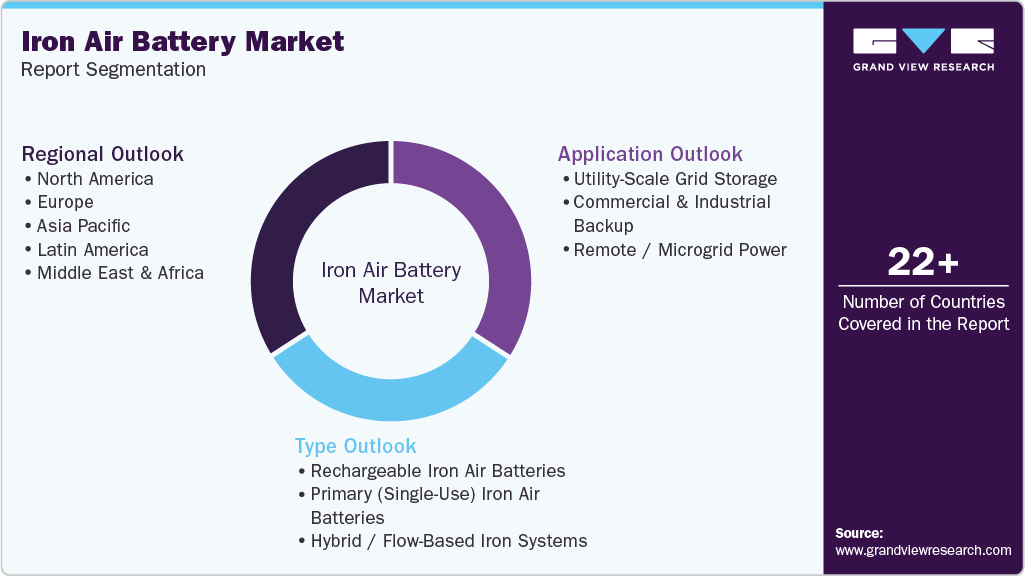
This report forecasts revenue growth at global, regional, and country levels and provides an analysis of the latest industry trends in each of the sub-segments from 2021 to 2033. For this study, Grand View Research has segmented the global iron air battery market report based on the type, application and region.
-
Type Outlook (Revenue, USD Million, 2021 - 2033)
-
Rechargeable Iron Air Batteries
-
Primary (Single-Use) Iron Air Batteries
-
Hybrid / Flow-Based Iron Systems
-
-
Application Outlook (Revenue, USD Million, 2021 - 2033)
-
Utility-Scale Grid Storage
-
Commercial & Industrial Backup
-
Remote / Microgrid Power
-
-
Regional Outlook (Revenue, USD Million, 2021 - 2033)
-
North America
-
U.S.
-
Canada
-
Mexico
-
-
Europe
-
Germany
-
UK
-
France
-
-
Asia Pacific
-
China
-
India
-
Japan
-
South Korea
-
-
Latin America
-
Brazil
-
-
Middle East & Africa
-
Saudi Arabia
-
UAE
-
-
Frequently Asked Questions About This Report
b. The iron–air battery market is primarily driven by the accelerating global shift toward long-duration energy storage solutions, increasing penetration of renewable power generation, and the need to enhance grid reliability and resilience.
b. The global iron air battery market size was estimated at USD 59.1 million in 2025 and is expected to reach USD 69.8 million in 2026.
b. The global Iiron air battery market is expected to grow at a compound annual growth rate of 17.9% from 2026 to 2033 to reach USD 221.9 million by 2033.
b. Based on the type segment, primary (single-use) iron–air batteries held the largest revenue share of more than 49.7% in 2025.
b. Some of the key players operating in the global Iron Air Battery market include Form Energy, ESS Tech Inc., Phinergy, Zinc8 Energy Solutions, Log9 Materials, Ore Energy, Panasonic Energy Co., Ltd., GP Batteries International Limited, Nanografi Nano Technology, and EnZinc Inc


Share this report with your colleague or friend.
Need a Tailored Report?
Customize this report to your needs — add regions, segments, or data points, with 20% free customization.


ISO 9001:2015 & 27001:2022 Certified
We are GDPR and CCPA compliant! Your transaction & personal information is safe and secure. For more details, please read our privacy policy.
Trusted market insights - try a free sample
See how our reports are structured and why industry leaders rely on Grand View Research. Get a free sample or ask us to tailor this report to your needs.












