
- Home
- »
- Clothing, Footwear & Accessories
- »
-
Innerwear Market Size And Share, Industry Report, 2033GVR Report cover
![Innerwear Market Size, Share & Trends Report]()
Innerwear Market (2026 - 2033) Size, Share & Trends Analysis Report By Product (Bottom Innerwear, Top Innerwear), By Material (Cotton, Wool, Polyester, Nylon, Polyester), By Distribution Channel (Offline, Online), By End User (Men, Women, Kids), By Region, And Segment Forecasts
- Report ID: GVR-4-68040-102-3
- Number of Report Pages: 110
- Format: PDF
- Historical Range: 2021 - 2025
- Forecast Period: 2026 - 2033
- Industry: Consumer Goods
- Report Summary
- Table of Contents
- Segmentation
- Methodology
- Download FREE Sample
-
 Download Sample Report
Innerwear Market Summary
The global innerwear market size was estimated at USD 235.22 billion in 2025 and is projected to reach USD 371.75 billion by 2033, growing at a CAGR of 6.0% from 2026 to 2033. The market is increasingly influenced by changing consumer perceptions around fit, comfort, and personal identity, as innerwear becomes more closely associated with everyday confidence rather than basic utility.
Key Market Trends & Insights
- The Asia Pacific innerwear market accounted for a revenue share of 41.65% in 2025.
- The innerwear market in China accounted for a share of 29.61% of the global revenue in 2025.
- By product, the bottom innerwear accounted for a revenue share of 50.83% in 2025.
- By material, the cotton accounted for a revenue share of 50.80% in 2025.
- By end-user, the women’s innerwear accounted for a revenue share of 62.02% in 2025.
Market Size & Forecast
- 2025 Market Size: USD 235.22 Billion
- 2033 Projected Market Size: USD 371.75 Billion
- CAGR (2026-2033): 6.0%
This shift is particularly visible across core categories within the foundation garment market, where products are expected to provide both functional support and a refined wearing experience. Consumers are becoming more aware of how innerwear supports different body shapes, postures, and lifestyle needs, leading to a shift away from standardized sizing toward products that recognize individual variation. As a result, expectations around how innerwear should feel, fit, and perform during daily use are being fundamentally redefined.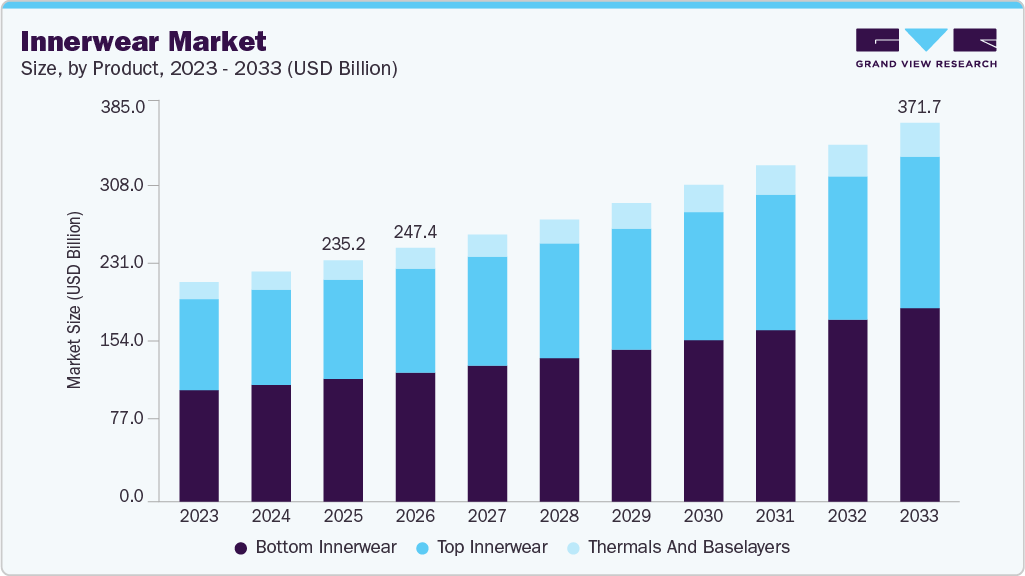
Demand for inclusive sizing and body-responsive design has strengthened across the innerwear landscape, including bras, shapewear, briefs, and other foundation garments. Brands are moving beyond narrow size frameworks and investing in improved pattern engineering, stretch-enabled fabrics, and adaptive construction techniques that better accommodate a wider range of body proportions. The focus is no longer limited to expanding size charts, but instead centers on delivering consistent comfort, support, and durability across different fits. This approach has enabled manufacturers to engage previously underserved consumer groups while improving retention among buyers who prioritize reliability and long-term wear comfort in foundation garment purchases.
Marketing and brand positioning have evolved alongside these product developments, with innerwear increasingly presented through realistic, relatable imagery rather than idealized imagery. Advertising campaigns now feature models of varied body shapes, ages, and appearances, reinforcing the idea that innerwear and foundation garments are designed for everyday bodies rather than aspirational standards. This shift has improved consumer trust and engagement, as shoppers are more likely to invest in products that align with their own experiences and expectations. The growing visibility of inclusive branding has also strengthened emotional connections with innerwear brands, thereby supporting loyalty in a competitive market.
At the same time, digital retail channels are playing an expanding role in shaping purchasing behavior across the innerwear and foundation garment market. Online platforms provide access to a wider assortment of styles, sizes, and support levels, supported by detailed product descriptions, sizing guidance, and user reviews. This environment allows consumers to make informed decisions while prioritizing privacy and convenience. Social media, fashion content, and brand-led digital storytelling further amplify exposure to new designs, materials, and fit innovations, reinforcing innerwear’s positioning as a considered lifestyle purchase rather than a routine necessity.
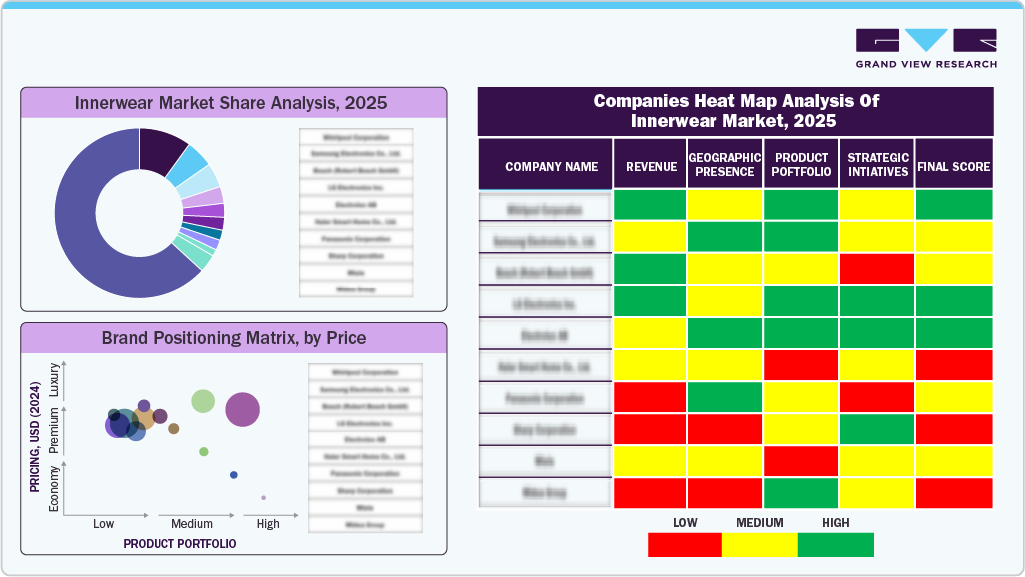
Brand Market Share Analysis
Established brands and emerging players in the innerwear market operate in an intensely competitive environment defined by rapid product refresh cycles, material innovation, and continuous refinement of fit and comfort standards across men’s and women’s categories. Competition is increasingly centered on fabric performance, construction quality, and design detailing, with brands differentiating through seamless engineering, contour-led silhouettes, and refined finishing that enhance wearability under everyday clothing. As consumer expectations rise, innerwear manufacturers are regularly updating collections to reflect evolving preferences for lightweight support, smooth profiles, and discreet aesthetics that align with modern dressing habits.
Consumer Insights for Innerwear:
Shifts in everyday dressing habits and heightened sensitivity to comfort are redefining how consumers engage with the innerwear market globally. Innerwear is increasingly evaluated as a performance layer that must function reliably across long work hours, commuting, domestic routines, and extended wear rather than as a passive undergarment. Consumers expect bras, briefs, shapewear, and foundation garments to maintain fit stability, breathability, and support throughout the day without causing pressure points, rolling, or irritation. Younger consumers, particularly those aged 18-35, gravitate toward innerwear that delivers functional benefits, such as stretch adaptability, smooth silhouettes under clothing, and lightweight support, while remaining visually minimal and suitable for daily rotation.
Digital content plays a decisive role in shaping innerwear purchasing behaviour, especially in online channels. Buyers rely heavily on real-body demonstrations, fit comparison videos, and user reviews to assess how innerwear performs during movement, while sitting, and during extended wear. Visual proof of factors such as fabric opacity, stretch recovery, seam visibility, and support consistency has become central to purchase confidence. Innerwear brands that clearly communicate intended use, support level, and fit characteristics are better positioned to reduce return rates and build trust in a category where poor fit directly impacts consumer satisfaction.
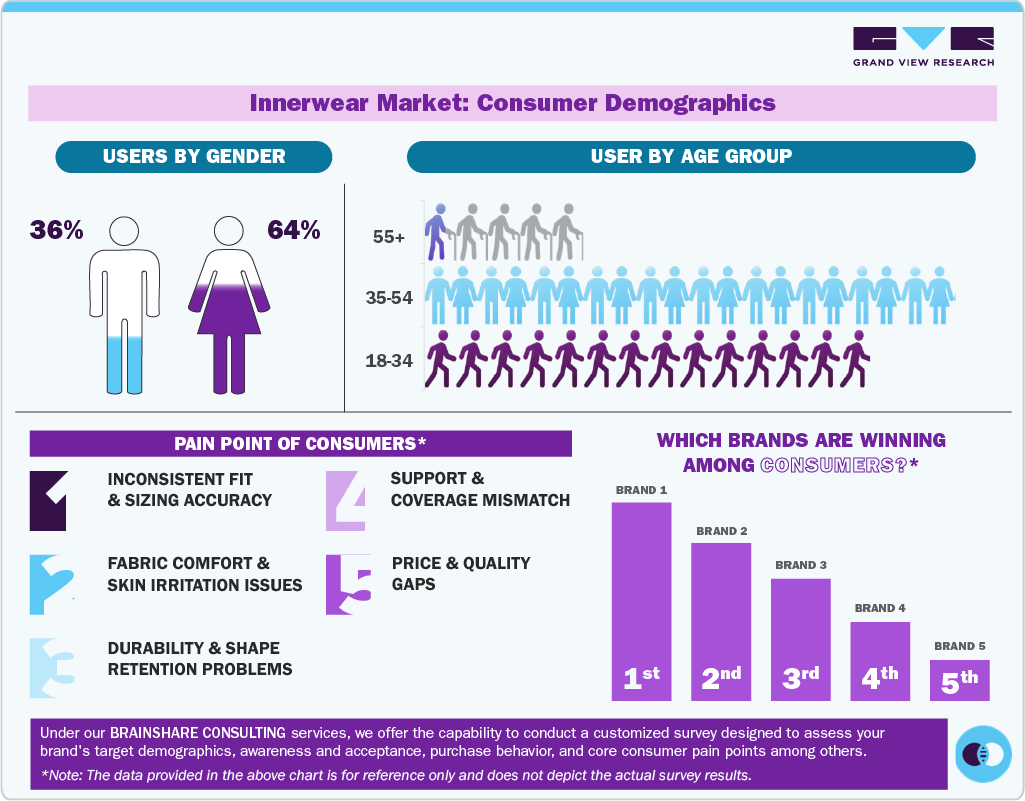
Fabric quality and construction standards strongly influence repeat buying and brand loyalty within the innerwear market. Consumers increasingly expect breathable materials, controlled elasticity, and shape retention to be built into everyday products rather than reserved for premium lines. Features such as soft-touch waistbands, adjustable components, seamless or low-profile construction, and durable stitching are now baseline expectations. Products that successfully avoid common issues, such as overheating, loss of elasticity, fabric pilling, or discomfort after washing, consistently outperform basic alternatives and drive higher repurchase rates.
Pricing Analysis:
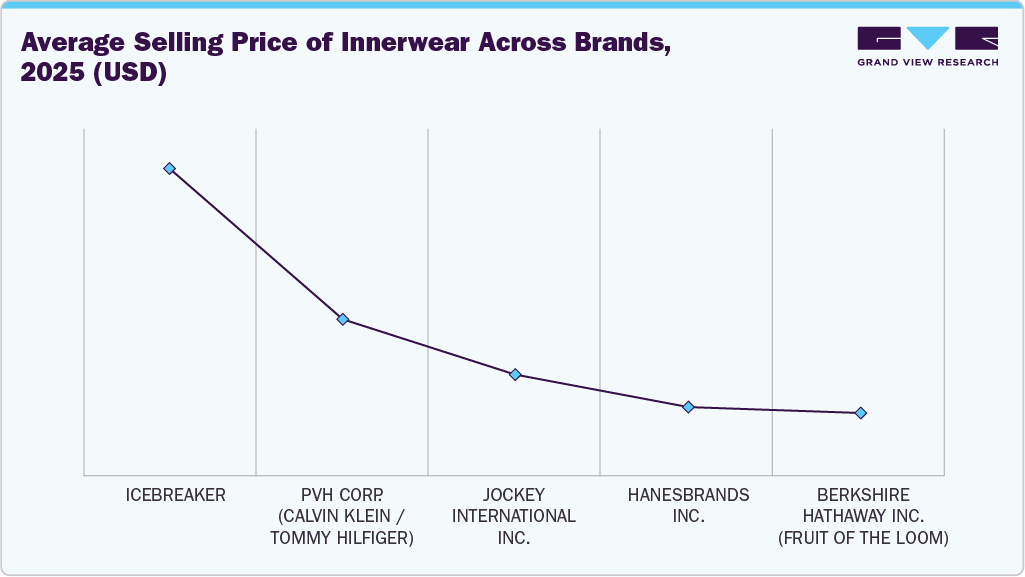
The innerwear industry is structured around clearly differentiated value propositions, with leading global brands commanding higher price points through strong fit credibility, material quality, and long-term wear performance. Established players such as Victoria’s Secret, Triumph, Wacoal, and Spanx attract consumers who prioritise consistent sizing, engineered support, premium fabrics, and proven durability, particularly within bras, shapewear, and foundation garments. These brands are often preferred by working professionals and repeat buyers who view innerwear as a long-term comfort investment rather than a disposable purchase.
A broad set of digitally native and mass-premium brands operate in the mid-range of the market, appealing to consumers seeking reliable comfort, modern design, and good fabric performance without the premium brand markup. Companies such as Calvin Klein Underwear, Jockey, Marks & Spencer, and Uniqlo gain traction through balanced pricing, wide size availability, and dependable everyday wear, making them popular for wardrobe replenishment and multi-pack purchases. This segment benefits from high repeat buying driven by predictable fit, accessible price points, and strong online distribution.
Product Insights
The bottom innerwear market segment accounted for a global revenue share of 50.83% in 2025. Consumers prioritize products that deliver stable fit, breathability, and comfort during extended wear, particularly across workdays, commuting, and prolonged sitting or movement. Demand is increasingly shaped by functional enhancements such as non-rolling waistbands, seamless or low-profile edges, moisture-managing fabrics, and durable stretch that retains shape after repeated washing.
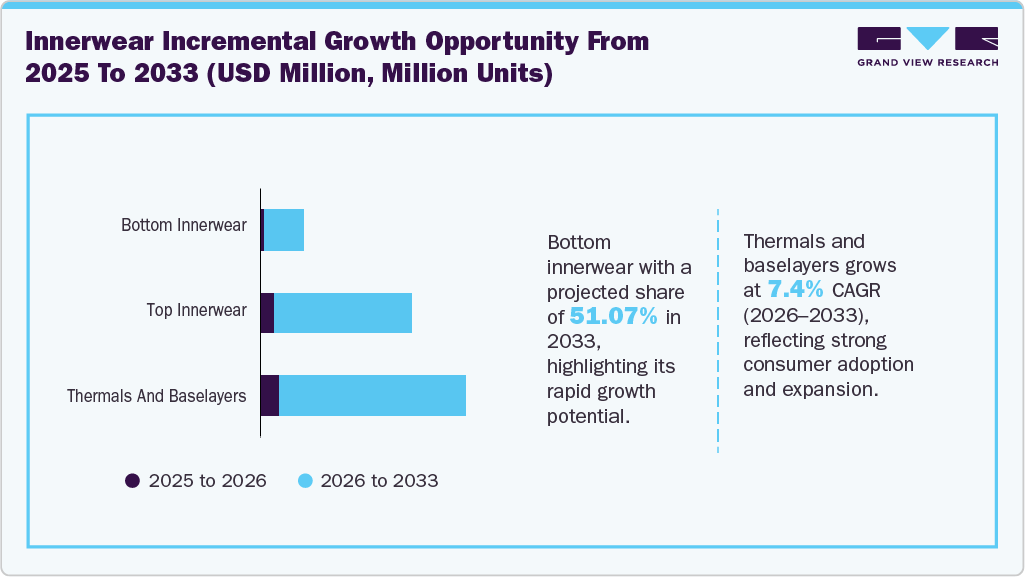
The thermals and baselayers segment is projected to grow at a CAGR of 7.4% from 2026 to 2033, supported by rising demand for temperature-regulating innerwear that can be worn across varied climates, daily routines, and layered dressing needs. Increasing participation in outdoor activities, winter travel, and long commuting hours is encouraging consumers to invest in innerwear that provides consistent warmth without bulk, particularly in urban markets where lightweight layering is preferred over heavy outerwear. Demand is further strengthened by growing awareness of performance fabrics such as moisture-wicking, thermal-retentive, and breathable materials, which improve comfort during extended wear.
Material Insights
Cotton innerwear accounted for a revenue share of 50.80% in 2025. Cotton is widely preferred across briefs, panties, boxers, and vests due to its natural breathability, softness, and moisture-absorbing properties, making it suitable for prolonged daily use across varied climates. Consumers strongly associate cotton innerwear with comfort, hygiene, and long-term wearability, particularly in warm and humid regions where heat management and irritation prevention are key purchase considerations.
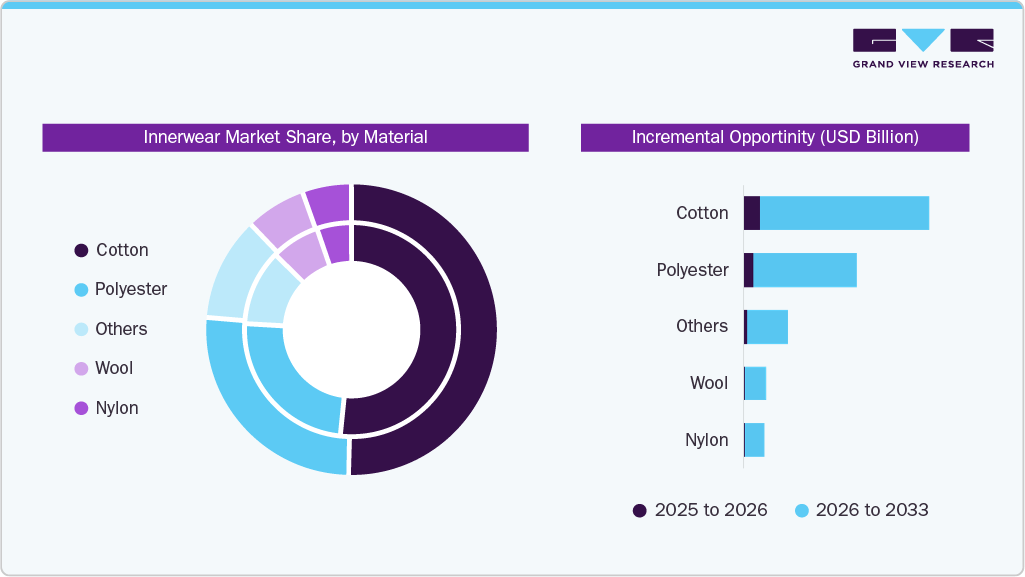
The polyester innerwear market is projected to grow at a CAGR of 6.9% from 2026 to 2033. The growth is driven by expanding urban populations, longer daily wear hours, and increasing participation in fitness, travel, and outdoor activities in large consumer markets such as China, India, and Brazil, where performance-oriented innerwear is gaining traction. Compared with cotton-based alternatives, polyester innerwear offers advantages such as faster drying, higher shape retention, resistance to shrinkage, and improved durability under frequent washing, making it well-suited for high-usage conditions. Adoption is also increasing in modern wardrobes where lightweight construction, moisture management, and compatibility with athleisure and fitted outerwear align with contemporary dressing preferences, reinforcing polyester’s growing role within the global market.
End-user Insights
The women’s innerwear industry segment accounted for a global revenue share of around 62.02% in 2025. Increasing workforce participation, longer daily wear hours, and greater emphasis on body support and silhouette compatibility have reinforced demand for bras, panties, shapewear, and foundation garments that perform reliably across varied clothing styles. In parallel, rising awareness of fit accuracy, fabric comfort, and body-responsive design has encouraged consumers to replace older innerwear more regularly, sustaining women’s innerwear as the largest and most resilient segment.
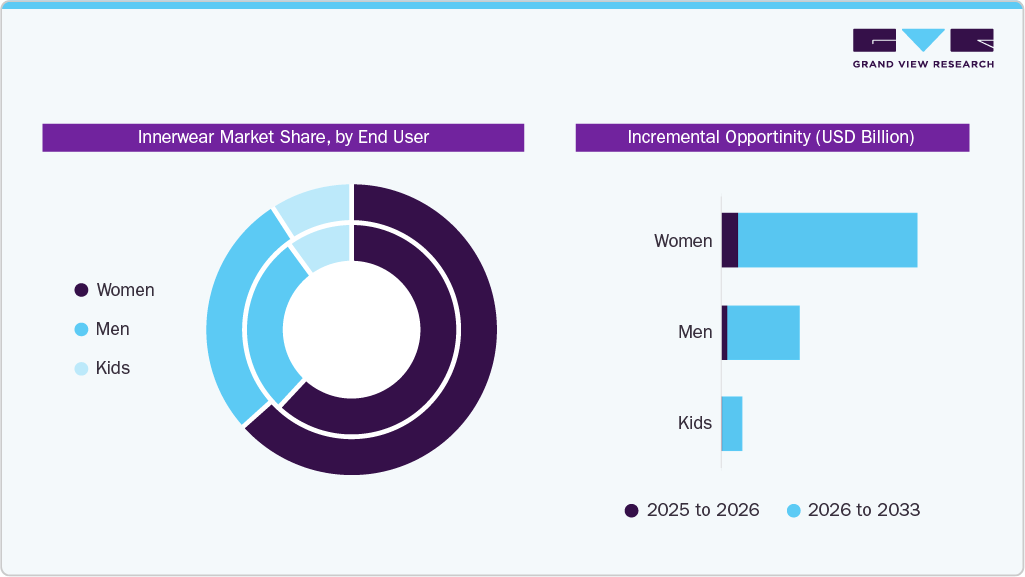
Men’s innerwear market projected to grow at a CAGR of 5.7% from 2026 to 2033, supported by shifting lifestyle patterns, rising focus on personal comfort, and greater willingness among male consumers to invest in fit-driven essentials. The demand is driven by longer work hours, increased participation in fitness and outdoor activities, and growing adoption of fitted formal and casual apparel, which places higher performance expectations on innerwear. Men are increasingly replacing innerwear more frequently to address issues such as heat management, movement comfort, and shape retention, rather than treating purchases as infrequent replenishments.
Distribution Channel Insights
Sales of innerwear through offline channels accounted for a global revenue share of 74.85% in 2025. Innerwear buyers often prefer in-store shopping to assess fabric softness, stretch, opacity, and construction quality, particularly for bras, shapewear, and fitted bottom innerwear, where precise sizing and support are critical. Specialty lingerie stores, department stores, and brand-exclusive outlets continue to play a central role by offering size trials, fitting assistance, and immediate product availability, which reduces the risk of returns.
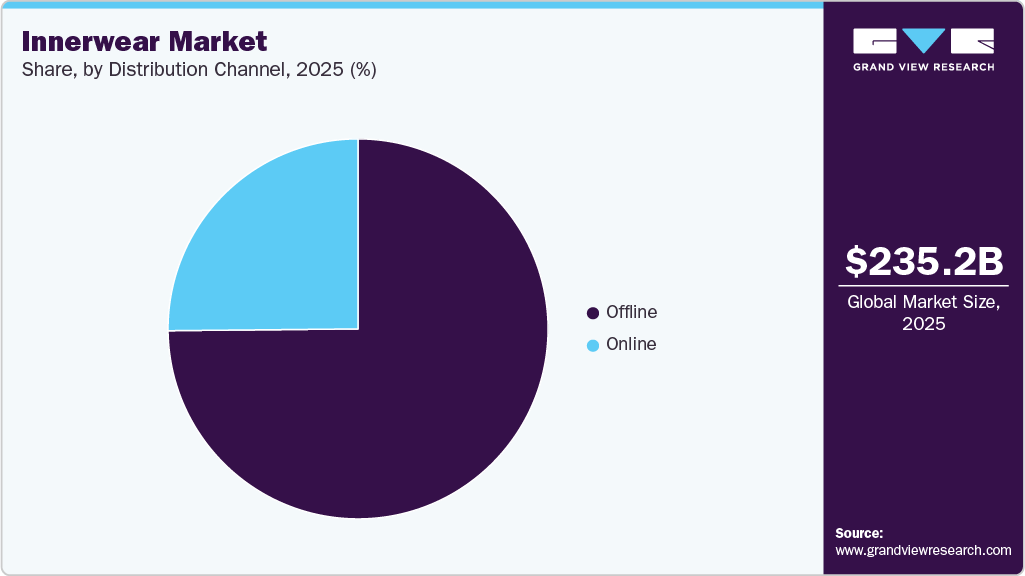
The sale of innerwear through online channels is projected to grow at a CAGR of 7.9% from 2026 to 2033. Online channels are benefiting from wider product assortments, easy size comparison, and access to detailed product information that helps shoppers evaluate fit, fabric composition, and support features before purchase. Growth is particularly strong for repeat purchases of familiar styles, multipacks, and subscription-based replenishment, where consumers prioritize speed and ease over in-store trials. In addition, improvements in size standardization, flexible return policies, and personalized recommendations are reducing purchase friction, while mobile-first shopping behavior and social commerce are further accelerating online adoption.
Regional Insights
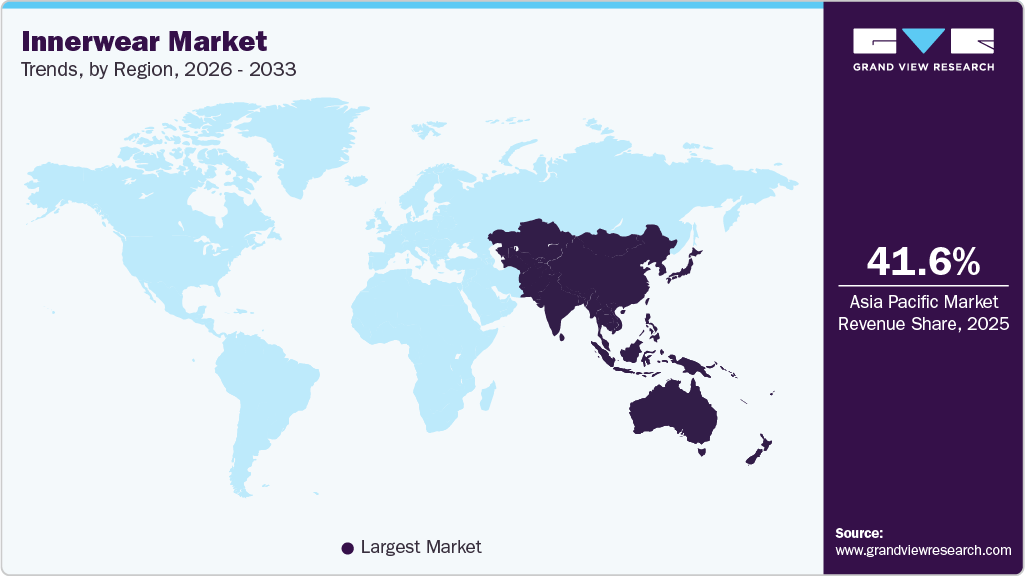
The Asia Pacific innerwear market accounted for a revenue share of 41.65% in 2025 and is projected to grow at a CAGR of 6.7% from 2026 to 2033. Dense urban populations, warm climatic conditions, and long daily wear cycles drive frequent replacement of innerwear, particularly in core markets such as China, India, Indonesia, and Vietnam. Consumers are increasingly shifting from unorganized local products to branded innerwear that offers improved fabric quality, consistent fit, and durability, especially in men’s briefs, women’s everyday bras, and bottom innerwear. The rapid expansion of value-focused domestic brands, aggressive retail rollout in tier-2 and tier-3 cities, and widespread adoption of mobile-first e-commerce platforms continue to raise penetration, positioning Asia Pacific as the fastest-growing and most volume-driven region in the global market.
China Innerwear Market Trends
The innerwear market in China accounted for a share of 29.61% of the global revenue in 2025. reflecting its massive consumer base and the high replacement frequency of the category. Innerwear demand in China is driven by dense urban living, long daily wear hours, and a strong emphasis on hygiene and comfort, which encourage frequent replenishment across men’s, women’s, and basic innerwear categories. Rising disposable incomes and lifestyle upgrades are pushing consumers away from low-quality, unbranded innerwear toward organized, branded products that offer better fabric performance, consistent fit, and durability.
The India innerwear market is projected to grow at a CAGR of 8.1% from 2026 to 2033. High population density, warm climatic conditions, and long daily wear hours result in frequent replacement of innerwear, particularly across men’s briefs, women’s everyday bras, and bottom innerwear. Growth is further supported by improving disposable incomes and a steady shift from unorganized, locally produced products toward branded innerwear that offers better fit, fabric quality, and durability.
North America Innerwear Market Trends
The innerwear industry in North America accounted for a share of 18.12% of the global revenue in 2025. Consumers across the U.S. and Canada replace innerwear regularly due to hygiene expectations, changing fit, and evolving comfort preferences, making it a high-rotation category rather than an occasional purchase. Demand is reinforced by a mature retail ecosystem comprising specialty lingerie stores, department stores, mass retailers, and brand-owned channels, ensuring wide availability across price points and distribution channels.
The innerwear industry in the U.S. is projected to grow at a CAGR of 5.1% from 2026 to 2033. Innerwear purchases in the U.S. are largely driven by routine replenishment rather than discretionary fashion spending, as consumers replace products regularly to maintain comfort, hygiene, and performance. The market benefits from widespread acceptance of category differentiation, such as everyday basics, performance innerwear, shapewear, and occasion-specific styles, which encourages multi-category purchasing within households.
Europe Innerwear Market Trends
The innerwear industry in Europe accounted for 25.08% of the global revenue share in 2025, driven by strong penetration of organized apparel brands, a high fashion cycle, and early adoption of sustainability-led product ranges. Innerwear in Europe is closely aligned with mainstream fashion calendars, with frequent collection updates, collaborations, and design refreshes that encourage repeat purchasing beyond basic replacement needs. In addition, stringent regulatory standards on textiles, chemicals, and labeling have pushed brands toward higher-value compliant products, increasing average selling prices across the region.
The innerwear market in the UK is projected to grow at a CAGR of 4.7% from 2026 to 2033. Consumers are placing greater importance on innerwear that supports long wear at home, work, and during daily routines, reinforcing demand for comfortable, well-fitted basics rather than occasion-led purchases. Urban living and smaller household sizes are encouraging more frequent wardrobe refreshes focused on functionality, fit consistency, and fabric comfort.
The Germany innerwear market is projected to grow at a CAGR of 4.9% from 2026 to 2033, supported by strong consumer emphasis on product quality, durability, and functional performance. German consumers tend to prioritize well-engineered innerwear that delivers consistent fit, long wear life, and fabric reliability, leading to steady replacement of older garments rather than impulse-driven fashion purchases. Demand is reinforced by high awareness of material standards, skin comfort, and wash durability, particularly across everyday basics such as bras, briefs, and foundation garments.
Central & South America Innerwear Market Trends
The innerwear industry in Central & South America is projected to grow at a CAGR of 5.2% from 2026 to 2033. Innerwear consumption in the region is driven by warm climatic conditions, long daily wear hours, and strong emphasis on hygiene and comfort, which together result in frequent replenishment across men’s briefs, women’s everyday bras, and bottom innerwear. Expanding middle-class populations in countries such as Brazil, Mexico, Colombia, and Chile are gradually shifting demand from unbranded or informal innerwear toward organized, branded products that offer better fabric quality, consistent fit, and durability.
Middle East & Africa Innerwear Market Trends
The innerwear industry in the Middle East & Africa is projected to grow at a CAGR of 4.6% from 2026 to 2033. High temperatures across large parts of the region drive strong demand for lightweight, breathable innerwear that supports comfort during long daily wear, resulting in relatively high replacement frequency for basic categories such as briefs, underwear, and everyday bras. Growth is further supported by a young, expanding population, rising urban employment, and greater exposure to global apparel brands, particularly in Gulf countries and major African cities.
Key Innerwear Companies:
The following key companies have been profiled for this study on the innerwear market.
- Hanesbrands Inc.
- Berkshire Hathaway Inc. (Fruit of the Loom)
- PVH Corp.
- Jockey International Inc.
- icebreaker
- Minus33 Merino Wool Clothing
- American Eagle Outfitters, Inc.
- Ralph Lauren Corporation
- Wacoal Holdings Corporation
- Spanx, LLC
- Victoria's Secret
- Calvin Klein
- Marks and Spencer plc
Recent Developments
-
In September 2025, Jockey introduced a new Seamless Innerwear Collection for women, created to offer an invisible, second-skin feel beneath clothing. The range is crafted using advanced bonding techniques that eliminate traditional seams and stitches, ensuring a smooth, contouring fit that prevents visible lines. Designed with lightweight, stretchy fabric, the collection delivers all-day comfort, breathability, and a barely noticeable feel. By combining innovative construction with refined aesthetics, Jockey aims to provide modern women with innerwear that complements both everyday wear and performance-driven lifestyles.
-
In July 2025, Victoria’s Secret expanded its top-selling Body by Victoria intimates line with a new bra innovation that prioritizes both comfort and support. The recently introduced Body by Victoria FlexFactor Lightly Lined Plunge Demi Bra features an innovative flexible titanium underwire and advanced design elements that enable a soft, almost wireless feel while still providing reliable shaping and everyday wearability. This new silhouette aims to blend seamless movement with structured support, enhancing the comfort and performance of one of the brand’s most popular collections.
Innerwear Market Report Scope
Report Attribute
Details
Market size value in 2026
USD 247.43 billion
Revenue Forecast in 2033
USD 371.75 billion
Growth rate
CAGR of 6.0% from 2026 to 2033
Actuals
2021 - 2025
Forecast period
2026 - 2033
Quantitative units
Revenue in USD million/billion, volume in million units, and CAGR from 2026 to 2033
Report coverage
Revenue forecast, volume forecast, company ranking, competitive landscape, growth factors, and trends
Segments covered
Product, material, end-user, distribution channel, region
Regional scope
North America; Europe; Asia Pacific; Central & South America; Middle East & Africa
Country scope
U.S.; Canada; Mexico; Germany; UK; France; Italy; Spain: China; Japan; India; South Korea; Australia & New Zealand; Brazil; South Africa
Key companies profiled
Hanesbrands Inc.; Berkshire Hathaway Inc. (Fruit of the Loom); PVH Corp.; Jockey International Inc.; icebreaker; Minus33 Merino Wool Clothing; American Eagle Outfitters, Inc.; Ralph Lauren Corporation; Wacoal Holdings Corporation; Spanx, LLC; Victoria's Secret; Calvin Klein; Marks and Spencer plc
Customization scope
Free report customization (equivalent up to 8 analysts’ working days) with purchase. Addition or alteration to country, regional & segment scope.
Pricing and purchase options
Avail customized purchase options to meet your exact research needs. Explore purchase options
Global Innerwear Market Report Segmentation
This report forecasts revenue & volume growth at the global, regional & country levels and provides an analysis of the latest trends and opportunities in each of the sub-segments from 2021 to 2033. For this study, Grand View Research has segmented the global innerwear market report based on product, material, end-user, distribution channel, and region:
-
Product Outlook (Volume, Million Units; Revenue, USD Million, 2021 - 2033)
-
Top Innerwear
-
Bras and Bralettes
-
Vests and Camisoles
-
-
Bottom Innerwear
-
Underwear
-
Panties and Leggings
-
-
Thermals and Baselayers
-
- Material Outlook (Volume, Million Units; Revenue, USD Million, 2021 - 2033)
-
Cotton
-
Wool
-
Merino Wool
-
Cashmere Wool
-
Alpaca Wool
-
Mohair Wool
-
Others
-
-
Polyester
-
Nylon
-
Others
-
-
End-user Outlook (Volume, Million Units; Revenue, USD Million, 2021 - 2033)
-
Men
-
Women
-
Kids
-
-
Distribution Channel Outlook (Volume, Million Units; Revenue, USD Million, 2021 - 2033)
-
Offline
-
Online
-
-
Regional Outlook (Volume, Million Units; Revenue, USD Million, 2021 - 2033)
-
North America
-
U.S.
-
Canada
-
Mexico
-
-
Europe
-
Germany
-
UK
-
France
-
Italy
-
Spain
-
-
Asia Pacific
-
China
-
Japan
-
India
-
South Korea
-
-
Australia & New Zealand
-
Central & South America
-
Brazil
-
-
Middle East & Africa
-
South Africa
-
-
Frequently Asked Questions About This Report
b. Some key players operating in innerwear market include Hanesbrands Inc., PVH Corp., Jockey International Inc., Ralph Lauren Corporation, Calvin Klein, • American Eagle Outfitters, Inc.
b. Key factors that are driving the innerwear market growth include a significant shift in societal attitudes toward body positivity and self-acceptance. Consumers now seek innerwear that embraces their individuality, supports their body shape, and promotes self-confidence.
b. The global innerwear market size was estimated at USD 235.22 billion in 2025 and is expected to reach USD 247.43 billion in 2026.
b. The global innerwear market is expected to grow at a compounded growth rate of 6.0% from 2026 to 2033 to reach USD 371.75 billion by 2033.
b. The bottom Innerwear segment dominated the global innerwear market with a share of 50.83% in 2025. This is attributed to comfort, functionality, and personal style in bottom undergarments. The increasing availability of a wide range of products and designs suitable for various purposes, including sports, regular wear, and functional wear, is anticipated to further fuel the product demand.


Share this report with your colleague or friend.
Need a Tailored Report?
Customize this report to your needs — add regions, segments, or data points, with 20% free customization.


ISO 9001:2015 & 27001:2022 Certified
We are GDPR and CCPA compliant! Your transaction & personal information is safe and secure. For more details, please read our privacy policy.
Trusted market insights - try a free sample
See how our reports are structured and why industry leaders rely on Grand View Research. Get a free sample or ask us to tailor this report to your needs.












