
- Home
- »
- Homecare & Decor
- »
-
Games And Puzzles Market Size, Industry Report, 2033GVR Report cover
![Games And Puzzles Market Size, Share & Trends Report]()
Games And Puzzles Market (2026 - 2033) Size, Share & Trends Analysis Report By Type (Games, Puzzles), By Licensing (Licensed, Non-licensed), By Distribution Channel (Offline, Online), By Region, And Segment Forecasts
- Report ID: GVR-2-68038-379-9
- Number of Report Pages: 150
- Format: PDF
- Historical Range: 2021 - 2025
- Forecast Period: 2026 - 2033
- Industry: Consumer Goods
- Report Summary
- Table of Contents
- Segmentation
- Methodology
- Download FREE Sample
-
 Download Sample Report
Games And Puzzles Market Summary
The global games and puzzles market size was estimated at USD 22.49 billion in 2025 and is projected to reach USD 103.96 billion by 2033, growing at a CAGR of 21.7% from 2026 to 2033. The nostalgia associated with classic tabletop entertainment, the scope of face-to-face social connection enabled by board games, and the intellectual stimulation offered by puzzles are among the key factors supporting growth in the global games & puzzles market.
Key Market Trends & Insights
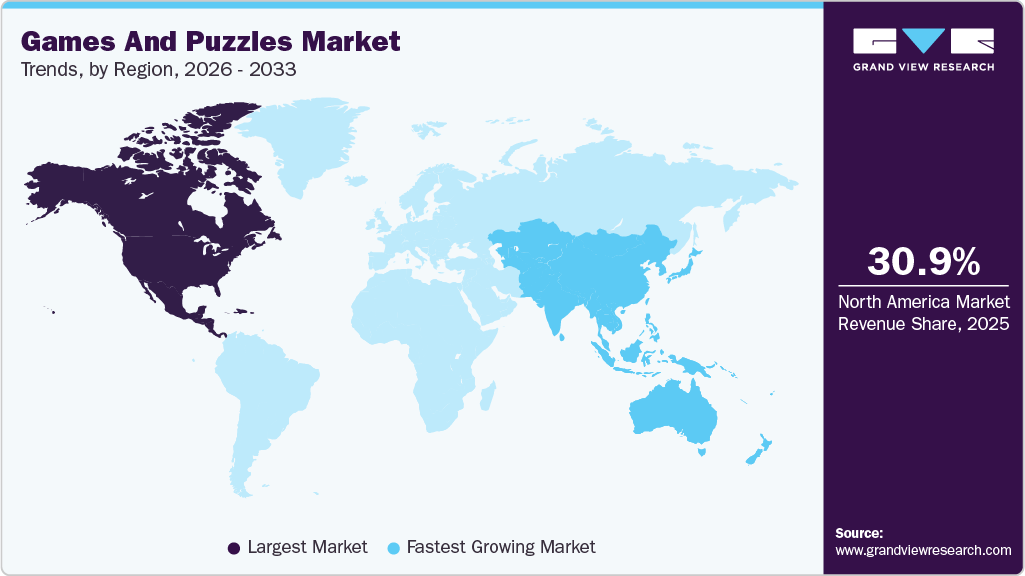
- North America games & puzzles market accounted for a revenue share of 30.92% in 2025.
- The games & puzzles market in the U.S. is expected to grow at a CAGR of 22.1% from 2026 to 2033.
- By type, games accounted for a revenue share of 57.46% in 2025.
- By licensing, non-licensed accounted for a revenue share of 70.56% in 2025.
- By distribution channel, sales through offline channels accounted for a revenue share of 53.07% in 2025.
Market Size & Forecast
- 2025 Market Size: USD 22.49 Billion
- 2033 Projected Market Size: USD 103.96 Billion
- CAGR (2026-2033): 21.7%
- North America: Largest market in 2025
- Asia Pacific: Fastest growing market
Consumers are seeking screen-free leisure formats that encourage shared experiences across families, friends, and community groups, strengthening demand for strategy games, word-based puzzles, and repeat-play social titles. Premium adult participation is also rising, with segments such as the Tetra Tower Game Market benefiting from renewed interest in simple, competitive tabletop formats that fit casual gatherings and modern lifestyle consumption.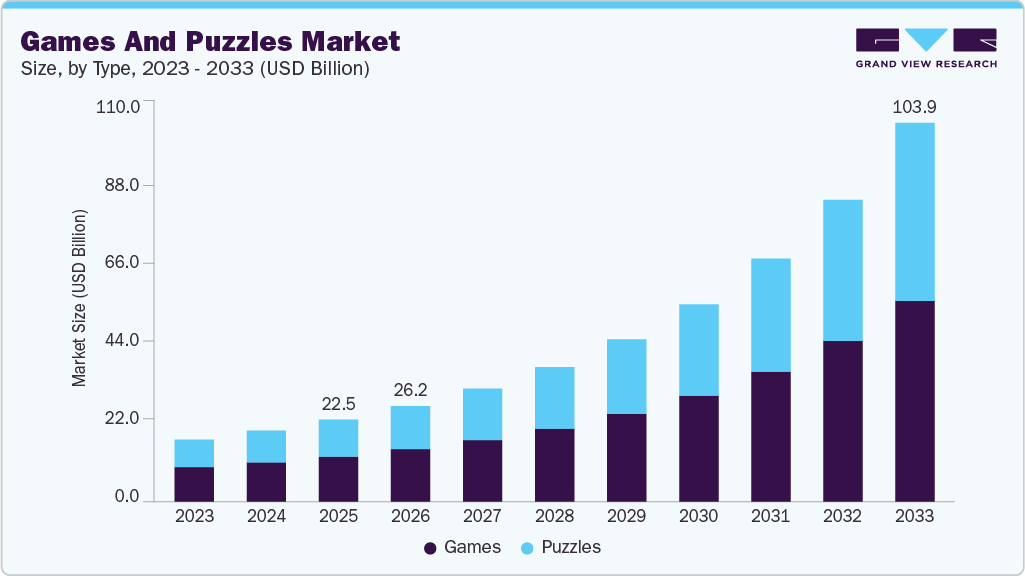
Games and puzzles are also gaining stronger traction due to expanding awareness of their cognitive and emotional health value. Psychology Today highlights that engaging with word puzzles and board games supports brain health by strengthening executive function, improving decision-making, and enhancing memory through active mental engagement. A WordsRated.com survey referenced in the article found that 65% of U.S. adults enjoy board games, with many players reporting mood benefits linked to serotonin response, helping reduce anxiety and improve emotional well-being. These factors are positioning puzzles and tabletop products as more than entertainment, reinforcing their role as accessible tools for mental fitness, stress relief, and social bonding across age groups.
In parallel, the market is witnessing renewed cultural momentum through the rise of board game clubs and offline gaming communities, particularly among younger adults seeking real-world social interaction outside digital platforms. The New York Times has highlighted the growing appeal of board game clubs as an “extremely offline” form of joy, reflecting broader consumer demand for intentional in-person leisure experiences. This shift is strengthening the adoption of group-play formats and adult-oriented tabletop categories, supporting growth in areas such as the Tetra Tower Game market, where repeatable competition and shared engagement are central purchasing drivers.
The segment is further supported by broader recovery trends across the global toy and leisure industry. The Toy Association reported that the global toy industry rebounded in 2025, with sales rising 7%, driven by pop culture relevance, licensed products, and increased engagement from teens and adults. This rebound is directly benefiting games and puzzles, where collectibles demand, adult participation, and social-play formats continue to expand category reach. As consumers increasingly value cognitive stimulation, offline community interaction, and durable, replayable entertainment, games & puzzles remain one of the most resilient and fast-evolving segments in global leisure goods.
Brand Market Share Insights
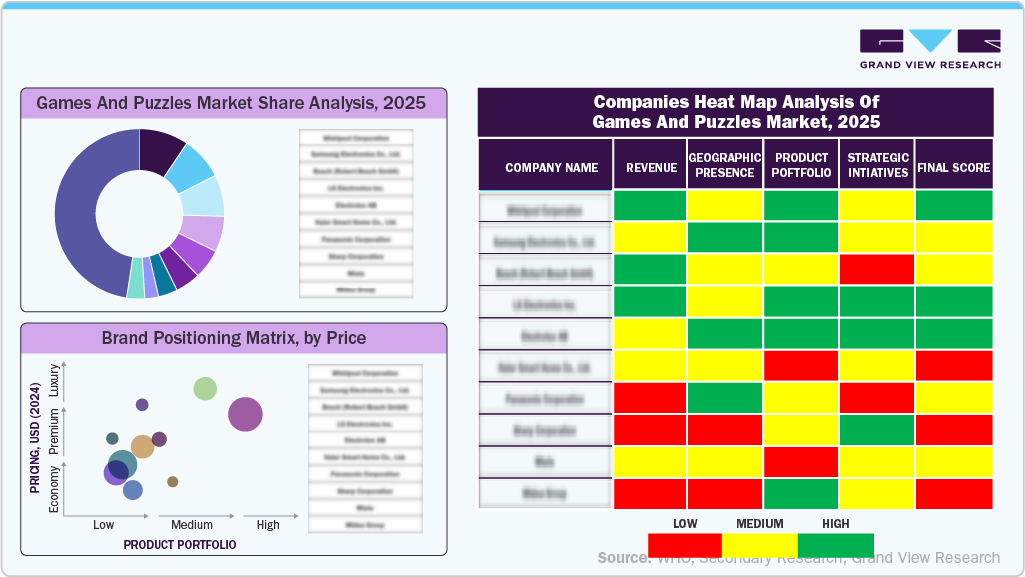
The global games & puzzles industry is characterized by the presence of established toy and entertainment companies alongside a growing base of specialty tabletop publishers and digitally native challengers, all competing to meet evolving consumer expectations around social engagement, cognitive stimulation, and premium play experiences. Manufacturers are increasingly developing games and puzzle products that integrate deeper strategy, replayability, and experiential design into formats suited for both family entertainment and adult leisure, enabling seamless transition from casual play to hobbyist-level engagement.
Leading players, including Ravensburger and Hasbro, continue to expand beyond traditional board games and jigsaw puzzles into modern strategy titles, licensed storytelling formats, and collectible tabletop experiences that appeal across age groups. At the same time, sustainability has emerged as a key strategic focus, with companies adopting recycled cardboard, reduced-plastic packaging, and environmentally conscious production practices in response to rising consumer demand for responsible leisure goods.
Consumer Insights
Families increasingly invest in modern board games for group interaction, while younger adults are driving growth in strategy titles, party games, and franchise-based formats tied to popular entertainment brands. Puzzle buying has also broadened beyond traditional demographics, with consumers using high-piece-count jigsaws and premium art puzzles as relaxation products that support stress relief and focus during every day routines. Digital discovery plays a major role, with buyers relying heavily on gameplay explainers, community ratings, and influencer-led demonstrations that highlight replay depth and group suitability.
Consumers often avoid products that feel overly simplistic, lack balanced difficulty progression, or wear down quickly through poor board construction and low-quality puzzle cuts. As a result, manufacturers are focusing on stronger material standards, immersive thematic design, modular expansion packs, and collectible licensed editions that extend product lifespan. Demand is rising for cooperative and narrative-driven tabletop games that sustain multi-session interest, as well as puzzles with sharper print resolution, thicker pieces, and premium packaging that support both usability and gifting appeal.
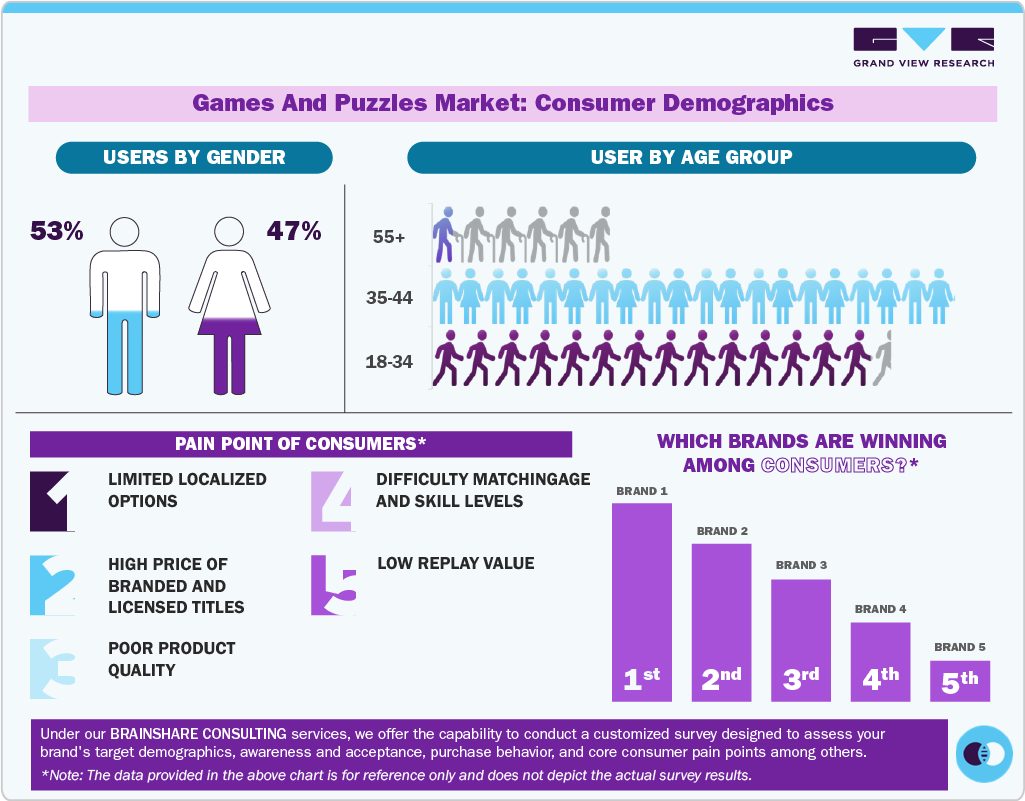
Value-driven consumers typically choose mass-market family classics and entry-priced puzzles, while higher-income hobbyists invest in designer tabletop games, limited-edition releases, and premium collectible formats. Licensed products are a key growth lever, as brands increasingly collaborate with major franchises, such as anime series, film properties, and lifestyle brands, to attract fandom-driven purchasing and repeat engagement. With demand anchored in social connection, cognitive play, and experiential home entertainment, games & puzzles are emerging as one of the most resilient and fast-evolving segments within global consumer leisure.
Type Insights
Games accounted for a share of 57.46% of the global revenue in 2025. Board games, card games, and strategy-based tabletop products remain central to household and social entertainment, offering accessible group interaction, competitive engagement, and repeat-play value that puzzles alone cannot always provide. Leading companies such as Hasbro, Mattel, Ravensburger, and Asmodee continue to strengthen this category through expanding portfolios of party games, licensed franchises, and modern strategy titles that appeal across both family and adult consumer segments.
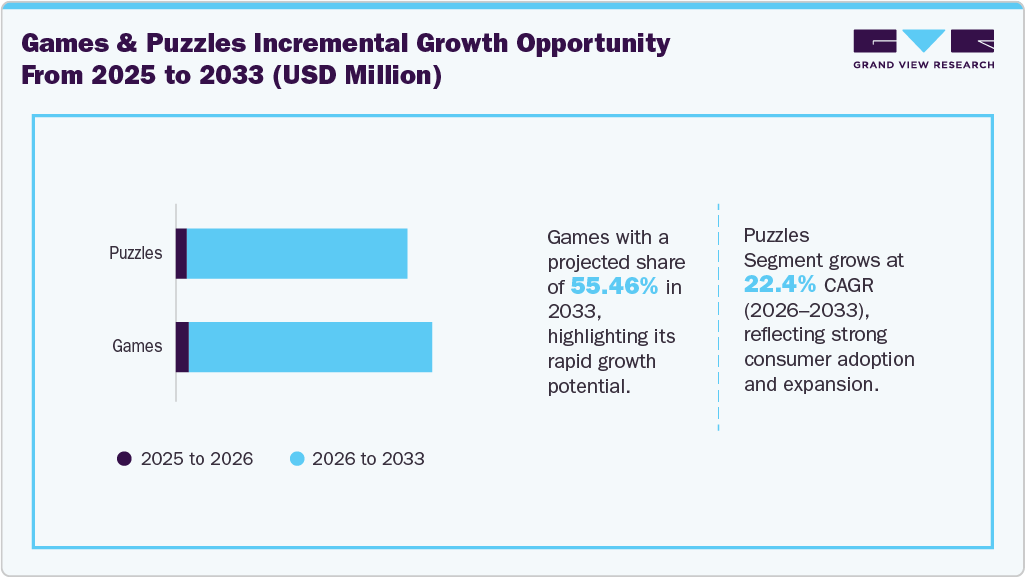
The puzzles segment is projected to grow at a CAGR of 22.4% from 2026 to 2033, supported by rising consumer interest in screen-free cognitive engagement, mindfulness-driven leisure, and home-based entertainment routines. Jigsaw puzzles, word puzzles, and logic-based formats are increasingly being adopted not only as recreational products but also as tools associated with stress relief, mental focus, and brain-health benefits. Demand is expanding strongly among adults and older consumers seeking intellectually stimulating activities, while younger demographics are also engaging with puzzles through premium design-led offerings and social puzzle-solving trends.
Innovative type development, including limited-edition art puzzles, licensed storytelling formats, and higher-difficulty collections, is further strengthening category momentum. The growing availability of sustainable puzzle materials and elevated packaging has also positioned puzzles as lifestyle-oriented purchases rather than seasonal gifting items.
Licensing Insights
Non-licensed games & puzzles accounted for a share of 70.56% of the global revenue in 2025. Consumers consistently purchase non-licensed products because they offer broad social usability, timeless appeal, and repeat engagement across households, classrooms, and casual group settings. Classic board games, abstract strategy formats, standard playing card games, and traditional jigsaw puzzles remain widely preferred as they do not depend on entertainment cycles and maintain long-term relevance.
This segment also benefits from greater pricing accessibility and wider retail penetration; as non-licensed games are more commonly positioned as everyday leisure staples rather than premium collectible purchases. Buyers often prioritize simplicity, ability to replay, and familiarity, particularly for family entertainment and gifting occasions where universal appeal matters more than franchise branding.
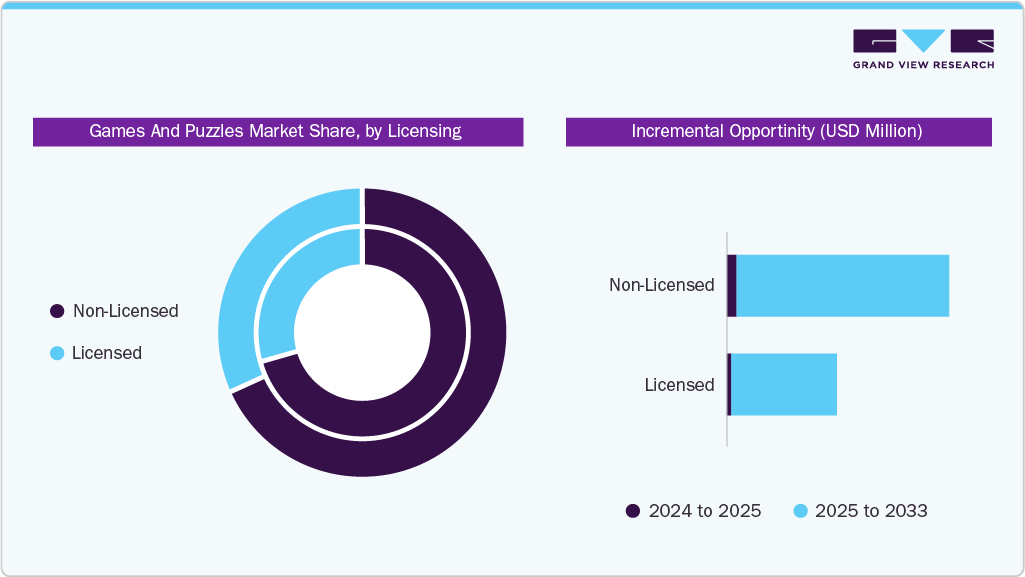
Licensed games & puzzles are projected to grow at a CAGR of 22.9% from 2026 to 2033. Licensed titles are increasingly purchased not only for gameplay value but also for their emotional familiarity, collectible appeal, and strong gifting relevance. Categories such as movie-based board games, branded trivia formats, and franchise-led puzzle collections are gaining traction as consumers seek immersive experiences connected to well-known films, television series, gaming IP, and children’s entertainment brands. This growth is further supported by the expanding influence of pop culture across tabletop leisure, where recognizable characters and licensed narratives enhance engagement and encourage repeat purchases.
Distribution Channel Insights
Sales of games & puzzles through offline stores accounted for a share of around 53.07% of the global revenue in 2025. Consumers often prefer purchasing board games and puzzles in-store because packaging, component quality, puzzle piece thickness, and overall play format are easier to assess through direct evaluation than online images alone. Specialty toy stores, bookstores, and department chains also support demand through curated displays, staff recommendations, and seasonal gifting assortments that encourage impulse purchase and family-oriented shopping.
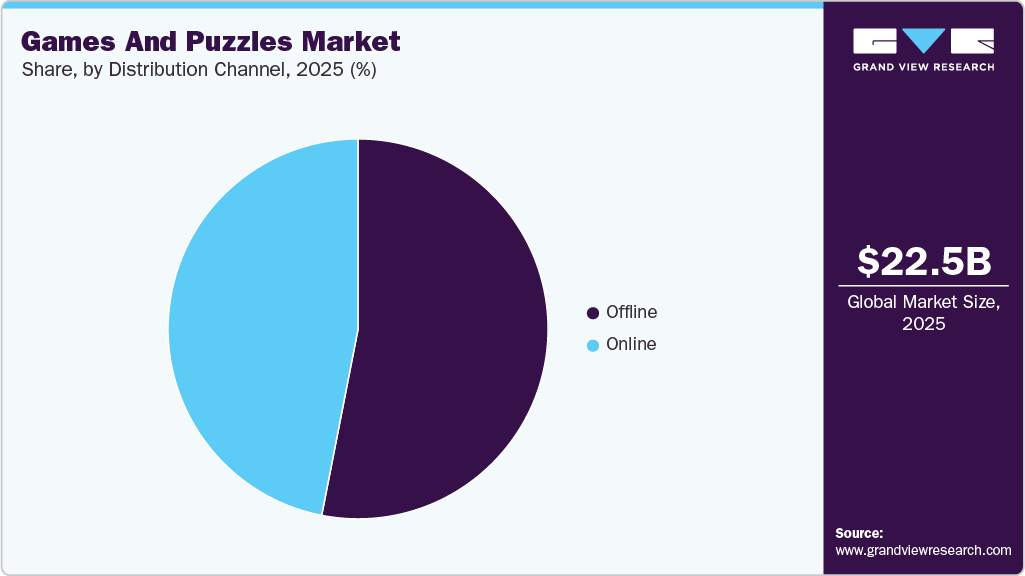
Sales of games & puzzles through online channels are projected to grow at a CAGR of 22.4% from 2026 to 2033. Consumers increasingly prefer purchasing games and puzzles online because digital retail offers a wider assortment of titles, difficulty levels, and niche categories than most physical stores can stock. Online channels also allow shoppers to compare gameplay ratings, watch demonstration videos, and rely on verified user reviews before selecting higher-involvement products such as strategy board games, premium puzzle sets, or licensed editions. Growth is further strengthened by direct-to-consumer launches, subscription-style puzzle offerings, frequent promotional events, and improved home delivery convenience, positioning online retail as the fastest-growing distribution channel in the games & puzzles industry.
Regional Insights
North America games and puzzles market accounted for a share of 30.92% of the global revenue in 2025, driven by the region’s large base of habitual board game and puzzle consumers across both the U.S. and Canada. North America has one of the most mature tabletop entertainment cultures globally, supported by strong household penetration of family board games, rising adult participation in modern strategy titles, and widespread use of puzzles as cognitive and wellness-oriented leisure products. Demand is particularly strong for party games, licensed board games, and premium jigsaw puzzle collections that align with gifting occasions and repeat-play social routines.
U.S. Games And Puzzles Market Trends
The games & puzzles market in the U.S. is projected to grow at a CAGR of 22.1% from 2026 to 2033, driven by the country’s strong consumer shift toward experience-based discretionary spending and the rising demand for offline, skill-oriented entertainment products. U.S. buyers are increasingly purchasing games and puzzles as premium home leisure formats that deliver lasting value through the ability to replay, problem-solving depth, and shared engagement, rather than as low-cost seasonal items. The market is also being shaped by rapid type turnover and innovation in modern strategy and narrative-based tabletop formats, supported by a highly active publishing ecosystem and strong visibility through specialty hobby retail.
Canada games & puzzles market is projected to grow at a CAGR of 19.3% from 2026 to 2033.Canadian buyers are showing stronger uptake of puzzles and tabletop games as value-driven entertainment formats that offer long-term usability, educational relevance, and social interaction without recurring costs. The market is also benefiting from Canada’s strong specialty retail presence and community-based adoption, where board game libraries, local hobby stores, and organized play spaces are expanding participation beyond traditional family purchasing.
Europe Games And Puzzles Market Trends
The games & puzzles market in Europe is projected to grow at a CAGR of 22.3% from 2026 to 2033. European markets such as Germany, France, and the Nordics show high household penetration of puzzles and strategy games, driven by long-standing traditions of family tabletop play and rising adult participation in modern hobby gaming. Demand is also being reinforced by the popularity of premium puzzle collections, locally produced board games, and licensed European-language editions that sustain repeat purchasing beyond seasonal gifting.
The UK games and puzzles market is projected to grow at a CAGR of 21.4% from 2026 to 2033. Demand is being supported by strong crossover with the book and stationery market, where puzzles and games are increasingly positioned as premium leisure goods rather than toy-only purchases. The U.K. also benefits from high consumer exposure to quiz culture, trivia-led entertainment, and structured social play, which continues to strengthen demand for group-based tabletop formats.
The games and puzzles market in Germany is projected to grow at a CAGR of 23.8% from 2026 to 2033. Growth is being driven by rising consumer demand for screen-free activities that offer measurable mental engagement, particularly among older adults and families seeking alternatives to passive media consumption. The German market is also characterized by strong demand for high-specification products, thick puzzle boards, precision-cut pieces, and durable game components, where purchasing decisions are closely tied to craftsmanship and long-term usability rather than novelty.
Asia Pacific Games And Puzzles Market Trends
The games & puzzles market in Asia Pacific is projected to grow at a CAGR of 22.6% from 2026 to 2033. Countries such as China, India, Japan, and South Korea are seeing rising demand for board games and puzzles as urban consumers increasingly seek structured, screen-light recreation for households, cafés, and social gatherings. Growth is being reinforced by the expansion of specialty retail and e-commerce access across the region, which has improved availability of modern strategy titles, licensed games, and premium puzzle formats.
China games and puzzles market accounted for a share of 38.69% of the regional revenue in 2025. China is seeing an accelerating uptake of board games and puzzles among younger urban consumers, where offline social recreation and home-centered leisure are expanding as alternatives to purely digital entertainment. The market is further strengthened by China’s highly efficient retail and distribution environment, with platforms such as Tmall and JD.com enabling nationwide reach for both imported premium titles and fast-growing local brands.
The games and puzzles market in India is projected to grow at a CAGR of 26.5% from 2026 to 2033. Demand is increasingly supported by parents and educators seeking non-digital learning tools that encourage problem-solving, concentration, and group interaction, strengthening uptake of puzzles, logic games, and classroom-friendly board formats. The market is also benefiting from India’s strong gifting economy and the rise of premiumization in urban consumer segments, where tabletop products are being purchased as higher-quality lifestyle items rather than low-cost seasonal toys.
Central And South America Games And Puzzles Market Trends
The games & puzzles market in Central and South America is projected to grow at a CAGR of 18.7% from 2026 to 2033, supported by rising consumer interest in affordable, family-oriented entertainment and expanding availability of tabletop products across retail and e-commerce channels. Demand is being driven by growing adoption of board games and puzzles as everyday leisure options for households and social gatherings, particularly in major urban markets.
Middle East & Africa Games And Puzzles Market Trends
The games & puzzles market in the Middle East & Africa is projected to grow at a CAGR of 20.3% from 2026 to 2033, supported by expanding retail infrastructure and rising demand for affordable family entertainment across urban centers. Consumption is being shaped by increasing interest in board games and puzzles as social and home-based leisure activities, particularly in the Gulf region and South Africa. International brands and local distributors are strengthening type availability through shopping malls, specialty toy retailers, and rapidly growing e-commerce platforms.
Key Games And Puzzles Company Insights
Key players operating in the games and puzzles market are undertaking various initiatives to strengthen their presence and increase the reach of their products and services. Strategies such as expansion activities and partnerships are key in propelling the market growth.
Key Games And Puzzles Companies:
The following key companies have been profiled for this study on the games and puzzles market
- Buffalo Games
- Hasbro, Inc.
- Mattel, Inc.
- Ceaco, Inc.
- Ravensburger AG
- Schmidt Spiele
- Cubicfun 3D Puzzle
- Educa Borras
- Castorland
- Cobble Hill
Recent Developments
-
In April 2025, Friskies launched a cat-inspired board game as part of its effort to engage pet owners in a more playful, interactive way. The game is designed around feline-themed fun, reinforcing the brand’s connection to cat culture beyond traditional pet food products. The initiative reflects a growing trend of pet brands using creative lifestyle extensions and entertainment-focused marketing to strengthen consumer engagement and brand loyalty.
-
In May 2024, The Op Games has launched a new MONOPOLY: One Piece Edition, inspired by the popular anime series. The special version reimagines the classic board game with themed artwork, custom tokens, and locations tied to the One Piece world, offering fans a fresh collectible experience. The release reflects the growing demand for licensed tabletop games that combine well-known franchises with familiar family entertainment formats.
Games And Puzzles Market Report Scope
Report Attribute
Details
Market size value in 2026
USD 26.25 billion
Revenue Forecast in 2033
USD 103.96 billion
Growth rate
CAGR of 21.7% from 2026 to 2033
Actuals
2021 - 2025
Forecast period
2026 - 2033
Quantitative units
Revenue in USD million/billion and CAGR from 2026 to 2033
Report coverage
Revenue forecast, company ranking, competitive landscape, growth factors, and trends
Segments covered
Type, licensing, distribution channel, region
Regional scope
North America; Europe; Asia Pacific; Central & South America; Middle East & Africa
Country scope
U.S.; Canada; Mexico; Germany; UK; France; Italy; Spain: China; Japan; India; South Korea; Australia & New Zealand; Brazil; South Africa
Key companies profiled
Buffalo Games; Hasbro, Inc.; Mattel, Inc.; Ceaco, Inc.; Ravensburger AG; Schmidt Spiele; Cubicfun 3D Puzzle; Educa Borras; Castorland; Cobble Hill
Customization scope
Free report customization (equivalent up to 8 analysts’ working days) with purchase. Addition or alteration to country, regional & segment scope. Pricing and purchase options
Avail customized purchase options to meet your exact research needs. Explore purchase options Global Games And Puzzles Market Report Segmentation
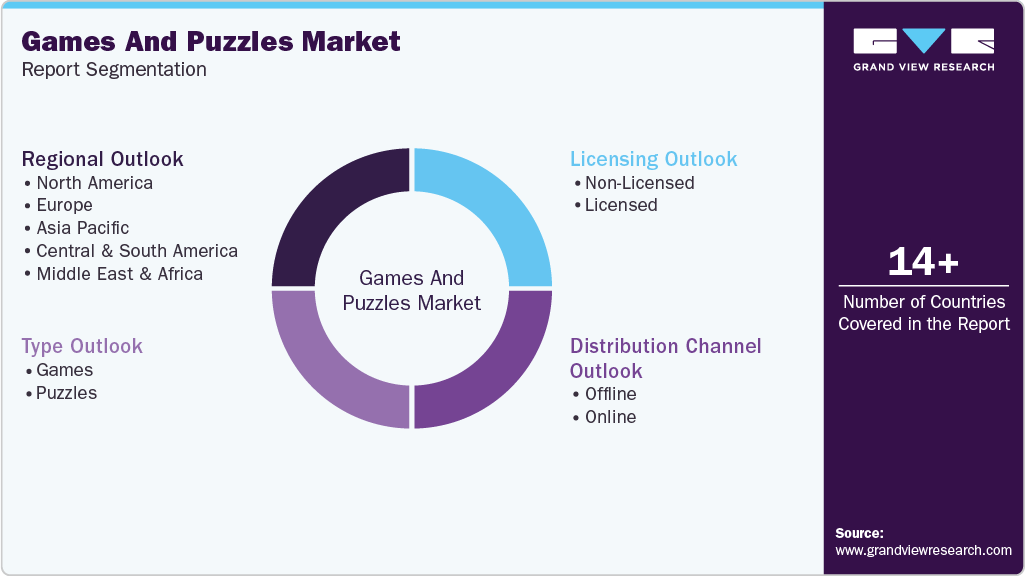
This report forecasts revenue growth at global, regional & country levels and provides an analysis of the latest trends and opportunities in each of the sub-segments from 2021 to 2033. For this study, Grand View Research has segmented the global games and puzzles market report on the basis of type, licensing, distribution channel, and region:
-
Type Outlook (Revenue, USD Million, 2021 - 2033)
-
Games
-
Board Games
-
Card Games
-
-
Puzzles
-
-
Licensing Outlook (Revenue, USD Million, 2021 - 2033)
-
Non-Licensed
-
Licensed
-
-
Distribution Channel Outlook (Revenue, USD Million, 2021 - 2033)
-
Offline
-
Online
-
-
Regional Outlook (Revenue, USD Million, 2021 - 2033)
-
North America
-
U.S.
-
Canada
-
Mexico
-
-
Europe
-
Germany
-
UK
-
France
-
Italy
-
Spain
-
-
Asia Pacific
-
China
-
Japan
-
India
-
South Korea
-
Australia & New Zealand
-
-
Central & South America
-
Brazil
-
-
Middle East & Africa
-
South Africa
-
-
Frequently Asked Questions About This Report
b. The global games and puzzles market was estimated at USD 22.49 billion in 2025 and is expected to reach USD 26.25 billion in 2026.
b. Some of the key players operating in the games and puzzles market include Buffalo Games; Hasbro, Inc.; Mattel, Inc.; Ceaco, Inc.; Ravensburger AG; Schmidt Spiele; Cubicfun 3D Puzzle; Educa Borras; Castorland; Cobble Hill.
b. Key factors that are driving the games and puzzles market growth include the nostalgia derived from playing such games, the scope of social interaction that games and puzzles provide escapism from technology, coupled with intellectual stimulation and growing interest in licensed games and puzzles.
b. North America dominated the games and puzzles market with a share of about 30.92% in 2025. The growth of the regional market is mainly driven by the presence of popular market players in the geography, combined with constant product innovation and mergers & acquisitions.
b. The global games and puzzles market is expected to grow at a compound annual growth rate of 21.7% from 2026 to 2033 to reach USD 103.96 billion by 2033.


Share this report with your colleague or friend.
Need a Tailored Report?
Customize this report to your needs — add regions, segments, or data points, with 20% free customization.


ISO 9001:2015 & 27001:2022 Certified
We are GDPR and CCPA compliant! Your transaction & personal information is safe and secure. For more details, please read our privacy policy.
Trusted market insights - try a free sample
See how our reports are structured and why industry leaders rely on Grand View Research. Get a free sample or ask us to tailor this report to your needs.












