France Dairy Alternatives Market Summary
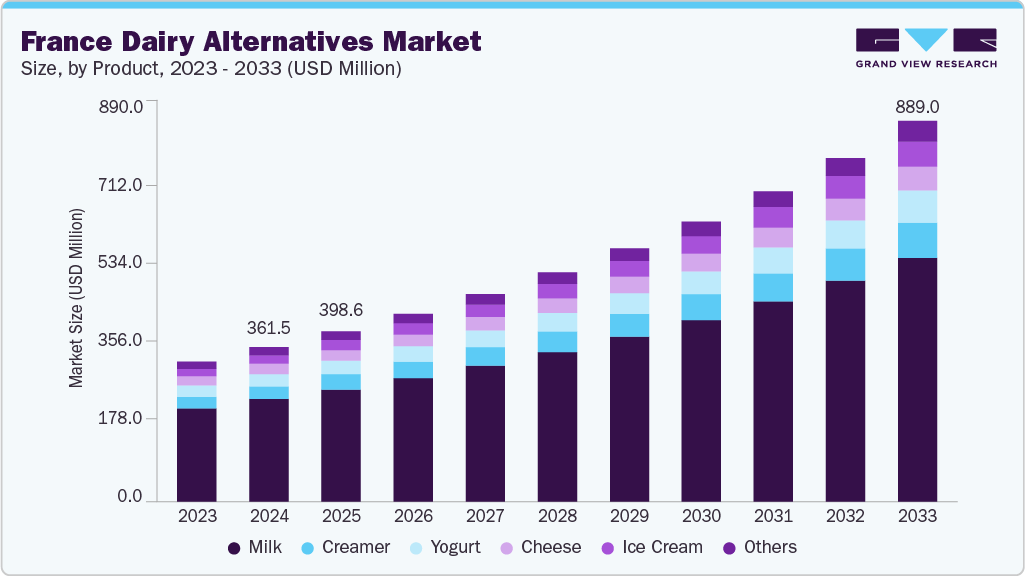
The France dairy alternatives market size was estimated at USD 361.5 million in 2024 and is projected to reach USD 889.0 million by 2033, growing at a CAGR of 10.5% from 2025 to 2033. The French dairy alternatives industry has witnessed a steady increase in demand, driven by rising lactose intolerance and growing health consciousness among consumers.
Key Market Trends & Insights
- By source, the soy segment held the highest market share of 37.0% in 2024.
- Based on product, the ice cream segment is projected to grow at the fastest CAGR of 12.2% from 2025 to 2033.
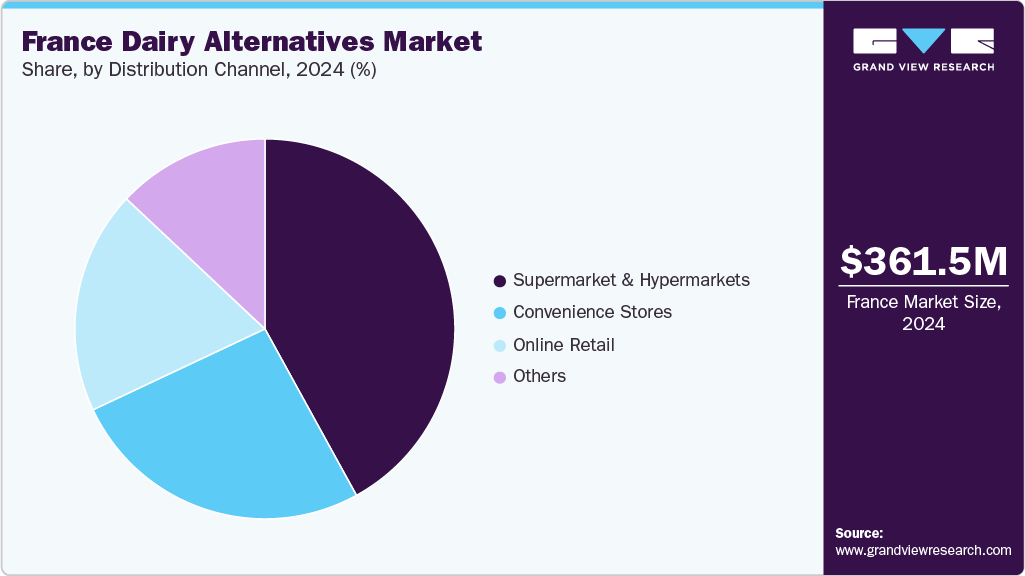
- By distribution channel, the supermarket & hypermarkets segment held the highest market share of 42.1% in 2024.
Market Size & Forecast
- 2024 Market Size: USD 361.5 Million
- 2033 Projected Market Size: USD 889.0 Million
- CAGR (2025-2033): 10.5%
In addition, climate concerns and France’s commitments under the EU Green Deal to reduce greenhouse gas emissions have encouraged the shift toward plant-based diets. Plant-based milk and yogurts are gaining traction among product categories, with notable local innovations in oat and almond-based yogurts and vegan cheeses. Companies like Jay & Joy, France’s first vegan cheese maker, are expanding availability in supermarkets, while retailers like Carrefour and Monoprix have increased plant-based private labels. The French government is investing in local plant protein sources, including peas and fava beans, to reduce reliance on imports for key ingredients. For instance, the France Relance plan, launched in September 2020, strengthens domestic supply chains for plant-based dairy alternatives while creating greater market stability.
France’s culinary heritage has traditionally centered around dairy products, but evolving consumer preferences are reshaping this narrative. Younger consumers, particularly those under 35, are actively exploring plant-based options for environmental, ethical, and health reasons, with social media and influencer campaigns playing a significant role in awareness. In addition, France’s culinary schools and chefs are increasingly incorporating plant-based dairy alternatives into professional training and restaurant offerings, indicating a cultural shift beyond home consumption. For instance, renowned France culinary schools such as Ferrandi Paris and Le Cordon Bleu have begun offering modules on plant-based cooking, which includes the use of alternative milks and vegan cheeses in classic France dishes.
Consumer Insights
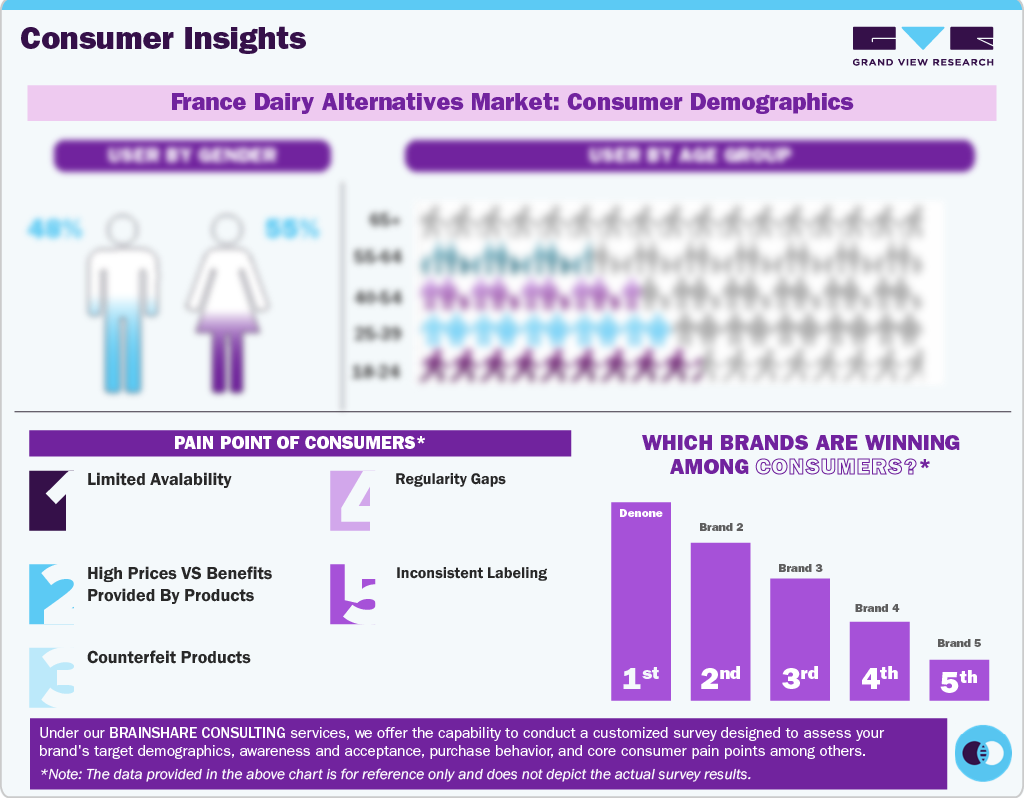
In France, plant-based milks and yogurts are the most widely available alternatives, offering a diverse range that attracts consumers and supports the shift toward plant-based diets. However, other categories, especially plant-based cheeses, face limited distribution, restricting consumer access. Despite growing interest, many still view cheese alternatives as overly processed, affecting their reputation. In France, 750 people were asked about their attitudes towards the consumption of plant-based foods, their trust in these products, their current consumption habits and the key drivers of their food choices. In France, people are cutting back on dairy primarily for health reasons, cited by 38.0% of respondents, while 30% are motivated by animal welfare and 29.0% by environmental concerns. As part of this shift, 31.0% plan to replace animal-based products with plant-based dairy alternatives.
French consumers increasingly seek dairy alternatives that deliver authentic taste, texture, and nutrition while aligning with values of health and animal welfare. Many consumers are open to innovative dairy alternatives that match the experience of traditional dairy. France companies are exploring the world of dairy-free cheeses to future-proof their portfolios. For instance, Bel Group has been in the dairy cheese business for 150 years and entered a new era in 2020 when it announced it would create dairy-free versions of its iconic cheeses.
Source Insights
The soy segment dominated the French dairy alternatives industry and accounted for a revenue share of 37.0% in 2024, driven by its high protein density and affordability, paired with government-backed efforts to encourage domestic soy cultivation and reduce reliance on imports. For consumers, soy remains a practical choice, offering a dairy-free option that is both affordable and nutritionally rich. This has kept soy products in demand, especially among families looking for cost-effective yet healthy alternatives as grocery price pressures persist in France.
The almond segment is expected to grow at the fastest CAGR of 11.6% from 2025 to 2030. This growth is driven by shifting consumer preferences toward premium, naturally sweet, and low-calorie dairy alternatives, with almond milk increasingly featured in cafes and bakeries across France. They are naturally lactose-free, low in saturated fat, and often enriched with vitamins E and D, making them an attractive choice for those who are lactose intolerant or focused on healthier lifestyles. Beyond personal health, many consumers are turning to plant-based options for environmental reasons. Almonds require less water footprint than cow’s dairy, and many almond products are marketed as organic or clean‑label. This aligns well with the values of France’s growing segment of eco-conscious consumers, further strengthening the demand for almond-based dairy alternatives in the market.
Product Insights
The milk segment dominated the market with a revenue share of 66.1% in 2024, reflecting its position as the leading product category within France’s dairy alternatives market as consumers continue to shift toward lactose-free and plant-based options for health and sustainability reasons. In this segment, almond milk led in revenue, driven by its perceived health benefits and wide availability across France supermarkets. At the same time, oat milk emerged as the fastest-growing sub-segment, due to its creamy texture and appeal to consumers seeking products that closely match the taste and feel of cow’s milk. Retailers in France have adapted quickly to this demand. Major supermarket chains such as Carrefour and E.Leclerc have expanded shelf space for plant-based milk while introducing more private-label options to make these products affordable and widely accessible. As a result, plant-based milks are now commonly found across hypermarkets and neighborhood stores. Collectively, these factors strengthen the position of the milk segment within France dairy alternatives industry, driven by health, environmental policy, evolving consumer preferences, and systemic institutional adoption supporting long-term category growth.
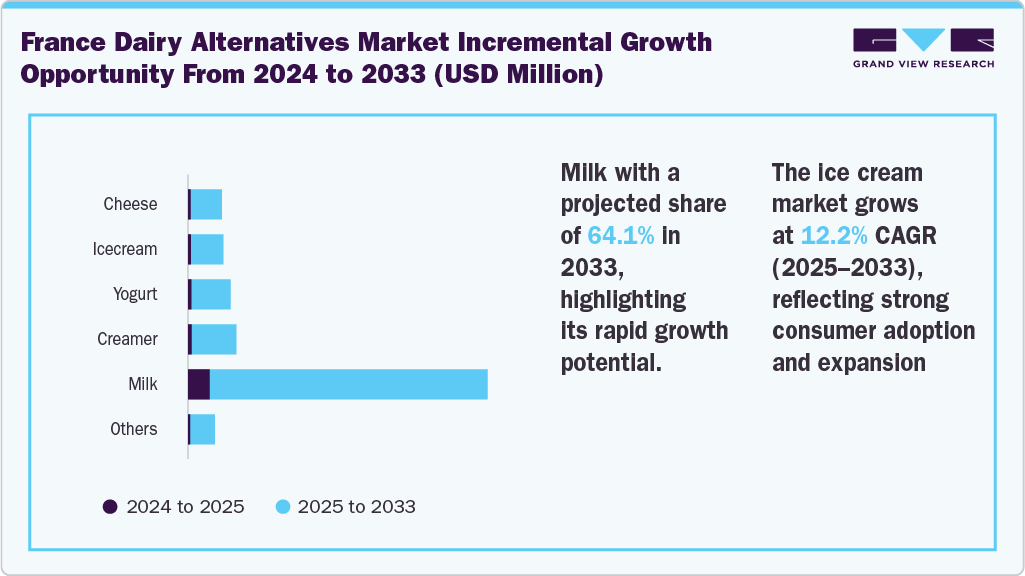
The ice cream segment is expected to grow at the fastest CAGR of 12.2% over the forecast period in the France dairy alternatives market. In France, the word for ice cream is “glace,” and dairy-free options are widely available under the name “glace végétale,” often translated as “vegetable ice cream.” This term is used for ice creams made with vegetable fats, which do not have a required minimum percentage, and with non-dairy proteins. Essentially, “glace végétale” means that the usual animal proteins found in ice cream, such as milk and eggs, are replaced by plant-based ingredients like soy milk, oat milk, pea protein, or other vegetable-based milks. France ice cream, in general, is known for being creamier and richer than other varieties like Italian gelato, due to its higher butterfat content. Interestingly, even though France ice cream contains milk or cream, it is not classified as a dairy product in France.
Distribution Channel Insights
Supermarket & hypermarket distribution channels led the market with a revenue share of 42.1% in 2024, due to the strong retail infrastructure in France and consumers’ preference for convenient, one-stop shopping for dairy alternatives. Large chains such as Carrefour, E.Leclerc, and Intermarché have steadily expanded their plant-based product ranges, dedicating more shelf space to almond, oat, and soy milk, as well as plant-based yogurts and cheeses, to meet growing consumer demand for these options. The competitive pricing and frequent promotions in these retail formats have also played a role in driving volume sales, making plant-based alternatives more accessible to a wider range of consumers. In addition, the rise in private-label plant-based dairy products in France supermarkets has helped address consumer price sensitivity while promoting the availability of clean-label andorganic options.
The online retail distribution segment is projected to experience the fastest CAGR from 2025 to 2030, supported by the rapid expansion of France’s grocery e-commerce market and evolving consumer buying habits favoring convenience and product variety. Beyond the ease of home delivery, online shopping allows consumers in France to explore new brands, check nutritional details, and find specialty plant-based products that are not always available in nearby stores. The growth of this trend has been supported by ongoing improvements in digital infrastructure and e-commerce logistics, with both large retailers and independent platforms expanding their reach and enhancing customer experience. This has turned online retail into an important channel for plant-based milk, yogurt, and cheese, attracting health-conscious and environmentally aware shoppers who value flexibility and informed choices when buying dairy alternatives delivered straight to their doors.
Key France Dairy Alternatives Company Insights
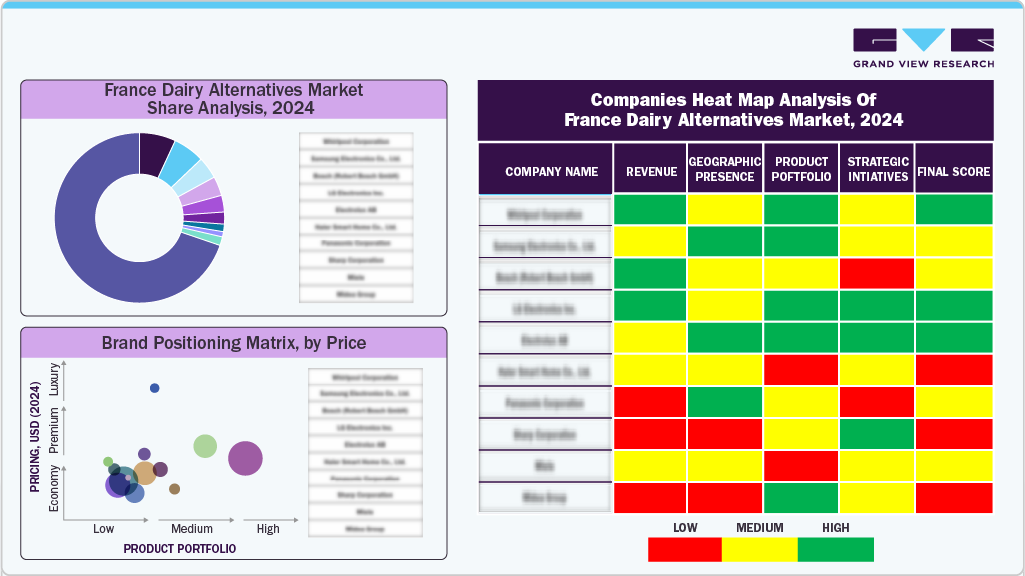
Some key companies operating in the France dairy alternatives industry include Danone, Ecotone, Sojasun, Andros, LACTALIS, and others.
-
Danone is one of the leading players in the dairy alternatives market, leveraging its strong distribution networks and deep market presence to expand its plant-based offerings. Through its brands Alpro and Silk, Danone provides a wide range of non-dairy products, including almond, oat, soy, and coconut-based milks, yogurts, and creamers, catering to France’s growing demand for lactose-free and sustainable options.
-
Ecotone is a major player in France's organic and plant-based food sector, operating under well-recognized brands such as Bjorg and Bonneterre. These brands offer a broad portfolio of dairy alternative products, including soy, almond, and oat milks, as well as plant-based yogurts and creams, which are widely available across France supermarkets and organic stores.
Key France Dairy Alternatives Companies:
- Danone
- Ecotone
- Sojasun
- Andros
- LACTALIS
France Dairy Alternatives Market Report Scope
|
Report Attribute
|
Details
|
|
Market size value in 2025
|
USD 398.6 million
|
|
Revenue forecast in 2033
|
USD 889.0 million
|
|
Growth rate
|
CAGR of 10.5% from 2025 to 2033
|
|
Base year for estimation
|
2024
|
|
Historical data
|
2021 - 2023
|
|
Forecast period
|
2025 - 2033
|
|
Quantitative units
|
Revenue in USD Million and CAGR from 2025 to 2033
|
|
Report coverage
|
Revenue forecast, company ranking, competitive landscape, growth factors, trends
|
|
Segments covered
|
Source, products, distribution channel
|
|
Key companies profiled
|
Danone; Ecotone; Sojasun; Andros; LACTALIS;
|
|
Customization scope
|
Free report customization (equivalent up to 8 analysts working days) with purchase. Addition or alteration to country, regional & segment scope.
|
|
Pricing and purchase options
|
Avail customized purchase options to meet your exact research needs. Explore purchase options
|
France Dairy Alternatives Market Report Segmentation
This report forecasts revenue growth at the country level and provides an analysis of the latest industry trends in each of the sub-segments from 2021 to 2033. For this study, Grand View Research has segmented the France dairy alternatives industry report based on source, product, and distribution channel:
-
Source Outlook (Revenue, USD Million, 2021 - 2033)
-
Soy
-
Almond
-
Coconut
-
Rice
-
Oats
-
Others
-
Product Outlook (Revenue, USD Million, 2021 - 2033)
-
Milk
-
Yogurt
-
Cheese
-
Ice cream
-
Creamer
-
Others
-
Distribution Channel Outlook (Revenue, USD Million, 2021 - 2033)

 Download Sample Report














