Europe Jewelry Market Summary
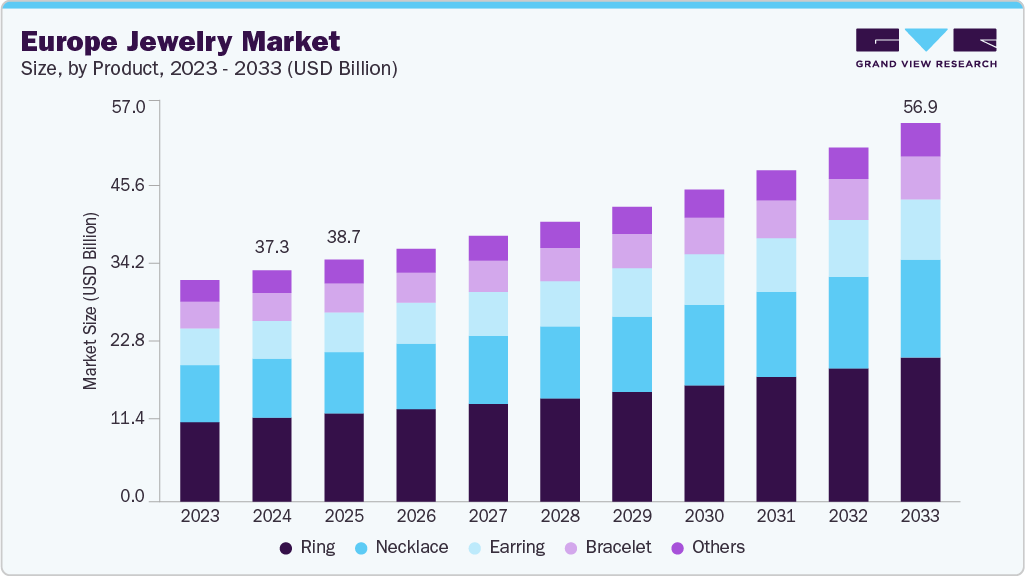
The Europe jewelry market size was estimated at USD 37.32 billion in 2024, and is projected to reach USD 56.99 billion by 2033, growing at a CAGR of 5.0% from 2025 to 2033. Rising disposable incomes, growing fashion consciousness, and increasing demand for sustainable and personalized jewelry are key drivers of the Europe jewelry market.
Key Market Trends & Insights
- The ring market in Europe is expected to witness a CAGR of 5.5% from 2025 to 2033.
- By material, the gold jewelry market in Europe led the market and accounted for a share of 51.0% in 2024.
- By material, the diamond jewelry market in Europe is expected to witness a CAGR of 5.5% during the forecast period.
- By distribution channel, the offline retail stores led the market and accounted for a share of 83.4% in 2024.
- By end use, women dominated the Europe jewelry market, with a share of 68.9% in 2024.
Market Size & Forecast
- 2024 Market Size: USD 37.32 Billion
- 2033 Projected Market Size: USD 56.99 Billion
- CAGR (2025-2033): 5.0%
- Italy: Largest market in 2024
- UK: Fastest growing market
The Europe jewelry market is propelled by strong tourism activity, which boosts sales of luxury and artisanal pieces. Technological advancements such as 3D printing and smart jewelry are attracting tech-savvy consumers. Collaborations between designers and fashion houses are also increasing brand appeal.
Furthermore, social media and influencer marketing are significantly shaping purchasing trends and consumer engagement. Companies such as BOLTENSTERN offer fine jewelry, including necklaces, rings, and earrings made with 3D printing technology.
Product Insights
The rings market in accounted for a share of 32.8% of the revenue in 2024. The European jewelry market, particularly for rings, is driven by several key factors including rising disposable income, increasing demand for luxury and personalized items, and strong cultural significance of rings in engagements and weddings. Growing consumer preference for sustainable and ethically sourced materials is also shaping market trends. In addition, the influence of fashion trends, celebrity endorsements, and expanding online retail channels is boosting accessibility and sales across the region. Companies such as RHEINFRANK offer rings in various antique designs, appealing to consumers for their timeless appeal.
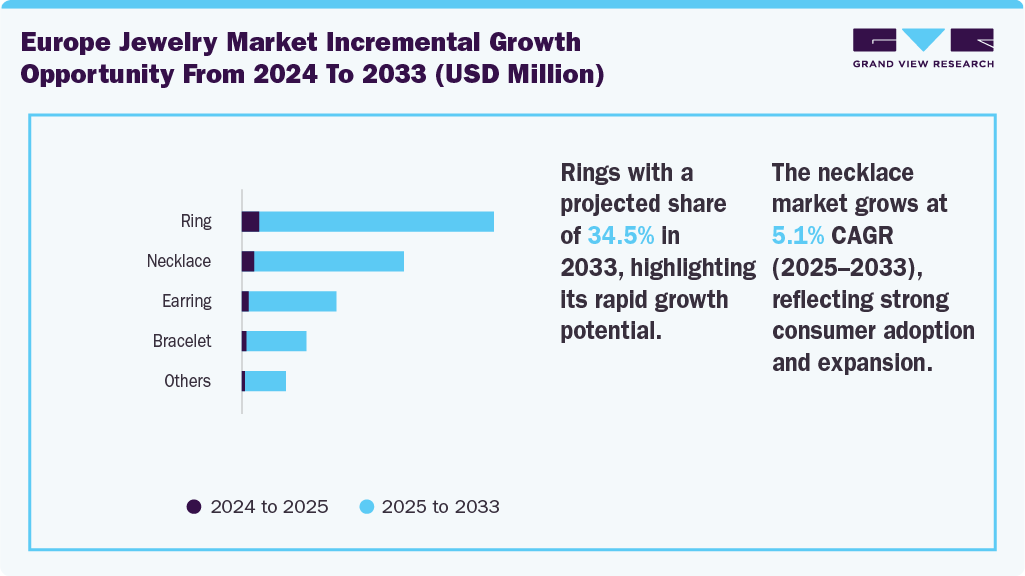
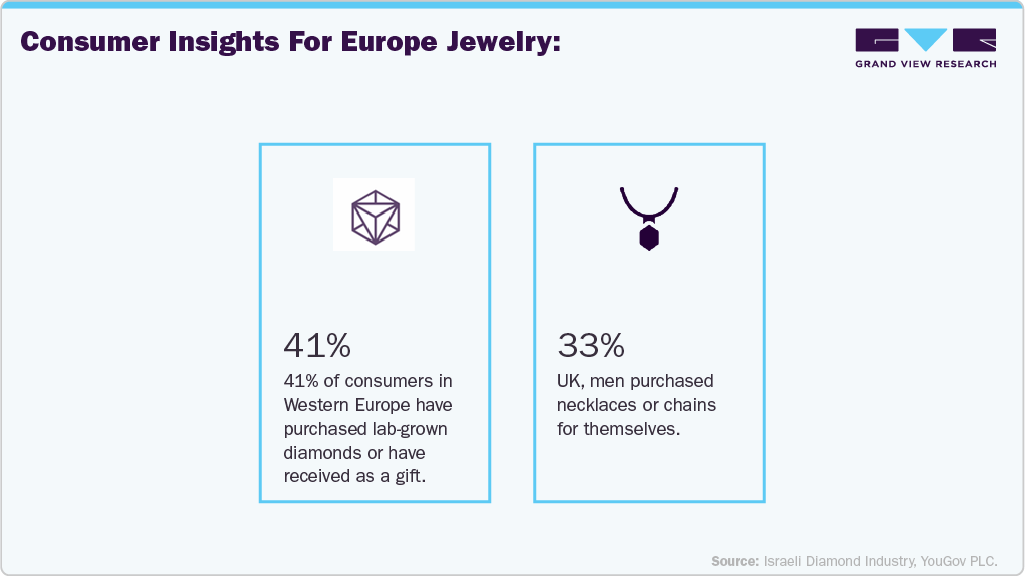
The necklace market is projected to grow at a CAGR of 5.1% from 2025 to 2033. The necklace segment in the European jewelry market is driven by evolving fashion trends, increasing consumer interest in statement and personalized pieces, and rising disposable incomes. Demand is also fueled by gifting traditions, especially during festive seasons and special occasions. The growth of e-commerce and social media marketing has further enhanced the visibility and accessibility of unique and designer necklaces. Moreover, sustainability and ethical sourcing are becoming important purchase considerations for modern consumers. For instance, a survey published by YouGov in June 2025, about 33% of men in UK purchased necklaces & chains for themselves.
Material Insights
The gold jewelry material market in Europe accounted for the largest share of 51.0% of the revenue in 2024. The gold jewelry market in Europe is driven by its enduring appeal as a symbol of wealth, tradition, and timeless elegance. Consumers are drawn to both classic and contemporary gold designs, with growing interest in yellow, white, and rose gold variations. Economic stability and investment value also contribute to gold's popularity, especially in premium segments. Traditional craftsmanship, especially from countries such as Italy and France, boosts demand for high-quality gold pieces. In addition, the trend of layering and minimalist fashion has increased the appeal of lightweight gold jewelry. Companies such as Mara Paris, based in France offer a wide range of jewelry made in 18k gold and in gold vermeil material.
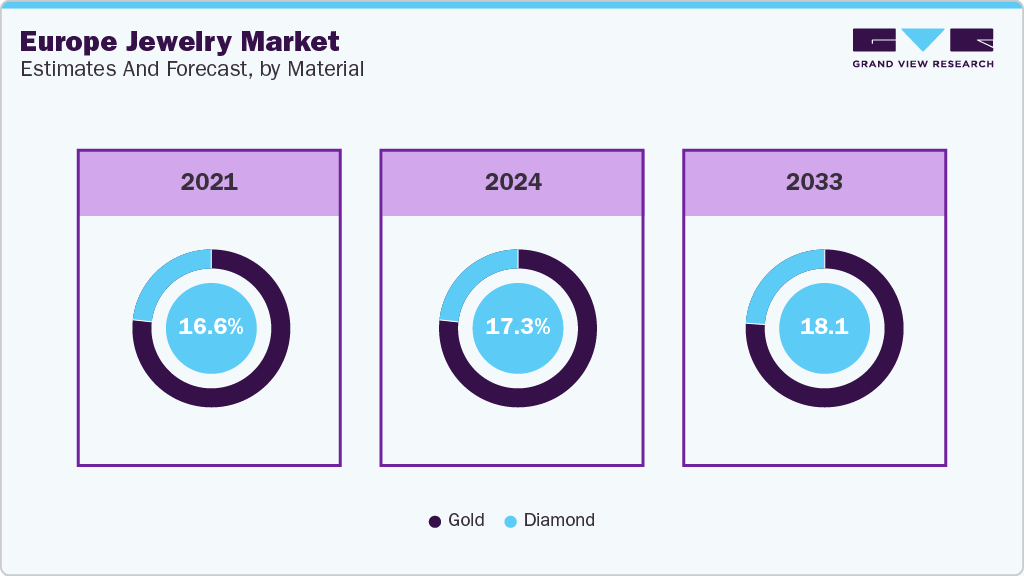
The diamond jewelry market is projected to grow at a CAGR of 5.5% from 2025 to 2033. The diamond jewelry market in Europe benefits from its association with luxury, romance, and long-lasting value. Engagement rings and special occasion pieces remain key drivers, supported by cultural traditions and emotional significance. Technological advancements in diamond cutting and certification have increased consumer trust and product transparency. Demand is also rising for lab-grown diamonds, especially among younger, eco-conscious buyers. High-end brands and bespoke services further strengthen the diamond segment’s appeal in the European luxury market.
Distribution Channel Insights
The jewelry sales through the offline retail stores accounted for a share of around 83.4% of the Europe revenue in 2024. In Europe, offline retail channels such as jewelry stores, supermarkets, and hypermarkets remain vital for the jewelry market due to their ability to offer personalized service, in-person product inspection, and instant purchases. Jewelry stores, in particular, provide a premium shopping experience with expert consultations and access to exclusive collections. Supermarkets and hypermarkets cater to more affordable and mass-market segments, offering convenient access to fashion jewelry. These physical outlets also benefit from established customer trust and brand loyalty.
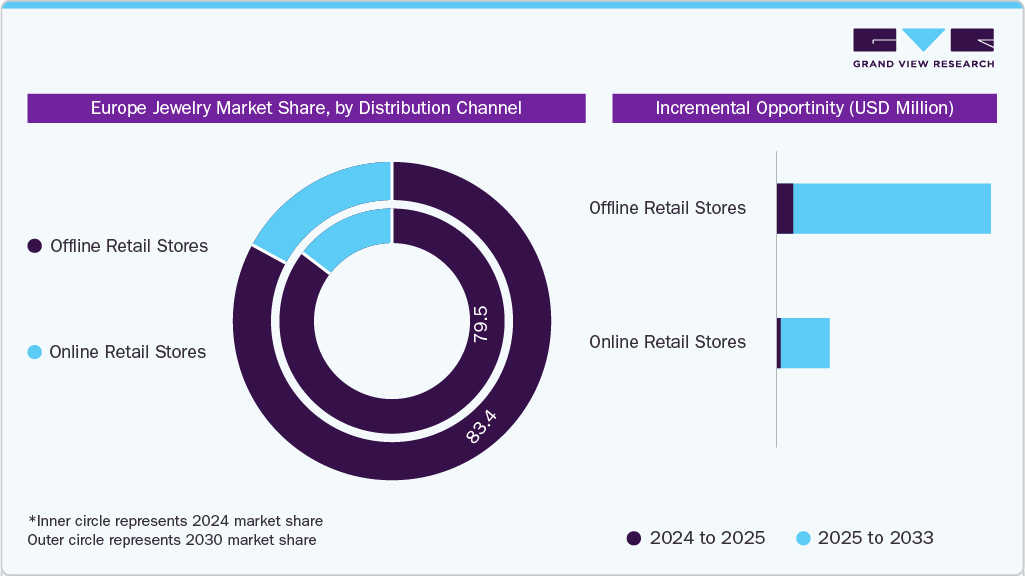
The jewelry sales through the offline retail stores are projected to grow at a CAGR of 7.4% from 2025 to 2033. Online retail channels are rapidly growing in Europe’s jewelry market, driven by convenience, wider product variety, and competitive pricing. Digital platforms enable consumers to browse, customize, and purchase jewelry from the comfort of their homes. The rise of virtual try-on tools, detailed product visuals, and customer reviews enhances the buying experience. In addition, online stores support emerging designers and niche brands, expanding consumer access beyond traditional brick-and-mortar offerings.
End User Insights
The women end user segment in Europe jewelry market accounted for a share of around 68.9% of the revenue in 2024. Women remain the dominant end user segment in the European jewelry market, with consistent demand across luxury, fashion, and everyday wear categories. Jewelry is often purchased for self-expression, milestone celebrations, and gifting, with a wide preference for earrings, necklaces, rings, and bangles. Design trends range from classic elegance to contemporary statement pieces, catering to diverse tastes. Ethical sourcing and personalization have become increasingly important factors influencing women's jewelry purchases. For instance, according to the data published in July 2024, about 58% of women wish to receive jewelry as a gift, fueling the market growth.
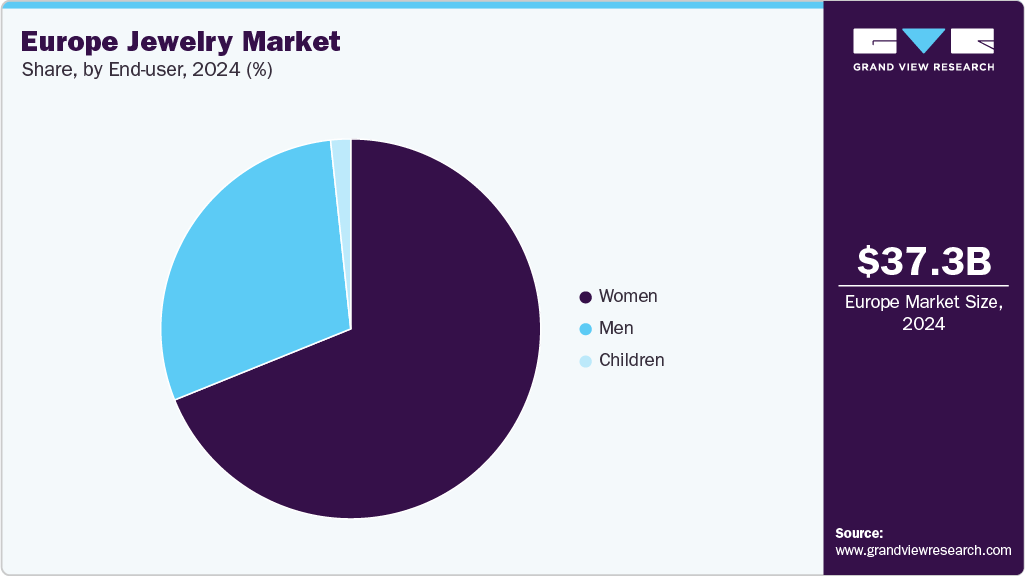
The men end user segment in Europe jewelry market is projected to grow at a CAGR of 4.4% from 2025 to 2033. The men’s segment in the European jewelry market is experiencing steady growth, driven by evolving fashion norms and increased acceptance of jewelry as a form of personal expression. Popular items include rings, bracelets, cufflinks, and chains, often designed with minimalist or bold aesthetics. Demand is particularly strong among younger demographics seeking stylish and modern accessories. According to the survey published by YouGov in June 2025, about 17% of men in the UK bought jewelry such as chains, bracelets, and earrings for themselves.
Regional Insights
The Europe jewelry market is driven by a blend of cultural heritage, innovation in design, and rising demand for high-quality craftsmanship. Tourism plays a significant role, with visitors often purchasing jewelry as luxury souvenirs. The influence of fashion weeks and designer collaborations continues to set new trends and boost consumer interest. In addition, digital transformation and AR-based virtual try-ons are enhancing the shopping experience, attracting tech-savvy buyers. For instance, Fabergé UK Limited introduced Fabergé x Beetlejuice, a collection of fine jewelry, designed in partnership with Fabergé x Beetlejuice and featuring jewelry in 18k gold material.
Italy Jewelry Market Trends
In 2024, Italy is projected to dominate the European jewelry market, holding the largest share at 23.5%, driven by its reputation for its exceptional craftsmanship, artisanal techniques, and heritage in goldsmithing. Italian jewelry is often associated with luxury, elegance, and high design value, attracting both local and international buyers. The strong presence of family-owned brands and manufacturing hubs such as Vicenza and Arezzo supports innovation and export growth. Italy’s focus on design excellence and traditional artistry continues to drive its competitive edge globally. Companies such as UNOAERRE and Buccellati offer artisanal jewelry, including earrings, bracelets, and rings, handcrafted, offering a timeless elegance.
UK Jewelry Market Trends
The UK jewelrymarket is the fastest-growing market, projecting a CAGR of 5.7%, driven by a mix of contemporary fashion trends, heritage brands, and a strong culture of gifting for occasions such as weddings, anniversaries, and royal celebrations. The market benefits from a well-established retail infrastructure, including both high-street and luxury outlets. London’s status as a global fashion and financial hub attracts international shoppers and boosts premium sales. Increasing interest in lab-grown diamonds and ethical sourcing is also influencing consumer preferences in the UK.
Key Europe Jewelry Company Insights
The Europe jewelry market is dynamic and continually evolving, with key players actively adopting new strategies to maintain a competitive edge. Companies are investing heavily in R&D to develop innovative designs, incorporate sustainable materials, and enhance customer engagement through technology-driven solutions such as virtual try-ons. In addition, brands are expanding their presence across emerging European regions and targeting diverse consumer segments through localized marketing and strategic partnerships with regional retailers. This approach helps increase brand visibility and capture a broader customer base across the continent.
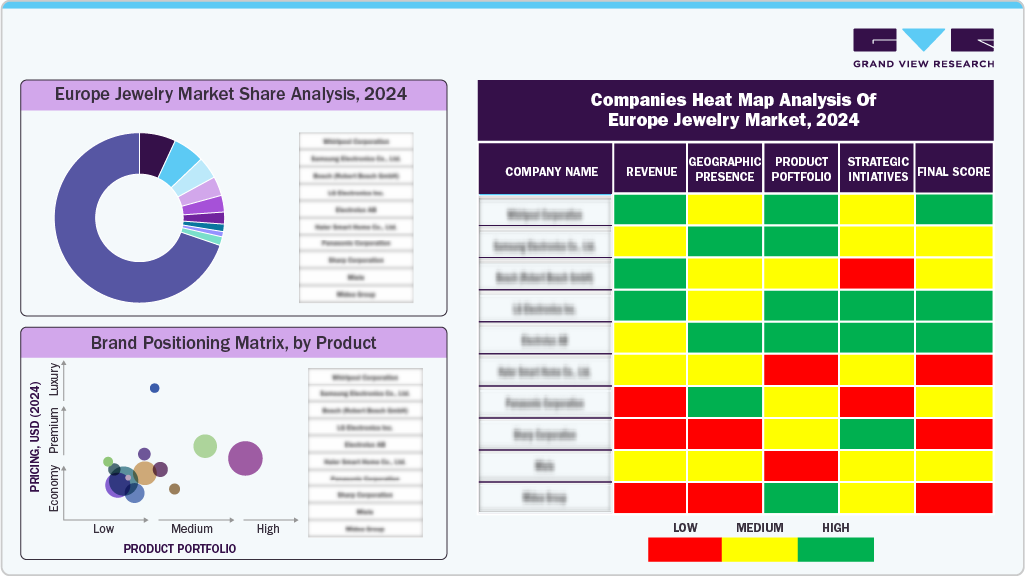
Key Europe Jewelry Companies:
- Cartier
- Chopard
- Boucheron
- BVLGARI
- UNOAERRE
- Buccellati
- Fabergé UK Limited
- Piranesi
- Messika
- Van Cleef & Arpels
Recent Developments
-
In June 2025, De Beers introduced Ombré Desert Diamonds, its first flagship “beacon” jewelry concept in over a decade, showcasing multi-stone pieces inspired by desert hues to reignite interest in naturally colored diamonds. The company also introduced Origin, De Beers Group, a polished diamond program offering full provenance via blockchain-backed traceability, enriching consumer connection through origin, rarity, and social-impact storytelling.
-
In May 2022, the renowned Italian brand, Gucci collaborated with Finnish tech company Oura and introduced a smart ring- Gucci x Ōura. The smart ring has sensors that track wearers’ heart rate, temperature, and sleep activity and transmits the body’s hidden signals through the Ōura application.
Europe Jewelry Market Report Scope
|
Report Attribute
|
Details
|
|
Market value size in 2025
|
USD 38.7 billion
|
|
Revenue forecast in 2033
|
USD 56.99 billion
|
|
Growth rate (revenue)
|
CAGR of 5.0% from 2025 to 2033
|
|
Actuals
|
2021 - 2024
|
|
Forecast period
|
2025 - 2033
|
|
Quantitative (Revenue) units
|
Revenue in USD million/billion, and CAGR from 2025 to 2033
|
|
Report coverage
|
Revenue forecast, company ranking, competitive landscape, growth factors, and trends
|
|
Segments covered
|
Product, material, distribution channel, end use, country
|
|
Regional Scope
|
Europe
|
|
Country scope
|
Germany; UK; France; Italy; Spain
|
|
Key companies profiled
|
Cartier; Chopard; Boucheron; BVLGARI; UNOAERRE; Buccellati; Fabergé UK Limited; Piranesi; Messika; Van Cleef & Arpels
|
|
Customization scope
|
Free report customization (equivalent up to 8 analysts’ working days) with purchase. Addition or alteration to country, regional & segment scope.
|
|
Pricing and purchase options
|
Avail customized purchase options to meet your exact research needs. Explore purchase options
|
Europe Jewelry Market Report Segmentation
This report forecasts revenue growth at the regional and country levels and provides an analysis of the latest industry trends and opportunities in each of the sub-segments from 2021-2033. For the purpose of this study, Grand View Research has segmented the Europe jewelry market report on the basis of product, material, distribution channel, end user, and country:
-
Product Outlook (Revenue, USD Million, 2021 - 2033)
-
Necklace
-
Ring
-
Earring
-
Bracelet
-
Others
-
Material Outlook (Revenue, USD Million, 2021 - 2033)
-
Platinum
-
Gold
-
Diamond
-
Others
-
Distribution Channel Outlook (Revenue, USD Million, 2021 - 2033)
-
Offline Retail Stores
-
Online Retail Stores
-
End User Outlook (Revenue, USD Million, 2021 - 2033)
-
Country Outlook (Revenue, USD Million, 2021 - 2033)
-
Europe
-
Germany
-
UK
-
France
-
Italy
-
Spain
Frequently Asked Questions About This Report
b. The Europe Jewelry market size was estimated at USD 37.3 billion in 2024 and is expected to reach USD 38.7 billion in 2025.
b. The Europe Jewelry market is expected to grow at a compound annual growth rate (CAGR) of 5.0% from 2025 to 2033 to reach USD 56.99 billion by 2033.
b. The ring market accounted for a revenue share of 32.8% in 2024, driven by growing consumer demand for personalized and luxury accessories, which is a key driving factor in the European ring jewelry market.
b. Some key players operating in the Europe Jewelry market include Cartier, Chopard, Boucheron, BVLGARI, UNOAERRE, Buccellati, and Fabergé UK Limited.
b. Key factors driving market growth in the Europe jewelry market include strong demand for luxury and designer brands, increasing consumer preference for sustainable and ethically sourced materials, and a growing trend toward personalized and customized jewelry. Market expansion is further supported by rising disposable incomes, digital transformation in retail, and the influence of fashion trends and celebrity endorsements.

 Download Sample Report














