
- Home
- »
- Distribution & Utilities
- »
-
Distributed Energy Resource Management System Market, 2033GVR Report cover
![Distributed Energy Resource Management System Market Size, Share & Trends Report]()
Distributed Energy Resource Management System Market (2026 - 2033) Size, Share & Trends Analysis Report By Component (Software, Services), By Application (Virtual Power Plants, Grid Optimization & Stability, Renewable Energy Integration), By Region, And Segment Forecasts
- Report ID: GVR-4-68040-854-6
- Number of Report Pages: 120
- Format: PDF
- Historical Range: 2021 - 2024
- Forecast Period: 2026 - 2033
- Industry: Energy & Power
- Report Summary
- Table of Contents
- Segmentation
- Methodology
- Download FREE Sample
-
 Download Sample Report
Distributed Energy Resource Management System Market Summary
The global distributed energy resource management system market size was estimated at USD 780 million in 2025 and is projected to reach USD 2,756 million by 2033, growing at a CAGR of 16.7% from 2026 to 2033. Market growth is primarily driven by the rapid integration of distributed energy resources (DERs) such as solar PV, wind, battery energy storage systems (BESS), electric vehicles, and demand response assets into power grids.
Key Market Trends & Insights
- North America accounted for approximately 39.0% of the global distributed energy resource management system market revenue in 2025.
- The distributed energy resource management system market in the U.S. is expected to grow significantly over the forecast period.
- By component, the software segment held the highest market share of over 68% in 2025.
- By application, the grid optimization & stability segment held the highest market share of over 30% in 2025.
Market Size & Forecast
- 2025 Market Size: USD 780 Million
- 2033 Projected Market Size: USD 2,756 Million
- CAGR (2026-2033): 16.7%
- North America: Largest market in 2025
- Asia Pacific: Fastest growing market
Utilities and grid operators are increasingly adopting DERMS solutions to manage grid complexity, enhance grid flexibility, and maintain reliability amid rising renewable energy penetration. In addition, growing concerns around grid congestion, voltage instability, and intermittency of renewable generation are accelerating the deployment of advanced DERMS platforms. These systems enable real-time monitoring, forecasting, optimization, and control of distributed assets across transmission and distribution networks. Technological advancements such as AI-based analytics, cloud-based platforms, advanced forecasting algorithms, and integration with ADMS, SCADA, and EMS are further enhancing DERMS capabilities.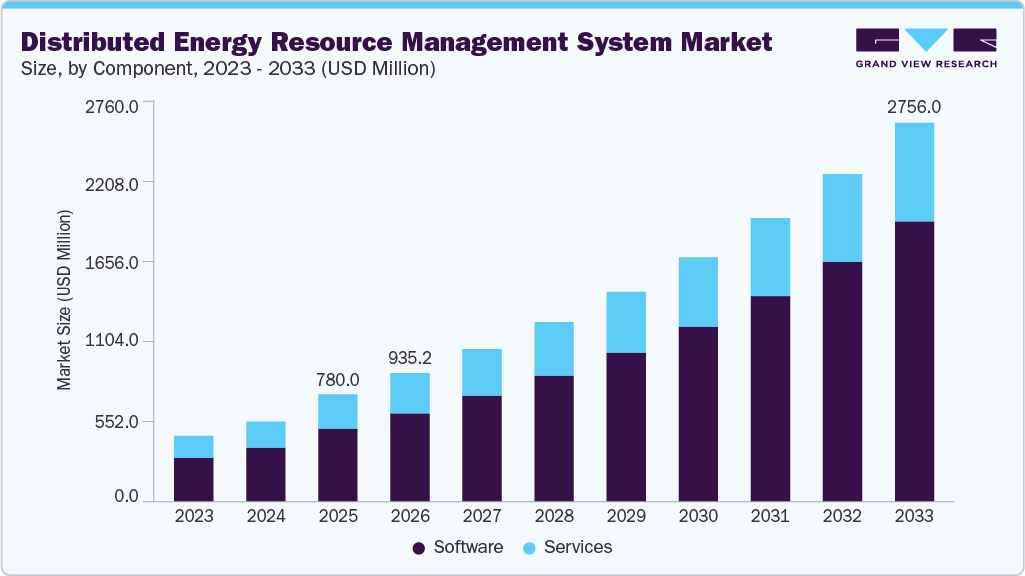
The market is also gaining momentum due to supportive government policies, decarbonization targets, and utility investments in smart grid infrastructure. Increasing focus on cost optimization, grid resilience, cybersecurity, and automation, along with the growing need to support virtual power plants (VPPs), microgrids, and transactive energy models, is expected to sustain steady market expansion over the forecast period.
Drivers, Opportunities & Restraints
The global Distributed Energy Resource Management System (DERMS) market is primarily driven by the rapid integration of distributed energy resources (DERs) such as solar PV, wind power, battery energy storage systems, electric vehicles, and demand response assets into distribution networks. Utilities and grid operators are increasingly deploying DERMS solutions to manage bidirectional power flows, improve grid stability, and optimize network performance amid rising renewable energy penetration. In addition, growing investments in smart grid infrastructure, increasing electrification, and the need to enhance grid flexibility and resilience continue to support market growth.
Opportunities are expanding due to technological advancements in artificial intelligence, advanced analytics, cloud-based platforms, and real-time forecasting tools, which enable better visibility, control, and optimization of distributed energy assets. The growing adoption of virtual power plants (VPPs), microgrids, and transactive energy models is further driving demand for advanced DERMS platforms. Increasing focus on automation, digital grid management, and integration with ADMS, SCADA, and EMS systems is also creating new growth opportunities across both developed and emerging markets.
However, the market faces restraints such as high initial implementation and integration costs, complexity associated with interoperability between legacy systems and DERMS platforms, and the need for skilled workforce training. In addition, regulatory uncertainty, lack of standardized communication protocols, and cybersecurity concerns can slow deployment timelines. Data privacy challenges and cautious adoption behaviour among traditional utilities may further limit market expansion over the forecast period.
Component Insights
The software segment held the largest revenue share of approximately 68% in 2025 in the global Distributed Energy Resource Management System (DERMS) market. This dominance is primarily driven by the growing need for centralized monitoring, control, optimization, and forecasting of distributed energy resources across increasingly complex power distribution networks. DERMS software plays a critical role in enabling real-time grid visibility, bidirectional power flow management, voltage regulation, and load balancing, allowing utilities and grid operators to maintain reliability while integrating high levels of renewable energy. The rising adoption of cloud-based platforms, advanced analytics, and AI-enabled decision-support tools has further strengthened the importance of software solutions in supporting efficient and scalable DER orchestration across utility, commercial, and industrial applications.
The software segment is also expected to register the fastest CAGR of 17.9% over the forecast period, supported by increasing investments in grid digitalization, automation, and smart distribution management. Growing deployment of virtual power plants (VPPs), microgrids, demand response programs, and electric vehicle charging infrastructure is driving demand for advanced DERMS software capable of real-time optimization and predictive control. In addition, continuous advancements in machine learning algorithms, interoperability standards, cybersecurity features, and integration with ADMS, SCADA, and EMS platforms are enhancing software performance and reliability. These factors are positioning DERMS software as both the largest and fastest-growing component segment in the global market.
Application Insights
The grid optimization & stability segment dominated the application segment in the global distributed energy resource management system market, accounting for a revenue share of approximately 30% in 2025. This growth is primarily driven by the increasing need to manage voltage fluctuations, grid congestion, and bidirectional power flows resulting from the rapid integration of distributed energy resources such as solar PV, wind power, and battery energy storage systems. DERMS platforms play a critical role in optimizing grid performance, enhancing reliability, and supporting stable power delivery across distribution networks. Their importance is rising further due to growing investments in smart grid infrastructure and the increasing focus on grid resilience and operational efficiency.
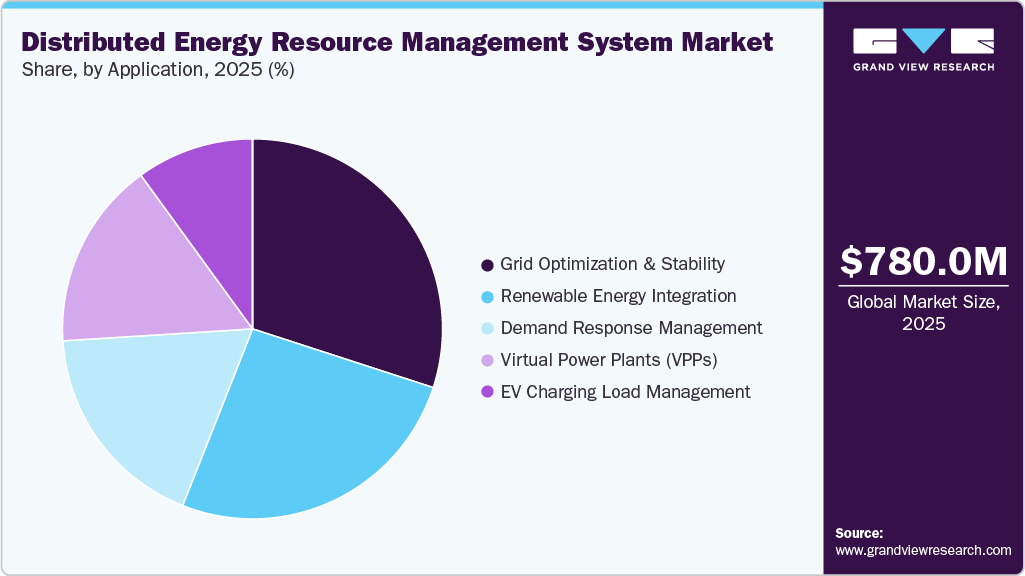
The EV charging load management segment is expected to register the fastest CAGR of 24.1% over the forecast period, supported by the rapid expansion of electric vehicle adoption and charging infrastructure. Growing demand for smart charging, peak load management, and grid-friendly EV integration is driving utilities and charging operators to deploy DERMS solutions for real-time monitoring and control of EV charging loads. In addition, increasing focus on vehicle-to-grid (V2G) capabilities, demand response participation, and automation of charging operations is improving system efficiency and reliability, positioning EV charging load management as the fastest-growing application segment in the distributed energy resource management system market.
Regional Insights
North America accounted for approximately 39.0% of the global distributed energy resource management system market revenue in 2025, driven by advanced power grid infrastructure, high penetration of distributed energy resources, and strong investments in smart grid modernization.
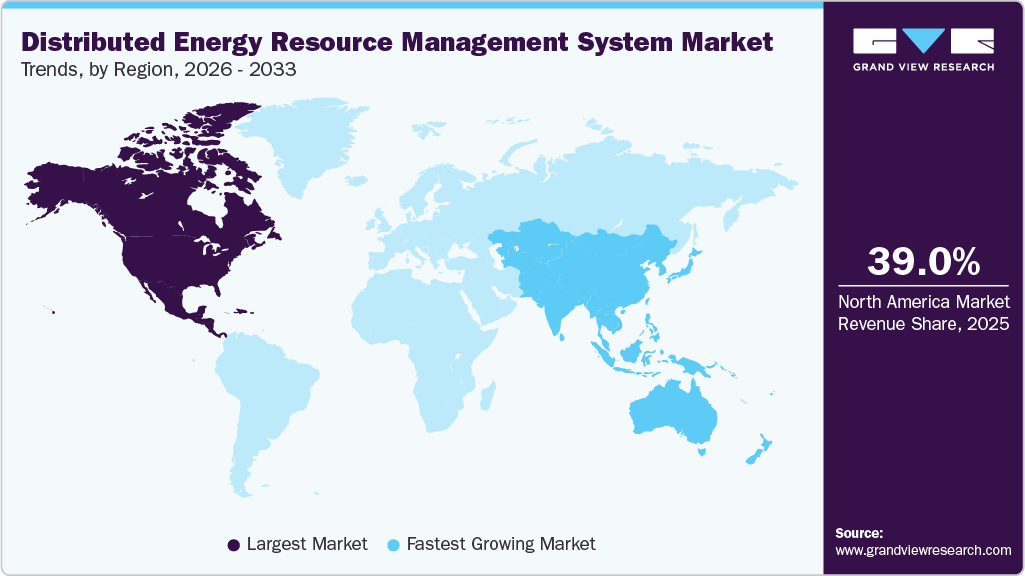
The region’s dominance is supported by widespread deployment of solar PV, battery energy storage systems, electric vehicles, and demand response programs, which have increased the need for advanced DER orchestration and grid optimization solutions. In addition, supportive regulatory frameworks, utility-led digitalization initiatives, and the early adoption of virtual power plants and grid automation technologies continue to strengthen North America’s leading position in the global DERMS market.
U.S. Distributed Energy Resource Management System Market Trends
The U.S. distributed energy resource management system market remains a major contributor to regional growth, driven by large-scale integration of renewable energy, EV charging infrastructure, and behind-the-meter energy resources across utilities and commercial consumers. Utilities are increasingly deploying DERMS platforms to manage grid congestion, voltage stability, peak demand, and bidirectional power flows across complex distribution networks. Rising focus on grid resilience, decarbonization targets, demand-side management, and integration of VPPs and microgrids is further supporting DERMS adoption, positioning the U.S. as one of the most important and technologically advanced markets globally.
Asia Pacific Distributed Energy Resource Management System Market Trends
Asia Pacific is expected to register the fastest CAGR of 22.8% over the forecast period, driven by rapid urbanization, rising electricity demand, and increasing investments in renewable energy and smart grid infrastructure across countries such as China, India, Japan, Australia, and South Korea. Governments and utilities across the region are focusing on distributed solar deployment, battery storage adoption, EV integration, and grid modernization, which is accelerating demand for DERMS solutions. In addition, expanding microgrid projects, electrification initiatives, and digital transformation of power distribution networks are expected to support strong market expansion across the Asia Pacific region.
Europe Distributed Energy Resource Management System Market Trends
Europe represents a steadily growing market for DERMS, supported by strong renewable energy targets, decarbonization policies, and grid flexibility initiatives across the region. Increasing penetration of distributed solar, wind, and energy storage systems, along with growing adoption of demand response and transactive energy models, is driving the need for advanced DER management solutions. The market also benefits from regulatory support for smart grids, energy efficiency, and cross-border energy integration, particularly in countries such as Germany, the UK, France, and the Nordic region.
Latin America Distributed Energy Resource Management System Market Trends
The Latin America distributed energy resource management system market is supported by growing investments in renewable energy capacity, distributed solar installations, and grid modernization projects, particularly in countries such as Brazil, Mexico, and Chile. Increasing focus on improving grid reliability, reducing transmission losses, and integrating distributed generation is driving the adoption of DERMS platforms. In addition, rising electricity demand and gradual digitalization of distribution networks are expected to contribute to market growth across the region.
Middle East & Africa Distributed Energy Resource Management System Market Trends
The Middle East & Africa distributed energy resource management system market is witnessing steady growth, driven by increasing deployment of distributed solar power, microgrids, and energy storage systems across both urban and remote areas. Governments across key countries such as Saudi Arabia, the UAE, South Africa, and Egypt are investing in smart grid initiatives and renewable integration to enhance energy security and grid efficiency. Growing focus on grid automation, electrification, and sustainable energy transition, along with rising adoption of digital energy management solutions, is expected to support market expansion across the region.
Key Distributed Energy Resource Management System Company Insights
Some of the key players operating in the global Distributed Energy Resource Management System (DERMS) market include Siemens AG, GE Vernova, Schneider Electric SE, ABB Ltd., Oracle Corporation, Enel X, AutoGrid Systems Inc., Generac Holdings Inc., Open Access Technology International, and Itron Inc., among others. These companies are actively investing in advanced DERMS software platforms, AI-driven analytics, cloud-based optimization tools, and grid automation technologies to enhance real-time visibility, control, and orchestration of distributed energy resources. Their strategic focus includes improving grid stability, renewable integration, demand response management, EV charging load optimization, and virtual power plant (VPP) enablement, helping utilities and grid operators improve operational efficiency, reliability, and resilience across modern distribution networks.
Key Distributed Energy Resource Management System Companies:
The following key companies have been profiled for this study on the distributed energy resource management system market.
- ABB Ltd.
- AutoGrid Systems Inc.
- Enel X
- GE Vernova
- Generac Holdings Inc.
- Itron Inc.
- Open Access Technology International
- Oracle Corporation
- Schneider Electric SE
- Siemens AG
Recent Developments
-
In March 2025, Oracle Corporation expanded its DERMS capabilities with advanced distribution management enhancements, including support for grid-connected energy resources and real-time data integration for battery energy storage systems (BESS) to aid utilities in optimizing renewable dispatch and grid reliability across distribution networks.
-
In 2025, Schneider Electric SE was recognized as a leader in the 2025 DERMS Green Quadrant, highlighting its DERMS platform’s strengths in AI readiness, interoperability, and grid modernization support, helping utilities accelerate scalable DER integration and electrification initiatives.
Distributed Energy Resource Management System Market Report Scope
Report Attribute
Details
Market definition
The Distributed Energy Resource Management System (DERMS) market represents the global revenue generated from software platforms, subscriptions, and related services used to monitor, control, and optimize distributed energy resources such as solar, wind, battery storage, electric vehicles, and demand response across power distribution networks.
Market size value in 2026
USD 935.2 million
Revenue forecast in 2033
USD 2,756 million
Growth rate
CAGR of 16.7% from 2026 to 2033
Base year for estimation
2025
Historical data
2021 - 2023
Forecast period
2026-2033
Quantitative units
Revenue in USD million/billion and CAGR from 2026 to 2033
Report coverage
Revenue forecast, competitive landscape, growth factors, and trends
Segments covered
Component, application, region
Regional scope
North America; Europe; Asia Pacific; Latin America; Middle East & Africa
Country scope
U.S.; Canada; Mexico; Germany; UK; France; China; India; Japan; South Korea; Brazil; Saudi Arabia; UAE
Key companies profiled
Siemens AG; GE Vernova; Schneider Electric SE; ABB Ltd.; Oracle Corporation; Enel X; AutoGrid Systems Inc.; Generac Holdings Inc.; Open Access Technology International; Itron Inc.
Customization scope
Free report customization (equivalent up to 8 analysts working days) with purchase. Addition or alteration to country, regional & segment scope.
Pricing and purchase options
Avail customized purchase options to meet your exact research needs. Explore purchase options
Global Distributed Energy Resource Management System Market Segmentation
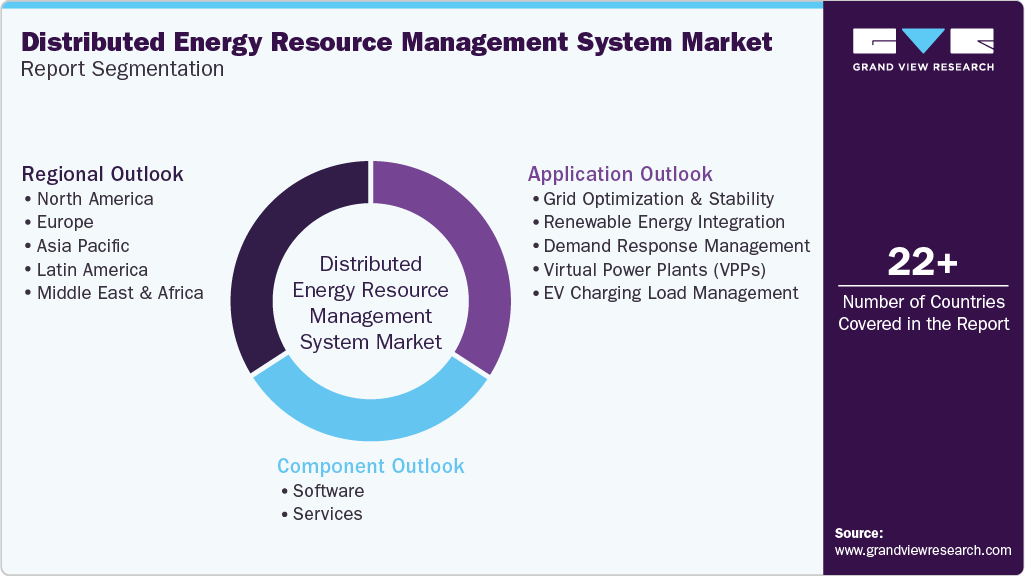
This report forecasts revenue growth at global, regional, and country levels and provides an analysis of the latest industry trends in each of the sub-segments from 2021 to 2033. For this study, Grand View Research has segmented the global distributed energy resource management system market report on the basis of component, application, and region.
-
Component Outlook (Revenue, USD Million, 2021 - 2033)
-
Software
-
Services
-
-
Application Outlook (Revenue, USD Million, 2021 - 2033)
-
Grid Optimization & Stability
-
Renewable Energy Integration
-
Demand Response Management
-
Virtual Power Plants (VPPs)
-
EV Charging Load Management
-
-
Regional Outlook (Revenue, USD Million, 2021 - 2033)
-
North America
-
U.S.
-
Canada
-
Mexico
-
-
Europe
-
Germany
-
UK
-
France
-
-
Asia Pacific
-
China
-
India
-
Japan
-
South Korea
-
-
Latin America
-
Brazil
-
-
Middle East & Africa
-
Saudi Arabia
-
UAE
-
-
Frequently Asked Questions About This Report
b. The global distributed energy resource management system market size was estimated at USD 780 million in 2025 and is expected to reach USD 935.2 million in 2026.
b. The global distributed energy resource management system market is expected to grow at a compound annual growth rate of 16.7% from 2026 to 2033 to reach USD 2756 million by 2033.
b. Based on the component segment, software held the largest revenue share of 68% in 2025.
b. Some of the key players operating in the global distributed energy resource management system market include Siemens AG, GE Vernova, Schneider Electric SE, ABB Ltd., Oracle Corporation, Enel X, AutoGrid Systems Inc., Generac Holdings Inc., Open Access Technology International, and Itron Inc., among others.
b. The key factors driving the distributed energy resource management system market include the rapid growth of distributed energy resources such as solar PV, wind power, battery energy storage systems, electric vehicles, and demand response programs, along with increasing investments in smart grid infrastructure and grid digitalization.


Share this report with your colleague or friend.
Need a Tailored Report?
Customize this report to your needs — add regions, segments, or data points, with 20% free customization.


ISO 9001:2015 & 27001:2022 Certified
We are GDPR and CCPA compliant! Your transaction & personal information is safe and secure. For more details, please read our privacy policy.
Trusted market insights - try a free sample
See how our reports are structured and why industry leaders rely on Grand View Research. Get a free sample or ask us to tailor this report to your needs.












