
- Home
- »
- Renewable Energy
- »
-
Dispatchable Renewables Market, Industry Report, 2033GVR Report cover
![Dispatchable Renewables Market Size, Share & Trends Report]()
Dispatchable Renewables Market (2026 - 2033) Size, Share & Trends Analysis Report By Technology (Concentrated Solar Power, Biomass, Geothermal), By End Use (Utilities, Industrial, Commercial), By Region, And Segment Forecasts
- Report ID: GVR-4-68040-865-2
- Number of Report Pages: 110
- Format: PDF
- Historical Range: 2021 - 2024
- Forecast Period: 2026 - 2033
- Industry: Energy & Power
- Report Summary
- Table of Contents
- Segmentation
- Methodology
- Download FREE Sample
-
 Download Sample Report
Dispatchable Renewables Market Summary
The global dispatchable renewables market size was estimated at USD 59.27 billion in 2025 and is projected to reach USD 116.79 billion by 2033, growing at a CAGR of 8.9% from 2026 to 2033. Market growth is primarily driven by the increasing integration of variable renewable energy sources, rising electricity demand, and the growing need for reliable and flexible power generation solutions.
Key Market Trends & Insights
- Asia Pacific dispatchable renewables market held the largest share of 42.3% of the global market in 2025.
- The dispatchable renewables market in the China is expected to grow significantly over the forecast period.
- By technology, Hydropower held the highest market share of 55.31% in 2025.
- By End use, Utilities held the highest market share of 51.3% in 2025.
Market Size & Forecast
- 2025 Market Size: USD 59.27 Billion
- 2033 Projected Market Size: USD 116.79 Billion
- CAGR (2026-2033): 8.9%
- Asia Pacific: Largest market in 2025
Dispatchable renewable technologies such as hydropower, biomass, geothermal, and concentrated solar power (CSP) play a critical role in maintaining grid stability by providing a controllable and consistent electricity supply. Rapid urbanization, expanding industrial activity, and accelerating decarbonization targets across major economies are further supporting market expansion, while the modernization of power infrastructure is strengthening the role of dispatchable clean energy systems worldwide.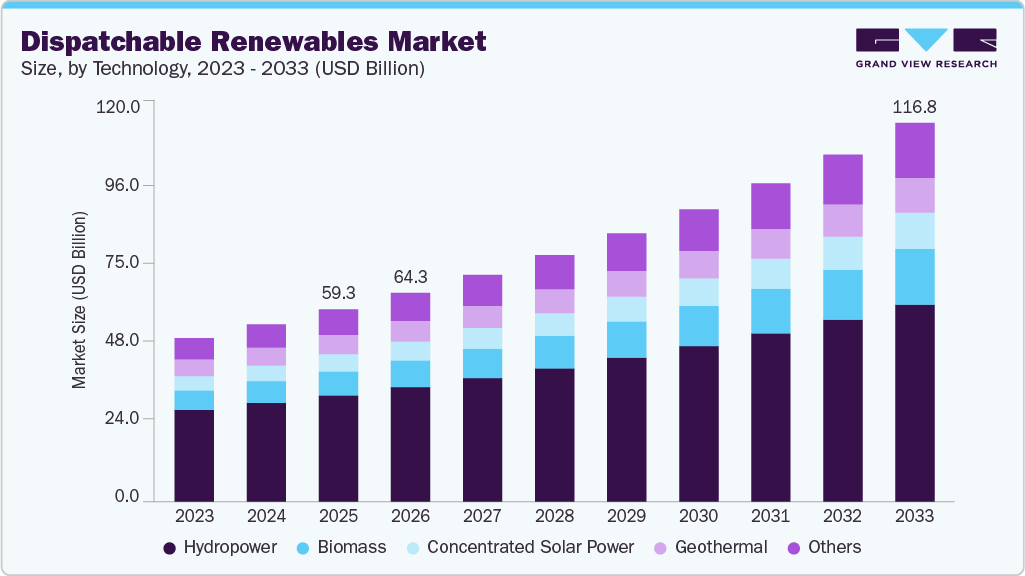
Growing investments from governments, utilities, and private energy developers in hydropower expansion, biomass facilities, geothermal exploration, and CSP projects are accelerating market development globally. Strengthening renewable energy mandates, grid reliability requirements, and long-term clean energy procurement strategies are further enhancing market stability and improving energy security. In addition, advancements in turbine efficiency, plant optimization technologies, and hybrid renewable storage integration are increasing operational performance and expanding deployment opportunities. Strategic collaborations between public authorities, power producers, and infrastructure investors continue to strengthen project pipelines and commercialization pathways, positioning dispatchable renewables as a critical component in supporting grid resilience while advancing long-term global decarbonization objectives.
Drivers, Opportunities & Restraints
The primary driver of the dispatchable renewables market is the accelerating integration of variable renewable energy sources such as wind and solar into national grids. Governments across North America, Europe, and the Asia Pacific are implementing renewable portfolio standards, capacity remuneration mechanisms, and grid reliability mandates to ensure a stable power supply. As electricity systems transition toward higher shares of intermittent generation, utilities are increasingly investing in hydropower, biomass, geothermal, and concentrated solar power (CSP) to provide firm and controllable electricity. In addition, the ability of dispatchable renewables to supply baseload and peak-load power without dependence on fossil fuels significantly strengthens their adoption across both developed and emerging economies.
A major opportunity lies in the modernization of aging hydropower infrastructure, expansion of biomass-based cogeneration, and development of hybrid renewable systems integrated with energy storage. Emerging economies in the Asia Pacific and Latin America are witnessing rising electricity demand, creating strong investment potential for multipurpose hydropower and waste-to-energy projects. Furthermore, advancements in turbine efficiency, digital plant optimization, and geothermal drilling technologies are improving operational performance and expanding deployment feasibility across new geographies.
However, the market faces restraints, including high upfront capital costs and long project development timelines, particularly for large hydropower and geothermal installations. Environmental and land-use concerns, permitting complexities, and community opposition in certain regions may delay project approvals. In addition, resource availability constraints and grid interconnection challenges can limit scalability in specific markets, potentially affecting long-term expansion.
Technology Insights
Based on technology, hydropower accounted for the largest market revenue share of 55.31% in 2025, supported by its well-established global infrastructure base, long asset lifespan, and ability to provide reliable baseload and peak-load electricity. Its large-scale deployment across Asia Pacific, North America, and Latin America, along with ongoing modernization and capacity uprating initiatives, has positioned hydropower as the backbone of the dispatchable renewables market. Technology’s proven operational stability and grid-balancing capability make it a preferred choice for utilities integrating higher shares of intermittent renewable energy.
Biomass is expected to register the fastest CAGR of 11.12% during the forecast period, driven by increasing adoption in industrial cogeneration, waste-to-energy projects, and supportive carbon reduction policies. Growing utilization of agricultural residues, municipal solid waste, and forestry by-products is further strengthening segment expansion. Meanwhile, concentrated solar power (CSP) is gaining traction in high solar irradiance regions due to its thermal storage capability, enabling reliable and dispatchable electricity generation. Geothermal energy continues to contribute to steady growth, particularly in the resource-rich areas, owing to its consistent baseload generation profile and expanding exploration activities.
End use Insights
Based on end use, the utilities segment accounted for the largest market revenue share of 51.3% in 2025, supported by large-scale deployment of hydropower, biomass, geothermal, and concentrated solar power plants for grid-connected electricity generation. Utilities continue to prioritize dispatchable renewable assets to enhance grid reliability, manage peak demand, and support the integration of intermittent wind and solar capacity. Long-term power purchase agreements (PPAs), renewable portfolio standards, and grid modernization initiatives are further strengthening investment in this segment.
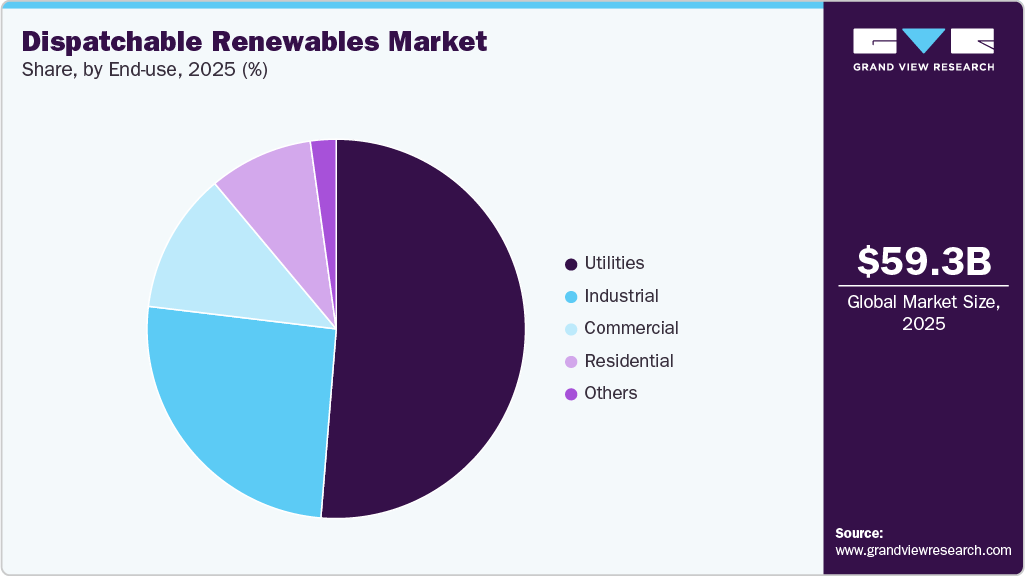
The commercial segment is expected to register the fastest CAGR of 11.0% during the forecast period, driven by increasing adoption of distributed renewable energy systems and corporate decarbonization commitments. Industrial applications are also witnessing strong growth, supported by rising demand for captive renewable power and biomass-based cogeneration to reduce carbon footprints and energy costs. Meanwhile, the residential segment continues to expand steadily, reflecting growing consumer awareness and supportive policy incentives for small-scale dispatchable renewable installations.
Regional Insights
Asia Pacific Dispatchable Renewables Market Trends
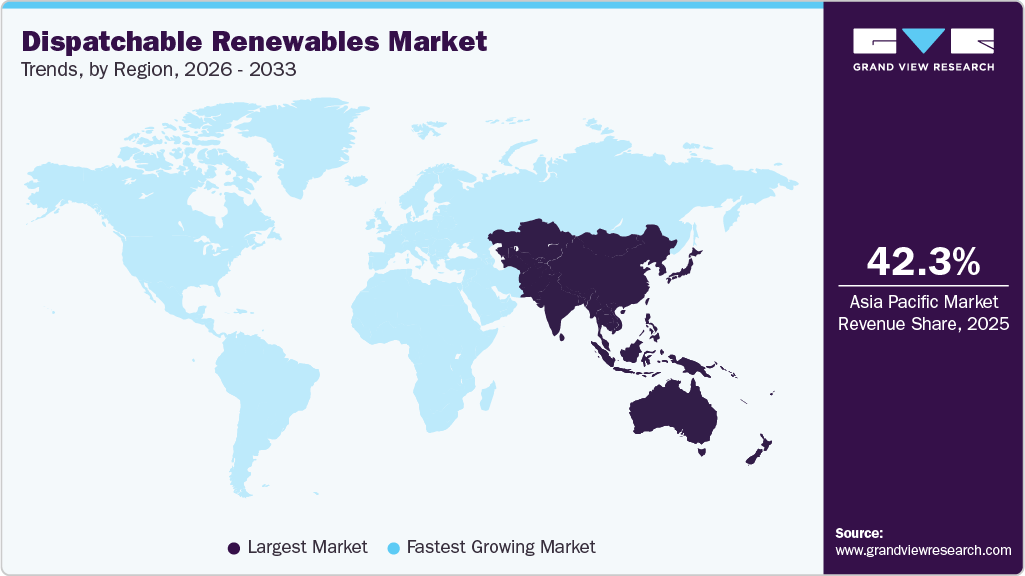
Asia Pacific held the largest revenue share of 42.3% in the global dispatchable renewables market in 2025. Large-scale hydropower installations, rapid industrialization, and rising electricity demand across major economies such as China and India drive the region’s dominance. Expanding infrastructure development, supportive clean energy policies, and increasing investments in geothermal and biomass projects are further strengthening regional growth. Asia Pacific is also projected to maintain a strong growth trajectory over the forecast period, supported by continued grid expansion and energy security initiatives.
U.S. Dispatchable Renewables Market Trends
The United States represents the largest market within North America, accounting for the majority of the regional revenue share. Growth is supported by an extensive hydropower fleet, increasing biomass utilization, and expanding concentrated solar power (CSP) projects in high-irradiance states. Ongoing grid modernization programs and long-term renewable procurement strategies continue to reinforce the country’s leadership in dispatchable renewable deployment.
Europe Dispatchable Renewables Market Trends
Europe holds a significant share of the global dispatchable renewables market, driven by ambitious decarbonization targets and strong policy support for renewable integration. Hydropower remains a key contributor to grid balancing across Nordic and Alpine countries, while biomass and geothermal projects are expanding to support district heating and industrial applications. The region continues to prioritize flexible clean energy systems to ensure reliability amid the phase-out of coal-fired power generation.
North America Dispatchable Renewables Market Trends
North America accounted for one of the leading shares of the global dispatchable renewables market in 2025, supported by its mature hydropower infrastructure and growing biomass capacity. The region benefits from strong regulatory frameworks, renewable portfolio standards, and grid reliability requirements that encourage investment in firm and flexible renewable power generation. Utilities across the U.S. and Canada continue to modernize aging hydropower assets and expand biomass-based cogeneration facilities to support increasing renewable penetration and maintain system stability.
Latin America Dispatchable Renewables Market Trends
Latin America is projected to register CAGR of 9.3% during the forecast period, driven by expanding electricity demand and substantial hydropower potential across countries such as Brazil and Chile. Increasing government initiatives to improve energy access, coupled with private-sector investments in renewable infrastructure, are accelerating market expansion. The region’s abundant natural resources and supportive regulatory environment position it for sustained growth in dispatchable renewable capacity.
Middle East & Africa Dispatchable Renewables Market Trends
The Middle East & Africa (MEA) dispatchable renewables market is witnessing steady development, supported by diversification strategies and growing electricity demand. Investments in hydropower and geothermal exploration, particularly in resource-rich areas, are contributing to regional expansion. Although infrastructure and financing challenges remain in certain markets, long-term renewable initiatives and international collaborations are expected to drive gradual adoption across the region.
Key Dispatchable Renewables Company Insights
Some of the key players operating in the global dispatchable renewables market include Siemens Energy, Voith Hydro, ANDRITZ Hydro, GE Renewable Energy, China Three Gorges Corporation, Statkraft, Enel Green Power, ENGIE, Xcel Energy, and Babcock & Wilcox Enterprises. These companies are actively focused on expanding hydropower modernization projects, scaling biomass and geothermal installations, and advancing concentrated solar power (CSP) technologies to strengthen grid reliability and low-carbon power generation capacity.
Their strategic initiatives primarily involve upgrading aging hydropower fleets, investing in high-efficiency turbines and digital plant optimization solutions, and developing hybrid renewable systems integrated with energy storage. Market participants are also forming partnerships with utilities, infrastructure developers, industrial operators, and government agencies to enhance operational efficiency, improve project bankability, and optimize long-term power purchase agreements (PPAs).
As global electricity demand rises and grids integrate higher shares of intermittent renewable energy, these companies are prioritizing scalable dispatchable generation pathways with improved efficiency and reduced lifecycle emissions. Continued investments in advanced turbine technologies, waste-to-energy solutions, geothermal exploration, and large-scale infrastructure expansion are expected to strengthen supply capabilities, drive technological innovation, and support the long-term growth of the dispatchable renewables market worldwide.
Key Dispatchable Renewables Companies:
The following key companies have been profiled for this study on the dispatchable renewables market.
- Andritz Hydro
- Babcock & Wilcox Enterprises
- China Three Gorges Corporation
- Enel Green Power
- ENGIE
- GE Renewable Energy
- Siemens Energy
- Statkraft
- Voith Hydro
- Xcel Energy Inc.
Recent Developments
-
In June 2025, GE Renewable Energy successfully commissioned India’s first variable-speed pumped-storage hydropower units at the Tehri Hydropower Complex, delivering four 250 MW pumped-storage units designed to enhance grid flexibility and expand firm renewable generation capacity. This project marks a significant advancement in long-duration dispatchable renewables and supports grid stability as variable renewables grow.
-
In 2025, Siemens Energy strengthened its strategic position with a favourable FY 2025 performance and raised mid-term targets through 2028, reflecting confidence in its capabilities across sustainable energy technologies, including hydropower and grid integration solutions that support dispatchable renewable deployment.
Dispatchable Renewables Market Report Scope
Report Attribute
Details
Market Definition
The Dispatchable Renewables Market refers to the global revenue generated from the development, installation, and operation of renewable energy technologies such as hydropower, biomass, geothermal, and concentrated solar power that provide controllable, reliable, and on-demand electricity across utility, industrial, commercial, and residential end uses.
Market size value in 2026
USD 64.35 billion
Revenue forecast in 2033
USD 116.79 billion
Growth rate
CAGR of 8.9% from 2026 to 2033
Base year for estimation
2025
Historical data
2021 - 2024
Forecast period
2026 - 2033
Quantitative units
Revenue in USD billion/million, and CAGR from 2026 to 2033
Report coverage
Revenue forecast, competitive landscape, growth factors, and trends
Segments covered
Technology, end use, region
Regional scope
North America; Europe; Asia Pacific; Latin America; Middle East & Africa
Country scope
U.S.; Canada; Mexico; Germany; UK; France; Italy; Spain; Norway; China; India; Japan; South Korea; Australia; Brazil; Argentina; Saudi Arabia; UAE; South Africa
Key companies profiled
Siemens Energy; Voith Hydro; ANDRITZ Hydro; GE Renewable Energy; China Three Gorges Corporation; Statkraft; Enel Green Power; ENGIE; Xcel Energy; Babcock & Wilcox Enterprises
Customization scope
Free report customization (equivalent up to 8 analysts working days) with purchase. Addition or alteration to country, regional & segment scope.
Pricing and purchase options
Avail customized purchase options to meet your exact research needs. Explore purchase options
Global Dispatchable Renewables Market Report Segmentation
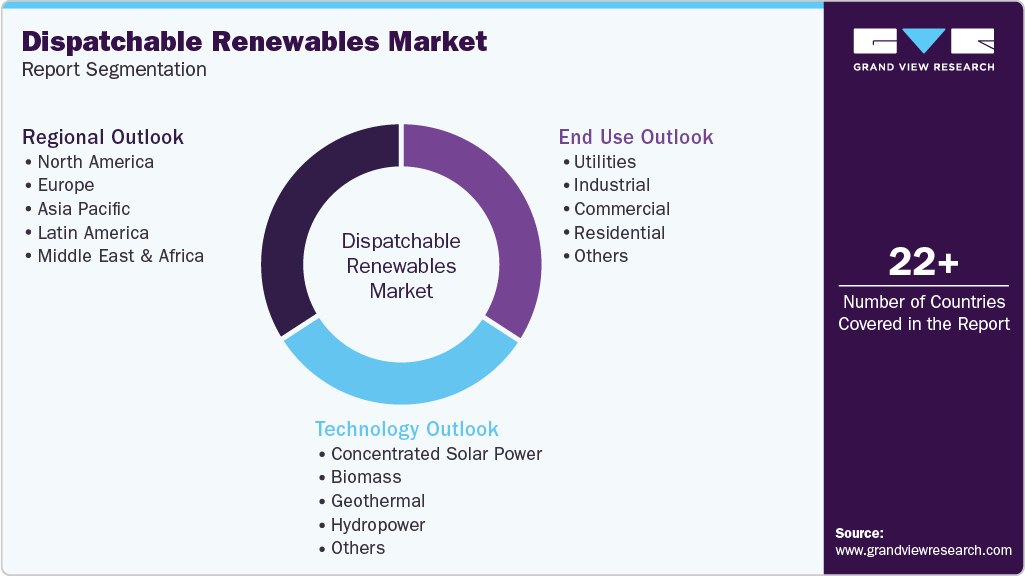
This report forecasts revenue growth at global, regional, and country levels and provides an analysis of the latest industry trends in each of the sub-segments from 2021 to 2033. For the purpose of this study, Grand View Research has segmented the global dispatchable renewables market report on the basis of technology, end use, and region:
-
Technology Outlook (Revenue, USD Million, 2021 - 2033)
-
Concentrated Solar Power
-
Biomass
-
Geothermal
-
Hydropower
-
Others
-
-
End Use Outlook (Revenue, USD Million, 2021 - 2033)
-
Utilities
-
Industrial
-
Commercial
-
Residential
-
Others
-
-
Regional Outlook (Revenue, USD Million, 2021 - 2033)
-
North America
-
U.S.
-
Canada
-
Mexico
-
-
Europe
-
Germany
-
UK
-
France
-
Italy
-
Spain
-
Norway
-
-
Asia Pacific
-
China
-
India
-
Japan
-
South Korea
-
Australia
-
-
Latin America
-
Brazil
-
Argentina
-
-
Middle East & Africa
-
Saudi Arabia
-
UAE
-
South Africa
-
-
Frequently Asked Questions About This Report
b. The global dispatchable renewables market size was estimated at USD 59.27 billion in 2025 and is expected to reach USD 64.35 billion in 2026.
b. The global dispatchable renewables market is expected to grow at a compound annual growth rate of 8.9% from 2026 to 2033 to reach USD 116.79 billion by 2033.
b. Based on the technology segment, Hydropower held the largest revenue share of more than 55.3% in 2025.
b. Some of the key players operating in the global dispatchable renewables market include Siemens Energy, Voith Hydro, ANDRITZ Hydro, GE Renewable Energy, China Three Gorges Corporation, Statkraft, Enel Green Power, ENGIE, Xcel Energy, and Babcock & Wilcox Enterprises, among others.
b. The key factors driving the growth of the dispatchable renewables market include increasing integration of intermittent renewable energy sources such as wind and solar, rising demand for grid reliability and peak-load management, supportive government policies promoting clean and firm power generation, and expanding investments in hydropower modernization, biomass facilities, geothermal development, and concentrated solar power projects.


Share this report with your colleague or friend.
Need a Tailored Report?
Customize this report to your needs — add regions, segments, or data points, with 20% free customization.


ISO 9001:2015 & 27001:2022 Certified
We are GDPR and CCPA compliant! Your transaction & personal information is safe and secure. For more details, please read our privacy policy.
Trusted market insights - try a free sample
See how our reports are structured and why industry leaders rely on Grand View Research. Get a free sample or ask us to tailor this report to your needs.












