
- Home
- »
- Consumer F&B
- »
-
Decaffeinated Coffee Market Size, Industry Report, 2033GVR Report cover
![Decaffeinated Coffee Market Size, Share & Trends Report]()
Decaffeinated Coffee Market (2026 - 2033) Size, Share & Trends Analysis Report By Product (Roasted, Raw), By Bean Species (Arabica, Robusta), By Distribution Channel (Online, Offline), By Region (North America, Europe), And Segment Forecasts
- Report ID: GVR-4-68038-410-9
- Number of Report Pages: 80
- Format: PDF
- Historical Range: 2021 - 2025
- Forecast Period: 2026 - 2033
- Industry: Consumer Goods
- Report Summary
- Table of Contents
- Segmentation
- Methodology
- Download FREE Sample
-
 Download Sample Report
Decaffeinated Coffee Market Summary
The global decaffeinated coffee market size was valued at USD 3,175.8 million in 2025 and is expected to reach USD 5,222.7 million by 2033, growing at a CAGR of 6.7% from 2026 to 2033. Growth is driven by rising health awareness, increasing demand for low-caffeine beverages, expanding aging populations, growing incidence of lifestyle-related health concerns, and wider availability of premium, organic, and specialty decaf variants across retail, e-commerce, and foodservice channels worldwide.
Key Market Trends & Insights
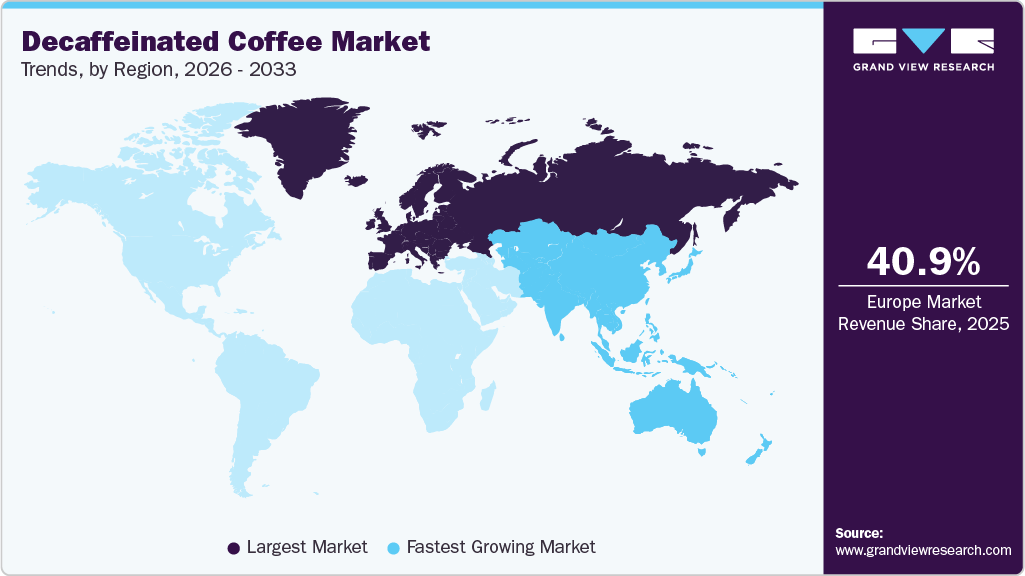
- The Europe region accounted for the largest revenue share of 40.97% in 2025.
- Germany decaffeinated coffee market held a significant market share in Europe region in 2025.
- Based on product, the roasted segment dominated the market with a revenue share of over 85.63% in 2025.
- Based on bean species, the Arabica decaffeinated coffee segment held the largest revenue market share of 57.35% in 2025.
- Based on distribution channel, the offline channel held the largest revenue market share of 80.92% in 2025.
Market Size & Forecast
- 2025 Market Size: USD 3,175.8 Million
- 2033 Projected Market Size: USD 5,222.7 Million
- CAGR (2026-2033): 6.7%
- Europe: Largest market in 2025
- Asia Pacific: Fastest growing market
Coffee is one of the most popular hot beverages in the world, with Europe and North America accounting for the highest consumption. The global coffee market continues to grow, but consumption patterns vary widely across countries. Northern European nations dominate the upper tiers, driven by a long-standing café culture and high per-capita spending. According to a YouGov survey in 2024, 53% of Americans drink at least one cup of coffee per day. 79% drink caffeinated coffee, while only 10% drink decaf, and 10% drink both. While there are a variety of options on how to drink coffee these days, it seems most Americans just like regular coffee.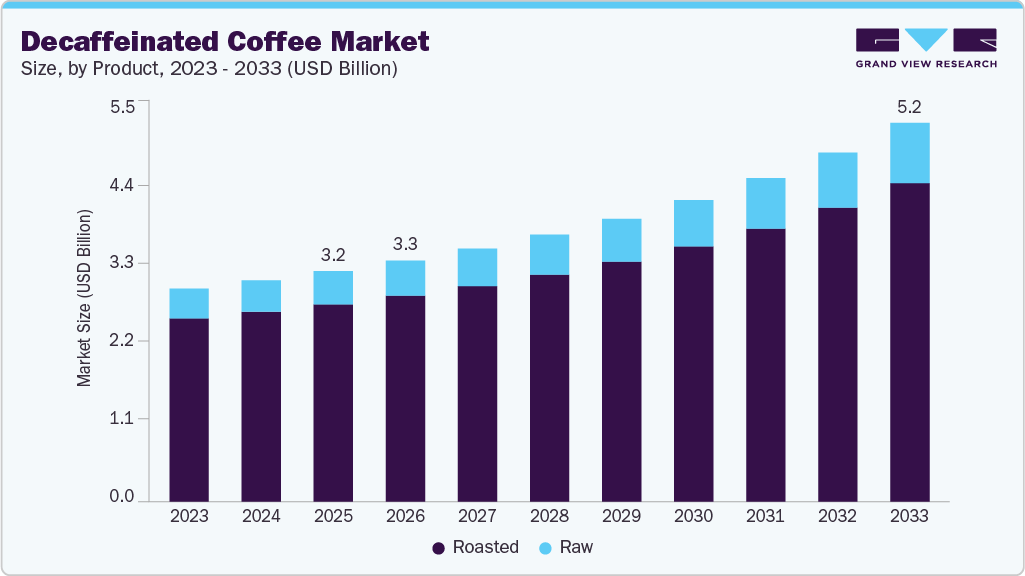
However, rising awareness of health and wellness, particularly the impact of caffeine on human health, has become a powerful driver of growth in the decaffeinated coffee market. Consumers are increasingly informed about how caffeine can affect physiological processes such as sleep patterns, anxiety levels, and cardiovascular stress, prompting many to seek alternatives that allow enjoyment of coffee without these adverse effects.
Decaf coffee demand is increasing, particularly in contexts where consumers want the ritual and flavour of coffee without stimulant effects. For instance, decaf coffee sales surged by 40% year-over-year in South Korea, with decaf representing a significant share of total coffee revenue as consumers sought evening and late-day alternatives to regular caffeinated brews. This trend underscores a broader pattern of health-driven purchasing decisions, where convenience and sensory enjoyment are paired with wellness priorities.
The specialty decaffeinated coffee is experiencing growth due to increasing consumer demand for high-quality, flavorful, and ethically sourced caffeine-free options. Additionally, specialty coffee roasters are expanding their decaffeinated offerings to cater to discerning coffee enthusiasts seeking an artisanal experience without caffeine. Furthermore, the rising popularity of craft beverages, greater transparency in sourcing, and the influence of third-wave coffee culture have contributed to making specialty decaffeinated coffee a lucrative market segment.
Innovation is the key engine of the specialty decaffeinated coffee segment in the US. Specialty coffee is currently maintaining a 13-year high, with 46% of Americans enjoying this type of coffee in the past day, as per the NCA’s report. Within the specialty category, there is a recent trend of relatively unknown coffee beverages just a few years ago, skyrocketing in popularity. For example, 45% of American adults had a cold brew in the past week, up 162% from when the 2016 NCDT first added cold brew. These figures bode well with market players’ observations.
For instance, in July 2025, Colipse Coffee expanded its Swiss Water decaf lineup to include multiple bag sizes and precision grind options, reflecting a response to detailed consumer preferences for brewing methods and formats. Moreover, Copper Moon Coffee launched USDA-certified Organic Swiss Water Decaf Single Serve Pods in January 2025, designed to deliver rich, full-bodied flavor without caffeine, blending sustainability with ease of use for everyday consumers. Copper Moon delivers a coffee that’s 99.9% caffeine-free while preserving its full, rich taste.
Consumer Insights for Decaffeinated Coffee Market
The decaffeinated coffee market has long been considered a niche segment and an afterthought, often overlooked in favor of its caffeinated counterpart. However, recent trends suggest a shift in consumer attitudes and behaviors towards decaf coffee. The consumption patterns reveal that decaf coffee is not just an occasional choice for most consumers. Over 66% of respondents drink decaf at least several times a week, with nearly 40% consuming it daily or multiple times a day. This high frequency of consumption suggests that decaf has become a staple in many consumers' diets, rather than just an alternative option.
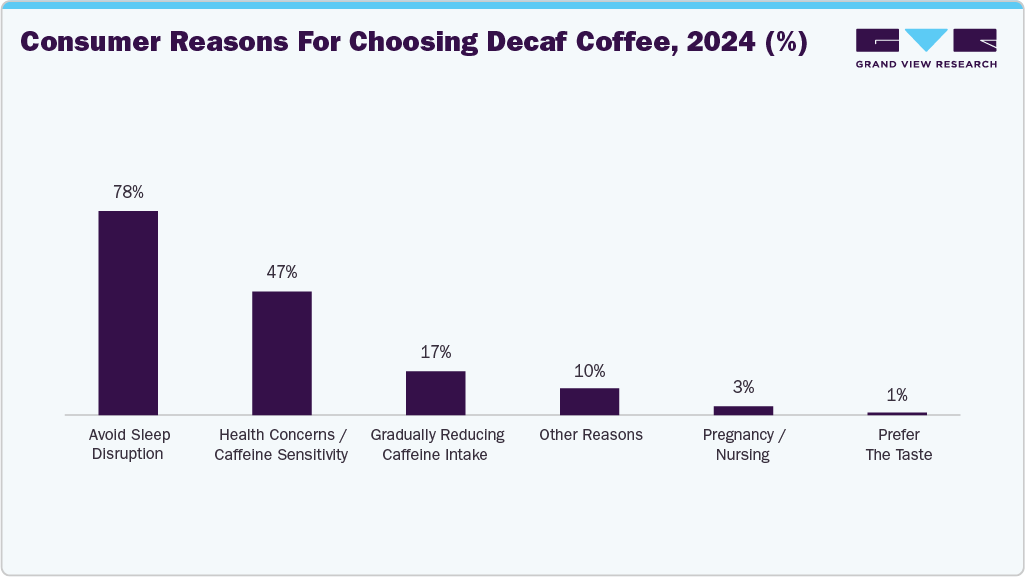
The motivations for choosing decaf reveal that consumers are primarily driven by lifestyle and health considerations. The overwhelming majority (78%) choose decaf to avoid sleep disruption, indicating that many consumers are becoming more conscious of their caffeine intake and its effects on sleep quality, while others are drinking decaf to gradually reduce their caffeine intake (16.9%). The second most popular category is health concerns and caffeine sensitivity (47.4%). This presents an opportunity for decaf brands to position their products as part of a healthy sleep routine and an alternative to caffeinated drinks.
Product Insights
The roasted decaffeinated coffee segment dominated the market with a revenue share of over 85.63% in 2025. The roasted decaffeinated coffee segment’s growth is driven by rising consumer preference for ready-to-brew formats that deliver convenience and consistent flavor. This segment benefits from growing demand in both household and café consumption, especially among health-conscious consumers seeking reduced caffeine without compromising taste. Increasing innovations in roasting technology and the expansion of premium decaf offerings further support the strong penetration of roasted decaf across mature coffee markets.
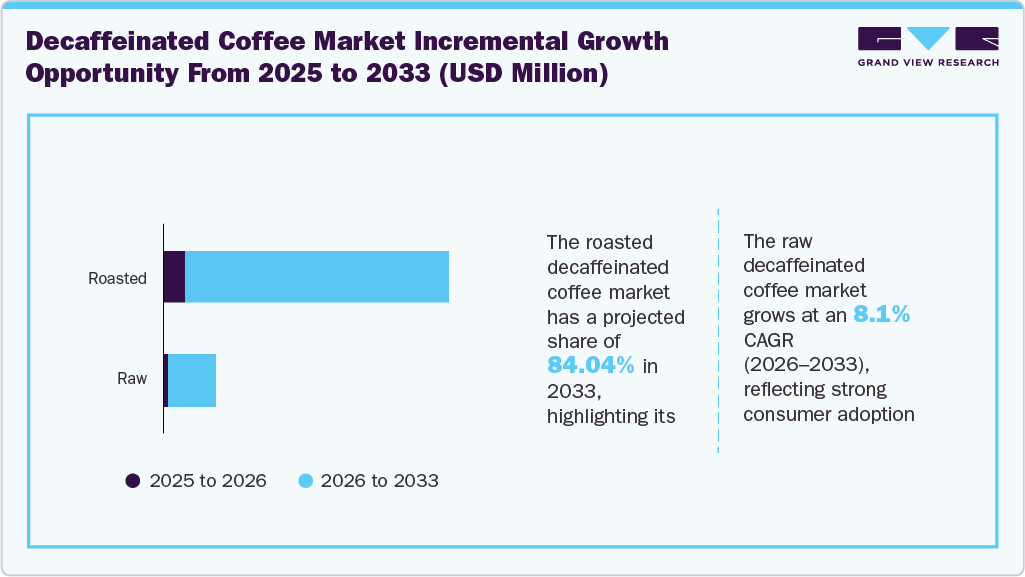
The raw decaffeinated coffee segment is expected to grow at the fastest CAGR of 8.1% during the forecast period. Raw decaffeinated coffee beans are gaining demand among commercial roasters and specialty coffee producers that prefer in-house roasting to maintain quality control and signature profiles. Moreover, the consumption of raw decaffeinated coffee beans is expanding because of the specialty coffee culture, where businesses emphasize sourcing transparency and unique flavor characteristics. Growth is further supported by increasing imports of decaffeinated green beans into North America and Europe, driven by rising interest in artisanal roasting and diversified decaf product portfolios.
Bean Species Insights
The arabica decaffeinated coffee segment held the largest revenue market share of 57.35% in 2025. Arabica decaffeinated coffee consumption is rising, driven by its superior flavor, smoother profile, and strong preference among premium consumers. In addition, the rising demand for high-quality decaf options in cafés, specialty stores, and e-commerce platforms is further fueling the demand for arabica decaffeinated coffee. Increasing adoption of gentle decaffeination methods helps preserve Arabica’s delicate flavor notes, making it the preferred choice for brands targeting the premium and specialty coffee segments.
Robusta decaffeinated coffee is expected to grow at a significant CAGR of 7.4% during the forecast period 2026 to 2033. Robusta decaffeinated coffee is positioned as a cost-effective alternative, appealing to price-sensitive consumers and manufacturers focused on mass-market blends. The robusta decaffeinated coffee industry is growing because of Robusta’s naturally higher body and stronger flavor, which remain desirable for producing instant coffee, commercial blends, and private-label decaf products. Growing demand for decaffeinated instant coffee in emerging economies supports Robusta’s increasing contribution to overall market volume.
Distribution Channel Insights
Offline channels held the highest revenue market share of 80.92% in 2025. Offline distribution remains a dominant channel in the decaffeinated coffee market, supported by strong sales through supermarkets, hypermarkets, and specialty stores. These outlets allow consumers to compare brands, explore premium decaf varieties, and access instant purchase options. Growing shelf presence of specialty and organic decaf products drives retail visibility and impulse buying. In addition, cafes and restaurants play a vital role in shaping consumer trial and repeat demand for high-quality decaf beverages.
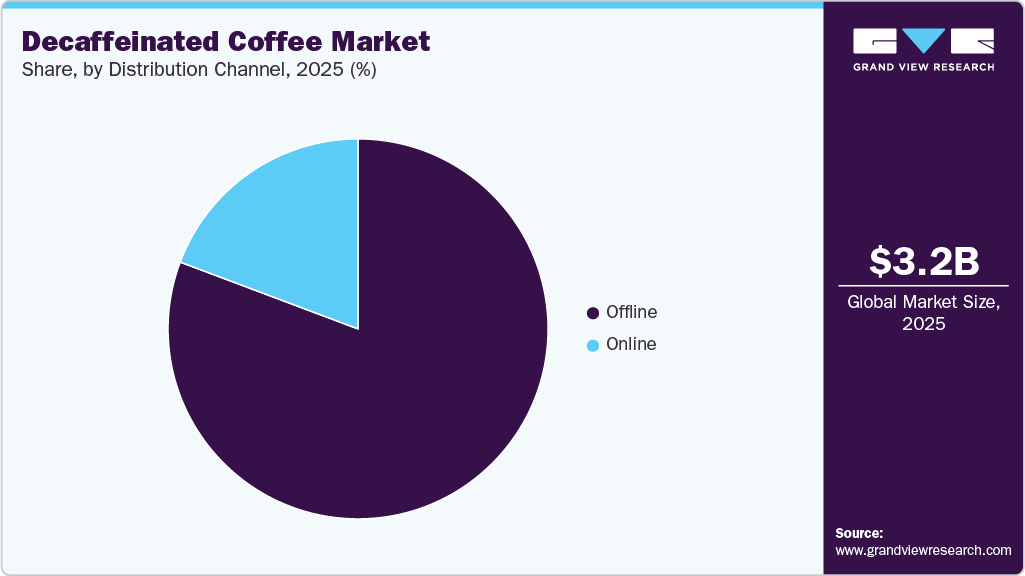
The online segment is expected to grow at the fastest CAGR of 7.8% over the forecast period. Online distribution is witnessing rapid growth in the decaffeinated coffee industry due to rising e-commerce adoption, the convenience of doorstep delivery, and access to a wider assortment of global specialty brands. Consumers increasingly rely on digital platforms to purchase premium, organic, or chemical-free decaf products that may not be available in local stores. Subscription models, brand-owned websites, and marketplaces such as Amazon are accelerating the shift toward online decaf purchases.
Regional Insights
North America decaffeinated coffee market accounted for the market share of 28.75% in 2025. The decaffeinated coffee industry in North America is experiencing steady growth driven by rising health consciousness, an expanding premium café culture, and increased demand for low-caffeine beverage options. Consumers are shifting toward high-quality, specialty decaf products that retain flavor while reducing caffeine intake. Strong penetration of convenience stores, supermarkets, and online retail channels further supports market expansion. In addition, innovations in gentle decaffeination techniques are attracting new consumer groups seeking healthier and flavorful coffee alternatives.
U.S. Decaffeinated Coffee Market Trends
The decaffeinated coffee market in the U.S. is expanding as consumers increasingly prioritize wellness, reduced caffeine intake, and premium coffee experiences. Demand is rising across young professionals, older adults, and health-focused individuals who seek flavorful decaf options without compromising taste. Strong growth in specialty cafés, artisanal roasters, and subscription-based coffee services is boosting visibility. In addition, advancements in natural decaffeination processes are encouraging consumers to shift toward cleaner, chemical-free decaf varieties.
Europe Decaffeinated Coffee Market Trends
The decaffeinated coffee industry in Europe accounted for the largest revenue share of 40.97% in 2025, driven by rising health awareness, strong café culture, and a growing preference for premium, sustainable coffee options. Consumers across Western and Central Europe increasingly seek low-caffeine beverages that maintain rich flavor profiles, boosting demand for high-quality Arabica decaf. Expanding specialty roasters, organic product availability, and widespread adoption of eco-friendly decaffeination methods are further strengthening market penetration across both retail and foodservice channels.
Spain's decaffeinated coffee market is expected to grow at the fastest CAGR in the European region in the forecast period. Spain remains Europe’s leading market for decaffeinated coffee. In 2023, the country imported around 28 thousand tonnes, significantly ahead of Switzerland, which ranked second with about 10 thousand tonnes. Spain’s late dining habits, combined with rising awareness of caffeine’s impact on sleep, are contributing to the growing preference for decaf options. Vietnam supplied about 61% (17 thousand tonnes) of Spain’s decaffeinated coffee imports.
Asia Pacific Decaffeinated Coffee Market Trends
The decaffeinated coffee market in Asia Pacific is expanding as urbanization, rising incomes, and Western lifestyle influences shape consumer preferences. Growing health awareness is encouraging consumers to choose low-caffeine alternatives without compromising taste. Increasing penetration of international café chains, specialty coffee shops, and premium retail outlets is boosting visibility for decaf products. Markets such as Japan, South Korea, China, and Australia are leading adoption, supported by strong interest in high-quality and sustainably sourced coffee.
The China decaffeinated coffee market held the largest market share in APAC in 2025. Rapid growth in e-commerce and ready-to-drink options is accelerating decaffeinated coffee consumption across the country. Younger consumers are becoming key demand drivers, preferring convenient formats and innovative flavor profiles. Regional roasters and global brands are increasingly launching Arabica-focused and chemical-free decaf offerings to meet rising quality expectations. In addition, expanding awareness of digestive comfort and reduced caffeine intake is encouraging broader acceptance of decaffeinated coffee across the diverse Chinese market.
Key Decaffeinated Coffee Companies Insights
Some of the key companies in the global decaffeinated coffee market are Don Pablo Coffee, Swiss Water Decaffeinated Coffee Inc., Volcanica Coffee Company, Swiss Water Decaffeinated Coffee Inc., Jo Coffee, Fresh Roasted Coffee, LLC, and others. To address growing competition and increasing demand from commercial buyers, the companies have adopted enhanced marketing, improved retail presence, effective distribution strategies, and more. Multiple key companies have also focused on strategies such as innovation, collaborations, partnerships, and offering attractive offers to retail customers and others.
-
Don Pablo Coffee specializes in specialty-grade coffee's growing and roasting process. Its decaf offerings include Subtle Earth Organic Swiss Water Decaf, Don Pablo Colombian Swiss Water Decaf, Don Pablo Bourbon Infused Decaf Coffee, and Don Pablo's Decaf Sampler Gift Box. It also offers a range of products, including organic whole bean, organic ground, organic low acid, cold brew, K-cups, and more.
-
Volcanica Coffee Company offers multiple coffee products, such as flavored coffee, Costa Rican coffee, Colombian coffee, Ethiopian Coffee, Geisha Coffee, Guatemalan coffee, Sumatra Coffee, and more. It also provides its offerings to wholesale buyers. Its collection includes a variety of coffee offerings, such as estate, peaberry, decaf, organic, dark roast, low acid, and others.
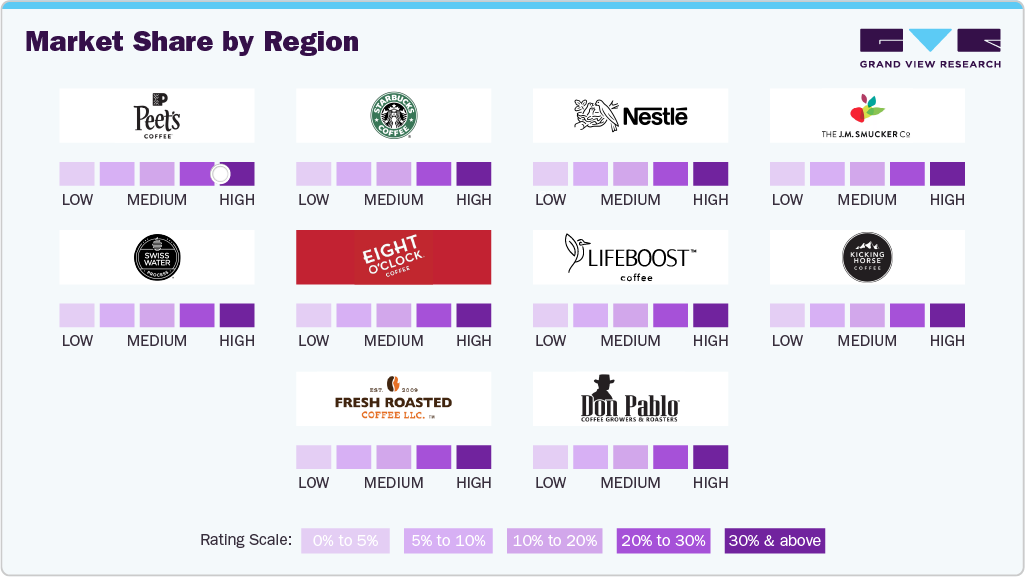
Key Decaffeinated Coffee Companies:
The following key companies have been profiled for this study on the decaffeinated coffee market.
- JDE Peet's
- Starbucks Coffee Company
- Nestlé S.A.
- The J.M. Smucker Co.
- Swiss Water Decaffeinated Coffee Inc.
- Tata Consumer Products (The Eight O'Clock Coffee Company)
- Lifeboost Coffee LLC
- Kicking Horse Coffee Co. Ltd.
- Fresh Roasted Coffee, LLC
- Don Pablo Coffee
Recent Developments
-
In January 2026, Explorer Cold Brew, Inc. expanded its coffee portfolio by acquiring Savorista, a specialty coffee brand known for decaf and half-caffeinated blends. The deal was aimed at strengthening Explorer’s caffeine-conscious offerings and leveraging its national distribution to accelerate the growth of Savorista’s products.
-
In January 2026, Nespresso launched a limited-edition French Lavender & Vanilla Decaffeinated Vertuo pod, featuring high-quality decaffeinated Arabica beans infused with delicate French lavender and vanilla notes. The new flavor targeted the growing demand for flavorful, caffeine-free coffee experiences and was made available in stores and online.
-
In January 2026, Frequent Coffee expanded its specialty decaf lineup, introducing a range of decaffeinated coffees produced using rare and advanced processing methods, including carbonic maceration, yeast inoculation, mucilage ethyl acetate, thermal shock, Swiss Water, and sugarcane EA, to deliver origin-driven flavor complexity and showcase decaf quality beyond traditional offerings.
Decaffeinated Coffee Market Report Scope
Report Attribute
Details
Market value size in 2026
USD 3,321.6 million
Revenue Forecast in 2033
USD 5,222.7 million
Growth rate (revenue)
CAGR of 6.7% from 2026 to 2033
Actuals
2021 - 2025
Forecast period
2026 - 2033
Quantitative (revenue) units
Revenue in USD million/billion, and CAGR from 2026 to 2033
Report coverage
Revenue forecast, company ranking, competitive landscape, growth factors, and trends
Segments covered
Product, bean species, distribution channel, region
Regional Scope
North America; Europe; Asia-Pacific; Central & South America; Middle East & Africa
Country scope
U.S.; Canada; Mexico; Germany; UK; France; Italy; Spain; China; Japan; Australia & New Zealand; India; Brazil; Argentina; Saudi Arabia; UAE
Key companies profiled
JDE Peet's; Starbucks Coffee Company; Nestlé S.A.; The J.M. Smucker Co.; Swiss Water Decaffeinated Coffee Inc.; Tata Consumer Products (The Eight O'Clock Coffee Company); Lifeboost Coffee LLC; Kicking Horse Coffee Co. Ltd.; Fresh Roasted Coffee, LLC; Don Pablo Coffee
Customization scope
Free report customization (equivalent up to 8 analysts’ working days) with purchase. Addition or alteration to country, regional & segment scope.
Pricing and purchase options
Avail customized purchase options to meet your exact research needs. Explore purchase options
Global Decaffeinated Coffee Market Report Segmentation
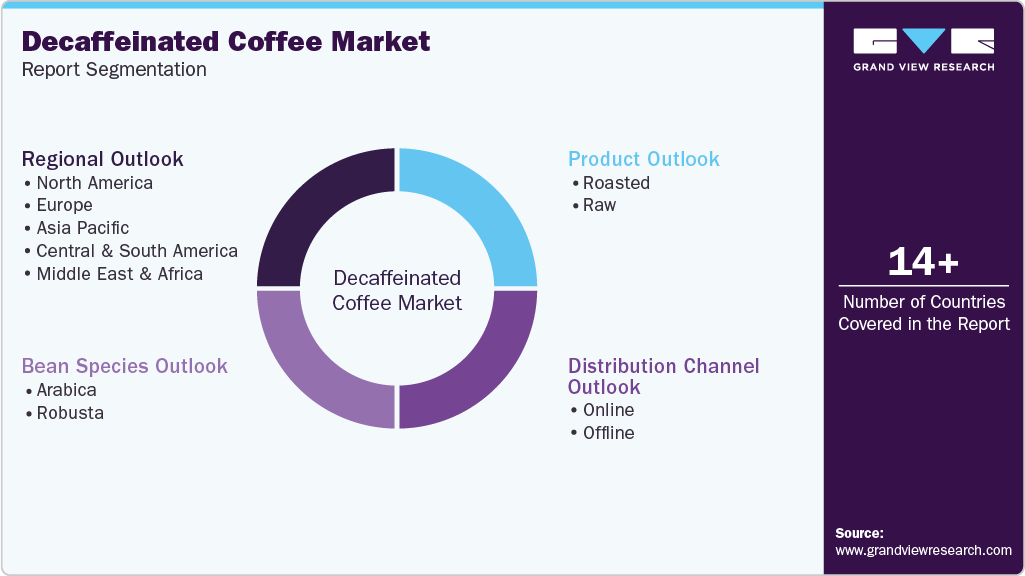
This report forecasts revenue growth at the global, regional and country levels and provides an analysis of the latest industry trends and opportunities in each of the sub-segments from 2021 to 2033. For this study, Grand View Research has segmented the global decaffeinated coffee market report on the basis of product, bean species, distribution channel, and region.
-
Product Outlook (Revenue, USD Million, 2021 - 2033)
-
Roasted
-
Raw
-
-
Bean Species Outlook (Revenue, USD Million, 2021 - 2033)
-
Arabica
-
Robusta
-
-
Distribution Channel Outlook (Revenue, USD Million, 2021 - 2033)
-
Online
-
Offline
-
-
Regional Outlook (Revenue, USD Million, 2021 - 2033)
-
North America
-
U.S.
-
Canada
-
Mexico
-
-
Europe
-
UK
-
Germany
-
France
-
Italy
-
Spain
-
-
Asia Pacific
-
Japan
-
India
-
China
-
Australia & New Zealand
-
-
Central & South America
-
Brazil
-
Argentina
-
-
Middle East & Africa
-
UAE
-
Saudi Arabia
-
-
Frequently Asked Questions About This Report
b. The global decaffeinated coffee market was valued at USD 3,175.8 million in 2025 and is expected to reach USD 3,321.6 million by 2026.
b. The global decaffeinated coffee market is expected to reach USD 5,222.7 million by 2033 and is projected to grow at a compound annual growth rate (CAGR) of 6.7% from 2026 to 2033.
b. The Europe region accounted for the largest revenue share of 40.97% in 2025. The Europe decaffeinated coffee industry is witnessing steady growth driven by rising health awareness, strong café culture, and a growing preference for premium, sustainable coffee options.
b. Some key players operating in the decaffeinated coffee market include JDE Peet's; Starbucks Coffee Company; Nestlé S.A.; The J.M. Smucker Co.; Swiss Water Decaffeinated Coffee Inc.; Tata Consumer Products (The Eight O'Clock Coffee Company); Lifeboost Coffee LLC; Kicking Horse Coffee Co. Ltd.; Fresh Roasted Coffee, LLC; Don Pablo Coffee.
b. The decaffeinated coffee market growth is driven by rising health awareness, increasing demand for low-caffeine beverages, expanding aging populations, growing incidence of lifestyle-related health concerns, and wider availability of premium, organic, and specialty decaf variants across retail, e-commerce, and foodservice channels worldwide.


Share this report with your colleague or friend.
Need a Tailored Report?
Customize this report to your needs — add regions, segments, or data points, with 20% free customization.


ISO 9001:2015 & 27001:2022 Certified
We are GDPR and CCPA compliant! Your transaction & personal information is safe and secure. For more details, please read our privacy policy.
Trusted market insights - try a free sample
See how our reports are structured and why industry leaders rely on Grand View Research. Get a free sample or ask us to tailor this report to your needs.












