
- Home
- »
- Homecare & Decor
- »
-
Collectibles Market Size And Share, Industry Report, 2033GVR Report cover
![Collectibles Market Size, Share & Trends Report]()
Collectibles Market (2026 - 2033) Size, Share & Trends Analysis Report By Category (Art & Antiques, Numismatics, Philately/Stamps, Toys & Action Figures, Comic & Graphic Novels, Trading Cards, Memorabilia, Others), By Type (Ancient, Vintage, Modern, Contemporary), By Region, And Segment Forecasts
- Report ID: GVR-4-68040-414-4
- Number of Report Pages: 110
- Format: PDF
- Historical Range: 2021 - 2025
- Forecast Period: 2026 - 2033
- Industry: Consumer Goods
- Report Summary
- Table of Contents
- Interactive Charts
- Methodology
- Download FREE Sample
-
 Download Sample Report
Collectibles Market Summary
The global collectibles market size was estimated at USD 320.30 billion in 2025 and is projected to reach USD 535.50 billion by 2033, growing at a CAGR of 6.9% from 2026 to 2033. For many, collecting is not just about financial investment but about preserving personal or cultural heritage.
Key Market Trends & Insights
- The Europe collectibles market held the largest global share of 37.28% in 2025.
- The UK collectibles industry led Europe with the largest share in 2025.
- By category, the art & antiques segment held the largest market share of 32.9% in 2025.
- Based on the type, the vintage segment held the largest market share of 39.9% in 2025.
Market Size & Forecast
- 2025 Market Size: USD 320.30 Billion
- 2033 Projected Market Size: USD 535.50 Billion
- CAGR (2026-2033): 6.9%
- Europe: Largest market in 2025
This emotional bond drives enthusiasts to seek out and invest in items that resonate with their experiences or passions, thereby fueling demand. Collectables can evoke profound feelings of nostalgia and personal connection. They often evoke cherished memories or significant moments in consumers' lives, creating a tangible link to the past. Items like vintage toys, rare comic books, and historical artifacts connect individuals with their pasts or with cherished interests.For example, vintage toys like Barbie dolls and action figures from the 1980s and 1990s have seen a resurgence in popularity as adults seek to relive their childhood memories. Collectors are willing to pay premium prices for well-preserved items from their formative years, reflecting a deep emotional attachment.

The increasing recognition of collectibles as viable investment assets has significantly boosted demand in the collectibles industry. Collectibles such as rare coins, stamps, and vintage wine can appreciate substantially over time, offering returns that rival those of traditional investments. For instance, rare coins like the 1933 Double Eagle gold coin, which was sold for over USD 7.5 million at auction, exemplify how collectibles can achieve remarkable financial returns.
The rise of digital technology and the advent of non-fungible tokens (NFTs) have introduced new dimensions to the market. NFTs allow digital assets to be bought, sold, and traded with proof of ownership and scarcity. For example, digital artworks by artists like Beeple have sold for millions of dollars, with Beeple’s “Everydays: The First 5000 Days” fetching a staggering USD 69 million at a Christie’s auction. This innovation has not only expanded the definition of what can be considered collectible but has also attracted a tech-savvy generation interested in digital ownership.
Celebrities and media exposure have played a crucial role in driving demand for collectibles. When high-profile figures showcase their collections or endorse certain items, it can significantly increase their desirability. For instance, the auction of Michael Jackson’s memorabilia, including iconic costumes and accessories, drew immense interest and high bids. Similarly, the popularity of celebrity-owned items, such as Elvis Presley’s guitars or Marilyn Monroe’s items, highlights how celebrity influence can drive demand and raise the market value of collectibles.
Pop culture trends often drive demand for specific collectibles. Items related to popular movies, television shows, or video games can become highly sought after. The success of franchises like Star Wars and Marvel has led to a thriving market for related collectibles, including action figures, posters, and limited-edition releases. For example, Star Wars action figures from the original 1970s and 1980s lines, particularly those in mint condition, have become valuable collector’s items. The growing interest in new pop culture phenomena further fuels the demand for related memorabilia.
Consumer Surveys & Insights
Generational patterns in collecting behavior have become increasingly distinct, with younger cohorts establishing themselves as the most engaged participants. According to eBay’s State of Collectibles 2023 (Australia), over half of surveyed Gen Z and millennial adults (18-34 years) identified as active collectors, compared with substantially lower engagement among older groups. The same report estimated that more than one in four Australian adults overall collect items such as coins (36%), LEGO sets (33%), toys (26%), and sneakers (22%), with entry-level price points under USD 100 serving as primary access channels.
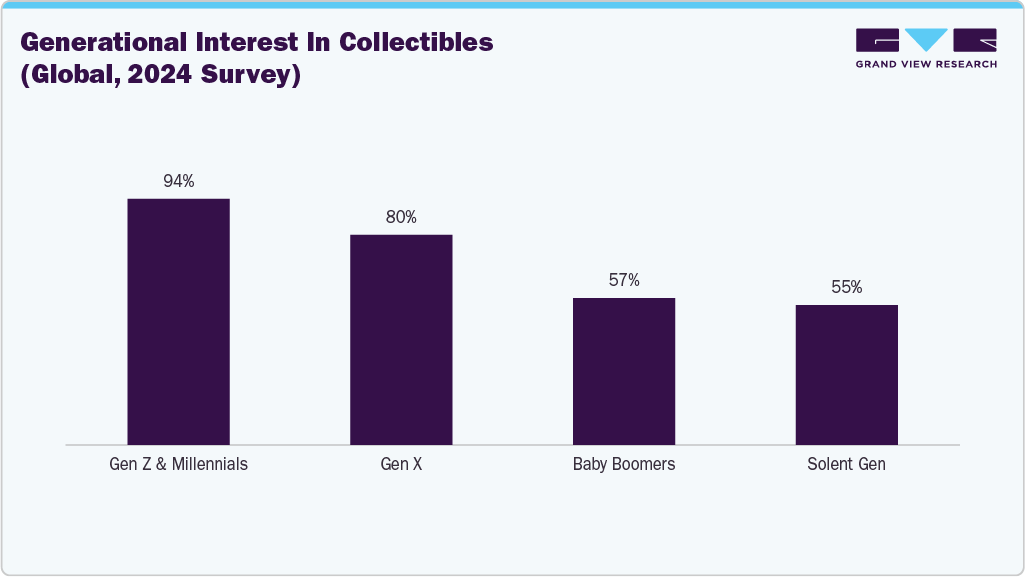
This increased activity among younger cohorts has been reinforced globally. A 2024 survey indicated that 94% of Gen Z and millennials expressed interest in collectibles, compared with 80% of Gen X, 57% of Baby Boomers, and 55% of the Silent Generation. Watches, jewelry, and wine or spirits were ranked highly by younger consumers, reflecting a preference for both lifestyle goods and categories viewed as alternative assets. In art collecting, younger buyers have increasingly shaped demand: Christie’s reported that 25% of its EMEA bidders in 2024 were millennials or younger, and Sotheby’s also noted strong millennial participation in luxury sales.
Gender dynamics within the global collectibles industry have undergone notable shifts, with evidence suggesting that participation is becoming increasingly balanced across categories. According to eBay’s State of Collectibles 2023 report, collecting was found to be a cross-demographic activity, with both men and women actively engaged across categories such as coins, LEGO sets, toys, and sneakers. While the report highlighted broad inclusivity, distinct patterns of category ownership were observed. Men were more frequently associated with traditionally male-coded categories such as trading cards, sneakers, and vintage electronics, whereas women demonstrated growing engagement in collectibles linked to fashion, lifestyle, and design.
Income has been observed as a primary determinant of category mix and purchase intensity in collectibles. At the top end, high-net-worth individuals (HNWIs) anchor demand. The 2024 Art Basel & UBS Survey of Global Collectibles reported that HNW collectors reduced average art and antiques spending to USD 363,905 in 2023 (from USD 532,985 in 2022), evidencing greater caution while still sustaining high-value transactions.
Category Insights
The art and antique segment led the collectibles market, accounting for the largest revenue share of 32.9% in 2025. This diverse sector encompasses a range of physical assets, including fine art, paintings, sculptures, pottery, antique furniture, and historical artifacts. A blend of aesthetic appeal, historical significance, and investment potential influences the market value of these art pieces. Contrasting with traditional financial products, the valuation of these items is subjective, driven by factors such as rarity, provenance, condition, and cultural relevance.
A new generation of collectors, including Millennials and Gen Z, is increasingly interested in vintage and antique items for their sustainability and unique character. Additionally, high-net-worth individuals and institutional investors are increasingly perceiving art and antiques as a contemporary alternative asset for portfolio diversification, especially during periods of economic uncertainty.
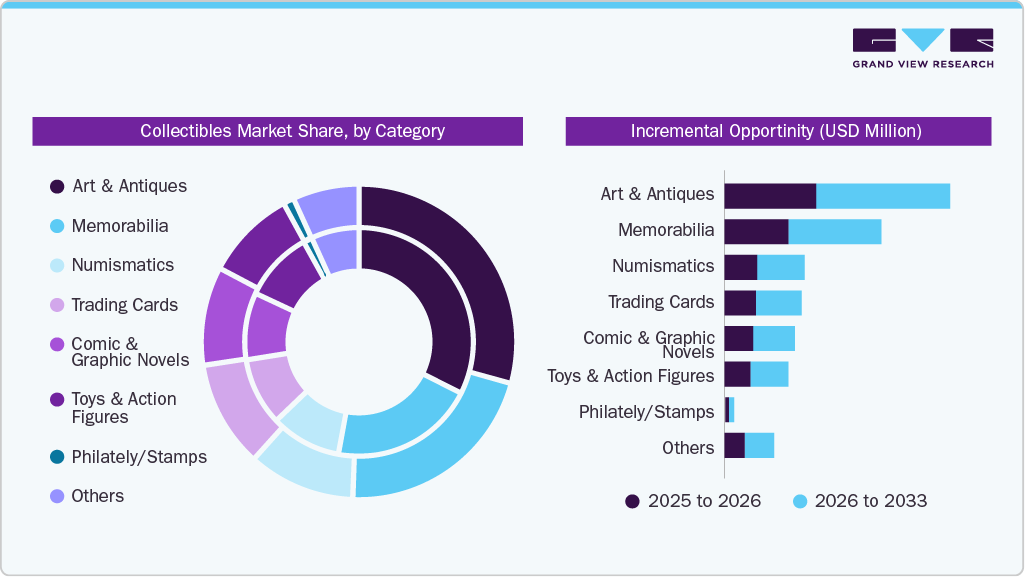
The trading cards segment is projected to grow at a CAGR of 7.4% over the forecast period. The trading cards segment of the collectibles industry is growing due to rising nostalgia-driven hobby interest, increased participation from younger collectors, and the expansion of pop culture and sports fandoms. The integration of digital platforms for trading, grading, and resale has improved market accessibility and liquidity, while limited-edition releases and professional authentication have enhanced perceived value.
Type Insights
The vintage collectibles led the collectibles industry, accounting for a revenue share of 39.9% in 2025. The vintage collectibles industry is a robust, rapidly expanding sector within the broader global collectibles industry. This segment is characterized by items from the early to mid-20th century that hold significant sentimental, cultural, and financial value. Unlike ancient artifacts, vintage collectibles are often tied to wars, colonial empires, pop culture, and nostalgia. They appeal to younger as well as traditional enthusiasts and encompass a diverse demographic of collectors and investors.
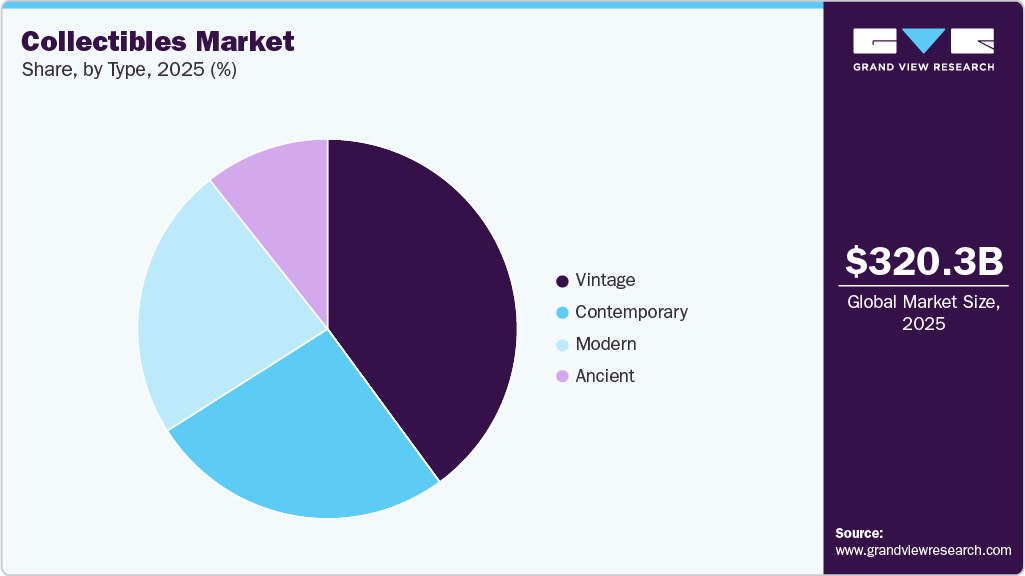
The contemporary collectibles segment is projected to grow at a CAGR of 7.1% from 2026 to 2033. The contemporary collectibles segment encompasses items created in the modern era, valued for their cultural relevance, scarcity, and artistic merit. Unlike traditional antiques, this market includes a diverse range of assets, including fine art by living artists, luxury goods, designer sneakers, and digital NFTs. In September 2025, the digital collectibles platform Panini Blockchain reported over USD 7.1 million in sales within the first 12 days, with three NFTs selling for USD 50,000 or more. This segment is known for its dynamic nature and strong appeal to a younger, digitally native audience seeking both aesthetic enjoyment and investment potential.
Moreover, the rise of online platforms and curated digital marketplaces has democratized access to collectibles, connecting a global network of buyers and sellers more efficiently. Furthermore, social media and influencer culture play a significant role in generating hype and creating demand for limited-edition releases and culturally significant items. For instance, Labubu designer toy dolls from the 2025 Ethereal Wanderers series, which went viral on TikTok and other social platforms, were originally priced between USD 13 and USD 16, with some reselling online for up to USD 700. In June 2025, a 131 cm mint green Labubu doll was sold for around USD 170,000 at a Labubu auction in Beijing.
Regional Insights
The collectibles industry in North America accounted for the revenue share of 32.8% in 2025. North America is one of the prominent regions for collectible revenue, driven by the presence of an established comic book industry, toy collectors, sports league enthusiasts, and vintage art appreciators. Multiple auction houses and companies in the region also provide collectors and investors with access to desired collectibles. Auction houses are expanding their services and reaching out to catering experts and high-income collectors interested in rare collectibles. Collectibles such as art, rare coins, sports memorabilia, and trading cards are becoming a diversified way to invest capital that was once perceived as a hobby. For instance, in September 2025, “space-flown” Sacagawea gold coins, which had been stored at Fort Knox for years, were sold for a total of USD 3.2 million. Seven of these coins had even travelled on a NASA space shuttle, highlighting the appreciated value over time.
U.S. Collectibles Market Trends
The U.S. is recognized as a pop culture powerhouse. Hollywood, Disney, Marvel, DC, and the music industry are based in the country, generating huge global demand for related toys, action figures, comics, and movie memorabilia. Events like Comic-Con in San Diego and New York serve as international gathering spots for collectors, further boosting demand for action-figure collectibles and other merchandise. For example, in May 2025, Star Wars action figures and toys were sold for USD 1.2 million at auction, while Hake's massive Jeff Jacob collection auction brought in a total of USD 2.65 million.
The popularity of auction houses is growing in North America. Major international houses with a significant presence in the U.S. include Sotheby's, Christie's, Phillips, and Bonhams. Similarly, pawn shops are a well-known part of American culture. These shops offer an alternative for people who cannot afford to buy from expensive auction houses or other upscale venues. They also provide individuals with a way to secure a loan by using valuable items such as antiques and art as collateral.
The collectibles market in Canada was valued at USD 11.19 billion in 2025. Canada’s market is expanding steadily, driven by robust interest in sports memorabilia (especially hockey cards) and by the growth of coin and art collections catering to dedicated local communities. The country contributes around 10% of North America’s collectibles volume, with digital trading platforms and third-party grading services enhancing transparency and attracting new participants. Vintage and heritage items are increasingly showcased in online auctions, broadening accessibility beyond traditional brick-and-mortar sales. Collectors aged 18-35 are particularly active, blending nostalgia with investment motivations. Canada’s blend of hobbyist and investment demand positions it for solid growth over the next decade.
Asia Pacific Collectibles Market Trends
The collectibles industry in Asia Pacific is projected to grow at a CAGR of 8.6% from 2026 to 2033. Rising disposable income is further fueling demand for collectibles. The market is particularly strong in fine art, jewelry, watches, ceramics, calligraphy, and paintings. Buyers worldwide frequently visit the region to acquire high-value, culturally significant collectibles.
China’s rich history and diverse dynasties have produced highly valued antiques for their craftsmanship, cultural significance, and unique design. These factors continue to drive strong demand from the Sui to the Song Dynasties in the collectibles market. China is a growing contributor to global public auction sales. For instance, in May 2025, two rare Chinese antiques over 300 years old, part of a family collection in East Sussex, were sold for a combined USD 1,53,744. The items, a vase and a wine pitcher, date back to the reign of the Kangxi Emperor (1661-1722) and were originally acquired by art connoisseur and philanthropist William Cleverley Alexander in 1907 and 1913. Such high-value sales highlight the enduring appeal of Chinese antiques among collectors and their contribution to the market's growth.
The collectibles market in China is anticipated to grow at a CAGR of 9.9% from 2026 to 2033. China stands out as one of the fastest-growing markets globally, driven by a massive base of anime, gaming, and entertainment-related memorabilia and a booming auction sector for art and antiques. Products like blind-box figures and designer toys (e.g., Labubu) have achieved viral popularity, both domestically and internationally, fueling secondary market premiums and fan-driven demand. Online platforms in China dominate transaction volumes, and younger demographics actively participate in trend-led categories like esports cards and pop culture collectibles. Cultural heritage items and high-end art continue to attract affluent collectors, keeping China at the forefront of the Asia-Pacific growth story.
The Japan collectibles market was valued at USD 14.91 billion in 2025. The market grows at a healthy pace, with a strong cultural backbone in manga, anime, and toy collectibles, making comic books and trading cards among the top revenue generators. The market is forecast to expand at a solid CAGR, supported by both domestic demand and exports of high-quality figures and vintage items. Gashapon toys and sofubi figures (soft vinyl collectibles) are particularly beloved across generations, while social media and nostalgia trends (e.g., Showa era retro items) further deepen engagement. Although smaller than China’s overall market, Japan remains a significant hub for distinctive collectibles rooted in its unique pop culture and craftsmanship traditions.
The collectibles market in India is anticipated to grow at a CAGR of 10.5% from 2026 to 2033. Rising disposable incomes drive the growth, heightened cultural heritage appreciation, and expanding urban collector communities. Art and antiques dominate revenue, with traditional Indian paintings, sculptures, and heritage artifacts attracting high-net-worth interests. Digital platforms and auction houses are democratizing access to rare pieces, while younger investors increasingly view collectibles as alternative assets. Regional hubs beyond major metros are also emerging strong, further broadening the market base. This dynamic mix of traditional and contemporary segments positions India for robust market expansion.
Europe Collectibles Market Trends
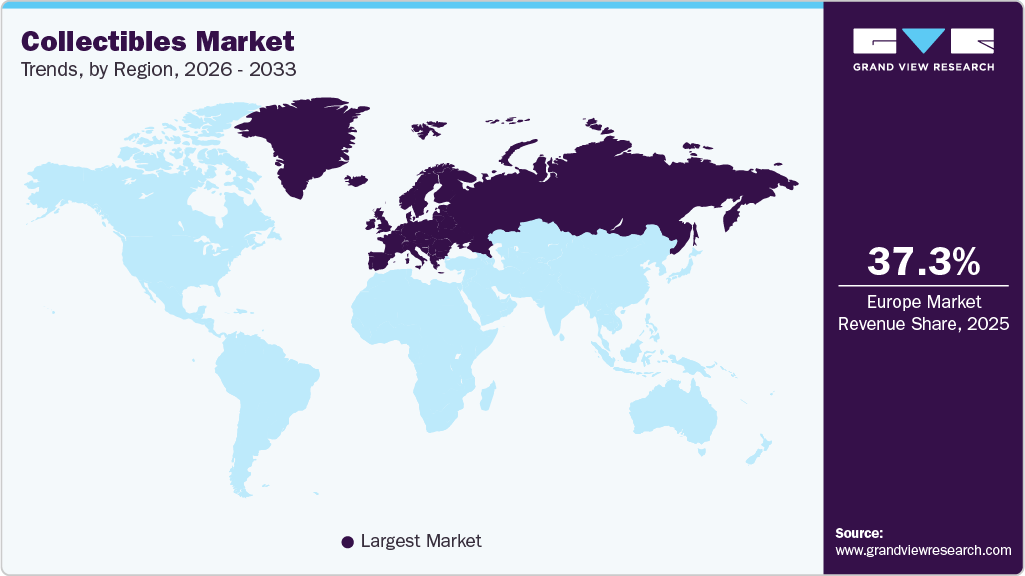
The Europe collectibles industry accounted for the largest revenue share of 37.3% in 2025. European antiques have been valued for centuries, with their unique and rare appeal developing over different historical periods. The region has a rich cultural and colonial heritage, contributing to the diverse market for collectibles. Collectors are drawn to this rarity, and in recent years, antique sales have risen due to various factors such as tourism, culture, and sports. For example, in 2024, Poland’s art and antiques market generated USD 160.1 million in sales, of which USD 98.4 million came from auctions.
Rare cultural treasures, historic manuscripts, World War artifacts, and pre- and post-colonial era heritage have always drawn strong interest from collectors worldwide. In 2024, the original watercolor artwork for the cover of Harry Potter and the Philosopher's Stone sold for a remarkable USD 1.92 million. In the same year, a nearly 1,800-year-old manuscript billed as the world’s oldest book in private hands and the earliest Christian liturgical book was sold for USD 3.9 million at Christie’s in London. Such rare pop and culture items continue to attract collectors from all over the world. Thus, the demand for such rare and valuable collectibles drives the market demand.
The collectibles market in the UK is projected to reach USD 42.79 billion in 2033. The UK’s collectibles landscape is maturing with strong earnings from auction houses like Sotheby’s and Christie’s and vibrant pop culture segments such as trading cards, blind-box toys, and limited-edition figures. Adult collectors (“kidults”) are a key growth driver, with social media and nostalgic fandom for franchises boosting engagement across categories. Events such as expos and comic conventions have helped mainstream interest, while online marketplaces support broader accessibility. Economic pressures have shifted some demand toward affordable collectibles, yet premium items still attract seasoned collectors. Brexit-related logistics have reshaped cross-border trade but haven’t dampened the overall upward market trajectory.
The Germany collectibles market was valued at USD 24.20 billion in 2025. Germany’s market reflects a blend of historical appreciation and contemporary enthusiasm, with strong demand for precision-made antiques, militaria, and vintage coins, complemented by pop culture segments such as trading cards and figures. Germany is set to register some of the highest growth rates in the European collectibles landscape, underpinned by robust collector communities and sophisticated online dealer networks. Digital auctions and specialty fairs have increased liquidity for rare items, while domestic cultural heritage campaigns help sustain interest in traditional categories. Unlike more volatile art markets, Germany’s collectibles show stable consumer confidence and steady institutional participation.
The collectibles market in France is set to expand at a CAGR of 7.1% from 2026 to 2033. France’s market leans heavily on luxury and cultural heritage, with fine art, vintage fashion pieces, and rare wine memorabilia capturing high-value sales among both domestic and international buyers. French galleries and auction houses remain foundational, supported by regulatory and institutional efforts to nurture the art and collectibles spaces. Interest in French historical artifacts and decorative arts drives a significant portion of revenue, while trading cards and comic collections are emerging double-digit niches. There’s also growing participation from younger collectors via online marketplaces and curated pop culture events. The appetite for collectibles as both investment and cultural expression sustains France’s relevance in the broader European market.
Key Collectibles Company Insights
The global collectibles market includes a mix of established brands and emerging players, with major companies proactively adapting to changing consumer preferences and expanding their product offerings to strengthen their market position.
-
Funko, Inc. is a leading collectible company known for its Funko Pop! vinyl figures. Headquartered in Everett, Washington, Funko has gained significant popularity through its extensive licenses with major franchises, including Marvel, Star Wars, Disney, and DC Comics. The company operates a diverse range of collectibles, including action figures, plush toys, and trading cards, catering to both retail and online segments. Funko has expanded its presence worldwide with its products available in over 40 countries, capitalizing on the growing demand for pop culture and nostalgia-driven collectibles.
-
The Pokémon Company International is a major player in the global collectibles industry, particularly through its highly successful Pokémon Trading Card Game (TCG). Headquartered in Bellevue, Washington, the company has transformed the Pokémon brand into a multibillion-dollar franchise with collectibles spanning toys, games, and apparel. Pokémon TCG has become a global phenomenon with competitive events and high-value trading card sales. The company is recognized for its ability to continuously innovate across the gaming and collectibles industries while leveraging its extensive intellectual property.
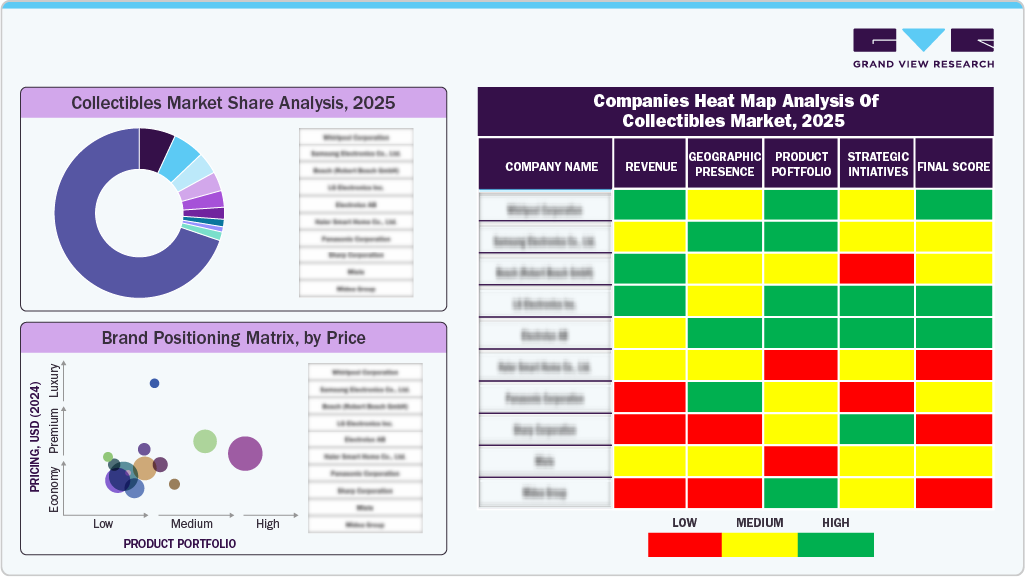
Key Collectibles Companies:
The following key companies have been profiled for this study on the collectibles market.
- Sotheby’s
- Christie’s International plc
- Hasbro, Inc.
- Heritage Auctions, Inc.
- Funko, Inc.
- The Upper Deck Company, LLC
- Lelands, Inc.
- Stanley Gibbons Group plc.
- ComicLink Corporation
- Hake’s Americana & Collectibles, Inc.
Recent Developments
-
In February 2026, Agoro introduced a new collection of blind-box collectibles made from pure silver and gold. This launch was designed to expand beyond traditional collectible coins into a format familiar to modern collectors, and the positive response, including fast sellouts and strong fan and retail enthusiasm, was encouraging.
-
In February 2026, Fanatics signed an exclusive multi-year partnership with David Beckham to produce new soccer trading cards and collectibles featuring his autographs and memorabilia. The company announced that Beckham’s signed cards, relics, and special inserts appeared in upcoming releases, starting with the Topps Premier League Chrome collection. This deal replaced his earlier agreement with Panini Group and strengthened Fanatics’ push into global soccer collectibles.
-
In January 2026, Cloudco Entertainment launched a new wave of global toy and collectible collaborations for the Care Bears brand, slated for 2026, partnering with companies such as Wow! Stuff, PMI Collectibles, ZURU, and Ravensburger, alongside existing partners like Basic Fun!, Simba, Headstart, and Ruz, to expand play patterns and product formats; the new launches included quirky plush reinterpretations with Fuggler, interactive puppetronics with shareable features, expanded collectible mini figures and blind-box items, as well as puzzles and creative sets.
-
In December 2025, Rolling Stone partnered with Keepsake Trading Cards to launch the 2025 Rolling Stone Bob Marley Keepsake Premiere Collection, a limited-edition collectible trading card set that honored the life and legacy of reggae legend Bob Marley with 250 uniquely crafted cards inspired by iconic magazine covers.
-
In August 2025, Sotheby’s launched its inaugural Abu Dhabi Collectors' Week, marking a strategic expansion into the Middle East. Scheduled from December 2-5 at the St. Regis Saadiyat Island Resort, the event will feature high-end auctions of automobiles, fine jewelry, rare watches, and real estate. Complementing the sales, a museum-quality art exhibition will showcase works from Old Masters to contemporary artists. Held in partnership with the Abu Dhabi Investment Office (ADIO), this initiative reinforces Sotheby’s presence in a growing luxury and collectibles market while supporting Abu Dhabi’s vision as a global cultural hub.
-
In February 2025, Funko partnered with the NBA to launch a new line of personalized Pop! Yourself collectibles featuring the official logos of all 30 NBA teams. The collaboration allows fans to design vinyl figures of themselves or loved ones dressed in team-branded outfits, complete with accessories such as a basketball or trophy, and packaged in exclusive NBA-themed boxes. The launch took place during NBA All-Star 2025 in the San Francisco Bay Area, where Funko hosted a Pop! Yourself an NBA FanCave at the NBA Crossover event. This initiative strengthens Funko’s licensed NBA product range and offers fans a more personal way to connect with basketball culture.
Collectibles Market Report Scope
Report Attribute
Details
Market revenue in 2026
USD 335.73 billion
Revenue forecast in 2033
USD 535.50 billion
Growth rate
CAGR of 6.9% from 2026 to 2033
Actuals
2021 - 2025
Forecast period
2026 - 2033
Quantitative units
Revenue in USD million/billion and CAGR from 2026 to 2033
Report coverage
Revenue forecast, company ranking, competitive landscape, growth factors, and trends
Segments covered
Category, type, region
Regional scope
North America; Europe; Asia Pacific; Central & South America; the Middle East & Africa
Country scope
U.S.; Canada; Mexico; Germany; UK; France; Italy; Spain; Japan; China; India; South Korea; Brazil; Argentina; South Africa; Saudi Arabia
Key companies profiled
Sotheby’s; Christie’s International plc; Hasbro, Inc.; Heritage Auctions, Inc.; Funko, Inc.; The Upper Deck Company, LLC; Lelands, Inc.; Stanley Gibbons Group plc.; ComicLink Corporation; Hake’s Americana & Collectibles, Inc.
Customization
Free report customization (equivalent up to 8 analysts working days) with purchase. Addition or alteration to country, regional & segment scope
Pricing and purchase options
Avail customized purchase options to meet your exact research needs. Explore purchase options
Global Collectibles Market Report Segmentation
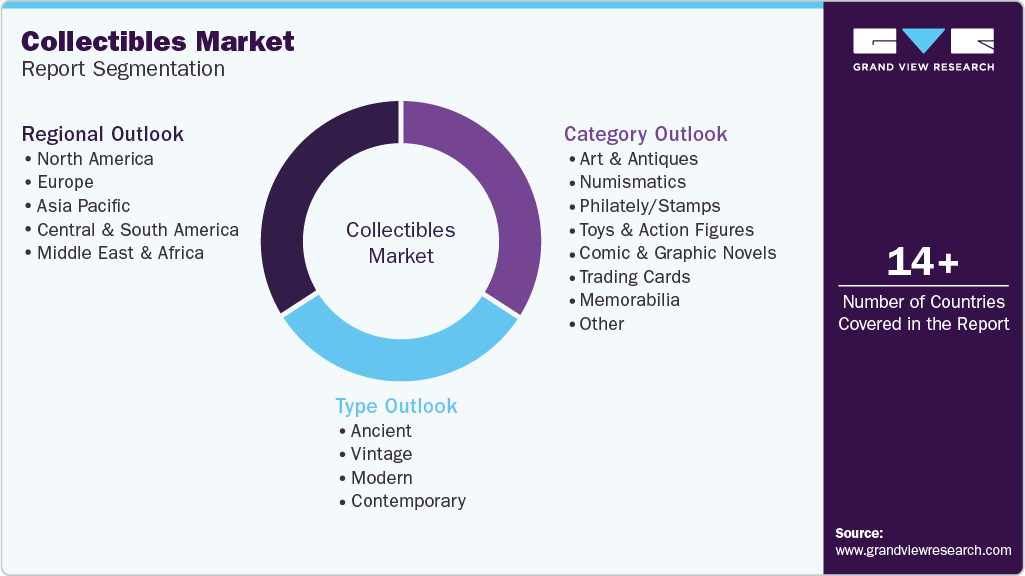
This report forecasts revenue growth at the global, regional, and country levels and provides an analysis of the latest industry trends and opportunities in each of the sub-segments from 2021 to 2033. For this study, Grand View Research has segmented the global collectibles market report based on category, type, and region:
-
Category Outlook (Revenue, USD Million, 2021 - 2033)
-
Art & Antiques
-
Numismatics
-
Philately/Stamps
-
Toys & Action Figures
-
Comic & Graphic Novels
-
Trading Cards
-
Memorabilia
-
Other
-
-
Type Outlook (Revenue, USD Million, 2021 - 2033)
-
Ancient
-
Vintage
-
Modern
-
Contemporary
-
-
Regional Outlook (Revenue, USD Million, 2021 - 2033)
-
North America
-
U.S.
-
Canada
-
Mexico
-
-
Europe
-
UK
-
Germany
-
France
-
Italy
-
Spain
-
-
Asia Pacific
-
Japan
-
China
-
India
-
South Korea
-
-
Central & South America
-
Brazil
-
Argentina
-
-
Middle East & Africa
-
South Africa
-
Saudi Arabia
-
-
Frequently Asked Questions About This Report
b. Europe dominated the collectibles market with a share of over 37.43% in 2024. The growth of the regional market is mainly driven by its rich cultural heritage, high concentration of historical artifacts, and strong tradition of art and antiques collecting. The region's well-established auction houses and museums attract significant interest and investment, contributing to high-value transactions.
b. Some of the key players operating in the collectibles market include Heritage Auctions, Inc., Funko, Inc., Hasbro, Inc., Christie's International plc, Sotheby's, Hake's Americana & Collectibles, Inc., Lelands, Inc., ComicLink Corporation, The Upper Deck Company, LLC, and Stanley Gibbons Group plc.
b. Key factors that are driving the collectibles market growth include rising in nostalgia and emotional connection, technological advancements, social media influence, cultural shifts and changing consumer preferences.
b. The global collectibles market was estimated at USD 306.44 billion in 2024 and is expected to reach USD 320.30 billion in 2025.
b. The global collectibles market is expected to grow at a compound annual growth rate of 6.6% from 2025 to 2033 to reach USD 535.50 billion by 2033.


Share this report with your colleague or friend.
Need a Tailored Report?
Customize this report to your needs — add regions, segments, or data points, with 20% free customization.


ISO 9001:2015 & 27001:2022 Certified
We are GDPR and CCPA compliant! Your transaction & personal information is safe and secure. For more details, please read our privacy policy.
Trusted market insights - try a free sample
See how our reports are structured and why industry leaders rely on Grand View Research. Get a free sample or ask us to tailor this report to your needs.












