
- Home
- »
- Homecare & Decor
- »
-
Christmas Decorative Products Market Size Report, 2033GVR Report cover
![Christmas Decorative Products Market Size, Share & Trends Report]()
Christmas Decorative Products Market (2026 - 2033) Size, Share & Trends Analysis Report By Product (Christmas Trees, Lights, Ornaments), By End Use (Residential, Commercial), By Distribution Channel (Offline, Online), By Region, And Segment Forecasts
- Report ID: GVR-4-68040-851-7
- Number of Report Pages: 100
- Format: PDF
- Historical Range: 2021 - 2025
- Forecast Period: 2026 - 2033
- Industry: Consumer Goods
- Report Summary
- Table of Contents
- Segmentation
- Methodology
- Download FREE Sample
-
 Download Sample Report
Christmas Decorative Products Market Summary
The global Christmas decorative products market size was valued at USD 12.68 billion in 2025 and is projected to reach USD 19.36 billion by 2033, growing at a CAGR of 5.5% from 2026 to 2033. The festive cheer majorly drives the market, celebrated with a wide range of home decorations, including lighting, ornaments, artificial trees, wreaths, garlands, and tabletop accents that brighten seasonal celebrations.
Key Market Trends & Insights
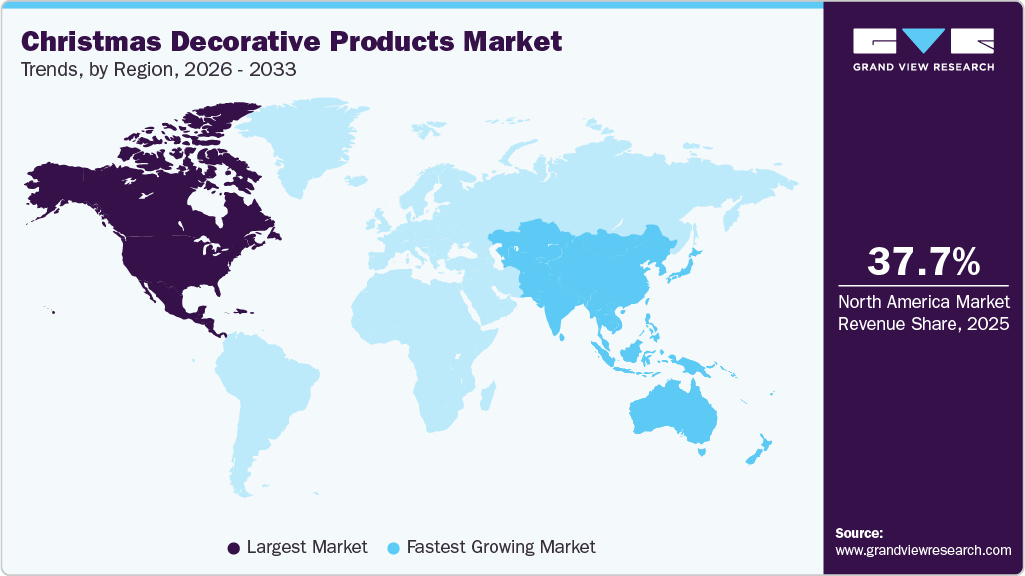
- The North America Christmas decorative products market held the largest revenue share of 37.7% in 2025.
- By product, the Christmas trees segment dominated the market with a revenue share of 36.5% in 2025.
- The ornaments segment is expected to grow at the fastest CAGR of 7.7% from 2026 to 2033.
- By end use, the residential segment held the highest market share of 67.6% in 2025.
- By distribution channel, the offline segment dominated the Christmas decorative products market in 2025.
Market Size & Forecast
- 2025 Market Size: USD 12.68 Billion
- 2033 Projected Market Size: USD 19.36 Billion
- CAGR (2026-2033): 5.5%
- North America: Largest market in 2025
- Asia Pacific: Fastest growing market
The companies combine traditions with new styles, creating emotional connections through nostalgic and personalized designs found in homes, stores, and public spaces around the world. The heightened consumer focus on experiential gifting and home ambiance, amplified by social media influences showcasing elaborate displays, alongside expanded e-commerce platforms offering seamless customization, are the key driving forces. Moreover, innovations such as app-controlled smart LED systems enabling synchronized light shows and color transitions; eco-conscious innovations such as biodegradable garlands made from natural fibers and upcycled resins; and laser projection technologies that project animated scenes onto facades for effortless, large-scale outdoor magic are also helping the market to grow.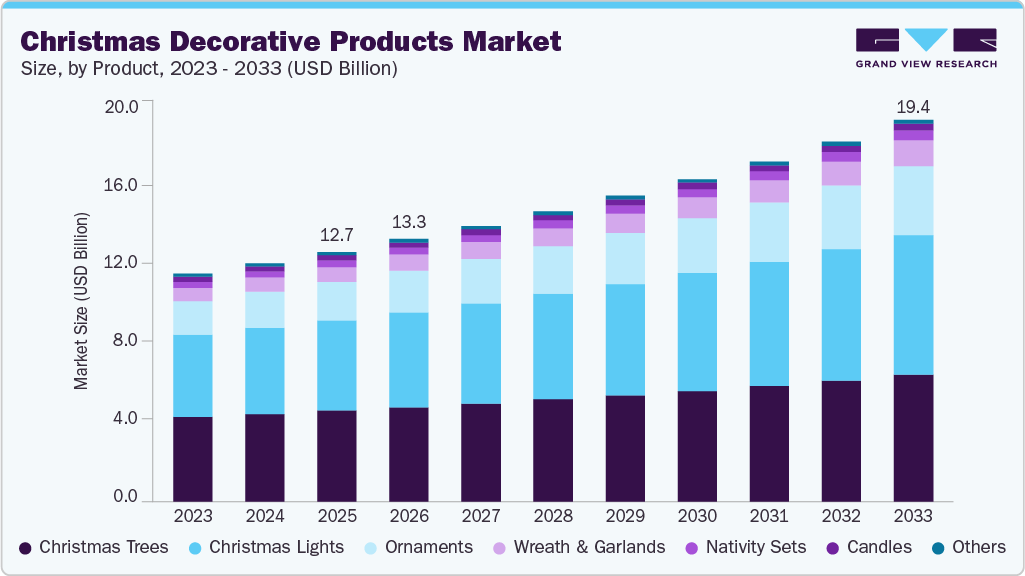
North America and Europe dominate the landscape, by deep-rooted holiday customs and affluent consumer bases that favor premium themed decorations for residential and commercial settings. Asia Pacific and Central & South America emerge as high-potential regions, where rapid urbanization and Western cultural permeation spark growing enthusiasm for festive adornments. For instance, in October 2025, Marks & Spencer, a globally recognized brand, partnered with designer Kelly Hoppen to launch a premium collection of neutral-toned tableware and seasonal decorations. This strategic collaboration aims to boost brand visibility and increase consumer awareness of sophisticated Christmas decorative products in the Asia Pacific region and beyond. Moreover, the Middle East and Africa present niche opportunities amid rising expatriate communities, though tempered by diverse traditions, collectively painting a picture of expansive global reach.
Consumer Insights
Post pandemic, people buying Christmas decorations are focusing more on a joyful experience, family time, and being together. There is also a growing interest in sustainability and social media trends. Many families with children look for ornaments, lights, and garlands that are associated with holiday nostalgia and family traditions. Christmas decorations help create a warm, cozy home environment. Additionally, vintage-style and personalized decorations, including custom-engraved baubles or family mementos, are gaining popularity with older generations owing to their emotional connection and lasting quality.
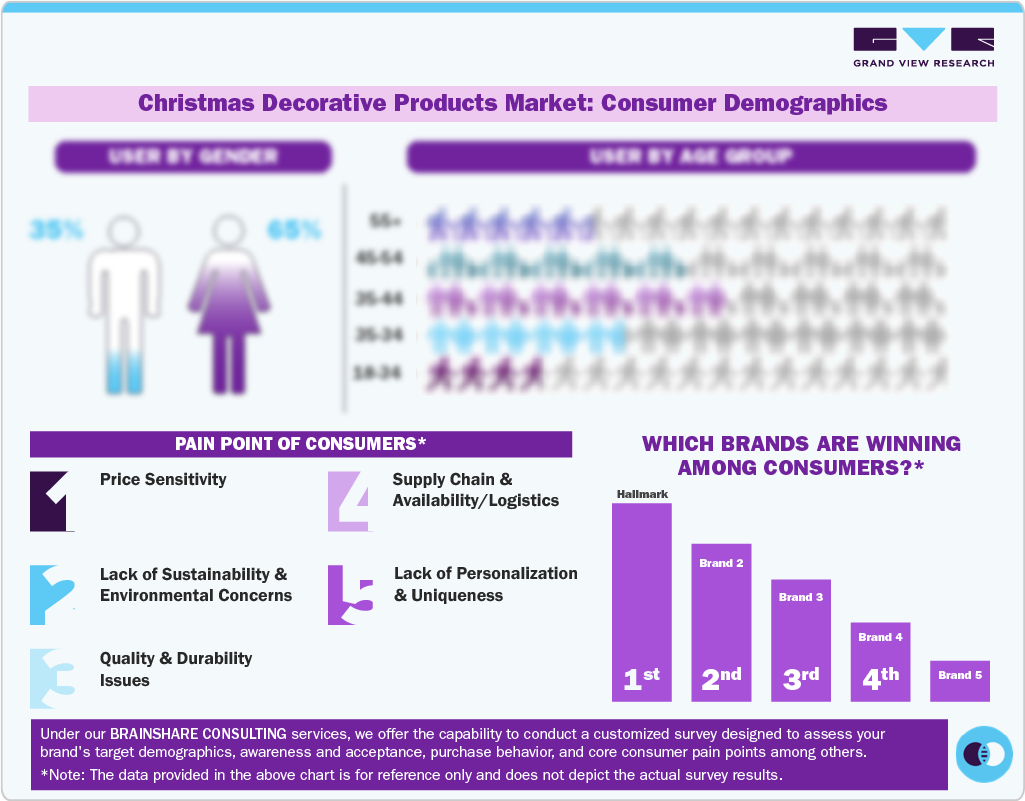
New trends such as layering of decorations, use of bold jewel colors including emerald, sapphire, and ruby, and adding fun touches such as big bows, animal shapes, and contemporary colors such as pink and teal are becoming more popular with younger shoppers. Millennials and Gen Z, ages 18 to 40, are inclined towards playful, eye-catching products. They also prefer multi-colored LED lights, eco-friendly materials such as reclaimed wood and dried plants, and cheerful decorations such as figurines or goth-inspired decorative pieces to help reduce holiday stress and make festive gatherings more fun responsibly.
People around the world prefer to procure Christmas decorations online, looking for early discounts, personalization, shopping recommendations, customer reviews, and fast shipping. The increase in online shopping shows that buyers are looking for flexible, eco-friendly products they can mix and match. Decorations that can be used in different ways, such as garlands that fit several rooms or themed trees for small gatherings, are gaining momentum. This trend is especially strong in cities and suburbs, where shoppers want good value and decorations that last.
Product Insights
The Christmas trees segment held the largest market revenue share of 36.5% in 2025. This segment is the foundation of the decorative products market, representing holiday traditions while also fitting into modern lifestyles with both natural and artificial alternatives. Christmas trees hold a key role in holiday decorating, with artificial trees especially popular for their convenience, ability to be reused, and realistic look. Consumers from strong cultural faiths are more inclined towards detailed home displays, highlighting their importance. Festive traditions turn homes into festive spaces, and factors including higher disposable incomes, consistently growing urban population, and the growth of online shopping help drive demand.
Sustainability concerns further propel innovation, as eco-conscious buyers favor low-maintenance artificial alternatives over harvested naturals, aligning with broader environmental values. For instance, in October 2025, Balsam Hill partnered with Braskem to introduce the first bio-based polyethylene Christmas trees, crafted using plant-derived materials that now make up over 95% of their product lineup to significantly reduce carbon emissions. Such innovative steps mark a major stride toward sustainable holiday decor, blending environmental responsibility with premium quality design.
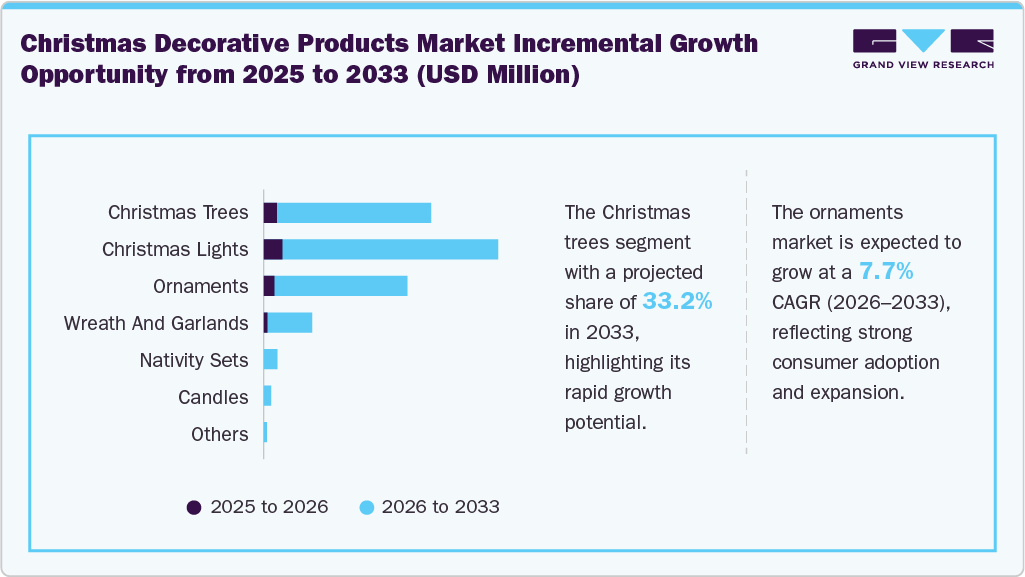
The ornaments segment is projected to grow at the fastest CAGR of 7.7% over the forecast period. This segment offers a wide range of designs, from classic glass ornaments to themed keepsakes, allowing consumers to create tree displays that reflect their family stories and current trends. The segment is growing at a brisk pace as people look for personalized touches among mass products. Ornaments are also seen as meaningful keepsakes that families pass down. In October 2025, YAMATO Co, Ltd. launched the limited-edition "Glass Deco Christmas Ornament Kit" and "Glass Deco Ornament Plate Pack for Christmas," which are sold at major retailers and online in Japan. These easy-to-use kits include 12 themed ornaments and 10 bright colors, including glitter, and meet the rising demand for DIY Christmas decorations.
Availability on e-commerce platforms, coupled with better spending capacities, makes it easier for people to buy trending products. In addition, social media trends help to bring in new cultural designs that attract more buyers. Urban millennials and Gen Z are inclined to buy ornaments that offer a mix of nostalgia with bold, eye-catching looks, so these decorations are popular beyond just the holiday season.
End Use Insights
The residential segment dominated the market in 2025. People prefer warm, welcoming spaces to gather with friends and family during the holidays. Many people are choosing sustainable and customizable decorations that match their lifestyles, and online shopping has made it easier to find more options. As cities expand along with the rising disposable incomes, more homeowners are picking long-lasting, eco-friendly products such as artificial trees and LED garlands to use year after year. Social media is also encouraging people, especially millennials and Gen Z, to try themed decorations that mix vintage and modern styles, making holiday decor a form of self-expression. According to the National Retail Federation consumer survey for 2025, people plan to spend an average of USD 890 each on holiday gifts, food, and decorations during the festive season. This is the second-highest amount on record, despite current economic dynamics.
The commercial segment is expected to grow at the fastest CAGR over the forecast period. Stores, hotels, and public spaces want eye-catching displays to attract visitors and strengthen their brands during the holidays. With the consistent rise in experiential marketing, immersive decorations are turning ordinary places into festive destinations, drawing more consumers and boosting sales. Urban infrastructure in developing economies is expanding, and thus, the demand for large, durable decorations is increasing, with a focus on sustainability, helping companies meet their social responsibility goals. With global tourism recovering, businesses are choosing flexible, modular designs that incorporate celebrations from different cultures, which is supporting growth as the economy improves. In 2024, Dubai Mall, managed by Emaar Properties, welcomed 111 million visitors, a 6% increase from 2023, making it the world's most visited destination for the second year in a row. With more visitors and higher retail activity, the commercial segment is experiencing strong growth, encouraging greater demand for premium Christmas decorations and festive retail experiences.
Distribution Channel Insights
The offline segment accounted for the largest revenue share of 67.3% in 2025. Shoppers enjoy visiting traditional stores, holiday shops, and pop-up markets to procure ornaments, wreaths, and lights in person. This hands-on experience gives them instant satisfaction and a chance to discover new items at festive displays. Many families prefer brick-and-mortar stores, allowing them to check the quality and size of decorations before buying, as per their preferences. Experiential retail, such as in-store events and themed displays, helps in experiencing nostalgia and builds a sense of community. Local stores provide purchase recommendations and are much more accessible during the busy holiday season. Big retailers such as Home Depot use interactive demo areas to keep shoppers engaged by making shopping more entertaining.
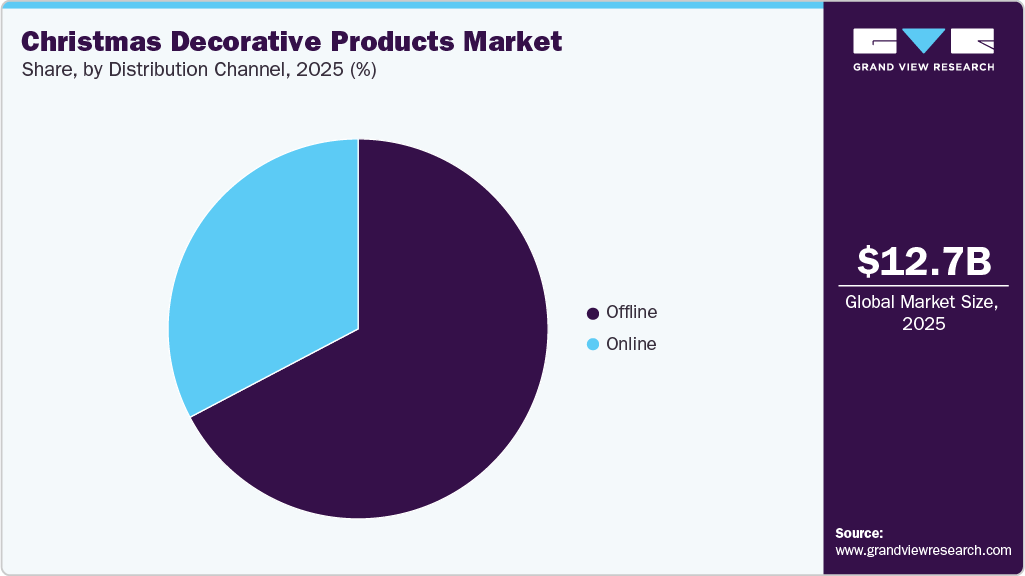
The online retail segment is projected to grow at the fastest CAGR over the forecast period, driven by rising consumer preference for convenient and at-home beverage options. E-commerce platforms such as Amazon and Wayfair dominate this space, enabling seamless browsing of vast inventories from smart LEDs to eco-friendly garlands, with virtual previews and rapid delivery fueling impulse buys during extended shopping windows. This surge reflects a paradigm shift toward tech-enabled festivity, where consumers curate their expected displays from home, prioritizing convenience amid busy lifestyles and global supply chains. According to a 2024 survey by the National Federation of Retail, 57% of U.S. consumers plan to make their holiday purchases through online channels, reflecting the continued shift toward digital shopping during the festive season.
Smartphone-friendly websites, AI recommendations, and augmented reality tools allow shoppers to perceive how decorations will look at home. These features attract younger buyers, including Gen Z, who care about sustainability and personalizing their spaces. Subscription boxes for seasonal decor also help make online shopping a regular habit instead of a one-time event.
Regional Insights
The North America Christmas decorative products market accounted for the largest revenue share of 37.7% in 2025. Strong cultural traditions around festive celebrations shape this region’s market. Families and communities buy decorations to create joyful, welcoming spaces, supported by good retail choices and seasonal promotions. Many consumers also care about sustainability, choosing eco-friendly materials, including recycled plastics and energy-saving LEDs. As more people move to cities, there is a rising demand for compact, eye-catching decorations that help turn apartments into festive homes. Smart home technology is making decorations more interactive, with features such as synchronized lighting and automated setups that improve the experience. According to a recent 2025 survey by the National Retail Federation, 91% of consumers plan to celebrate winter holidays such as Christmas, Kwanzaa, and Hanukkah. This high participation is expected to increase demand for Christmas decorations and other holiday-themed products.
U.S. Christmas Decorative Products Market Trends
The U.S. led the North American Christmas decorative products market in 2025. This market is shaped by strong cultural traditions and high consumer interest, as more households look to create welcoming holiday spaces. According to the Federal Reserve Bank of St. Louis, U.S. disposable personal income rose from USD 21,992.2 billion in August 2024 to USD 23,033.0 billion in August 2025. As incomes grow and lifestyles change, people are buying more products like artificial trees, LED lights, wreaths, and themed ornaments. These items combine nostalgia with modern touches, attracting both home and business buyers. The industry is also focusing on innovation, especially in sustainable materials like recyclable plastics and energy-saving technology, which matches the growing preference for eco-friendly holiday decor. Competition among major companies is strong, which leads to better quality and lower prices. However, these companies also face challenges like supply chain disruptions, especially since many products are sourced from Asia.
Europe Christmas Decorative Products Market Trends
The Europe Christmas decorative products market is expected to grow at a significant CAGR over the forecast period, as more people are interested in festive traditions that mix old customs with modern ways of living, from the Nordic countries to the Mediterranean. Community celebrations are becoming more popular, and both public and private displays now represent unity and resilience, especially after the pandemic. Online shopping, especially on sites like Amazon EU, is helping people find unique designs that fit different cultural and non-religious tastes. New sustainability rules, such as the EU's Green Deal, are pushing for eco-friendly materials like FSC-certified wood and low-VOC paints. Cities are also adding more festive lighting to public spaces, so the market is growing beyond just homes. A Eurostat survey found that 70% of Europeans plan to spend more on decorations in 2025, driven by optimism and cultural pride. These changes are helping Europe become a leader in the global festive market.
Asia Pacific Christmas Decorative Products Market Trends
The Christmas decorations market in the Asia Pacific is expected to grow at the fastest CAGR over the forecast period. In big cities, including Singapore and Tokyo, the market is strong owing to immigrant communities and trends led by young people. Christmas is becoming less about shopping and more about celebrating together and exchanging gifts. Rapid urban growth and a growing middle class are driving demand for colorful, space-saving decorations that fit high-rise homes. Online platforms like Alibaba and Shopee make it easier to buy themed kits with Asian designs. Blending cultures has also led to new designs, like Diwali-Christmas garlands, which attract a wider range of customers.
Central & South America Christmas Decorative Products Market Trends
The Central & South America Christmas decorative products experienced notable growth in 2025. A blend of colonial traditions and local creativity shapes family-centered celebrations in the region. Traditions such as posadas and nacimientos use decorations to unite communities and add color to seasonal stories. Urbanization encourages creative decorating in busy households, while remittances boost spending on festive goods. Online platforms like Mercado Libre make premium imports easier to find, and local fairs showcase handmade ornaments inspired by piñatas.
Middle East & Africa Christmas Decorative Products Market Trends
In cities such as Dubai and Johannesburg, global diasporas are boosting the market by mixing desert settings with festive evergreens and multicultural designs. Expatriate remittances and tourism help fund large displays in hotels and malls, and local youth use the holidays to express themselves. E-commerce sites like Jumia make imported decorations more accessible and offer regional crafts, including beaded wreaths from Kenyan artisans. As the middle class grows in Gulf states, demand is rising for gold-accented ornaments that symbolize abundance.
Key Christmas Decorative Products Company Insights
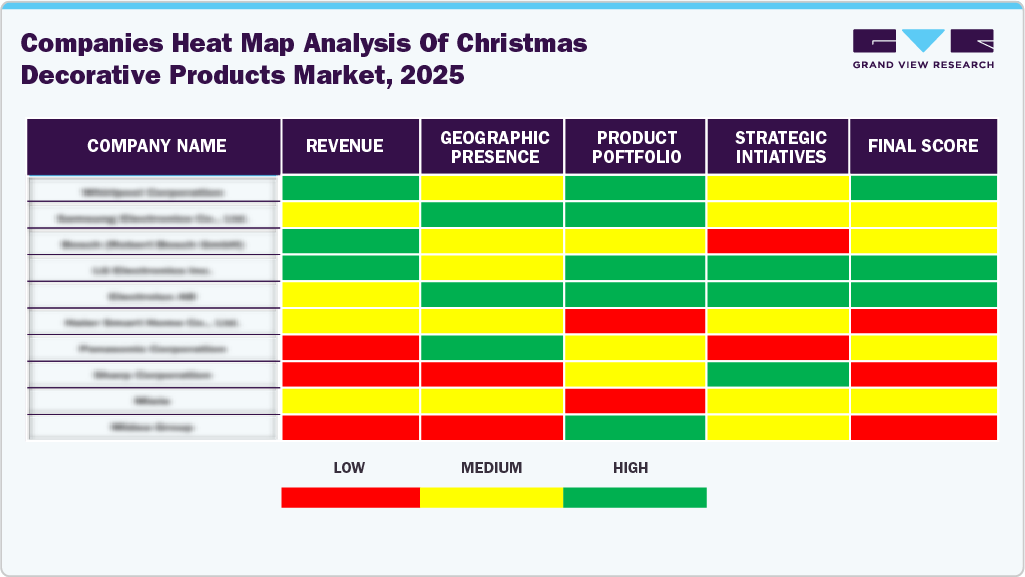
The global Christmas decorative products market is very competitive. Top companies are introducing new products to meet changing consumer tastes, such as sustainable materials, personalized designs, and smart technology. Working with e-commerce sites, retailers, and tech firms helps brands reach more customers and boost visibility. Recent products include eco-friendly ornaments, LED lights, and DIY kits, which appeal to environmentally conscious and tech-savvy buyers. These items are gaining popularity in both homes and businesses.
-
Hallmarkis a leading global provider of greeting cards, gifts, and home decor products worldwide. In the Christmas decorative products market, the company has been one of the pioneers since launching its Keepsake Ornament line in 1973, offering innovative, collectible designs that enhance holiday traditions and drive seasonal consumer engagement.
-
BALSAM HILL was founded in 2006 and is a California-based online retailer that specializes in premium artificial Christmas trees, wreaths, garlands, ornaments, and holiday décor, renowned for their lifelike realism and innovative features such as pre-strung LED lights.
Key Christmas Decorative Products Companies:
The following key companies have been profiled for this study on the Christmas decorative products market.
- Hallmark
- BALSAM HILL
- Roman Inc.
- National Tree Company
- Kurt S. Adler
- Department 56
- Old World Christmas
- IKEA
- Kaemingk
- Gisela Graham Limited
Recent Developments
-
In October 2025, Balsam Hill strengthened its sustainability efforts in the Christmas decorative products market with the launch of its reNEW commitment, transitioning all True Needle technology trees to 30% GRS-certified recycled plastic or 95% plant-based plastic. The company is also piloting a Christmas tree recycling program in Dublin, Ireland, and expanding light recycling initiatives in the U.S. These steps align with its long-term goal of creating reusable, recyclable, and eco-friendly artificial trees.
-
In January 2024, Plenitude, Italy's leading green energy provider, partnered with Pavegen to create a sustainable Christmas Wonderland in Milan's Piazza Duca d'Aosta. Featuring an 18-meter-tall Christmas tree powered by Pavegen's kinetic tiles. Visitors generated energy through interactive games, illuminating the tree and enhancing festive engagement. The event, which included a skating rink and charitable initiatives, highlighted Plenitude's net-zero emissions goal by 2040. This innovative approach showcased eco-friendly Christmas decorative solutions, blending sustainability with holiday aesthetics.
Christmas Decorative Products Market Report Scope
Report Attribute
Details
Market size value in 2026
USD 13.32 billion
Revenue forecast in 2033
USD 19.36 billion
Growth rate
CAGR of 5.5% from 2026 to 2033
Actuals
2021 - 2025
Forecast period
2026 - 2033
Quantitative units
Revenue in USD million and CAGR from 2026 to 2033
Report coverage
Revenue forecast, company ranking, competitive landscape, growth factors, trends
Segments covered
Product, end use, distribution channel, and region
Regional scope
North America, Europe, Asia-Pacific, Central & South America, Middle East & Africa
Country scope
U.S., Canada, Mexico, Germany, UK, France, Italy, Spain, China, India, Japan, South Korea, Australia & New Zealand, Southeast Asia, Brazil, Argentina, Saudi Arabia, South Africa, UAE
Key company profiled
Hallmark, BALSAM HILL, Roman Inc., National Tree Company, Kurt S. Adler, Department 56, Old World Christmas, IKEA, Kaemingk, Gisela Graham Limited
Customization scope
Free report customization (equivalent to 8 analysts working days) with purchase. Addition or alteration to country, regional & segment scope.
Pricing and purchase options
Avail customized purchase options to meet your exact research needs. Explore purchase options
Global Christmas Decorative Products Market Report Segmentation
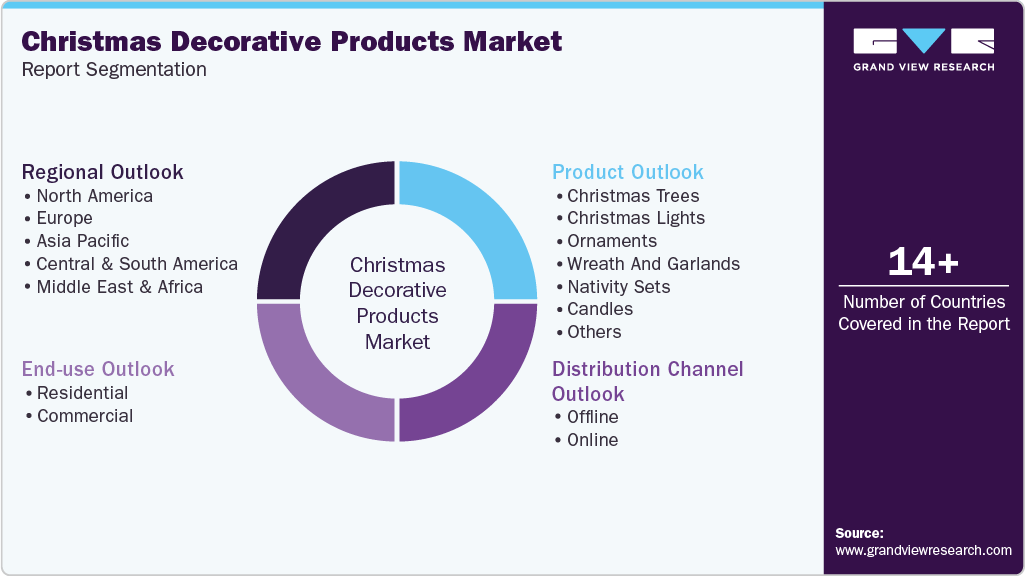
This report forecasts revenue growth at the global, regional, and country levels and provides an analysis of the latest industry trends and opportunities in each of the sub-segments from 2021 to 2033. For the purpose of this study, Grand View Research has segmented the global Christmas decorative products market report on the basis of product, end use, distribution channel, and region:
-
Product Outlook (Revenue, USD Million, 2021 - 2033)
-
Christmas Trees
-
Artificial
-
Natural
-
-
Christmas Lights
-
Ornaments
-
Wreath and Garlands
-
Nativity Sets
-
Candles
-
Others
-
-
End Use Outlook (Revenue, USD Million, 2021 - 2033)
-
Residential
-
Commercial
-
Restaurants & Hotels
-
Malls
-
Corporate Offices
-
Others
-
-
-
Distribution Channel Outlook (Revenue, USD Million, 2021 - 2033)
-
Offline
-
Department Stores
-
Specialty Stores
-
Supermarkets and Hypermarkets
-
-
Online
-
-
Regional Outlook (Revenue, USD Million, 2021 - 2033)
-
North America
-
U.S.
-
Canada
-
Mexico
-
-
Europe
-
Germany
-
U.K.
-
France
-
Italy
-
Spain
-
-
Asia Pacific
-
China
-
India
-
Japan
-
South Korea
-
Australia & New Zealand
-
Southeast Asia
-
-
Central & South America
-
Brazil
-
Argentina
-
-
Middle East & Africa
-
Saudi Arabia
-
South Africa
-
UAE
-
-
Frequently Asked Questions About This Report
b. The Christmas decorative products market was estimated at USD 12.68 billion in 2025 and is expected to reach USD 13.32 billion in 2026.
b. The Christmas decorative products market is expected to grow at a compound annual growth rate of 5.5% from 2026 to 2033 to reach USD 19.36 billion by 2033.
b. The Christmas trees segment held the largest market revenue share of 36.5% in 2025. This segment is the foundation of the decorative products market, representing holiday traditions while also fitting into modern lifestyles with both natural and artificial alternatives.
b. Some of the key players operating in the Christmas decorative products market include Hallmark, BALSAM HILL, Roman Inc., National Tree Company, Kurt S. Adler, Department 56, Old World Christmas, IKEA, Kaemingk, and Gisela Graham Limited.
b. The heightened consumer focus on experiential gifting and home ambiance, amplified by social media influences showcasing elaborate displays, alongside expanded e-commerce platforms offering seamless customization, are the key driving forces.


Share this report with your colleague or friend.
Need a Tailored Report?
Customize this report to your needs — add regions, segments, or data points, with 20% free customization.


ISO 9001:2015 & 27001:2022 Certified
We are GDPR and CCPA compliant! Your transaction & personal information is safe and secure. For more details, please read our privacy policy.
Trusted market insights - try a free sample
See how our reports are structured and why industry leaders rely on Grand View Research. Get a free sample or ask us to tailor this report to your needs.












