China Anti-aging Products Market Trends
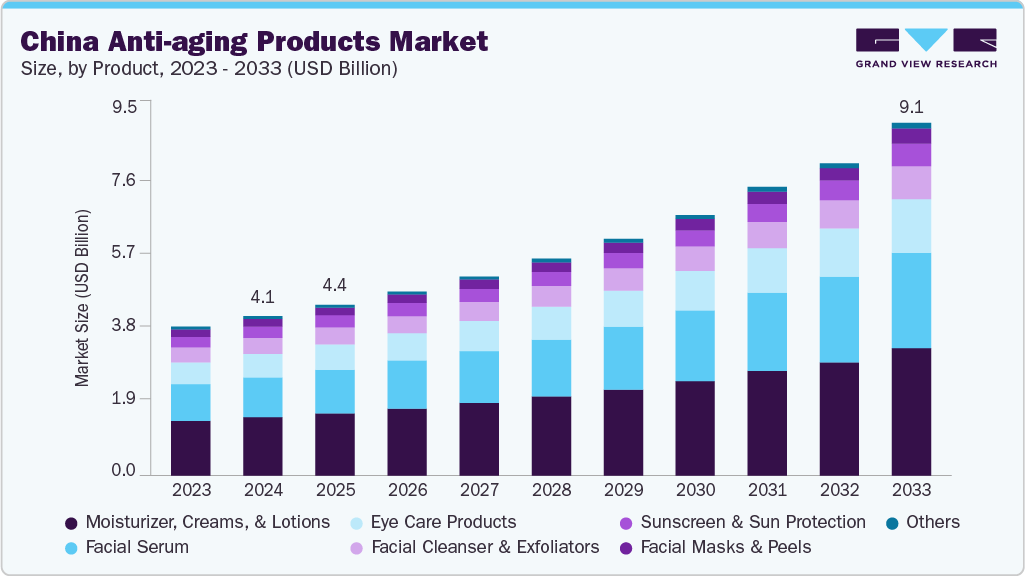
The China anti-aging products market size was estimated at USD 4,102.9 million in 2024 and is expected to reach USD 9,074.0 million by 2033, expanding at a CAGR of 9.5% from 2025 to 2033. The industry is primarily driven by a rapidly aging population, creating strong demand for age-related skincare and wellness solutions. The rising disposable income and a growing middle class fuel consumer spending on premium anti-aging products, particularly in urban areas. Younger generations, especially Gen Z and Millennials, are increasingly embracing preventive skincare from an early age to counteract stress, pollution, and digital exposure. The widespread influence of social media platforms and livestreaming e-commerce further accelerates consumer awareness and product adoption across age groups.
A major trend in China's market is the growing demand for science-backed, ingredient-focused skincare. Consumers, particularly those aged 35 and above, are increasingly knowledgeable about active ingredients and seek products with proven efficacy. Formulations featuring antioxidants, peptides, retinoids, hyaluronic acid, and collagen boosters are especially popular for targeting fine lines, dullness, and skin elasticity. There's also rising interest in advanced biotech ingredients like recombinant collagen and PDRN, which were once exclusive to clinical settings but are now incorporated into premium over-the-counter products.
Integrating Traditional Chinese Medicine (TCM) with modern skincare formulations is a growing trend in the Chinese anti-aging products market. Consumers are increasingly drawn to products that blend cultural heritage with scientific efficacy. Brands like Bayankala and Inoherb lead this movement by incorporating time-honored herbal ingredients, such as ginseng, goji berries, and peach gum collagen, into formulations supported by clinical testing and dermatological research. This fusion appeals to health-conscious consumers who value natural remedies, while still demanding results comparable to Western cosmeceuticals. As a result, TCM-inspired anti-aging products are gaining credibility and market share across mass and premium segments.
Consumer Insights & Surveys
The market is deeply influenced by a variety of factors, from scientifically backed ingredients and brand reputation to sustainability concerns and social influence. Consumers are becoming more demanding and expect transparency and tangible results from the products they purchase. Brands that can balance efficacy, affordability, and sustainable practices stand to gain the most in this competitive and growing beauty & personal care industry.
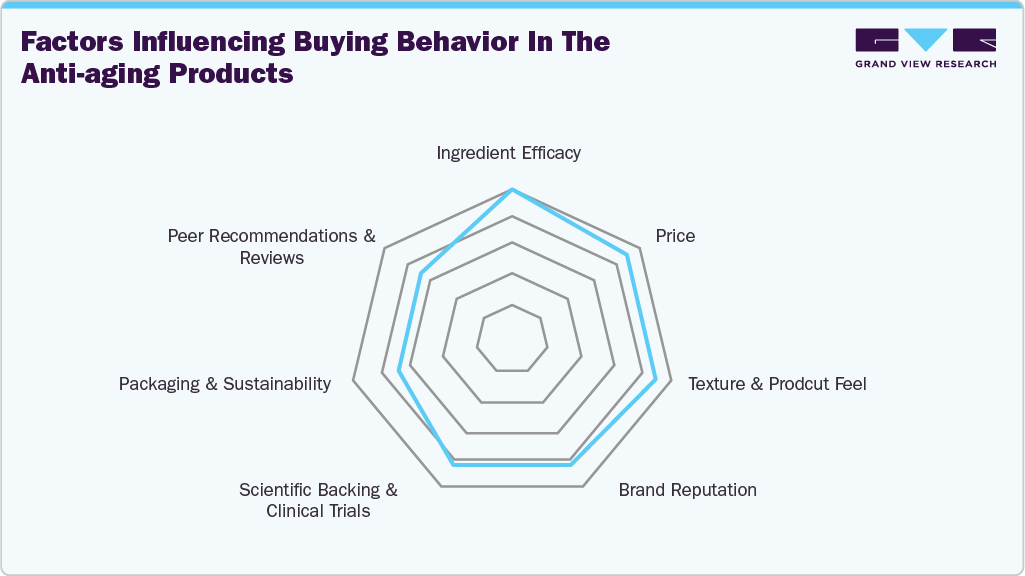
The most critical factor influencing consumer behavior in the market is the efficacy of ingredients. Consumers are becoming highly educated about active ingredients like retinol, hyaluronic acid, peptides, and vitamin C, which are proven to reduce wrinkles, increase skin firmness, and hydrate the skin. According to Grand View Research's analysis, over 80% of consumers read labels and seek products backed by clinical evidence. Price sensitivity is a notable factor influencing consumer decisions in this market. While high-end products with premium pricing appeal to wealthier consumers, the rise of affordable, efficacious options has expanded the market's reach. Budget-conscious consumers increasingly seek mid-range brands that offer affordable yet effective anti-aging products.
Product Insights
Moisturizer, creams, & lotions accounted for the largest revenue share of 36.75% in 2024. With rising pollution levels, prolonged sun exposure, and climate change, individuals are experiencing accelerated skin aging due to oxidative stress and collagen breakdown. Urban populations are more exposed to harsh environmental conditions that contribute to premature aging, making skincare protection a necessity rather than a luxury. As a response, skincare brands have developed advanced anti-aging moisturizers and lotions enriched with antioxidants, SPF, and pollution-fighting ingredients to counteract these external aggressors. Consumers are now prioritizing multi-functional skincare products that hydrate and protect against environmental damage, reinforcing the demand for high-quality anti-aging creams and lotions.
The demand for facial serum is projected to rise at a CAGR of 10.2% from 2025 to 2033. Facial serums are concentrated formulations designed to deliver potent active ingredients deep into the skin. They are particularly effective for targeting fine lines, wrinkles, dullness, and dehydration. The growing demand for personalized skincare has further boosted this segment, as consumers increasingly seek tailored treatments for their unique skin needs. In response, brands have introduced specialized serums addressing various skin types and conditions. Additionally, the rising emphasis on self-care and wellness, amplified by social media and influencer culture, has significantly contributed to the popularity of facial serums, establishing them as an essential component of modern skincare routines.
Distribution Channel Insights
The sale of anti-aging products in China through supermarkets and hypermarkets accounted for the largest revenue share of 30.16% in 2024. One of the main reasons consumers prefer supermarkets for skincare purchases is convenience. The ability to buy beauty products alongside everyday essentials makes shopping more efficient and seamless. Additionally, supermarkets benefit from large-scale purchasing power, offering competitive prices and making skincare more affordable for a wider customer base. This affordability and ease of access attract both cost-conscious shoppers and those looking for quick, hassle-free skincare solutions. To further enhance the shopping experience, supermarkets are investing in improved product displays and specialized sections.
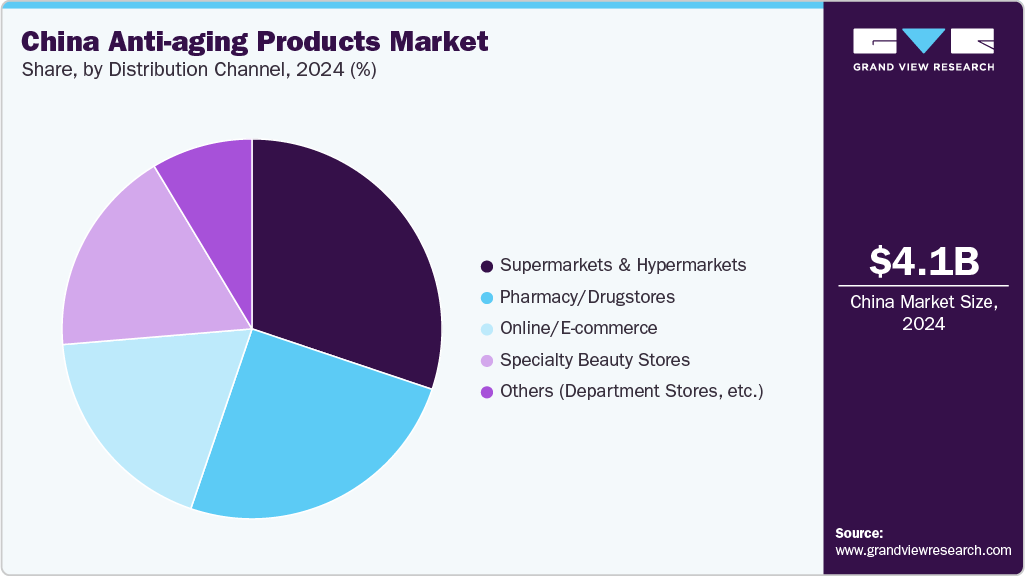
The sale of anti-aging products through online channels is expected to grow at a CAGR of 11.1% from 2025 to 2033. The rise of digitalization has significantly transformed consumer behavior, with many now preferring to browse, compare, and purchase anti-aging products online rather than in physical stores. E-commerce platforms offer a convenient and comprehensive shopping experience, featuring a wide selection of products, detailed information, customer reviews, and competitive pricing. As digital access expands, more consumers turn to online channels for skincare purchases, further driven by targeted digital marketing, influencer endorsements, and social media promotions. This shift has played a key role in accelerating the growth of e-commerce within the cosmetic industry.
Key China Anti-aging Product Company Insights
Key players operating in the China anti-aging products market are undertaking various initiatives to strengthen their presence and increase the reach of their products and services. Strategies such as expansion activities and partnerships are key in propelling the market growth.
Key China Anti-aging Product Companies:
- The Estée Lauder Companies Inc.
- L'Oréal S.A.
- Shiseido Company, Limited
- Beiersdorf AG
- The Procter & Gamble Company
- Amorepacific US, Inc.
- Proya Cosmetics Co.,Ltd
- Pechoin
- Herborist
- The Ordinary
Recent Developments
-
In April 2025, Galderma introduced Sculptra, a regenerative bio stimulator formulated with poly-L-lactic acid, to the Chinese market following its approval by the National Medical Products Administration (NMPA). Designed to correct mid-facial volume loss and contour deficiencies, Sculptra is supported by over 25 years of clinical data, demonstrating its long-standing safety profile and natural-looking results lasting up to two years.
-
In October 2024, BERLANDES, a biotechnology company based in Hangzhou, officially launched its PCCIDINCT2 Ovarian Capsules, an innovative anti-aging supplement designed to support ovarian function and overall reproductive health. Developed in collaboration with international research institutions, the formulation utilizes advanced nanobiotechnology to deliver active ingredients at the cellular level. Key components include antioxidants, inositol-vitamin B9 complex, Neumentix spearmint extract, NADH, and liposomal iron and B-vitamins.
-
In September 2024, Amorepacific introduced its luxury tech-skincare brand, AP Beauty, to mainland China. Building on 32 years of presence in the region, the company aims to strengthen its position through enhanced scientific innovation, localized product development, and the expansion of flagship brands such as Sulwhasoo, Laneige, and Innisfree. The move underscores Amorepacific’s strategy to align with evolving Chinese consumer preferences and growing demand for high-efficacy, science-backed skincare solutions.
China Anti-aging Products Market Report Scope
|
Report Attribute
|
Details
|
|
Market size value in 2025
|
USD 4,403.1 million
|
|
Revenue forecast in 2033
|
USD 9,074.0 million
|
|
Growth rate
|
CAGR of 9.5% from 2025 to 2033
|
|
Actuals
|
2021 - 2024
|
|
Forecast period
|
2025 - 2033
|
|
Quantitative units
|
Revenue in USD million/billion, and CAGR from 2025 to 2033
|
|
Report coverage
|
Revenue forecast, company ranking, competitive landscape, growth factors, and trends
|
|
Segments covered
|
Product, distribution channel
|
|
Country scope
|
China
|
|
Key companies profiled
|
The Estée Lauder Companies Inc.; L'Oréal S.A.; Shiseido Company, Limited; Beiersdorf AG; The Procter & Gamble Company; Amorepacific US, Inc.; Proya Cosmetics Co.,Ltd; Pechoin; Herborist; The Ordinary.
|
|
Customization
|
Free report customization (equivalent up to 8 analysts working days) with purchase. Addition or alteration to country, regional & segment scope.
|
|
Pricing and purchase options
|
Avail customized purchase options to meet your exact research needs. Explore purchase options
|
China Anti-aging Products Market Report Segmentation
This report forecasts revenue growth at the country level and provides an analysis of the latest industry trends and opportunities in each of the sub-segments from 2021 to 2033. For this study, Grand View Research has segmented the China anti-aging products market report by product and distribution channel.
-
Product Outlook (Revenue, USD Million, 2021 - 2033)
-
Facial Serum
-
Moisturizer, Creams, & Lotions
-
Eye Care Products
-
Facial Cleanser & Exfoliators
-
Facial Masks & Peels
-
Sunscreen & Sun Protection
-
Others (Facial Oil, Lip Care Products, etc.)
-
Distribution Channel Outlook (Revenue, USD Million, 2021 - 2033)

 Download Sample Report














