
- Home
- »
- Homecare & Decor
- »
-
Cabinets Market Size, Share & Trends, Industry Report, 2033GVR Report cover
![Cabinets Market Size, Share & Trends Report]()
Cabinets Market (2026 - 2033) Size, Share & Trends Analysis Report By Product (Kitchen Cabinets, Bathroom Cabinets), By Material (Wood, Metal, Plastic/Polymers), By Application (Commercial, Residential), By Type, By Region, And Segment Forecasts
- Report ID: GVR-4-68040-859-3
- Number of Report Pages: 110
- Format: PDF
- Historical Range: 2021 - 2024
- Forecast Period: 2026 - 2033
- Industry: Consumer Goods
- Report Summary
- Table of Contents
- Segmentation
- Methodology
- Download FREE Sample
-
 Download Sample Report
Cabinets Market Summary
The global cabinets market size was estimated at USD 190.54 billion in 2025 and is projected to reach USD 322.51 billion by 2033, growing at a CAGR of 6.9% from 2026 to 2033. The global cabinets industry is being driven by the rising importance of interior aesthetics and functional storage as central elements of modern residential and commercial spaces.
Key Market Trends & Insights
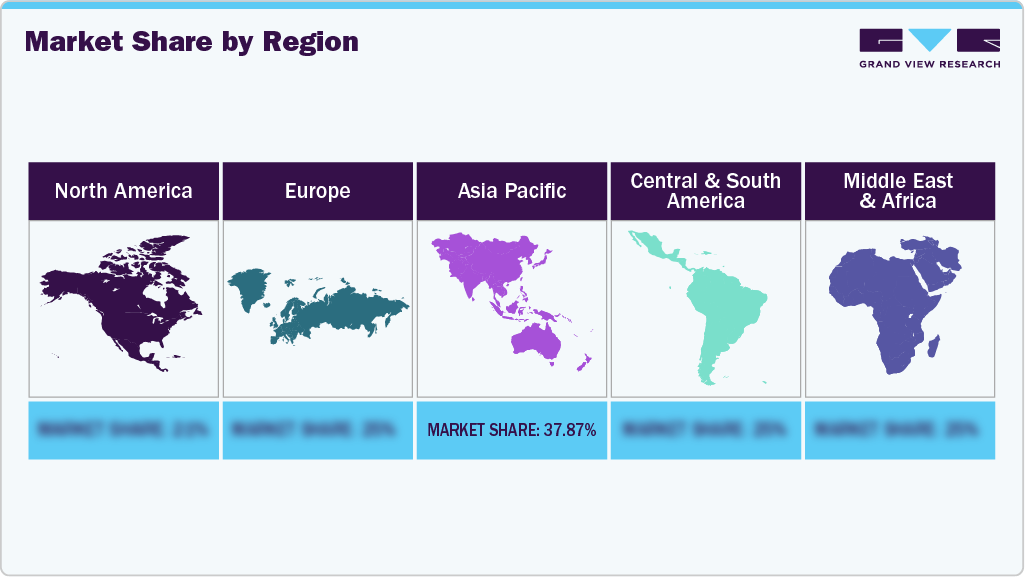
- Asia Pacific dominated the global cabinets market with the largest revenue share of 37.87% in 2025.
- The cabinets market in China accounted for the largest market revenue share in the Asia Pacific in 2025.
- By material, the wood segment led the market with the largest revenue share of 67.36% in 2025.
- By application, the residential segment led the market with the largest revenue share of 73.29% in 2025.
- By type, the retrofit/remodeling segment led the market with the largest revenue share of 56.56% in 2025.
Market Size & Forecast
- 2025 Market Size: USD 190.54 Billion
- 2033 Projected Market Size: USD 322.51 Billion
- CAGR (2026-2033): 6.9%
- Asia Pacific: Largest market share in 2025
Homeowners and developers increasingly view cabinets not just as utilitarian fixtures but as design statements that shape the overall look and value of kitchens, bathrooms, living spaces, and offices. According to a blog published in January 2024, consumers are prioritizing cabinetry that combines clean design, high-quality materials, and long-term durability, as evidenced by higher spending on home renovation and remodeling. This shift is encouraging manufacturers to focus on visually distinctive cabinet formats, including textured finishes, vertical detailing, and minimalist profiles, positioning cabinetry as a core component of contemporary interior design rather than a purely functional installation.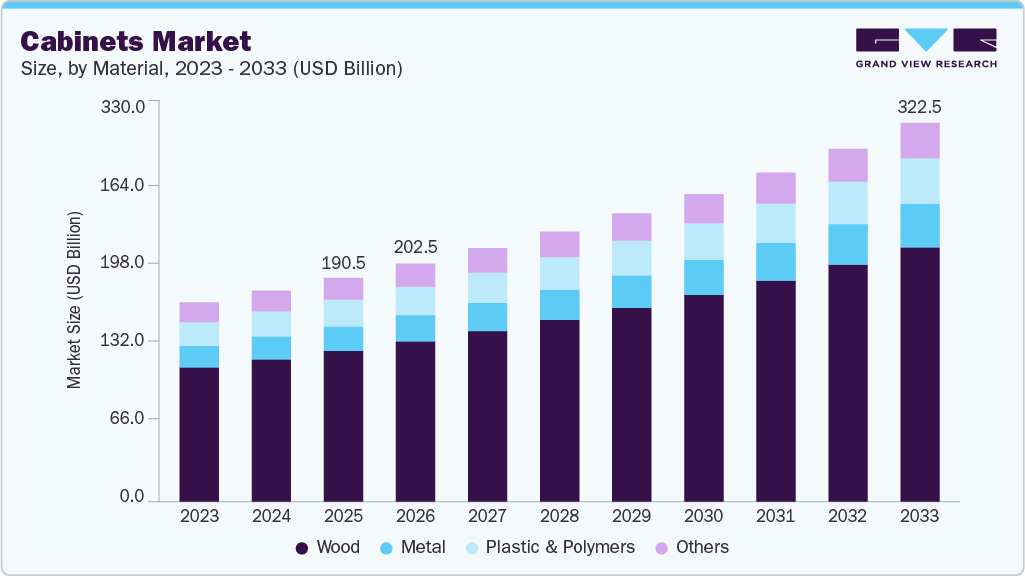
Design-led innovation is playing a critical role in shaping demand across the cabinets industry, with strong influence from premium interior, furniture, and architectural trends. High-end residential projects and designer-led renovations are increasingly incorporating statement cabinetry to differentiate spaces, driving interest in visually rich formats such as the fluted cabinets industry, where vertical grooves and ribbed surfaces add depth and architectural character. These designs align with broader preferences for warm, tactile, and craftsmanship-inspired interiors that move away from flat, plain surfaces. Manufacturers are responding by offering cabinets in a wide range of materials, finishes, and color palettes, allowing consumers to personalize storage solutions while maintaining cohesive interior themes.
Consumer awareness around quality, longevity, and sustainability is also influencing cabinet purchasing behavior. Buyers are increasingly willing to invest in premium cabinets that offer durable construction, moisture resistance, and ease of maintenance, particularly in high-usage areas such as kitchens and bathrooms. At the same time, sustainability considerations are gaining traction, with growing demand for responsibly sourced wood, low-VOC finishes, and environmentally conscious manufacturing practices. This has further supported demand for design-forward yet durable products within segments such as the fluted cabinets industry, where premium craftsmanship and material integrity are key selling points.
In addition, digital media, interior design platforms, and social content focused on home décor trends are accelerating consumer exposure to modern cabinetry styles. Online inspiration, renovation showcases, and influencer-led home transformations have made cabinets a visible lifestyle upgrade rather than a background fixture. As a result, consumers increasingly view cabinets as long-term design investments that enhance property value, functionality, and visual appeal. Supported by rising renovation spending, evolving aesthetic preferences, and continuous design innovation, the cabinets industry is expected to maintain steady growth momentum over the forecast period.
Brand Market Share Analysis
Established manufacturers and emerging players in the cabinets industry operate in a highly competitive environment shaped by continuous product innovation, design-led differentiation, and pricing flexibility across residential and commercial segments. Companies are increasingly competing on aesthetics, material finishes, modular functionality, and customization options to cater to evolving consumer preferences for modern, space-efficient interiors. Design trends such as textured surfaces, handle-less profiles, and architectural finishes are becoming key competitive levers, encouraging brands to regularly refresh product portfolios and launch differentiated collections.
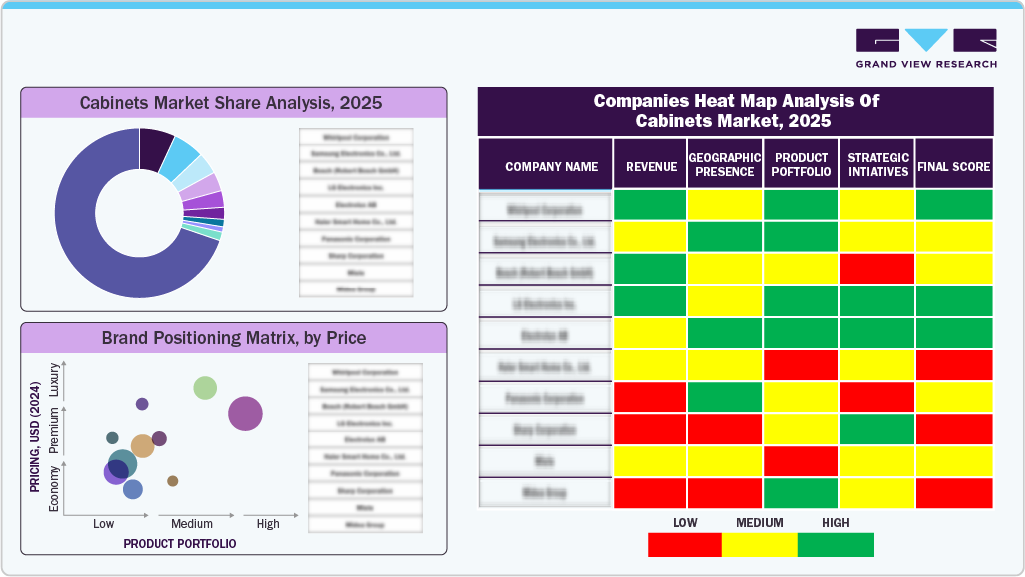
At the same time, cabinet manufacturers are strengthening their digital presence by expanding across e-commerce platforms, brand-owned websites, and online design configurators to engage digitally driven consumers and improve market reach. Strategic collaborations with interior designers, architects, real estate developers, and lifestyle influencers are also gaining traction, helping brands enhance visibility and credibility in design-conscious consumer segments. In addition, limited-edition collections, premium design series, and influencer-led interior showcases are being used to position cabinets as aspirational lifestyle products rather than purely functional storage solutions.
Consumer Insights for Cabinet
Buyers actively evaluate cabinets based on storage efficiency, internal configuration (drawers, pull-outs, soft-close systems), and compatibility with appliances, countertops, and room dimensions, particularly in kitchens and bathrooms where space utilization is critical. There is a strong preference for modular and semi-custom cabinets that allow flexibility during installation and future renovation, reflecting growing consumer awareness of lifecycle value rather than one-time purchase cost. Consumers are also showing heightened sensitivity to material performance, favoring cabinets that resist moisture, heat, and daily wear, especially in high-usage residential and commercial environments.
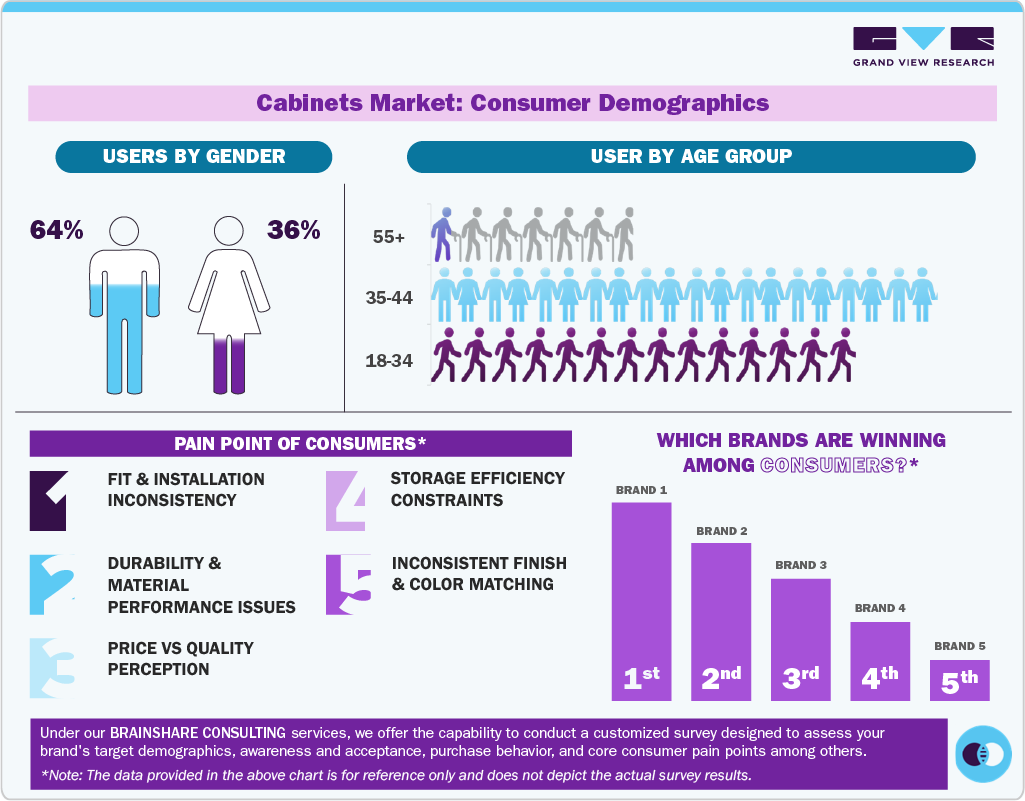
At the same time, purchasing behavior is being shaped by renovation-led demand rather than new construction alone, with homeowners increasingly upgrading cabinets to refresh interiors without full structural remodeling. This has led to rising interest in cabinets that can be retrofitted easily, integrate with existing layouts, and deliver a visible aesthetic impact through finishes, textures, and color updates. Consumers increasingly rely on showroom displays, digital visualizers, and sample-based selection to assess how cabinets will integrate with flooring, lighting, and wall treatments before purchase.
Product Insights
The kitchen cabinets segment led the market with the largest revenue share of 62.60% in 2025, driven by rapid urbanization and the rising adoption of modular kitchen layouts across developing economies such as China, India, and Brazil, where compact housing and apartment living are increasing the need for efficient storage solutions. Consumers are increasingly upgrading kitchens with cabinets that feature functional enhancements, such as soft-close hinges, pull-out organizers, corner storage systems, and built-in LED lighting, to improve usability and workflow efficiency. In addition, growing exposure to global interior design trends has encouraged homeowners to replace older cabinetry with contemporary designs that align with modern appliances and countertops.
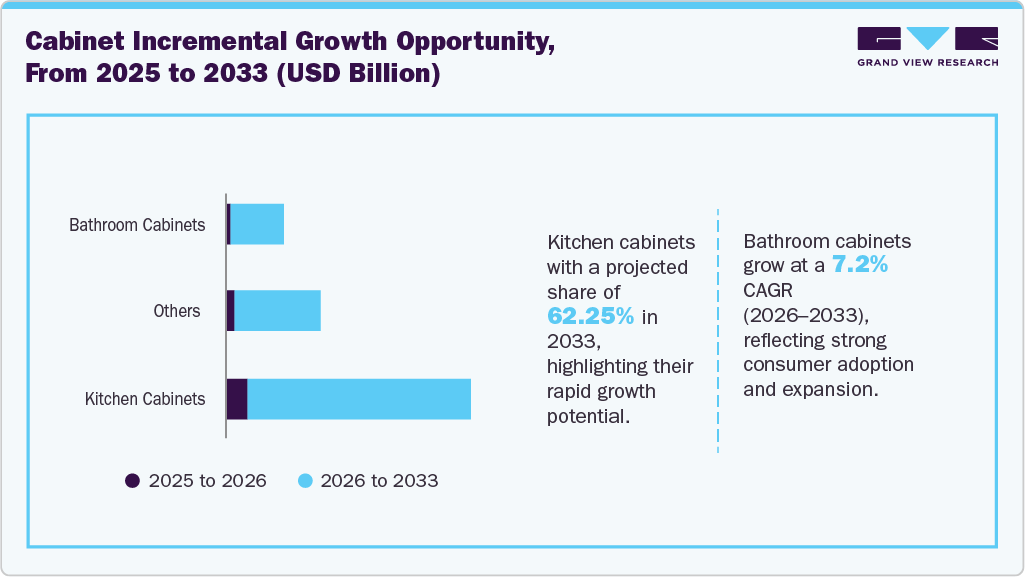
The bathroom cabinets segment is projected to grow at the fastest CAGR of 7.2% from 2026 to 2033. Rising urbanization and smaller living spaces are prompting consumers to adopt cabinets that help organize toiletries, personal care items, and cleaning supplies, while maintaining a clean, uncluttered bathroom environment. Demand is further supported by growing residential construction activity, particularly apartments and mixed-use developments, where standardized bathroom layouts require efficient and durable cabinetry solutions.
Material Insights
The wood segment led the market with the largest revenue share of 67.36% in 2025. Wood cabinets are widely favored in kitchens, bathrooms, and living spaces for their structural strength, load-bearing capacity, and long service life, making them suitable for both new construction and renovation projects. Consumers associate wood cabinetry with premium quality and warmth, particularly in residential interiors where visual continuity and long-term value are key purchasing considerations. In addition, wood offers high design flexibility, allowing manufacturers to deliver a wide range of finishes, stains, textures, and styles that align with both traditional and contemporary interiors.
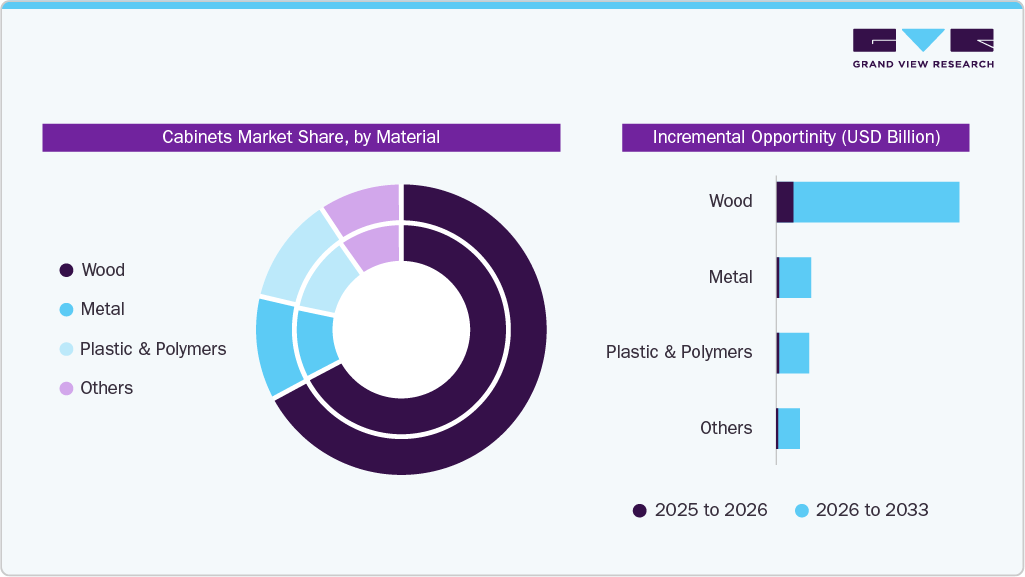
The metal cabinets segment is projected to grow at the fastest CAGR of 7.6% from 2026 to 2033, supported by rising demand across both commercial and residential applications, particularly in developing economies such as China, India, and Brazil. Growth is being driven by rapid urban construction, expansion of offices, healthcare facilities, retail spaces, and industrial kitchens, where metal cabinets are preferred for their strength, hygiene, and long service life. Compared with wood-based alternatives, metal cabinets offer advantages such as corrosion resistance, ease of cleaning, fire resistance, and lower maintenance requirements, making them well-suited for high-usage and moisture-prone environments. In residential settings, adoption is increasing in utility areas, modular kitchens, and contemporary interiors where metal finishes align with modern design preferences.
Application Insights
The residential segment led the market with the largest revenue share of 73.29% in 2025. Homeowners are increasingly upgrading kitchens and bathrooms to improve storage efficiency and interior aesthetics, making cabinet replacement a routine part of renovation projects. Urbanization and apartment living have further increased demand for built-in and space-efficient cabinetry across residential layouts. At the same time, the growing penetration of modular kitchens has directly expanded cabinet installations, as cabinets form the core structural and functional element of these designs.
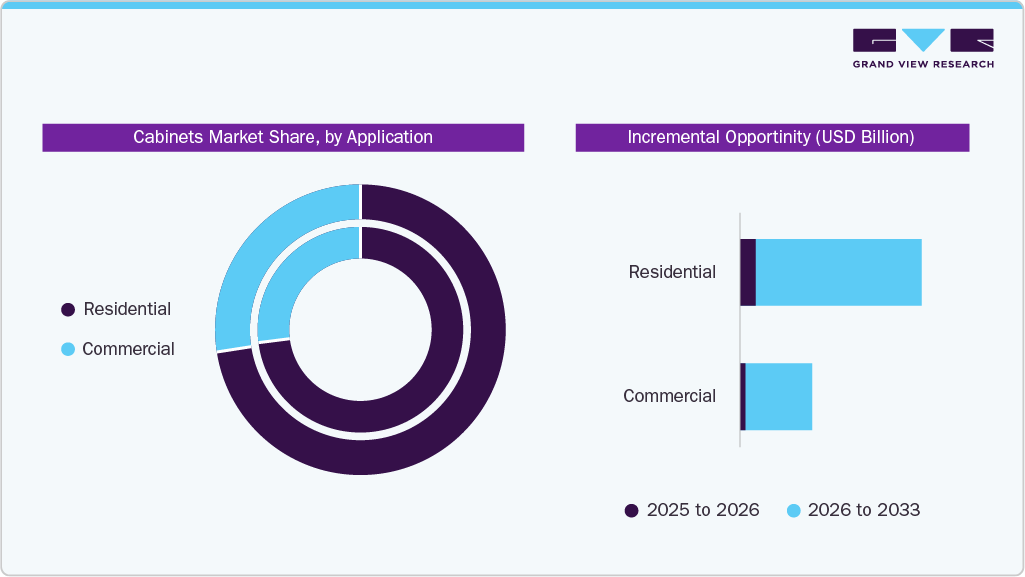
The commercial segment is projected to grow at the fastest CAGR of 7.2% from 2026 to 2033, driven by expanding commercial construction and frequent interior upgrades across offices, hospitality properties, healthcare facilities, and retail outlets. Commercial spaces require cabinets that can handle high traffic, frequent use, and strict hygiene standards, which is increasing demand for robust, easy-to-maintain designs. Fit-out cycles in hotels, offices, and retail stores are becoming shorter, leading to more frequent cabinet replacement during refurbishments rather than full structural renovation. In addition, standardized layouts in commercial projects are accelerating bulk procurement of cabinets with uniform specifications, supporting higher installation volumes.
Type Insights
Theretrofit/remodeling segment led the market with the largest revenue share of 56.56% in 2025. Homeowners and commercial property owners increasingly replace cabinets as part of kitchen and bathroom renovations to improve storage efficiency, update layouts, and refresh interior aesthetics at a lower cost than complete rebuilds. Retrofit demand is further supported by aging housing stock, especially in urban areas, where cabinets are among the first components upgraded during refurbishment projects. In addition, modular cabinet designs and standardized sizing have made replacement easier and faster, reducing installation time and disruption.
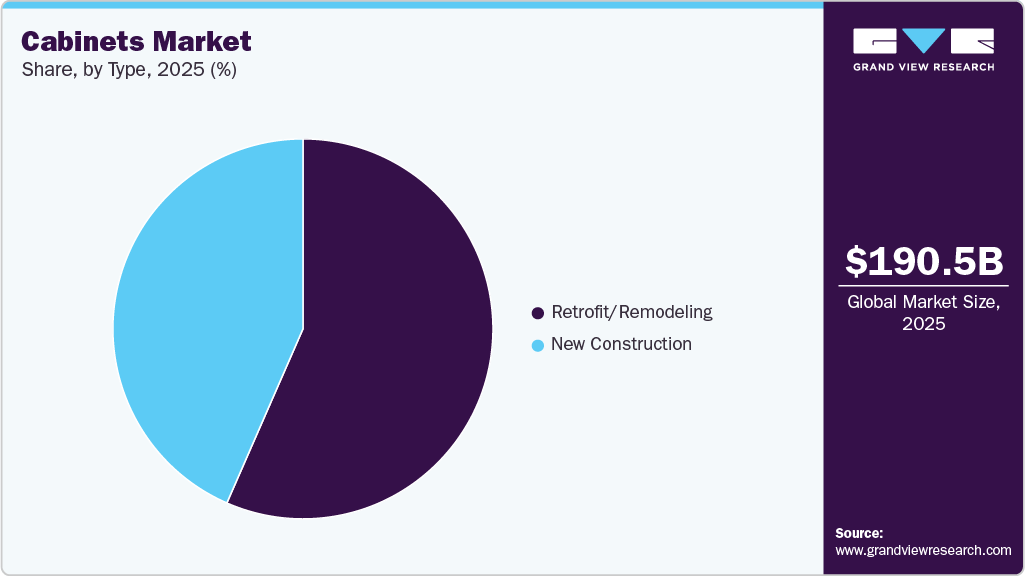
The new construction segment is projected to grow at the fastest CAGR of 7.0% from 2026 to 2033, driven by rising residential and commercial building activity and the increasing specification of modern, built-in cabinetry at the construction stage. Developers and contractors are installing cabinets as standard fixtures in new homes, apartments, hotels, offices, and mixed-use developments to meet buyer expectations for ready-to-use, finished interiors. Demand is particularly strong for modular, factory-finished cabinets that enable faster installation, consistent quality, and better cost control across large projects.
Regional Insights
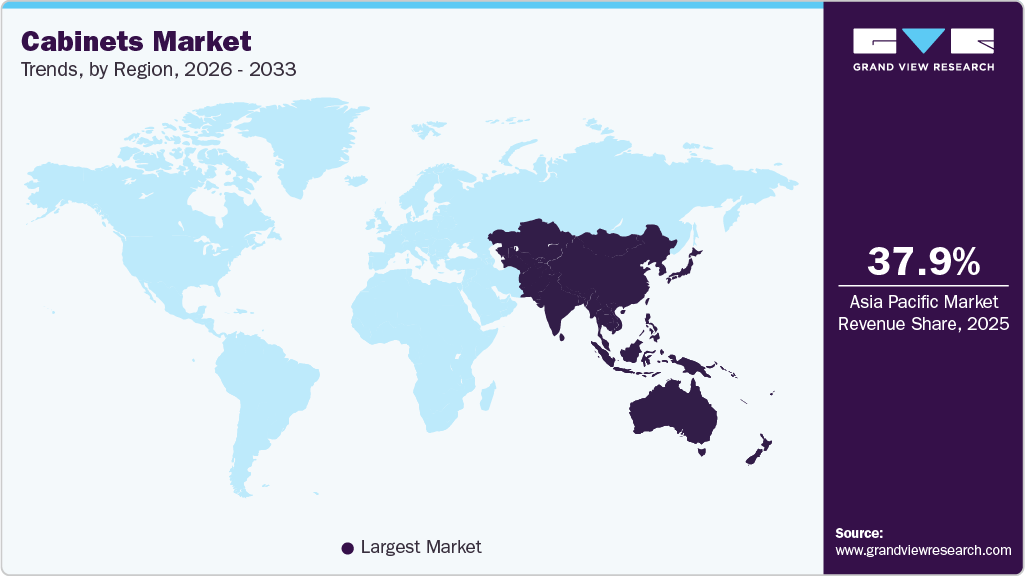
Asia Pacific dominated the global cabinets market with the largest revenue share of 37.87% in 2025 and is projected to grow at the fastest CAGR during the forecast period, driven by rapid urbanization, large-scale residential construction, and rising household spending on interior upgrades. Strong growth in apartment housing across China, India, Southeast Asia, and parts of Oceania is directly increasing demand for kitchen and bathroom cabinets as standard interior fixtures. Expanding middle-class populations and improving disposable incomes are encouraging consumers to invest in modular kitchens, built-in storage, and modern cabinetry solutions rather than basic furniture. In addition, government-backed housing programs, infrastructure development, and continuous expansion of organized real estate projects are sustaining high cabinet installation volumes.
China Cabinets Market Trends
The cabinets market in China accounted for the largest market revenue share in the Asia Pacific in 2025. Rapid urbanization and apartment living are increasing the demand for built-in kitchen and bathroom cabinets that support efficient space utilization and organized living. Chinese homeowners are increasingly upgrading interiors as incomes rise, with cabinets forming a core part of kitchen and bathroom modernization rather than standalone furniture purchases. The widespread adoption of modular kitchens and fitted bathroom layouts in urban households has further increased cabinet installation volumes.
The India cabinets market is projected to grow at a significant CAGR of 8.7% from 2026 to 2033. The rapid growth of apartment housing in metro and Tier-I cities is increasing demand for space-efficient built-in cabinetry. In addition, improving disposable incomes and wider availability of modular cabinet solutions through organized retail and local carpenters are making cabinet upgrades more accessible.
North America Cabinets Market Trends
The cabinets market in North America is anticipated to grow at a significant CAGR during the forecast period, supported by high renovation activity, strong housing turnover, and sustained spending on home improvement. Homeowners across the U.S. and Canada regularly upgrade kitchens and bathrooms to improve functionality, storage efficiency, and interior appearance, making cabinets one of the most frequently replaced fixtures. The region also has a mature modular kitchen and bathroom cabinet ecosystem, where built-in cabinetry is a standard feature in both new homes and renovation projects.
The cabinets market in the U.S. held a significant share in North America in 2025. U.S. households frequently invest in cabinet replacements as part of routine remodeling to improve storage efficiency, modernize layouts, and align interiors with current design trends. The large base of aging housing stock is continuously generating demand for cabinet upgrades, particularly in kitchens and bathrooms, where wear and tear is highest. In addition, the widespread availability of modular and ready-to-assemble cabinets through national home improvement retailers and online platforms has made replacement faster and more accessible.
Europe Cabinets Market Trends
The cabinets market in Europe is expected to grow at a substantial CAGR during the forecast period. The region’s market strength is supported by steady residential construction, large-scale urban redevelopment projects, and continuous household renovation activity across both Western and Central Europe. In addition, the growing number of hotels, serviced apartments, and mixed-use developments is driving demand for premium, functional cabinetry, particularly in kitchens and bathrooms. Demand is further supported by consumer preference for high-quality, durable, and design-led cabinets that align with modern European interior standards.
The UK cabinets market accounted for the significant market revenue share in Europe in 2025. Changing lifestyle habits, including higher time spent at home and greater focus on organized living spaces, are encouraging homeowners to upgrade kitchen and bathroom cabinets as part of routine interior improvements. Demand is further supported by the expansion of modular kitchens and fitted bathroom furniture across urban households, where space optimization is a priority.
The cabinets market in Germany is projected to grow at a significant CAGR of 5.5% from 2026 to 2033, supported by high adoption of modular kitchens and fitted bathroom furniture, particularly in urban households where space optimization and clean design are priorities. In addition, Germany’s emphasis on build quality, durability, and long product life encourages consistent replacement of older cabinetry with modern, factory-finished solutions.
Central & South America Cabinets Market Trends
The cabinets market in Central & South America is projected to grow at a substantial CAGR of 6.1% from 2026 to 2033. Growth in apartment housing across major urban centers is supporting demand for space-efficient cabinetry, particularly modular kitchens and fitted bathroom furniture. In addition, expanding middle-class populations and gradual improvement in disposable incomes are encouraging spending on modern home fixtures. The growing availability of modular cabinet solutions through organized retail and local manufacturers is further supporting steady demand across the region.
Middle East & Africa Cabinets Market Trends
The cabinets market Middle East & Africa is projected to grow at a significant CAGR of 7.9% from 2026 to 2033. supported by rising residential construction, increasing urban population, and growing investment in modern housing developments. Changing lifestyle patterns and higher expectations for organized, functional interiors are encouraging homeowners to upgrade kitchen and bathroom cabinets as part of regular home improvements. Rapid urban expansion across Gulf countries and parts of Africa is driving demand for modular kitchens and fitted bathroom furniture that optimize space in apartments and villas.
Key Cabinets Company Insight
The cabinets industry features a mix of established participants, with leadership concentrated among prominent international companies such as American Woodmark Corporation, MasterBrand, Inc., Cabinetworks Group, IKEA, Howdens Joinery Group Plc, and Nobia AB. Intensifying competition across regional and global markets is progressively driving consolidation within the industry.
Key Cabinets Companies:
The following key companies have been profiled for this study on the cabinets market.
- American Woodmark Corporation
- MasterBrand, Inc.
- Cabinetworks Group
- IKEA
- Howdens Joinery Group Plc
- Nobia AB
- Oppein Home Group Inc.
- GoldenHome Living
- Poggenpohl Möbelwerke GmbH
- Godrej Interio
Recent Developments
-
In January 2026, Medallion Cabinetry is rolling out a new brand direction for its 2026 product lineup centered on the theme “Capturing the art of living well,” with a focus on design quality and practical innovation shaped by insights from professional designers. The company plans to introduce refreshed cabinet styles and material options that bring architectural dimension and refined finishes to contemporary and transitional interiors.
-
In September 2025, KraftMaid Cabinetry announced a major update to its finish portfolio with the introduction of seven new color options, marking its most extensive finish expansion in more than a decade. The launch aims to give homeowners and designers greater flexibility to personalize kitchens and bathrooms, reflecting growing interest in both softer neutrals and bolder, nature-inspired tones.
Cabinets Market Report Scope
Report Attribute
Details
Market size value in 2026
USD 202.54 billion
Revenue Forecast in 2033
USD 322.51 billion
Growth rate
CAGR of 6.9% from 2026 to 2033
Base year for estimation
2025
Historical data
2021 - 2024
Forecast period
2026 - 2033
Quantitative units
Revenue in USD million/billion, and CAGR from 2026 to 2033
Report coverage
Revenue forecast, company ranking, competitive landscape, growth factors, and trends
Segments covered
Product, material, application, type, region
Regional scope
North America; Europe; Asia Pacific; Central & South America; Middle East & Africa
Country scope
U.S.; Canada; Mexico; Germany; UK; France; Italy; Spain: China; Japan; India; South Korea; Australia & New Zealand; Brazil; South Africa
Key companies profiled
American Woodmark Corporation; MasterBrand, Inc.; Cabinetworks Group; IKEA; Howdens Joinery Group Plc; Nobia AB; Oppein Home Group Inc.; GoldenHome Living; Poggenpohl Möbelwerke GmbH; Godrej Interio
Customization scope
Free report customization (equivalent up to 8 analysts’ working days) with purchase. Addition or alteration to country, regional & segment scope.
Pricing and purchase options
Avail customized purchase options to meet your exact research needs. Explore purchase options
Global Cabinets Market Report Segmentation
This report forecasts revenue growth at global, regional & country levels and provides an analysis of the latest trends and opportunities in each of the sub-segment from 2021 to 2033. For this study, Grand View Research has segmented the global cabinets market based on the product, material, application, type, and region:
-
Product Outlook (Revenue, USD Million, 2021 - 2033)
-
Kitchen Cabinets
-
Bathroom Cabinets
-
Others
-
-
Material Outlook (Revenue, USD Million, 2021 - 2033)
-
Wood
-
Metal
-
Plastic & Polymers
-
Others
-
-
Application Outlook (Revenue, USD Million, 2021 - 2033)
-
Residential
-
Commercial
-
-
Type Outlook (Revenue, USD Million, 2021 - 2033)
-
New Construction
-
Retrofit/Remodeling
-
-
Regional Outlook (Revenue, USD Million, 2021 - 2033)
-
North America
-
U.S.
-
Canada
-
Mexico
-
-
Europe
-
Germany
-
UK
-
France
-
Italy
-
Spain
-
-
Asia Pacific
-
China
-
Japan
-
India
-
South Korea
-
Australia & New Zealand
-
-
Central & South America
-
Brazil
-
-
Middle East & Africa
-
South Africa
-
-
Frequently Asked Questions About This Report
b. Some key players operating in the global cabinet market include American Woodmark Corporation; MasterBrand, Inc.; Cabinetworks Group; IKEA; Howdens Joinery Group Plc; Nobia AB; Oppein Home Group Inc.; GoldenHome Living; Poggenpohl Möbelwerke GmbH; Godrej Interio
b. The cabinet market is driven by sustained residential construction and renovation activity, as homeowners increasingly invest in organized, space-efficient interiors. Rising adoption of modular kitchens, built-in storage, and customization across mid- to high-income households is further supporting demand.
b. The global cabinet market size was estimated at USD 190.54 billion in 2025 and is expected to reach USD 202.54 billion in 2026.
b. The global cabinet market is expected to grow at a compound annual growth rate (CAGR) of 6.9% from 2026 to 2033 to reach USD 322.51 billion by 2033.
b. Kitchen cabinets accounted for a share of 62.60% of the global revenue in 2025, driven by sustained residential construction activity and frequent kitchen renovation cycles across urban housing. Their dominance is reinforced by higher average selling prices and strong consumer preference for modular, customized storage solutions integrated with modern kitchen layouts.


Share this report with your colleague or friend.
Need a Tailored Report?
Customize this report to your needs — add regions, segments, or data points, with 20% free customization.


ISO 9001:2015 & 27001:2022 Certified
We are GDPR and CCPA compliant! Your transaction & personal information is safe and secure. For more details, please read our privacy policy.
Trusted market insights - try a free sample
See how our reports are structured and why industry leaders rely on Grand View Research. Get a free sample or ask us to tailor this report to your needs.












