Brazil Anti-aging Products Market Trends
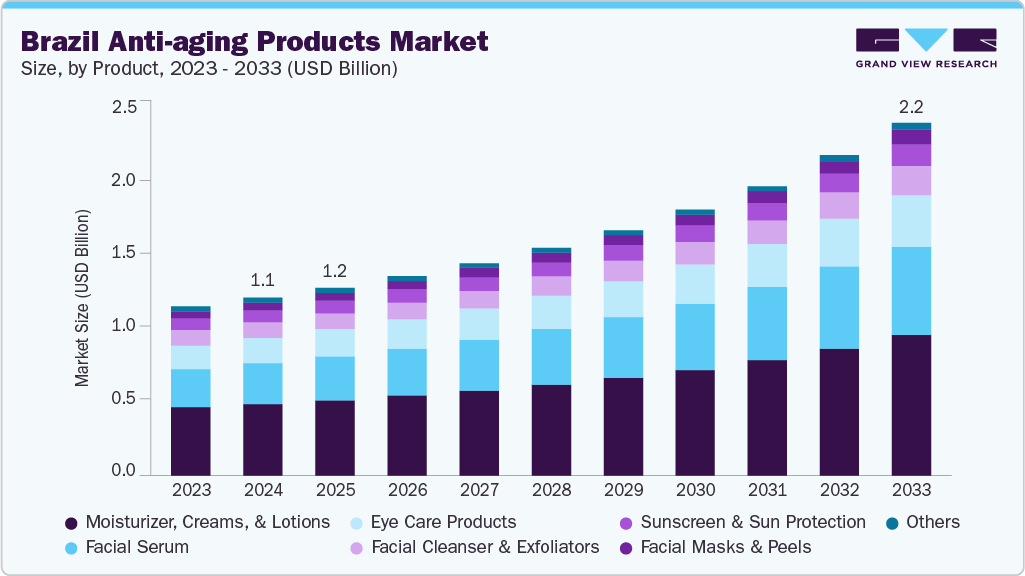
The Brazil anti-aging products market size was estimated at USD 1,087.9 million in 2024 and is projected to reach USD 2163.6 million by 2033, growing at a CAGR of 8.2% from 2025 to 2033. The Brazil market is driven by a growing middle-class population with rising disposable incomes, enabling greater investment in personal care and beauty products.
In addition, improved healthcare and increased life expectancy have led to a stronger focus on maintaining youthful skin through consistent skincare routines. Consumers are particularly drawn to products that provide hydration, stimulate collagen production, and offer protection against environmental aggressors such as UV radiation and pollution, which are prevalent concerns in the country.
Brazilian consumers are highly conscious of the ingredients in their skincare products, with a growing demand for formulations that include plant-based extracts, antioxidants, and organic components. For instance, in April 2023, Natura introduced the Chronos Intensive Antioxidant Serum, featuring Amazonian extracts like ingá, açaí berry, and cocoa. These ingredients help neutralize free radicals and activate the skin’s natural antioxidant mechanisms, protecting against premature aging. A consumer study found that after seven days, 81% of users reported increased radiance, and 92% felt their skin was softer. The serum aims to improve skin resilience and prevent oxidative stress.
There is also a significant interest in sun protection due to the country's tropical climate, making SPF-infused skincare a priority. In addition, the beauty market in Brazil has seen an increase in demand for hybrid products that combine skincare with makeup, such as tinted moisturizers with anti-aging benefits. Consumers are also drawn to personalized skincare solutions, with brands offering customized treatments that cater to specific skin concerns, such as hyperpigmentation and premature aging.
Consumer Insights & Surveys
The anti-aging products market in Brazil is transforming significantly, shaped by evolving consumer values and scientific innovation. Brands champion inclusivity and redefine aging as a stage of empowerment rather than decline. This shift is especially evident in cultures like Brazil’s, where traditional beauty ideals give way to more holistic and authentic approaches. The focus is on promoting long-term skin health through ‘pro-aging’ and ‘well-aging’ philosophies, prioritizing skin resilience over erasing wrinkles. For example, Brazil’s Natura has embraced this trend with its age-positive serum, which aligns with the growing movement toward celebrating natural aging. This product incorporates advanced botanical ingredients and reflects the brand’s commitment to sustainability and self-acceptance. Addressing consumer desires for transparency, multi-functionality, and barrier-supportive formulations, such innovations underscore a broader move toward mindful skincare that values health and individuality in the cosmetic industry.
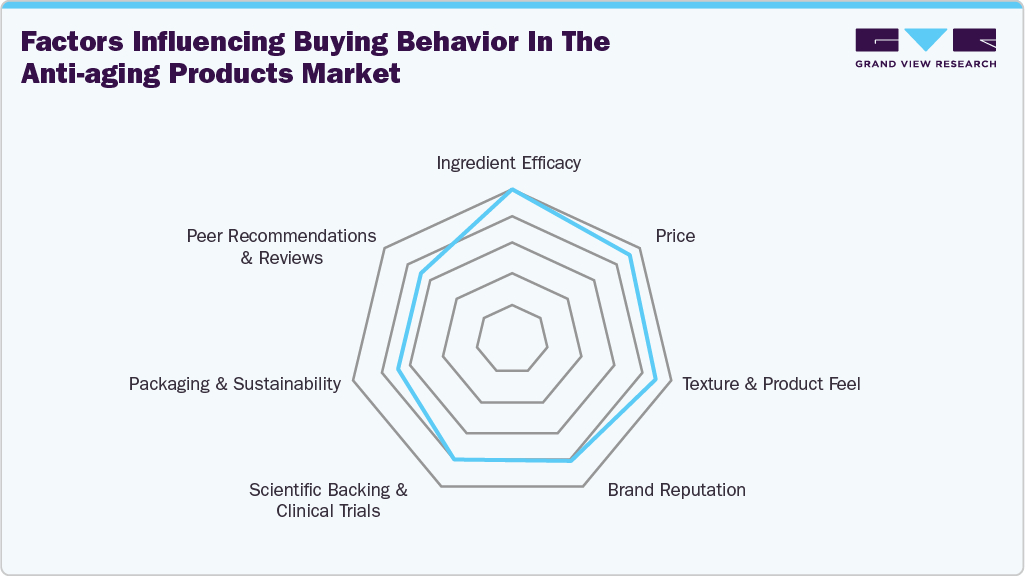
In Brazil, personal appearance plays a vital role in daily life and social identity, deeply influencing consumer behavior in the beauty and personal care industry. A survey by the Credit Protection Service (SPC Brasil) and the National Confederation of Store Managers (CNDL) highlights that Brazilian consumers place significant importance on their appearance and are willing to spend on beauty products and services to boost their self-esteem. According to the study, 62.7% of Brazilians consider themselves vain and concerned about their looks, while 65.7% believe maintaining personal beauty is a necessity rather than a luxury. In addition, nearly half of the respondents (49.4%) view spending on physical appearance as a valuable investment that contributes to their happiness and overall satisfaction.
Product Insights
Moisturizer, creams, & lotions accounted for a revenue share of about 40.08% in 2024. These products are deeply integrated into daily skin care routines across all age groups and genders, particularly in a country like Brazil, where appearance and skincare are highly prioritized due to its tropical climate and sun exposure. The demand for hydration, sun protection, and skin barrier repair makes moisturizers essential, especially when combined with anti-aging ingredients like retinol, hyaluronic acid, and vitamin C. Brands like Natura and O Boticário offer advanced anti-aging moisturizers formulated with both biotechnology and native botanical extracts, enhancing product appeal and efficacy.
The demand for facial serum is projected to rise at a CAGR of 9.1% from 2025 to 2033. Facial serums effectively address concerns like wrinkles, fine lines, hyperpigmentation, and loss of firmness, making them a preferred choice for personalized routines. The rise in urban lifestyles, pollution exposure, and UV damage has also encouraged consumers to adopt more advanced skincare, where serums play a critical role in skin repair and protection. Brands like Estée Lauder and L'Oréal have introduced facial serums featuring ingredients like vitamin C, hyaluronic acid, peptides, and plant stem cells, catering to premium and mass-market segments.
Distribution Channel Insights
The sale of anti-aging products in Brazil through supermarkets and hypermarkets accounted for a revenue share of about 32.98% in 2024. Consumers appreciate the ability to purchase skincare items alongside their daily necessities, making the shopping experience more efficient. In addition, supermarkets leverage their large-scale purchasing power to offer competitive prices, making anti-aging products more affordable for a broader audience. This affordability appeals especially to middle-income consumers seeking effective yet budget-friendly skincare solutions.
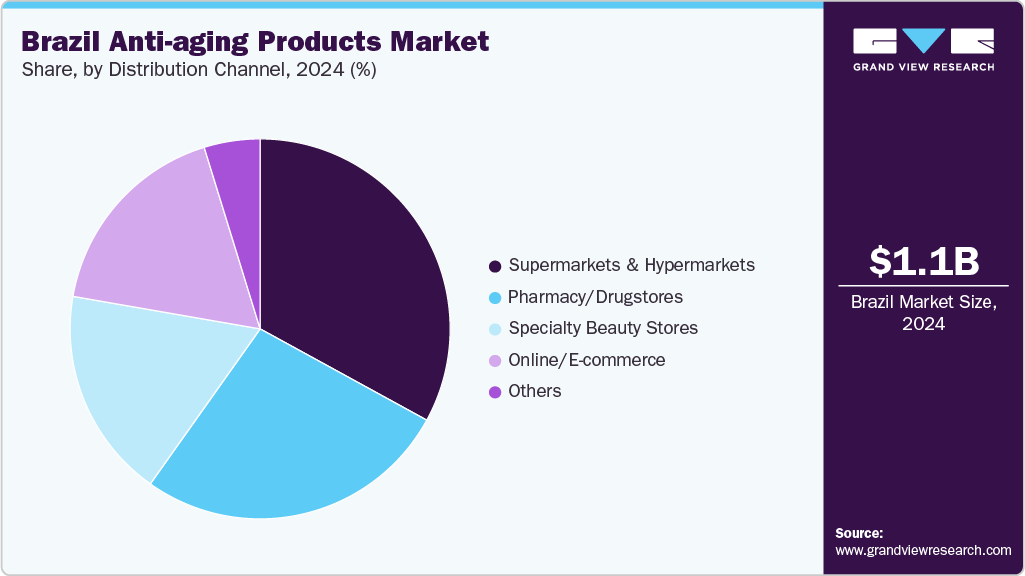
The sale of anti-aging products in Brazil through online retail channels is expected to grow at a CAGR of 10.0% from 2025 to 2033. E-commerce offers greater convenience, product variety, and access to detailed information, including user reviews and ingredient breakdowns, enabling more informed buying decisions. Expanding internet access and smartphone usage across urban and semi-urban areas has further fueled this shift. In addition, localized influencer marketing, social media engagement, and promotional campaigns on platforms like Instagram and TikTok increasingly drive product discovery and brand loyalty.
Key Brazil Anti-aging Products Company Insights
The Brazil anti-aging products industry features a diverse mix of established international brands and agile domestic players, each adapting to the changing needs of a more informed and discerning consumer base. Leading companies prioritize ongoing innovation to maintain a competitive edge in the anti-aging products industry, incorporating cutting-edge ingredients, biotechnological advancements, and dermatological science into their product development.
-
Unilever PLC is a multinational consumer goods company known for its diverse portfolio spanning beauty, personal care, food, and home care products. Founded in 1929, the company owns globally recognized skincare brands such as Dove, Pond’s, and Vaseline, which offer anti-aging solutions targeting wrinkles, hydration, and skin elasticity. Unilever provides products like Pond’s Age Miracle, formulated with retinol-C complex for skin renewal, and Dove Pro-Age, designed to nourish mature skin with hydrating ingredients.
-
Shiseido Company, Limited is a recognized Japanese multinational renowned for its skincare, makeup, and fragrance innovation. Established in 1872, the company has cultivated a strong global footprint and manages a portfolio of high-end brands such as Shiseido, Clé de Peau Beauté, and Elixir. It specializes in advanced skincare products that address key concerns like wrinkles, loss of elasticity, and hydration.
Key Brazil Anti-aging Products Companies:
- L'Oréal S.A.
- JNTL Consumer Health Private Limited (Neutrogena)
- The Procter & Gamble Company
- Beiersdorf AG
- Unilever PLC
- Shiseido Company, Limited
- The Estée Lauder Companies Inc.
- Natura &Co.
- O Boticário SA
- The Ordinary
Recent Developments
-
In April 2025, Dove expanded into Brazil’s facial skincare market with its new Regenerative line, positioned within the growing dermocosmetics segment. The range features science-backed formulations containing niacinamide (B3) and a vitamin A derivative (Pro-Retinol/retinyl propionate). Developed to be inclusive and effective across diverse Brazilian skin tones, it aligns with the trend toward simplified, results-oriented skincare routines.
-
In April 2025, Eucerin Sérum Epigenetic significantly advances Brazil’s anti-aging skincare segment. It incorporates epigenetic technology to target aging at a cellular level. The formulation features the proprietary Epicelline active, combined with long, and short-chain hyaluronic acids, bioactive saponins, and enoxolone, aiming to deliver intensive hydration, improve skin elasticity, and reduce the appearance of wrinkles.
Brazil Anti-aging Products Market Report Scope
|
Report Attribute
|
Details
|
|
Market size value in 2025
|
USD 1,150.0 million
|
|
Revenue forecast in 2033
|
USD 2,163.6 million
|
|
Growth rate (revenue)
|
CAGR of 8.2% from 2025 to 2033
|
|
Actuals
|
2021 - 2024
|
|
Forecast period
|
2025 - 2033
|
|
Quantitative units
|
Revenue in USD million and CAGR from 2025 to 2033
|
|
Report coverage
|
Revenue forecast, company ranking, competitive landscape, growth factors, and trends
|
|
Segments covered
|
Product, distribution channel
|
|
Country scope
|
Brazil
|
|
Key companies profiled
|
L'Oréal S.A.; JNTL Consumer Health Private Limited (Neutrogena); The Procter & Gamble Company; Beiersdorf AG; Unilever PLC; Shiseido Company, Limited; The Estée Lauder Companies Inc.; Natura &Co.; O Boticário SA; The Ordinary
|
|
Customization
|
Free report customization (equivalent up to 8 analysts working days) with purchase. Addition or alteration to country, regional & segment scope.
|
|
Pricing and purchase options
|
Avail customized purchase options to meet your exact research needs. Explore purchase options
|
Brazil Anti-aging Products Market Report Segmentation
This report forecasts revenue growth at the country level and provides an analysis of the latest industry trends and opportunities in each of the sub-segments from 2021 to 2033. For this study, Grand View Research has segmented the Brazil anti-aging products market report by product and distribution channel:
-
Product Outlook (Revenue, USD Million, 2021 - 2033)
-
Facial Serum
-
Moisturizer, Creams, & Lotions
-
Eye Care Products
-
Facial Cleanser & Exfoliators
-
Facial Masks & Peels
-
Sunscreen & Sun Protection
-
Others (Facial Oil, Lip Care Products, etc.)
-
Distribution Channel Outlook (Revenue, USD Million, 2021 - 2033)
Frequently Asked Questions About This Report
b. The Brazil anti-aging products market was estimated at USD 1,087.9 million in 2024 and is expected to reach USD 1,150.0 million in 2025.
b. The Brazil anti-aging products market is expected to grow at a compound annual growth rate of 8.2% from 2025 to 2033 to reach USD 2,163.6 million by 2033.
b. Moisturizer, Creams, & Lotions accounted for the revenue share of about 40.08% of Brazil anti-aging products market in 2024. The demand for hydration, sun protection, and skin barrier repair makes moisturizers essential, especially when combined with anti-aging ingredients like retinol, hyaluronic acid, and vitamin C.
b. Some of the key players in the Brazil anti-aging products market is L'Oréal S.A.; JNTL Consumer Health Private Limited (Neutrogena); The Procter & Gamble Company; Beiersdorf AG; Unilever PLC; Shiseido Company, Limited; The Estée Lauder Companies Inc.; Natura &Co.; O Boticário SA; The Ordinary.
b. The Brazil anti-aging products market is driven by a growing middle-class population with rising disposable incomes, enabling greater investment in personal care and beauty products. Additionally, improved healthcare and increased life expectancy have led to a stronger focus on maintaining youthful skin through consistent skincare routines.

 Download Sample Report














