
- Home
- »
- Renewable Energy
- »
-
Blue Carbon Market Size And Share, Industry Report, 2033GVR Report cover
![Blue Carbon Market Size, Share & Trends Report]()
Blue Carbon Market (2026 - 2033) Size, Share & Trends Analysis Report By Ecosystem Type (Mangroves, Seagrasses, Salt Marshes), By Project Type (Conservation, Restoration, Afforestation), By Application (Enterprise, Government), By Region, And Segment Forecasts
- Report ID: GVR-4-68040-858-1
- Number of Report Pages: 120
- Format: PDF
- Historical Range: 2021 - 2024
- Forecast Period: 2026 - 2033
- Industry: Energy & Power
- Report Summary
- Table of Contents
- Segmentation
- Methodology
- Download FREE Sample
-
 Download Sample Report
Blue Carbon Market Summary
The global blue carbon market size was estimated at USD 2.42 million in 2025 and is projected to reach USD 14.79 million by 2033, growing at a CAGR of 24.99% from 2026 to 2033. Market growth is primarily driven by the increasing global focus on climate change mitigation, rising adoption of nature-based carbon removal solutions, and expanding participation in voluntary carbon markets.
Key Market Trends & Insights
- Asia Pacific dominated the global blue carbon market with the largest revenue share of 39% in 2025.
- The blue carbon market in China is expected to grow at a significant CAGR over the forecast period.
- Based on ecosystem type, the mangroves segment accounted for the largest market revenue share in 2025.
- Based on project type, the conservation segment accounted for the largest market revenue share in 2025.
- Based on application, the enterprise segment led the market with the largest revenue share of 62% in 2025.
Market Size & Forecast
- 2025 Market Size: USD 2.42 Million
- 2033 Projected Market Size: USD 14.79 Million
- CAGR (2026-2033): 24.99%
- Asia Pacific: Largest market share in 2025
Blue carbon ecosystems such as mangroves, seagrasses, and salt marshes are gaining significant attention for their high carbon sequestration potential while simultaneously supporting coastal resilience, biodiversity conservation, and sustainable ecosystem management.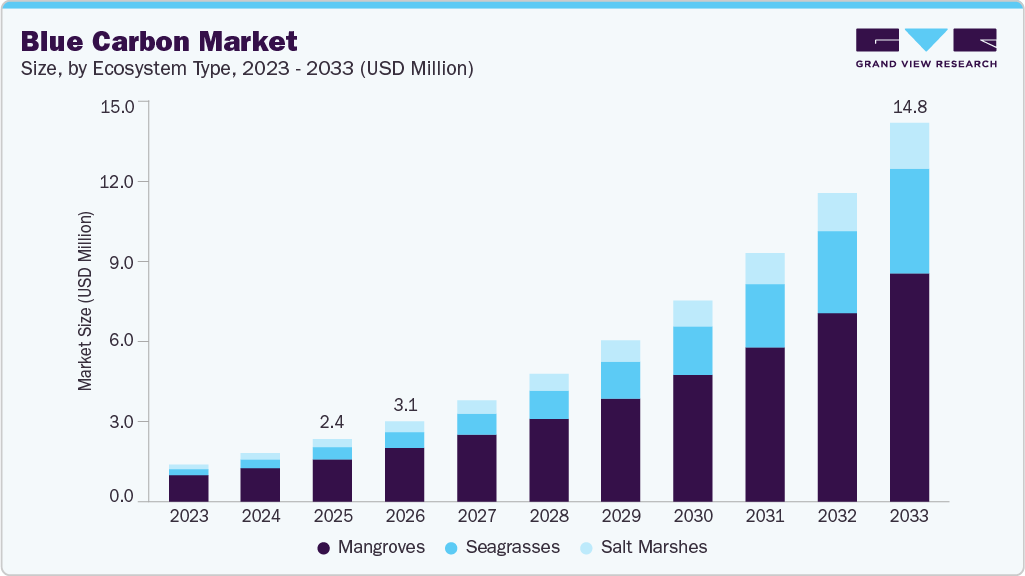
Growing investments from enterprises, governments, and environmental organizations in carbon offset initiatives are accelerating project development worldwide. Strengthening regulatory frameworks, corporate net-zero commitments, and improved carbon accounting methodologies are further supporting market expansion. In addition, advancements in monitoring, reporting, and verification (MRV) technologies are enhancing project credibility and attracting institutional funding. Strategic collaborations between conservation groups, project developers, and financial stakeholders continue to strengthen commercialization pathways, positioning blue carbon as a critical solution in achieving long-term global decarbonization goals.
Drivers, Opportunities & Restraints
The blue carbon industry is primarily driven by the increasing global urgency to combat climate change and reduce atmospheric carbon levels through nature-based solutions. Coastal ecosystems such as mangroves, seagrasses, and salt marshes are being widely recognized for their superior carbon sequestration capacity compared to terrestrial forests, making them essential to national and corporate decarbonization strategies. Rising participation in voluntary carbon markets, along with growing corporate commitments to achieve net-zero emissions, is encouraging enterprises to invest in blue carbon projects as part of long-term sustainability initiatives. In addition, supportive government policies focused on coastal restoration, biodiversity protection, and climate resilience are accelerating project development across multiple regions.
Despite these growth drivers, the market faces several restraints. High project development costs, complex regulatory approvals, and lengthy verification processes can delay implementation timelines. Challenges related to standardized carbon measurement, monitoring, and verification (MRV) frameworks may also create uncertainty for investors and project developers. Furthermore, risks associated with ecosystem degradation, land-use conflicts, and limited technical expertise in certain regions can impact project scalability and long-term carbon storage reliability. Limited awareness and fragmented policy structures in emerging markets may further restrict widespread adoption.
The market presents significant opportunities through advancements in carbon accounting technologies, satellite monitoring, and data-driven verification tools that enhance transparency and investor confidence. Increasing integration of blue carbon into global climate financing mechanisms and carbon credit trading platforms is expected to unlock new revenue streams for project developers. Growing collaboration between governments, environmental organizations, financial institutions, and private enterprises is further enabling large-scale conservation and restoration initiatives. As climate policies strengthen and demand for high-quality carbon credits rises, blue carbon projects are positioned to play a crucial role in supporting sustainable coastal economies while contributing meaningfully to global decarbonization efforts.
Ecosystem Type Insights
The mangroves segment led the market with the largest revenue share of 68.0% in 2025, driven by their exceptional carbon storage capacity and long-term sequestration potential. Mangrove ecosystems can capture significantly higher levels of carbon compared to many terrestrial habitats while also providing critical environmental benefits such as coastal protection, erosion control, and biodiversity preservation. Governments and environmental organizations are increasingly prioritizing mangrove conservation due to their role in climate mitigation and disaster risk reduction. In addition, the availability of established restoration methodologies and strong support from carbon credit programs continue to encourage large-scale mangrove protection projects globally.
The seagrasses segment is projected to register at the fastest CAGR of 30.88% during the forecast period, supported by rising scientific recognition of their carbon burial efficiency and expanding restoration initiatives. Seagrass meadows play a vital role in stabilizing marine ecosystems, improving water quality, and supporting fisheries, making them attractive for integrated climate and biodiversity strategies. Advancements in mapping technologies, underwater monitoring, and carbon measurement techniques are improving project feasibility and investor confidence. As awareness increases and funding expands, seagrass restoration is expected to emerge as a key growth avenue within the blue carbon industry.
Project Type Insights
The conservation segment led the market with the largest revenue share of 44.0% in 2025, primarily driven by the growing emphasis on protecting existing carbon-rich coastal ecosystems. Preventing ecosystem degradation is often more cost-effective than rebuilding damaged habitats, making conservation projects highly attractive for governments and carbon offset investors. These initiatives help maintain stored carbon stocks while delivering co-benefits such as habitat protection, shoreline stabilization, and enhanced climate resilience. Increasing regulatory support and corporate sustainability commitments are further strengthening investment in conservation-focused projects.
The restoration segment is anticipated to grow at the fastest CAGR of 30.25% over the forecast period, fueled by rising global efforts to rehabilitate degraded coastal environments. Restoration projects offer substantial long-term carbon sequestration potential and are increasingly supported by climate finance programs and international environmental agreements. Improvements in ecological engineering practices and project financing models are making large-scale restoration more viable. As organizations seek high-quality carbon credits with measurable ecological impact, restoration activities are expected to see accelerated adoption worldwide.
Application Insights
The enterprise segment led the market with the largest revenue share of 62.0% in 2025, driven by growing corporate participation in carbon offset markets and net-zero transition strategies. Companies across sectors are investing in blue carbon projects to compensate for hard-to-abate emissions while strengthening their environmental, social, and governance (ESG) profiles. Increasing stakeholder pressure, sustainability reporting requirements, and voluntary climate commitments are encouraging enterprises to secure long-term carbon credits from nature-based solutions.
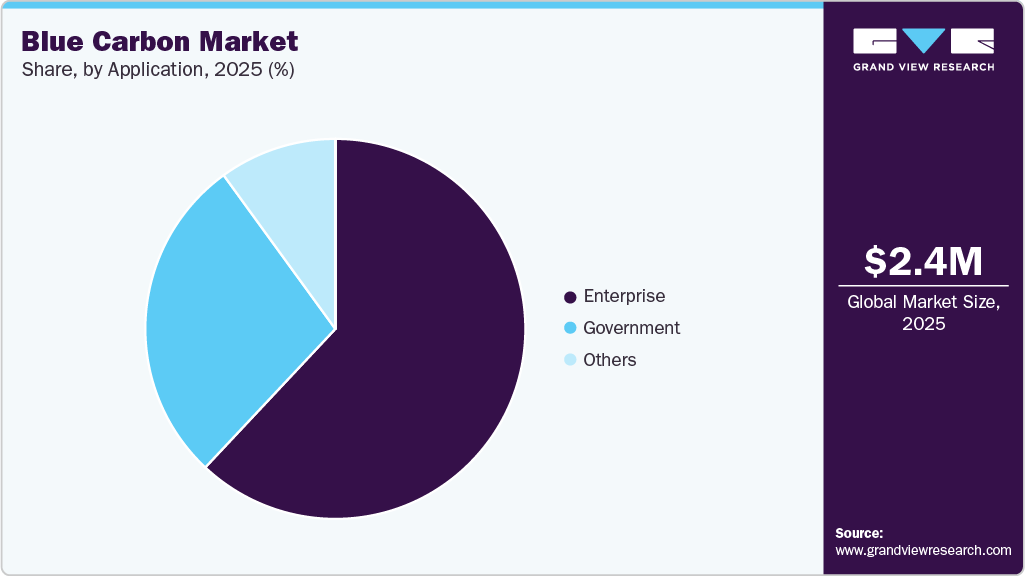
The enterprise segment is projected to register at the fastest CAGR of 27.36% during the forecast period, supported by expanding private-sector climate investments and rising demand for high-integrity carbon credits. Businesses are increasingly partnering with conservation groups and project developers to build diversified carbon portfolios that align with global climate targets. As voluntary carbon markets mature and pricing mechanisms improve, enterprise-led funding is expected to remain a primary catalyst for market expansion.
Regional Insights
The North America blue carbon market represents a significant share in global market in 2025, supported by advanced carbon accounting frameworks, strong institutional funding, and rising corporate participation in voluntary carbon markets. The region is increasingly investing in coastal habitat restoration to enhance climate resilience and address shoreline erosion. Supportive regulatory policies and the presence of experienced project developers are helping accelerate commercialization. Furthermore, enterprises are actively integrating blue carbon credits into their decarbonization strategies, contributing to steady regional growth.
U.S. Blue Carbon Market Trends
The blue carbon market in the U.S. accounted for the largest market revenue share in North America in 2025. Market growth is driven by increasing federal and state-level initiatives focused on wetland restoration, coastal protection, and natural climate solutions. Strong research capabilities, technological advancements in carbon monitoring, and growing partnerships between conservation organizations and private investors are supporting project expansion. As corporate demand for verified carbon credits rises, the U.S. is expected to remain a key contributor to global market development.
Asia Pacific Blue Carbon Market Trends
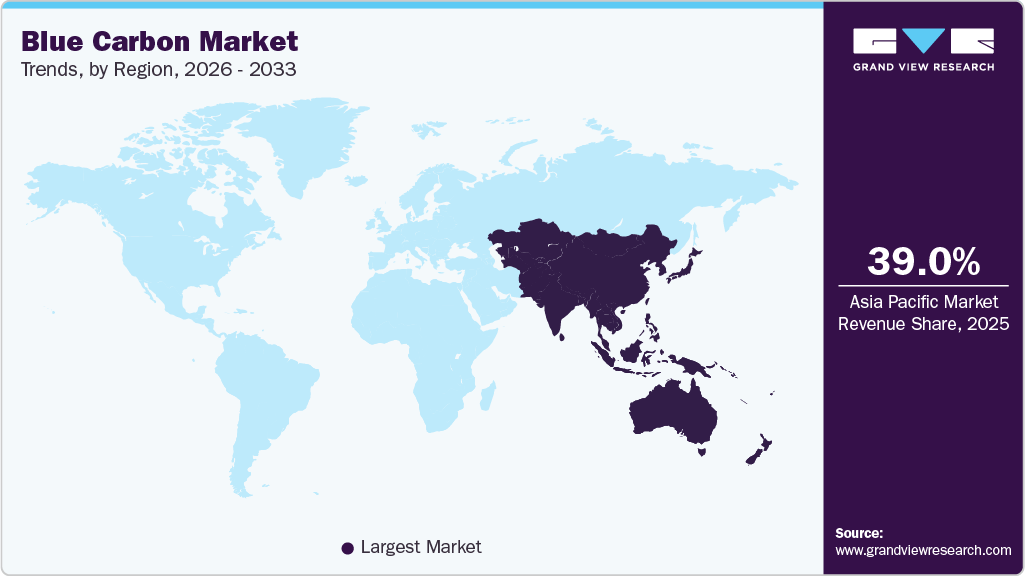
Asia Pacific dominated the global blue carbon market with the largest revenue share of 39.0% in 2025 and is projected to grow at the fastest CAGR during the forecast period, driven by the region’s extensive coastal ecosystems, including large mangrove forests and seagrass meadows across countries such as Indonesia, Australia, India, and Southeast Asia. Strong government initiatives focused on coastal conservation, climate adaptation, and biodiversity protection are accelerating project development. In addition, the region is witnessing increasing collaboration between international environmental organizations and local authorities to scale restoration programs. Growing awareness of nature-based carbon removal solutions and expanding participation in carbon credit markets are further strengthening the Asia Pacific’s leadership in the global blue carbon industry.
Europe Blue Carbon Market Trends
The blue carbon market in Europe is anticipated to grow at a considerable CAGR during the forecast period, supported by ambitious climate targets and comprehensive environmental policies aimed at achieving carbon neutrality. The region is prioritizing the protection and restoration of salt marshes, seagrasses, and other coastal habitats as part of broader biodiversity strategies. Increasing public funding, along with cross-border climate initiatives, is encouraging large-scale project deployment. In addition, the strong presence of sustainability-focused financial institutions is helping mobilize capital toward nature-based solutions across the region.
Latin America Blue Carbon Market Trends
The blue carbon market in Latin America is expected to register at a notable CAGR of 24.70% during the forecast period, driven by the region’s vast mangrove coverage and growing recognition of ecosystem-based climate mitigation. Countries such as Brazil, Mexico, and Colombia are actively promoting conservation and restoration efforts to support carbon sequestration and protect vulnerable coastlines. Improving regulatory frameworks and rising engagement from international climate funds are further enabling project development, positioning Latin America as an emerging growth hub.
Middle East & Africa Blue Carbon Market Trends
The blue carbon market in the Middle East & Africa (MEA) is projected to grow at a significant CAGR of 25.49% during the forecast period, supported by increasing investments in coastal sustainability and climate adaptation initiatives. Several countries are exploring mangrove restoration to combat desertification impacts, enhance biodiversity, and strengthen coastal defenses. While the market remains in an early stage due to funding and technical constraints, expanding environmental commitments and partnerships with global conservation bodies are expected to drive gradual adoption across the region.
Key Blue Carbon Company Insights
Some of the key players operating in the global blue carbon industry include Conservation International, The Nature Conservancy, Verra, South Pole, Climate Impact Partners, Plan Vivo Foundation, Wildlife Conservation Society, Blue Ventures, Silvestrum Climate Associates, and Restore America's Estuaries, among others.
These organizations are actively involved in the development, financing, certification, and implementation of blue carbon projects focused on conserving and restoring coastal ecosystems such as mangroves, seagrasses, and salt marshes. Market participants are prioritizing high-integrity carbon credit generation through robust monitoring, reporting, and verification (MRV) frameworks while strengthening partnerships with governments, research institutions, and local communities. In addition, increasing corporate demand for nature-based offsets and the expansion of voluntary carbon markets are encouraging these players to scale project pipelines and enhance long-term ecosystem protection, positioning blue carbon as a critical component of global climate mitigation strategies.
Key Blue Carbon Companies:
The following key companies have been profiled for this study on the blue carbon market.
- Blue Ventures
- Climate Impact Partners
- Conservation International
- Plan Vivo Foundation
- Restore America's Estuaries
- Silvestrum Climate Associates
- South Pole
- The Nature Conservancy
- Verra
- Wildlife Conservation Society
Recent Developments
-
In November 2025, Indonesia launched its Blue Carbon Ecosystems Roadmap and Action Guide to support the protection and restoration of mangroves, seagrasses, and other coastal ecosystems. The initiative focuses on strengthening carbon sequestration, improving climate resilience, and promoting sustainable ocean-based economic growth, marking a significant step toward advancing global nature-based climate solutions.
Blue Carbon Market Report Scope
Report Attribute
Details
Market Definition
The Blue Carbon market represents the global revenue generated from projects focused on the conservation, restoration, and sustainable management of coastal ecosystems such as mangroves, seagrasses, and salt marshes for carbon sequestration and climate mitigation.
Market size value in 2026
USD 3.10 million
Revenue forecast in 2033
USD 14.79 million
Growth rate
CAGR of 24.99% from 2026 to 2033
Base year for estimation
2025
Historical data
2021 - 2024
Forecast period
2026 - 2033
Quantitative units
Revenue in USD million/billion, and CAGR from 2026 to 2033
Report coverage
Revenue forecast, competitive landscape, growth factors, trends
Segments covered
Ecosystem type, project type, application, region
Regional scope
North America; Europe; Asia Pacific; Latin America; Middle East & Africa
Country scope
U.S.; Canada; Mexico; Germany; UK; France; Italy; Spain; China; India; Japan; Brazil; Argentina; Saudi Arabia; UAE; South Africa
Key companies profiled
Blue Ventures; Climate Impact Partners; Conservation International; Plan Vivo Foundation; Restore America's Estuaries; Silvestrum Climate Associates; South Pole; The Nature Conservancy; Verra; Wildlife Conservation Society
Customization scope
Free report customization (equivalent up to 8 analysts working days) with purchase. Addition or alteration to country, regional & segment scope.
Pricing and purchase options
Avail customized purchase options to meet your exact research needs. Explore purchase options
Global Blue Carbon Market Report Segmentation
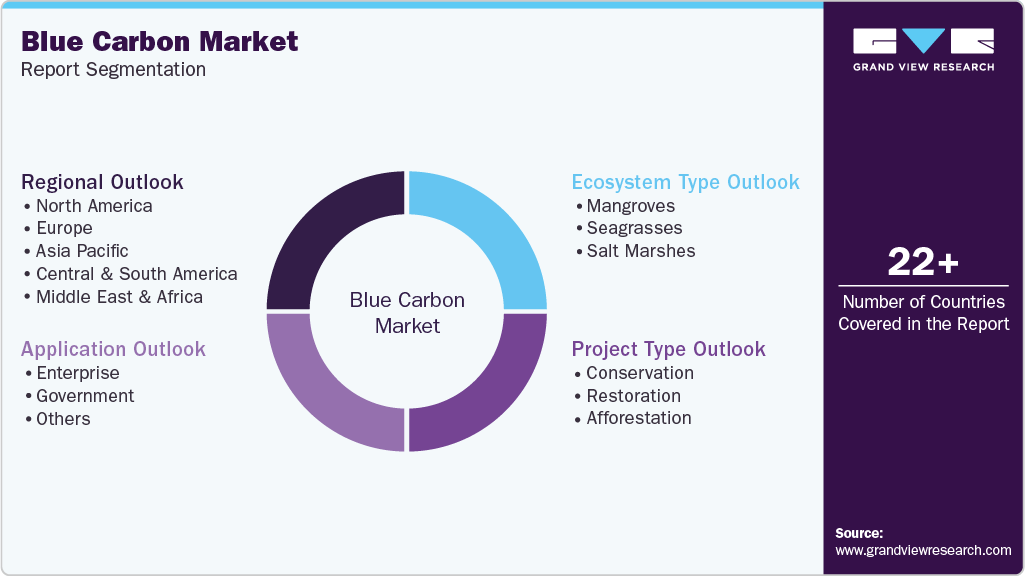
This report forecasts revenue growth at global, regional, and country levels and provides an analysis of the latest industry trends in each of the sub-segments from 2021 to 2033. For this study, Grand View Research has segmented the global blue carbon market report based on the ecosystem type, project type, application, and region:
-
Ecosystem Type Outlook (Revenue, USD Million, 2021 - 2033)
-
Mangroves
-
Seagrasses
-
Salt Marshes
-
-
Project Type Outlook (Revenue, USD Million, 2021 - 2033)
-
Conservation
-
Restoration
-
Afforestation
-
-
Application Outlook (Revenue, USD Million, 2021 - 2033)
-
Enterprise
-
Government
-
Others
-
-
Regional Outlook (Revenue, USD Million, 2021 - 2033)
-
North America
-
U.S.
-
Canada
-
Mexico
-
-
Europe
-
Germany
-
UK
-
France
-
Italy
-
Spain
-
-
Asia Pacific
-
China
-
India
-
Japan
-
-
Central & South America
-
Brazil
-
Argentina
-
-
Middle East & Africa
-
Saudi Arabia
-
UAE
-
South Africa
-
-
Frequently Asked Questions About This Report
b. The global blue carbon market size was estimated at USD 2.42 million in 2025 and is expected to reach USD 3.10 million in 2026.
b. The global blue carbon market is expected to grow at a compound annual growth rate of 24.99% from 2026 to 2033 to reach USD 14.79 million by 2033.
b. Based on the project type segment, Conservation held the largest revenue share of over 44% in the blue carbon market in 2025.
b. Some of the key vendors operating in the global blue carbon market include Conservation International, The Nature Conservancy, Verra, South Pole, Climate Impact Partners, Plan Vivo Foundation, Wildlife Conservation Society, Blue Ventures, Silvestrum Climate Associates, and Restore America's Estuaries, among others.
b. The key factors driving the blue carbon market include the increasing global focus on climate change mitigation, rising demand for nature-based carbon sequestration solutions, and growing participation in voluntary carbon markets.


Share this report with your colleague or friend.
Need a Tailored Report?
Customize this report to your needs — add regions, segments, or data points, with 20% free customization.


ISO 9001:2015 & 27001:2022 Certified
We are GDPR and CCPA compliant! Your transaction & personal information is safe and secure. For more details, please read our privacy policy.
Trusted market insights - try a free sample
See how our reports are structured and why industry leaders rely on Grand View Research. Get a free sample or ask us to tailor this report to your needs.












