
- Home
- »
- Renewable Energy
- »
-
Black Pellets Market Size & Share, Industry Report, 2040GVR Report cover
![Black Pellets Market Size, Share & Trends Report]()
Black Pellets Market (2026 - 2040) Size, Share & Trends Analysis Report By Application (Power Generation, Industrial Heating, Residential Heating), By Region (North America, Europe, Asia Pacific, Latin America, MEA), And Segment Forecasts
- Report ID: GVR-4-68040-844-7
- Number of Report Pages: 120
- Format: PDF
- Historical Range: 2021 - 2024
- Forecast Period: 2026 - 2035
- Industry: Energy & Power
- Report Summary
- Table of Contents
- Segmentation
- Methodology
- Download FREE Sample
-
 Download Sample Report
Black Pellets Market Summary
The global black pellets market size was estimated at USD 298.6 million in 2025 and is projected to reach USD 3,219.5 million by 2033, growing at a CAGR of 14.8% from 2026 to 2040. Black pellets are an advanced form of torrefied biomass fuel produced through thermal treatment of wood and agricultural residues, resulting in a hydrophobic, energy-dense, and coal-like solid fuel.
Key Market Trends & Insights
- The Europe black pellets market held the largest share of 55.1 % of the global market in 2025.
- The UK Black Pellets market is expanding on the back of rising demand for sustainable, higher-energy-density biomass fuels as utilities and industrial energy users seek to replace fossil coal with renewable alternatives.
- By application, the industrial heating held the highest market share of 43.4% in 2025.
Market Size & Forecast
- 2025 Market Size: USD 298.6 Million
- 2040 Projected Market Size: USD 3,219.5 Million
- CAGR (2026-2040): 14.8%
- Europe: Largest market in 2025
- Asia Pacific: Fastest growing market
These pellets offer superior calorific value, improved grindability, and enhanced storage stability compared to conventional white pellets, making them well-suited for co-firing and full substitution in coal-fired power plants. Growing demand for renewable solid fuels, coupled with the global push to reduce coal dependency and greenhouse gas emissions, is significantly supporting market growth.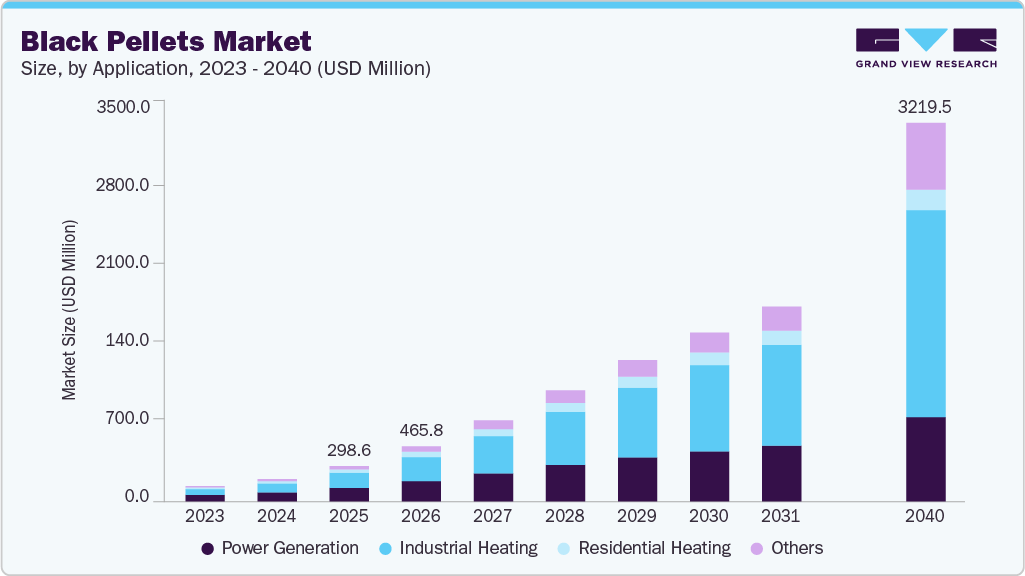
The global black pellet market continues to gain traction, driven by increasing adoption of low-carbon energy alternatives across power generation and industrial heating applications. Utilities and industrial users are increasingly integrating black pellets to leverage existing coal infrastructure while complying with stringent decarbonization and emission regulations. The fuel’s compatibility with conventional coal handling and combustion systems reduces retrofit costs, improving its commercial viability. Technological advancements in torrefaction processes, feedstock flexibility, and pellet durability, along with supportive government policies promoting biomass-based energy and carbon neutrality targets, are further strengthening market momentum worldwide.
Drivers, Opportunities & Restraints
The global black pellets market continues to expand, driven by rising demand for low-carbon, high-energy-density solid fuels as alternatives to coal in power generation and industrial heating applications. Utilities and industrial users are increasingly adopting black pellets to reduce greenhouse gas emissions while leveraging existing coal-fired infrastructure, minimizing the need for extensive retrofitting. The superior properties of black pellets, including higher calorific value, hydrophobicity, improved grindability, and enhanced storage stability, make them particularly suitable for co-firing and full fuel substitution in coal plants. Growing policy support for renewable energy, biomass co-firing mandates, and national decarbonization targets across Europe, North America, and parts of Asia are key factors accelerating market growth.
Emerging opportunities are linked to coal phase-out strategies, rising investments in biomass supply chains, and the increasing focus on energy security and fuel diversification. The scalability of torrefaction technologies enables the integration of black pellet production with diverse feedstocks, including forestry residues, agricultural waste, and energy crops, thereby improving resource utilization and promoting circular economy outcomes. Expanding international biomass trade, particularly between biomass-exporting regions and coal-dependent economies, further enhances market potential. Technological advancements in torrefaction efficiency, pellet durability, and logistics optimization are improving cost competitiveness and enabling broader adoption across power utilities and industrial boilers.
However, the market faces several restraints, including high production and capital costs associated with torrefaction facilities, feedstock preprocessing, and logistics infrastructure. Supply chain complexity, feedstock availability fluctuations, and transportation costs can impact pricing stability, particularly for export-oriented projects. Regulatory uncertainties related to biomass sustainability criteria, land-use concerns, and carbon accounting frameworks may also limit adoption in certain regions. Additionally, limited large-scale commercial reference projects compared to conventional biomass pellets continue to pose adoption risks for conservative utilities and industrial buyers.
Application Insights
The industrial heating segment accounted for the largest revenue share of approximately 43.4% in 2025 within the global black pellets market, driven by the growing replacement of coal and other fossil fuels in energy-intensive industrial processes. Industries such as cement, steel, chemicals, pulp & paper, and food processing are increasingly adopting black pellets as a low-carbon solid fuel for boilers, furnaces, and combined heat and power (CHP) systems. Black pellets offer higher energy density, consistent combustion performance, and compatibility with existing coal-based heating infrastructure, enabling industrial users to reduce emissions without major capital retrofits. Additionally, tightening emission regulations, rising carbon pricing mechanisms, and corporate decarbonization commitments are accelerating the transition toward torrefied biomass fuels for industrial thermal energy generation.
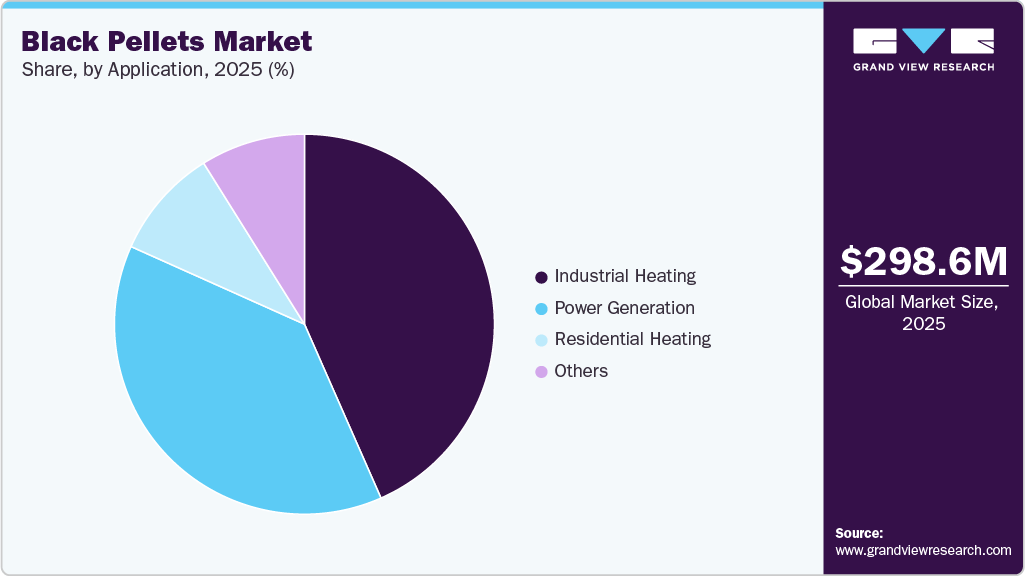
The industrial heating segment is also expected to register the fastest CAGR of 16.4% over the forecast period, reflecting strong momentum across both developed and emerging economies. Rapid industrialization, increasing fuel cost volatility, and heightened focus on energy security are prompting manufacturers to diversify fuel sources and adopt domestically available biomass alternatives. Advancements in torrefaction technology, improved supply chain reliability, and greater availability of standardized black pellet grades are enhancing fuel consistency and operational efficiency for industrial users. Moreover, government incentives supporting biomass-based heat generation, along with sustainability targets linked to Scope 1 emission reductions, are expected to further accelerate adoption, positioning industrial heating as both the largest and fastest-growing application segment in the global Black Pellet market.
Regional Insights
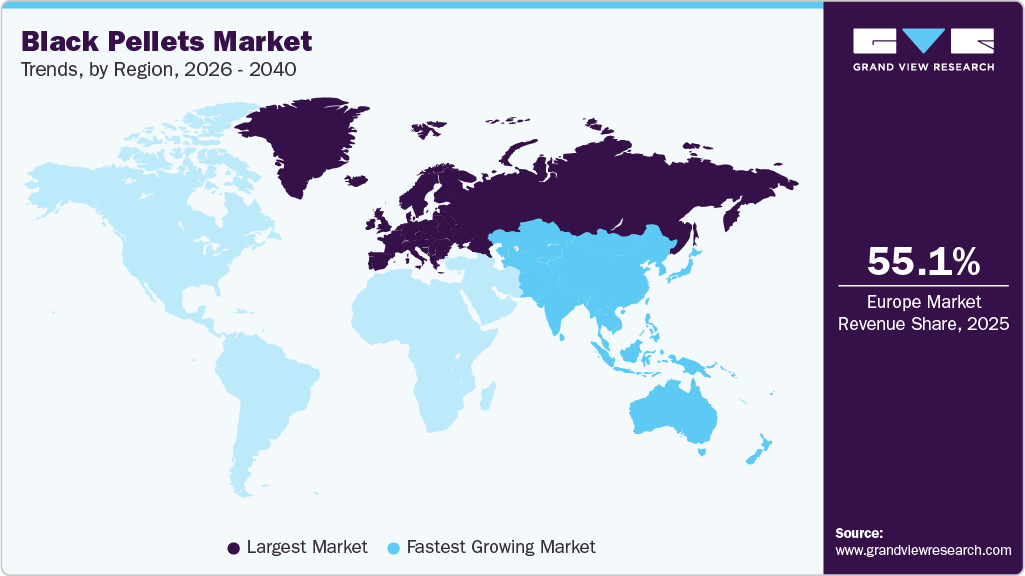
Europe accounted for approximately 55.1% of the global black pellets market revenue in 2025, supported by the region’s aggressive decarbonization agenda and early adoption of biomass-based energy solutions. The widespread phase-out of coal-fired power generation across countries such as the UK, Germany, the Netherlands, and the Nordic region has significantly accelerated demand for black pellets as a direct coal substitute. Strong policy frameworks under the EU Renewable Energy Directive (RED III), carbon pricing mechanisms, and biomass co-firing mandates have encouraged utilities and industrial users to integrate torrefied biomass fuels. Additionally, Europe’s well-developed biomass import infrastructure, long-term offtake agreements, and established sustainability certification standards continue to reinforce the region’s leadership in the global black pellets market.
UK Black Pellets Market Trends
The UK black pellets market is expanding on the back of rising demand for sustainable, higher-energy-density biomass fuels as utilities and industrial energy users seek to replace fossil coal with renewable alternatives. Growth is supported by strong policy frameworks and decarbonisation goals that prioritise biomass co-firing in power generation and renewable heat, alongside infrastructure for imports and logistics that facilitate reliable pellet supply. Technological improvements in torrefaction and pellet quality are enhancing combustion efficiency and broadening applications beyond utility-scale generation into industrial and heating segments, while sustainability criteria and regulatory drivers are shaping sourcing and market access
North America Black Pellets Market Trends
North America represents a significant and steadily growing market for black pellets, driven by increasing focus on industrial decarbonization, coal replacement, and biomass-based energy generation across the U.S. and Canada. The region benefits from abundant forestry and agricultural residues, well-developed biomass supply chains, and strong technical expertise in advanced biomass processing. Utilities and industrial users are increasingly adopting black pellets for coal co-firing, combined heat and power (CHP), and industrial boiler applications, as the fuel enables emissions reduction while leveraging existing coal-handling infrastructure. Supportive federal and state-level policies promoting renewable energy, carbon reduction, and sustainable forestry practices, along with rising investments in export-oriented torrefied biomass production facilities, continue to strengthen North America’s position in the global Black Pellet market.
The U.S. black pellets market is witnessing steady growth driven by increasing focus on industrial decarbonization, energy security, and biomass utilization across power generation and industrial heating applications. Growing adoption of black pellets in coal co-firing, combined heat and power (CHP) plants, and large-scale industrial boilers is supporting market expansion. Favorable federal and state-level incentives for renewable energy, along with emissions reduction targets, and the availability of abundant forestry and agricultural residues, further enhance the market potential. Moreover, rising investments in advanced biomass processing technologies and export-oriented production facilities position the U.S. as both a key consumer and supplier within the global black pellet supply chain.
Asia Pacific Black Pellets Market Trends
The Asia Pacific region is projected to register the fastest CAGR of approximately 19% over the forecast period, driven by rapid industrialization, increasing electricity and thermal energy demand, and growing reliance on imported coal. Countries such as Japan, South Korea, China, and India are increasingly adopting black pellets to meet renewable energy targets while maintaining grid stability and industrial output. Government-led initiatives promoting biomass co-firing, energy diversification, and emissions reduction are accelerating adoption across power utilities and industrial sectors. Improvements in regional biomass supply chains, expanding import capacity, and rising investments in torrefaction and pellet production facilities are further strengthening the Asia Pacific’s role as the fastest-growing market globally.
Latin America Black Pellets Market Trends
The black pellets market in Latin America is supported by growing interest in renewable solid fuels and the utilization of abundant forestry and agricultural residues. Countries across the region are exploring black pellets to enhance energy diversification, reduce fossil fuel dependency, and support industrial heating and power generation applications. Increasing private-sector participation and improving regulatory frameworks for biomass-based energy projects are expected to contribute to gradual market expansion.
Middle East & Africa Black Pellets Market Trends
The Middle East & Africa black pellets market is gaining traction as countries focus on energy diversification, industrial efficiency, and emissions reduction. Growing adoption of biomass-based fuels in cement, metals, and power generation facilities, particularly in regions with limited access to low-cost natural gas, is supporting market growth. Emerging biomass import initiatives, coupled with government-backed sustainability programs and industrial decarbonization strategies, are expected to gradually increase black pellet adoption across the region.
Key Black Pellets Company Insights
Some of the key players operating in the global black pellets market include Airex Energy Inc. and Arbaflame AS, among others.
-
Airex Energy Inc. is one of the prominent players in the global Black Pellet market, recognized for its advanced torrefaction technology and production of high-quality black pellets for industrial and power generation applications. The company focuses on upgrading low-value biomass into energy-dense, hydrophobic pellets that can directly replace coal in boilers and co-firing systems. Airex Energy’s technology emphasizes improved fuel stability, consistent calorific value, and compatibility with existing coal infrastructure, enabling industrial users to reduce carbon emissions without major retrofits.
-
Arbaflame AS is a leading European developer of black pellet technology, known for its proprietary steam-exploded biomass fuel branded as ArbaCore. The company specializes in producing high-performance black pellets designed for efficient combustion and handling coal-fired power plants and industrial heating systems. Arbaflame’s technology enhances pellet durability, grindability, and moisture resistance, making it suitable for long-distance transport and large-scale energy applications. With a strong presence in Europe and ongoing expansion efforts in Asia and North America, Arbaflame contributes significantly to the commercialization of torrefied biomass fuels and supports regional decarbonization and coal phase-out initiatives.
Key Black Pellets Companies:
The following are the leading companies in the black pellets market. These companies collectively hold the largest market share and dictate industry trends.
- Airex Energy Inc.
- Arbaflame AS
- Bioendev AB
- Blackwood Technology B.V.
- Idemitsu Kosan Co., Ltd.
- Khodal Bio Fuel
- NT Biomass Products Co., Ltd. (NTBC)
- SIMEC
- Talwandi Sabo Power Limited (TSPL)
- Thermya
Recent Developments
-
In March 2025, Idemitsu Kosan Co., Ltd. announced the expansion of its torrefied (black) pellet production capacity in Southeast Asia, strengthening its biomass fuel supply chain for coal co-firing and industrial heating applications. The expansion focuses on scaling up the production of high-energy-density black pellets using sustainably sourced biomass, targeting long-term supply agreements with power utilities in Japan and other Asia Pacific markets.
Black Pellet Market Report Scope
Report Attribute
Details
Market Definition
The black pellet market represents the global revenue generated from the production and sale of torrefied biomass pellets used as a low-carbon solid fuel in power generation and industrial heating applications.
Market size value in 2026
USD 465.85 million
Revenue forecast in 2040
USD 3,219.5 million
Growth rate
CAGR of 14.8% from 2026 to 2040
Base year for estimation
2025
Historical data
2021 - 2024
Forecast period
2026 - 2040
Quantitative Units
Revenue in USD million, volume in thousand tons and CAGR from 2026 to 2040
Report coverage
Revenue forecast, competitive landscape, growth factors, and trends
Segments covered
Application, region
Regional scope
North America; Europe; Asia Pacific; Latin America; Middle East & Africa
Country scope
U.S.; Canada; Germany; UK; Italy; China; Thailand; Japan
Key companies profiled
Airex Energy Inc.; Arbaflame AS; Idemitsu Kosan Co., Ltd.; NT Biomass Products Co., Ltd. (NTBC); Talwandi Sabo Power Limited (TSPL); Khodal Bio Fuel; Blackwood Technology B.V.; Bioendev AB; Thermya; SIMEC
Customization scope
Free report customization (equivalent up to 8 analysts working days) with purchase. Addition or alteration to country, regional & segment scope.
Pricing and purchase options
Avail customized purchase options to meet your exact research needs. Explore purchase options
Global Black Pellets Market Report Segmentation
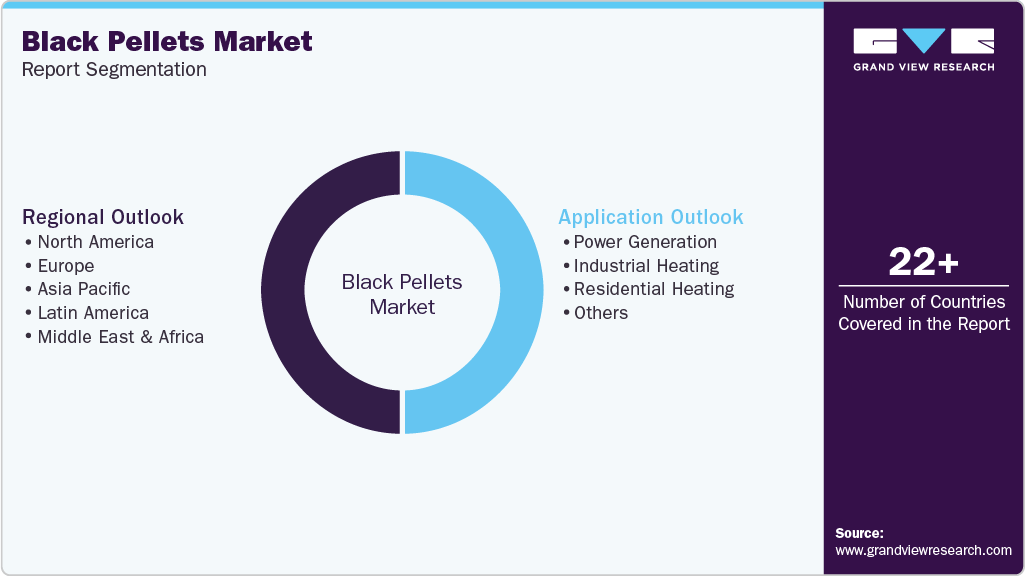
This report forecasts revenue growth at global, regional, and country levels and provides an analysis of the latest industry trends in each of the sub-segments from 2021 to 2040. For the purpose of this study, Grand View Research has segmented the global black pellets market report on the basis of application and region:
-
Application Outlook (Revenue, USD Million; Volume, Thousand Tons; 2021 - 2040)
-
Power Generation
-
Industrial Heating
-
Residential Heating
-
Others
-
-
Regional Outlook (Revenue, USD Million; Volume, Thousand Tons; 2021 - 2040)
-
North America
-
U.S.
-
Canada
-
-
Europe
-
Germany
-
UK
-
Italy
-
-
Asia Pacific
-
China
-
Thailand
-
Japan
-
-
Latin America
-
Middle East & Africa
-
Frequently Asked Questions About This Report
b. The global black pellets market size was estimated at USD 298.6 million in 2025 and is expected to reach USD 465.85 million in 2026.
b. The global black pellets market is expected to grow at a compound annual growth rate of 14.8% from 2026 to 2040 to reach USD 3,219.5 million by 2040.
b. Based on the application segment, industrial heating held the largest revenue share of more than 43% in 2025.
b. Some of the key vendors operating in the global black pellets market include Airex Energy Inc., Arbaflame AS, Idemitsu Kosan Co., Ltd., NT Biomass Products Co., Ltd. (NTBC), Talwandi Sabo Power Limited (TSPL), Khodal Bio Fuel, Blackwood Technology B.V., Bioendev AB, Thermya, and SIMEC, among others.
b. The key factors driving the black pellets market include the rising focus on decarbonization and fuel substitution, which is accelerating the adoption of torrefied biomass pellets as low-carbon alternatives to coal across power generation and industrial heating applications.


Share this report with your colleague or friend.
Need a Tailored Report?
Customize this report to your needs — add regions, segments, or data points, with 20% free customization.


ISO 9001:2015 & 27001:2022 Certified
We are GDPR and CCPA compliant! Your transaction & personal information is safe and secure. For more details, please read our privacy policy.
Trusted market insights - try a free sample
See how our reports are structured and why industry leaders rely on Grand View Research. Get a free sample or ask us to tailor this report to your needs.












