- Home
- »
- Clothing, Footwear & Accessories
- »
-
Baby High Chair Market Size, Share, Industry Report, 2033GVR Report cover
![Baby High Chair Market Size, Share & Trends Report]()
Baby High Chair Market (2025 - 2033) Size, Share & Trends Analysis Report By Product Type (Traditional, Convertible), By Material (Plastic, Metal/Mixed), By Price Tier (Economy, Premium), By Distribution Channel (Online, Offline), By Region, And Segment Forecasts
- Report ID: GVR-4-68040-815-3
- Number of Report Pages: 100
- Format: PDF
- Historical Range: 2021 - 2024
- Forecast Period: 2025 - 2033
- Industry: Consumer Goods
- Report Summary
- Table of Contents
- Segmentation
- Methodology
- Download FREE Sample
-
 Download Sample Report
Baby High Chair Market Summary
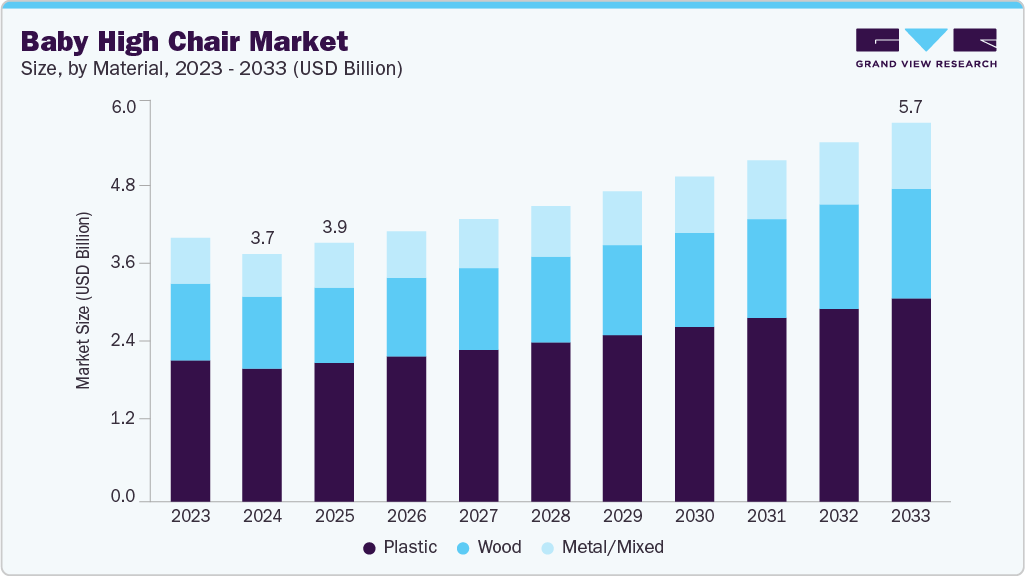
The global baby high chair market size was estimated at USD 3.71 billion in 2024 and is projected to reach USD 5.68 billion by 2033, growing at a CAGR of 4.9% from 2025 to 2033. The growth is attributed to rising parental focus on child safety, convenience, and multifunctional designs.
Key Market Trends & Insights
- By product type, traditional baby high chair led the market with a share of 36.46% in 2024.
- By material, plastic led the market and accounted for a share of 53.66% in 2024.
- By price tier, the economy segment held the largest market share of 45.84% in 2024.
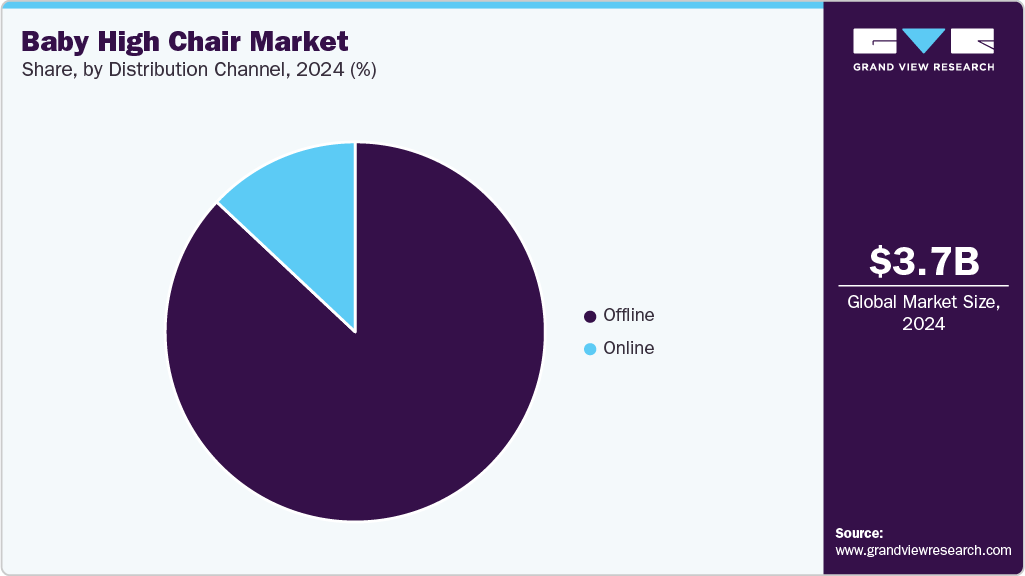
- By distribution channel, the offline sales accounted for a market share of 78.30% in 2024.
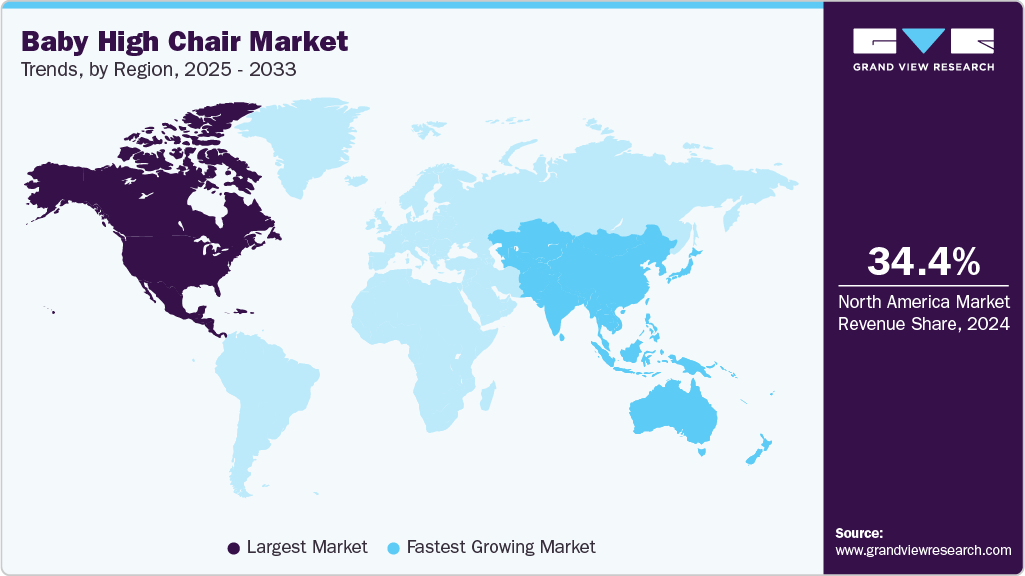
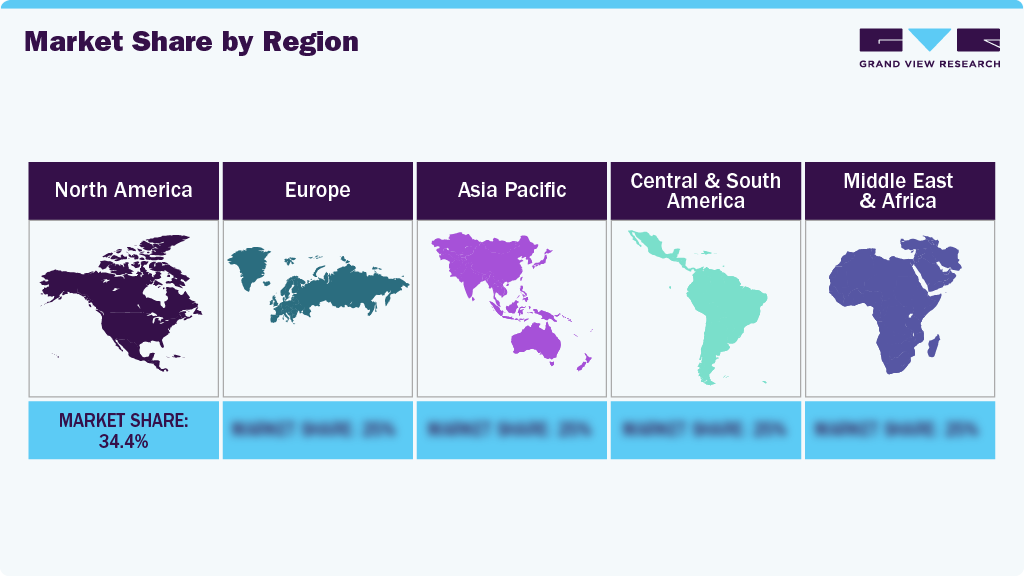
- By Region, North America held a market share of 34.45% in 2024.
Market Size & Forecast
- 2024 Market Size: USD 3.71 Billion
- 2033 Projected Market Size: USD 5.68 Billion
- CAGR (2025-2033): 4.9%
- North America: Largest market in 2024
- Asia Pacific: Fastest growing market
Moreover, the expansion of e-commerce accessibility and the introduction of premium product innovations are boosting overall market demand. A key ongoing trend in the baby high chair market is the rising popularity of convertible and space-saving designs that adapt as the child grows. Parents are increasingly opting for multifunctional chairs that transform into toddler seats or booster chairs, providing long-term value, sustainability, and convenience in smaller living spaces.The global baby high chair market is witnessing strong growth as parents increasingly prioritize safety, comfort, and hygiene in infant products. Enhanced safety features, such as five-point harnesses, anti-slip bases, and ergonomic seating, have become key differentiators. Brands such as Stokke and Peg Perego focus on certified, posture-supportive designs that ensure both security and usability.
Sustainability has emerged as a major influence on consumer purchasing decisions, with parents preferring high chairs made from eco-friendly materials like responsibly sourced wood, recyclable plastics, and non-toxic finishes. Brands such as Hauck and Stokke are responding by introducing long-lasting convertible designs that align with growing environmental awareness and reduce the frequency of product replacement.
Digital and social media platforms such as Instagram, YouTube, and parenting forums are increasingly shaping global consumer behavior and brand perception in the baby product segment. Parents today rely heavily on online communities, product reviews, and influencer recommendations when making purchasing decisions. Visual marketing campaigns that highlight safety features, design aesthetics, and ease of use have proven highly effective in driving brand awareness and trust. As a result, influencer collaborations and user-generated content are accelerating the adoption of branded high chairs, particularly among younger, tech-savvy parents seeking reliable and aspirational products.
Consumer Insights
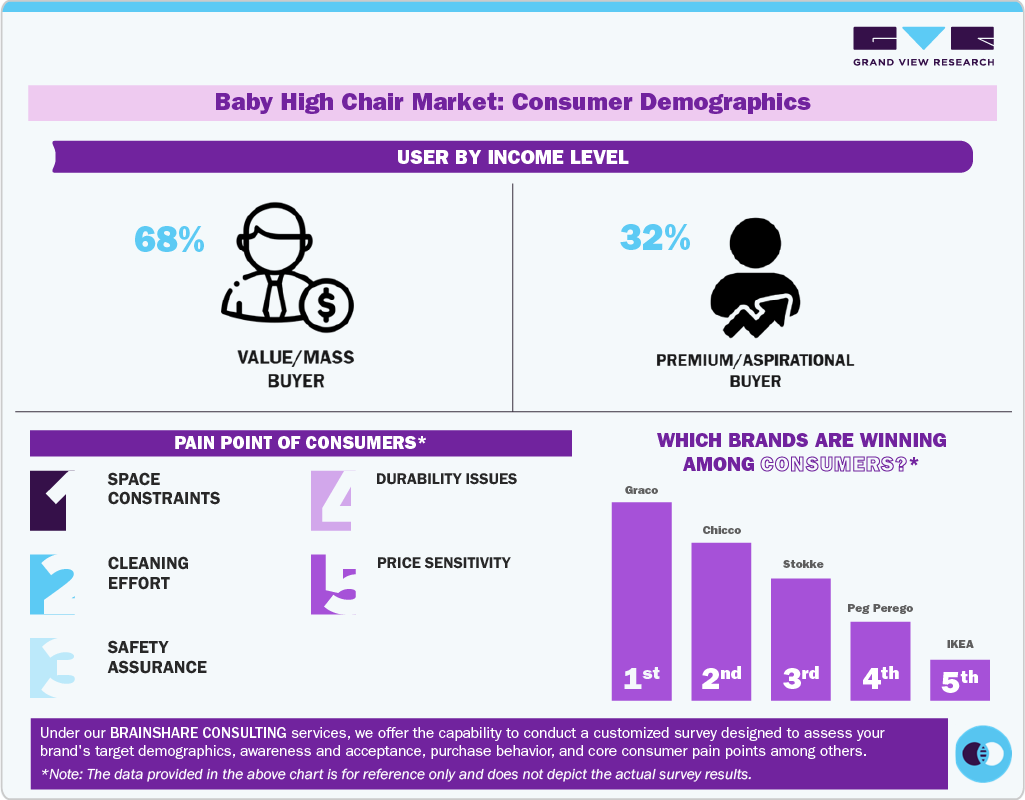
The global baby high chair market serves two distinct consumer groups divided by income level. Around 68-72% of buyers fall into the value or mass segment, comprising primarily middle-income families who emphasize safety, affordability, and practicality over design. This segment dominates sales volumes, particularly in Asia Pacific and Latin America, where price sensitivity remains high and local or private-label brands are popular. Meanwhile, premium or aspirational buyers, representing roughly 28-32% of the market, are concentrated in urban centers of North America and Europe. These consumers prioritize quality materials, multifunctional usability, and aesthetic appeal-often viewing high chairs as part of a modern home’s interior design rather than just a utility product.
Across segments, parents share a consistent set of purchase frustrations. The leading consumer pain points include space constraints, as urban homes become smaller; cleaning effort, since food residue and stains are common; safety assurance, driven by rising awareness of product recalls and certifications; durability issues, particularly with low-cost plastic models; and price sensitivity, which continues to limit premium adoption in developing regions. These issues directly shape brand strategies, pushing manufacturers toward foldable, easy-wash, and certified designs that cater to both functionality and peace of mind.
In terms of brand traction, a handful of companies have built strong consumer loyalty globally. Graco remains a market leader, valued for its balance of safety and price. Chicco continues to attract mid-range buyers through ergonomic comfort and trusted European quality, while Stokke dominates the premium space with its iconic Tripp Trapp model appealing to design-led parents. Peg Perego is strong among buyers seeking long-lasting, convertible solutions, and IKEA consistently wins the value segment with its minimalist, budget-friendly approach. Together, these brands define the competitive landscape across mass and premium tiers of the global baby high chair market.
Product Type Insights
Traditional baby high chair held a market share of 36.46% in 2024, largely as they cater to first-time parents seeking reliable, sturdy seating solutions without complex mechanisms. In many developing markets, traditional models are perceived as safer and more reliable, with a lower risk of malfunction compared to convertible or portable variants. Their lower replacement rate and wide availability in offline retail further supported their strong share, especially among mid- to low-income households.
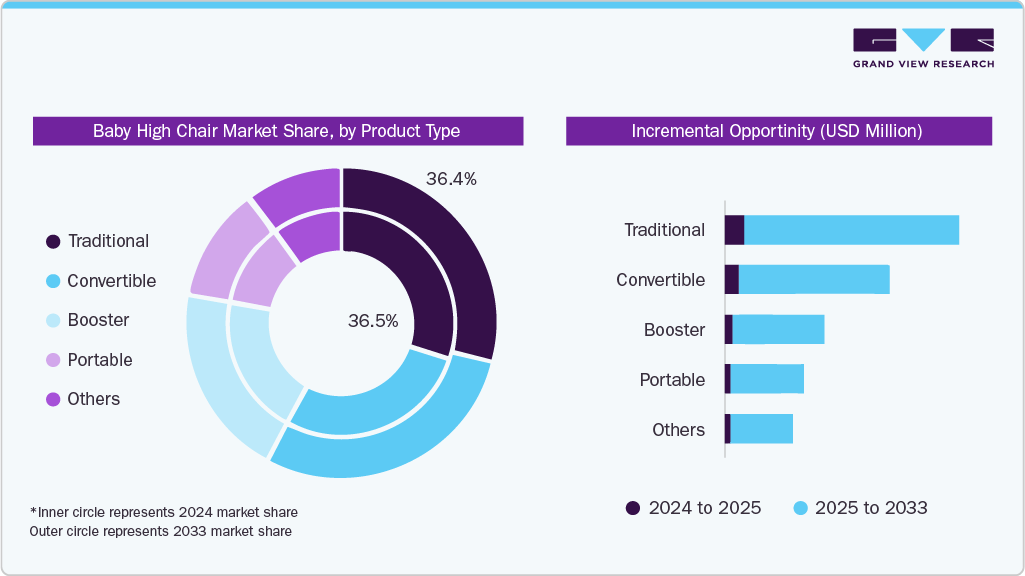
Convertible baby high chair is anticipated to witness a CAGR of 5.1% from 2025 to 2033. The demand stems from rising demand for multifunctional baby products that adapt to different growth stages. Urban families with limited space are increasingly opting for models that transition from infant feeding chairs to toddler seats, aligning with sustainability and “value per use” trends. Premium brands such as Stokke and Peg Perego are capitalizing on this with modular, design-forward offerings that appeal to affluent parents focused on long-term savings and product aesthetics.
Material Insights
Plastic baby high chair accounted for a revenue share of 53.66% in 2024. Plastic models dominated due to their combination of practicality and affordability. Lightweight design allows easy movement around the home, while smooth surfaces simplify cleaning. Moreover, plastic enables colorful, ergonomic designs at scale, driving mass adoption through both hypermarkets and online platforms. In emerging economies, the low price point and availability of unbranded or local plastic models made this category especially pervasive.
Metal/Mixed baby high chair are anticipated to grow at a CAGR of 5.0% from 2025 to 2033. The growth is tied to growing urban affluence and preference for minimalist, Scandinavian-style interiors. Parents in Europe, Japan, and North America increasingly view high chairs as part of home décor, prompting a shift toward metal-framed models with wood or composite accents. The segment also benefits from improved corrosion-resistant coatings and collapsible designs that combine strength with modern aesthetics.Price Tier Insights
Economy baby high chair segment accounted for 45.84% of global revenue in 2024. Economy products held nearly half of global revenue because affordability remains the primary purchase driver in large-volume markets such as Brazil, and Indonesia. Local manufacturers and private labels have expanded distribution through supermarkets and baby stores, keeping prices competitive. This segment also benefitted from heightened awareness of child safety, pushing even budget buyers toward basic certified models rather than makeshift feeding solutions.
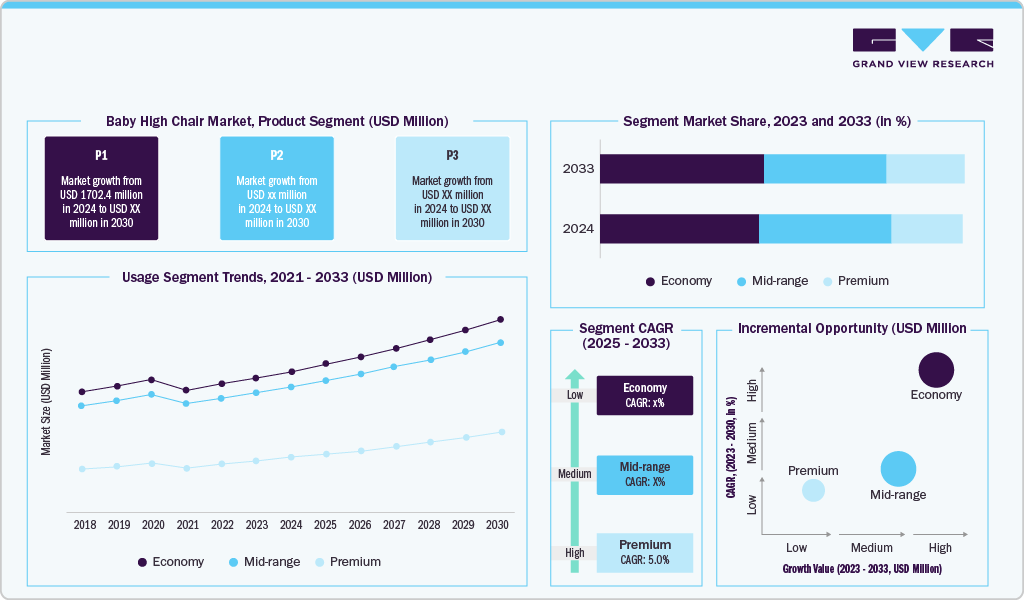
Mid-range high chair segment is anticipated to grow at a CAGR of 4.8% from 2025 to 2033. Mid-range chairs are gaining traction as parents transition from basic plastic units to models offering adjustable trays, reclining options, and premium finishes. The high CAGR reflects the “trading-up” trend, particularly in China, South Korea, and Western Europe, where dual-income households are more willing to invest in comfort and safety. This segment is also capturing share from premium brands as mid-tier manufacturers integrate design and quality improvements while keeping prices accessible.
Distribution Channel Insights
The sale of baby high chair through offline channels accounted for a revenue share of 78.30% in 2024, as most parents prefer to physically assess build quality, stability, and safety harnesses before purchase. High chairs are perceived as long-term safety products, and in-store staff guidance often influences purchase decisions. Moreover, offline dominance is amplified in Asia and Latin America, where fragmented e-commerce logistics and lower trust in online baby product quality still limit digital penetration.
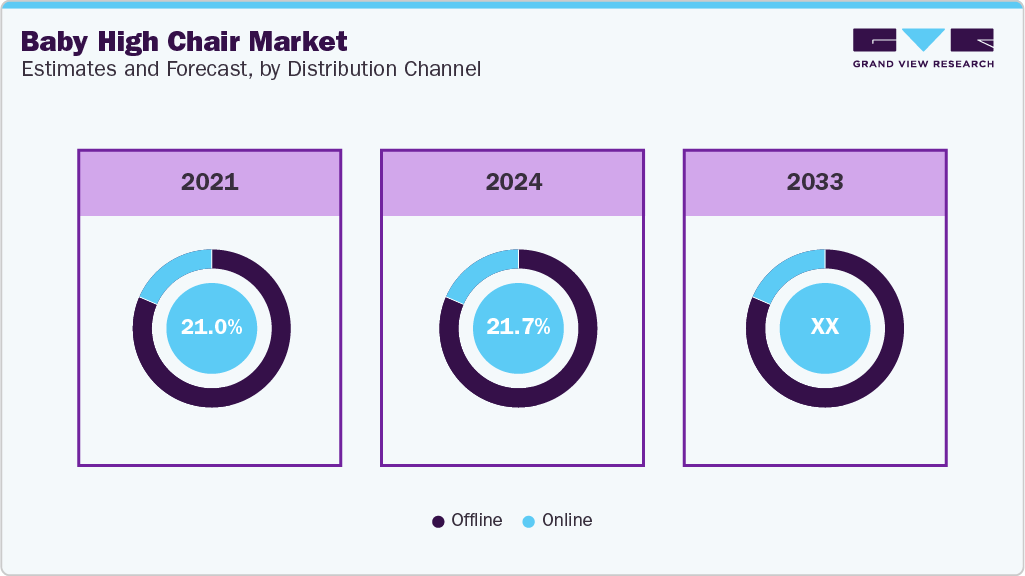
The sale of baby high chair through the online channel is expected to grow at a CAGR of 5.9% from 2025 to 2033, driven by 24/7 convenience, easy price comparison, and wider product selection. Growth is particularly strong in emerging markets and mid-range segments, as consumers increasingly embrace digital platforms for research and purchase, complementing traditional brick-and-mortar experiences.
Regional Insights
The North America baby high chair market held a revenue share of 34.45% in 2024. North America accounted for over one-third of global baby high chair revenue in 2024, driven by high product penetration, strong brand presence, and greater spending capacity among parents. The region’s mature baby care ecosystem-with established players such as Graco, Evenflo, and Fisher-Price-has built strong brand trust. Parents in the U.S. and Canada increasingly prioritize ergonomic design, safety certification, and sustainability, supporting steady demand for both traditional and convertible models. The presence of large-format baby specialty stores and omni-channel retail further reinforces consistent sales in the region.
U.S. Baby High Chair Market Trends
The U.S. baby high chair market is expected to grow at a CAGR of 4.5% from 2025 to 2033. The growth reflects sustained replacement demand and the shift toward premium and multifunctional designs. Rising urbanization and smaller living spaces are encouraging demand for compact, foldable, and convertible chairs. Moreover, growing emphasis on child safety regulations-such as compliance with ASTM and CPSC standards-continues to favor trusted branded products over unregulated imports. The rise of DTC brands and strong online visibility on platforms such as Amazon and BuyBuyBaby are also enabling broader market access for both established and niche players.
Asia Pacific Baby High Chair Market Trends
The Asia Pacific baby high chair market is anticipated to grow at a CAGR of 5.5% from 2025 to 2033, driven by rising disposable incomes, expanding middle-class populations, and urbanization in countries such as China, India, and Indonesia. Growing awareness of baby safety and hygiene, influenced by Western parenting trends, is fueling demand for branded, quality-certified high chairs. E-commerce growth, social media parenting communities, and aspirational consumer behavior are further accelerating premiumization in urban centers, while local manufacturers continue to make affordable plastic models accessible in rural markets.
Key Baby High Chair Company Insights
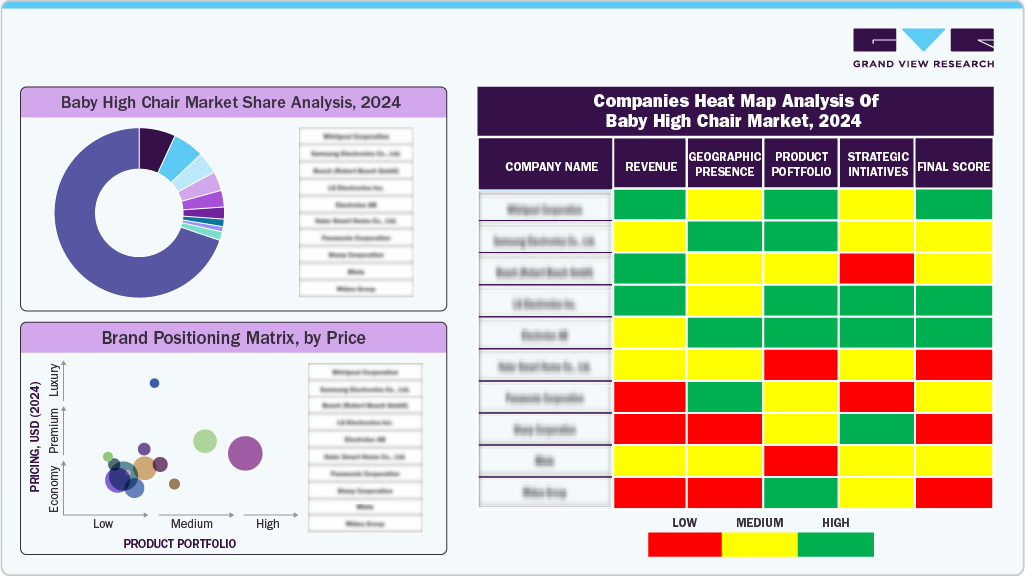
The global baby high chair market is characterized by a blend of long-established childcare brands, design-driven European manufacturers, and emerging regional players catering to diverse income groups and lifestyle preferences. Leading multinational companies such as Graco, Chicco, Peg Perego, and Evenflo dominate the mid to premium range through their strong brand reputation, adherence to international safety standards, and broad retail distribution networks across North America and Europe.
Premium design-oriented brands such as Stokke and Joovy have built a niche among urban, style-conscious parents seeking ergonomic, space-efficient, and aesthetically appealing products that blend with modern interiors. These companies emphasize modularity, sustainability, and innovation-features increasingly valued by dual-income households in developed markets.
Meanwhile, regional players such as R for Rabbit (India), Babyhug, Apramo (China), and Pigeon (Japan) are expanding in price-sensitive markets by offering durable, certified, yet cost-effective models that appeal to first-time parents. Their growing presence across e-commerce platforms and baby specialty stores is intensifying competition, especially in Asia Pacific. This multi-tiered landscape-spanning budget-friendly functional chairs to premium convertible designs-continues to define the market’s structure and global competitive balance.
Key Baby High Chair Companies:
The following are the leading companies in the baby high chair market. These companies collectively hold the largest Market share and dictate industry trends.
- Graco Inc.
- Chicco (Artsana Group)
- Peg Perego
- Stokke AS
- Evenflo
- Joovy
- IKEA
- Cosco Kids (Dorel Juvenile)
- R for Rabbit
- Pigeon Corporation
Recent Developments
-
In January 2025, Cybex launched the “Click & Fold” high chair - a sustainable, space-saving seating solution crafted from European beech wood. Designed to grow with the user from infancy to adulthood, it features adjustable height and depth settings and can be folded flat with a single click for easy storage. Combining functionality, ergonomics, and contemporary design, the chair reflects Cybex’s focus on adaptable and stylish family furniture for modern homes.
-
In March 2025, Lalo launched its product range at Target, aligning with Target’s initiative to expand and elevate its baby-care aisle through premium and design-forward brands.
Baby High Chair Market Report Scope
Report Attribute
Details
Market size value in 2025
USD 3.88 billion
Revenue forecast in 2033
USD 5.68 billion
Growth rate (Revenue)
CAGR of 4.9% from 2025 to 2033
Actual data
2021 - 2024
Forecast period
2025 - 2033
Quantitative units
Revenue in USD Million/ Billion, and CAGR from 2025 to 2033
Report coverage
Revenue forecast, company ranking, competitive landscape, growth factors, and trends
Segments covered
Product type, price tier, material, distribution channel, region
Regional scope
North America; Europe; Asia Pacific; Central & South America; Middle East & Africa
Country scope
U.S.; Canada; Mexico; UK; Germany; France; Italy; Spain; China; India; Japan; Australia& New Zealand; South Korea; Brazil; South Africa
Key companies profiled
Graco Inc.; Chicco (Artsana Group); Peg Perego; Stokke AS; Evenflo; Joovy; IKEA; Cosco Kids (Dorel Juvenile); R for Rabbit; Pigeon Corporationx
Customization scope
Free report customization (equivalent up to 8 analysts working days) with purchase. Addition or alteration to country, regional & segment scope. Pricing and purchase options
Avail customized purchase options to meet your exact research needs. Explore purchase options Global Baby High Chair Market Report Segmentation
This report forecasts revenue growth at the global, regional, and country levels and provides an analysis of the latest industry trends and opportunities in each of the sub-segments from 2021 to 2033. For this study, Grand View Research has segmented the global baby high chair market report based on product type, material, price tier, distribution channel, and region.
-
Product Type Outlook (Revenue, USD Million, 2021 - 2033)
-
Traditional
-
Convertible
-
Portable
-
Booster
-
Others
-
-
Price Tier Outlook (Revenue, USD Million, 2021 - 2033)
-
Economy
-
Mid-range
-
Premium
-
-
Material Outlook (Revenue, USD Million, 2021 - 2033)
-
Plastic
-
Wood
-
Metal/Mixed
-
-
Distribution Channel (Revenue, USD Million, 2021 - 2033)
-
Online
-
E-commerce marketplaces
-
Brand/DTC sites
-
-
Offline
-
Baby specialty stores
-
Hypermarkets/Supermarkets
-
Furniture stores
-
-
-
Regional Outlook (Revenue, USD Million, 2021 - 2033)
-
North America
-
U.S.
-
Canada
-
Mexico
-
-
Europe
-
UK
-
Germany
-
France
-
Italy
-
Spain
-
-
Asia Pacific
-
China
-
Japan
-
India
-
Australia & New Zealand
-
South Korea
-
-
Central & South America
-
Brazil
-
-
Middle East & Africa
-
South Africa
-
-
Frequently Asked Questions About This Report
b. The global baby high chair market size was estimated at USD 3.71 billion in 2024 and is expected to reach USD 3.88 billion in 2025.
b. The global baby high chair market is expected to grow at a compound annual growth rate (CAGR) of 4.9% from 2025 to 2033 to reach USD 5.68 billion by 2033.
b. Traditional baby high chair held a market share of 36.46% in 2024, largely as they cater to first-time parents seeking reliable, sturdy seating solutions without complex mechanisms.
b. Some key players in the baby high chair market include Graco Inc.; Chicco (Artsana Group); Peg Perego; Stokke AS; Evenflo; Joovy; IKEA; Cosco Kids (Dorel Juvenile); R for Rabbit; and Pigeon Corporationx, Fisher-Price (Mattel Inc.); Hauck GmbH & Co. KG
b. The baby high chair market is growing due to rising parental focus on child safety, convenience, and multifunctional designs. Additionally, the expansion of e-commerce accessibility and the introduction of premium product innovations are boosting overall market demand


Share this report with your colleague or friend.
Need a Tailored Report?
Customize this report to your needs — add regions, segments, or data points, with 20% free customization.


ISO 9001:2015 & 27001:2022 Certified
We are GDPR and CCPA compliant! Your transaction & personal information is safe and secure. For more details, please read our privacy policy.
Trusted market insights - try a free sample
See how our reports are structured and why industry leaders rely on Grand View Research. Get a free sample or ask us to tailor this report to your needs.