Automotive Fuel Cell Market Summary
The global automotive fuel cell market size was estimated at USD 6.89 billion in 2025 and is projected to reach USD 10.06 billion by 2033, growing at a CAGR of 4.9% from 2025 to 2033. The market growth is primarily driven by the rising demand for zero-emission mobility, increasing government support for hydrogen infrastructure, and the growing adoption of fuel cell electric vehicles (FCEVs) across passenger and commercial vehicle segments to meet stringent emission regulations.
Key Market Trends & Insights
- Asia Pacific automotive fuel cell market held the largest share of 70.2% of the global market in 2025.
- The automotive fuel cell market in the U.S. is expected to grow significantly over the forecast period.
- By type, the PEMFC segment held the highest market share of 91.9% in 2025.
- By application, the passenger cars segment held the largest revenue share in 2025.
Market Size & Forecast
- 2025 Market Size: USD 6.89 Billion
- 2033 Projected Market Size: USD 10.06 Billion
- CAGR (2026-2033): 4.9%
- Asia Pacific: Largest market in 2025
- North America: Fastest growing market
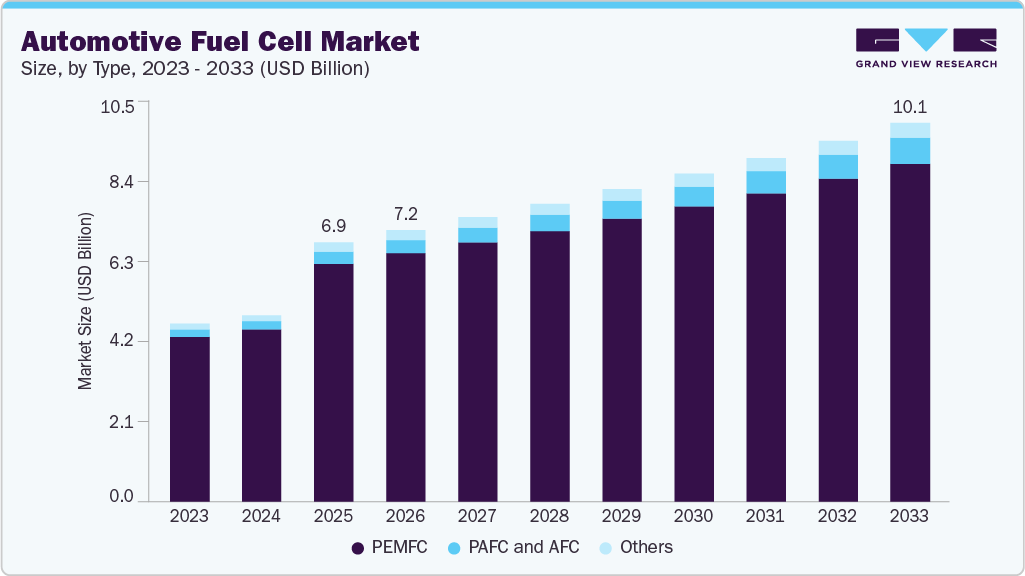
In addition, the market is gaining momentum due to continuous advancements in fuel cell stack efficiency, durability improvements, and cost reduction in key components such as membranes, catalysts, and bipolar plates. Expanding investments in green hydrogen production, along with partnerships between automakers, energy companies, and hydrogen refueling providers, are further accelerating deployment. These factors are expected to support steady market expansion over the forecast period.
Drivers, Opportunities & Restraints
The global automotive fuel cell market is primarily driven by the rising demand for zero-emission transportation, strict government emission regulations, and increasing adoption of hydrogen fuel cell electric vehicles (FCEVs), especially in heavy-duty trucks, buses, and long-range commercial fleets. Fuel cells are gaining traction due to their fast refueling time, long driving range, and suitability for applications where battery-only solutions may face limitations. In addition, growing investments by automakers and energy companies in hydrogen production and refueling infrastructure, along with national hydrogen roadmaps and subsidies, are supporting steady market growth.
Opportunities are expanding due to advancements in fuel cell stack efficiency, durability improvement, and cost reduction in key components such as catalysts, membranes, and bipolar plates. The market is also benefiting from the increasing availability of green hydrogen, the expansion of hydrogen refueling networks, and rising interest in fleet-based deployment models (public transport, logistics, and municipal fleets), where centralized fueling makes adoption easier. Further, partnerships across the hydrogen ecosystem, including OEMs, fuel suppliers, and infrastructure developers, are accelerating commercialization.
However, the market faces restraints such as the high upfront cost of fuel cell vehicles, limited hydrogen refueling infrastructure, and challenges related to hydrogen storage, transportation, and safety requirements. In addition, uncertainty around hydrogen supply pricing, competition from rapidly improving battery electric vehicles (BEVs), and dependency on government incentives can slow adoption. These factors may limit near-term penetration, especially in regions where hydrogen infrastructure is still under development.
Type Insights
The PEMFC segment dominated the type segment in the global automotive fuel cell market, accounting for a revenue share of 90.9% in 2025. This dominance is mainly driven by its high-power density, fast start-up, compact design, and strong compatibility with passenger and commercial FCEVs, making it the most preferred technology for automotive adoption.
The PAFC and AFC segment is expected to register the fastest CAGR of 10.3% over the forecast period, supported by rising R&D investments, improving efficiency and durability, and growing interest in alternative fuel cell technologies for future mobility applications, along with efforts to develop cost-effective and scalable fuel cell systems.
Application Insights
The passenger Cars segment dominated the global automotive fuel cell market, accounting for a revenue share of 54.4% in 2025. This growth is mainly driven by increasing demand for zero-emission personal mobility, rising adoption of FCEVs in key regions, and strong support from governments through incentives and hydrogen infrastructure development, making fuel cell passenger vehicles a viable alternative to conventional ICE vehicles.
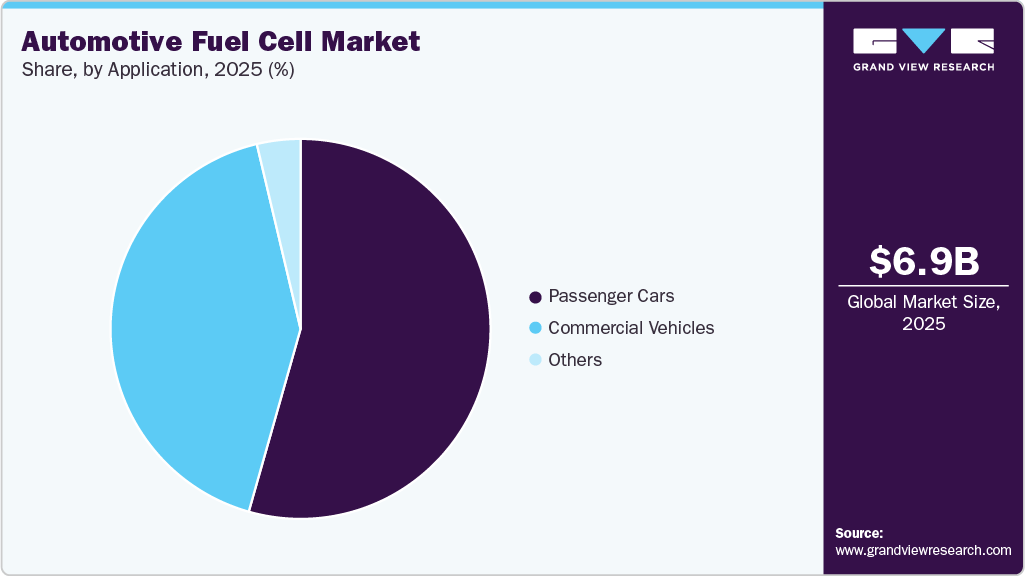
The commercial vehicles segment is expected to register the fastest CAGR of 7.2% over the forecast period, supported by rising demand for long-range, high-utilization transport solutions such as trucks and buses. Growing focus on fleet decarbonization, faster refueling benefits over BEVs, and increasing deployment of hydrogen-powered commercial fleets are further accelerating segment growth.
Regional Insights
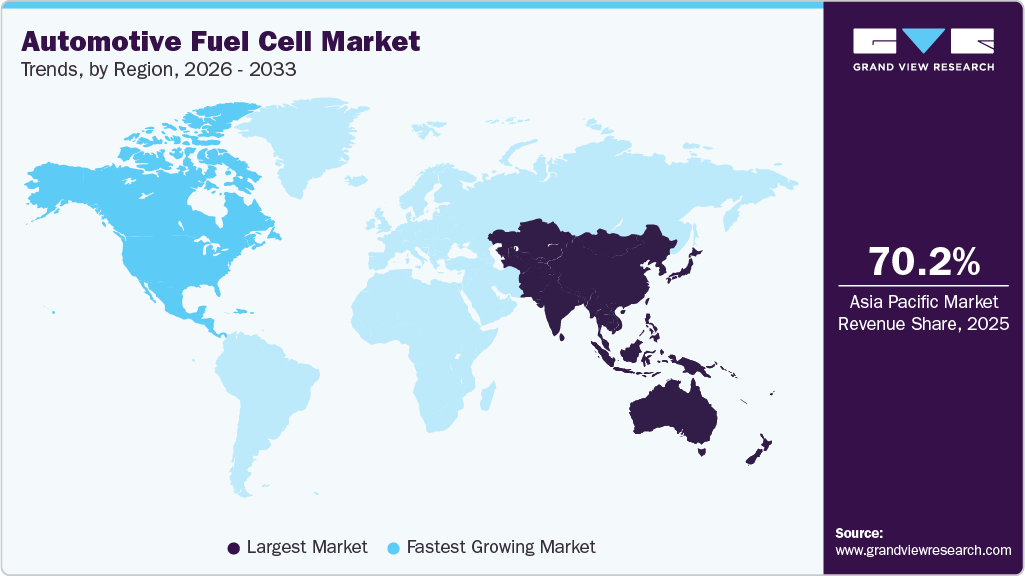
Asia Pacific accounted for 70.2% of the global automotive fuel cell market revenue in 2025, supported by strong government support for hydrogen mobility, large-scale deployment of fuel cell electric vehicles (FCEVs), and continuous investments in hydrogen production and refueling infrastructure. The region’s dominance is driven by active commercialization programs across Japan, South Korea, and China, along with the presence of leading fuel cell manufacturers and a strong policy push toward achieving long-term net-zero transportation goals.
North America Automotive Fuel Cell Market Trends
North America is expected to register the fastest CAGR of 9.5% over the forecast period, driven by rising investments in hydrogen infrastructure, increasing adoption of fuel cell buses and trucks, and growing focus on decarbonizing long-haul and heavy-duty transportation. The region is also witnessing stronger collaboration between automakers, energy companies, and government bodies to expand hydrogen refueling networks and improve fuel cell adoption at scale.
U.S. Automotive Fuel Cell Market Trends
The U.S. automotive fuel cell market remains a major contributor to North America’s growth, supported by increasing deployment of hydrogen-powered commercial fleets, pilot programs for fuel cell trucks and transit buses, and rising investments in clean hydrogen production. In addition, growing emphasis on reducing transportation emissions and improving energy security is encouraging fuel cell adoption, positioning the U.S. as a key market for future FCEV expansion.
Europe Automotive Fuel Cell Market Trends
Europe represents a steady market for automotive fuel cells, supported by strict emission reduction targets, growing adoption of hydrogen mobility solutions, and increasing focus on decarbonizing commercial transportation. The region is witnessing rising investments in hydrogen corridors, refueling infrastructure, and public-private collaborations, which are supporting gradual market expansion.
Latin America Automotive Fuel Cell Market Trends
The Latin American automotive fuel cell market is emerging steadily, supported by increasing interest in clean mobility solutions and the growing potential for green hydrogen production in countries such as Brazil, Chile, and Argentina. Expanding renewable energy capacity and early-stage hydrogen initiatives are expected to create long-term opportunities for fuel cell vehicle deployment.
Middle East & Africa Automotive Fuel Cell Market Trends
The Middle East & Africa automotive fuel cell market is developing gradually, driven by rising investments in hydrogen economy projects, clean energy diversification strategies, and increasing interest in zero-emission transportation. Countries such as Saudi Arabia and the UAE are focusing on hydrogen production and export potential, which is expected to support future adoption of fuel cell mobility solutions in the region.
Key Automotive Fuel Cell Company Insights
Some of the key players operating in the global automotive fuel cell market include Toyota Motor Corporation, Hyundai Motor Company, Honda Motor Co., Ltd., Ballard Power Systems, Plug Power Inc., Cummins Inc., Robert Bosch GmbH, Bloom Energy, Doosan Fuel Cell Co., Ltd., and Nedstack Fuel Cell Technology, among others. These companies are actively investing in fuel cell stack innovation, hydrogen storage systems, and vehicle integration technologies to improve performance, extend driving range, and reduce overall system costs for passenger and commercial FCEVs.
Key Automotive Fuel Cell Companies:
The following key companies have been profiled for this study on the automotive fuel cell market.
- Ballard Power Systems
- Bloom Energy
- Bosch (Robert Bosch GmbH)
- Cummins Inc.
- Doosan Fuel Cell Co., Ltd.
- Honda Motor Co., Ltd.
- Hyundai Motor Company
- Nedstack Fuel Cell Technology
- Plug Power Inc.
- Toyota Motor Corporation
Recent Developments
- In February 2025, Honda Motor Co., Ltd. unveiled its next-generation automotive fuel cell module, featuring more than double the durability of its current system, more than three times the volumetric power density, and approximately half the production cost compared to previous models. This advanced fuel cell module is designed to support expanded applications and broader regional deployment in fuel cell electric vehicles, with mass production planned to begin in 2026-2027, marking a significant step forward in making fuel cell technology more efficient and cost-competitive for automotive use.
Automotive Fuel Cell Market Report Scope
|
Report Attribute
|
Details
|
|
Market Definition
|
The automotive fuel cell market size refers to the total revenue generated from the sale and deployment of fuel cell systems and related components used in fuel cell electric vehicles (FCEVs) worldwide during a specific period.
|
|
Market size value in 2026
|
USD 7.21 billion
|
|
Revenue forecast in 2033
|
USD 10.06 billion
|
|
Growth rate
|
CAGR of 4.9% from 2026 to 2033
|
|
Base year for estimation
|
2025
|
|
Historical data
|
2021 - 2024
|
|
Forecast period
|
2026 - 2033
|
|
Quantitative Units
|
Revenue in USD million/billion, and CAGR from 2026 to 2033
|
|
Report coverage
|
Revenue forecast, competitive landscape, growth factors, and trends
|
|
Segments covered
|
Type, application, region
|
|
Regional scope
|
North America; Europe; Asia Pacific; Latin America; Middle East & Africa
|
|
Country scope
|
U.S.; Canada; Mexico; Germany; UK; France; China; India; Japan; South Korea; Brazil; Saudi Arabia; UAE
|
|
Key companies profiled
|
Toyota Motor Corporation; Hyundai Motor Company; Honda Motor Co., Ltd.; Ballard Power Systems; Plug Power Inc.; Cummins Inc.; Bosch (Robert Bosch GmbH); Bloom Energy; Doosan Fuel Cell Co., Ltd.; Nedstack Fuel Cell Technology
|
|
Customization scope
|
Free report customization (equivalent up to 8 analysts working days) with purchase. Addition or alteration to country, regional & segment scope.
|
|
Pricing and purchase options
|
Avail customized purchase options to meet your exact research needs. Explore purchase options
|
Global Automotive Fuel Cell Market Report Segmentation
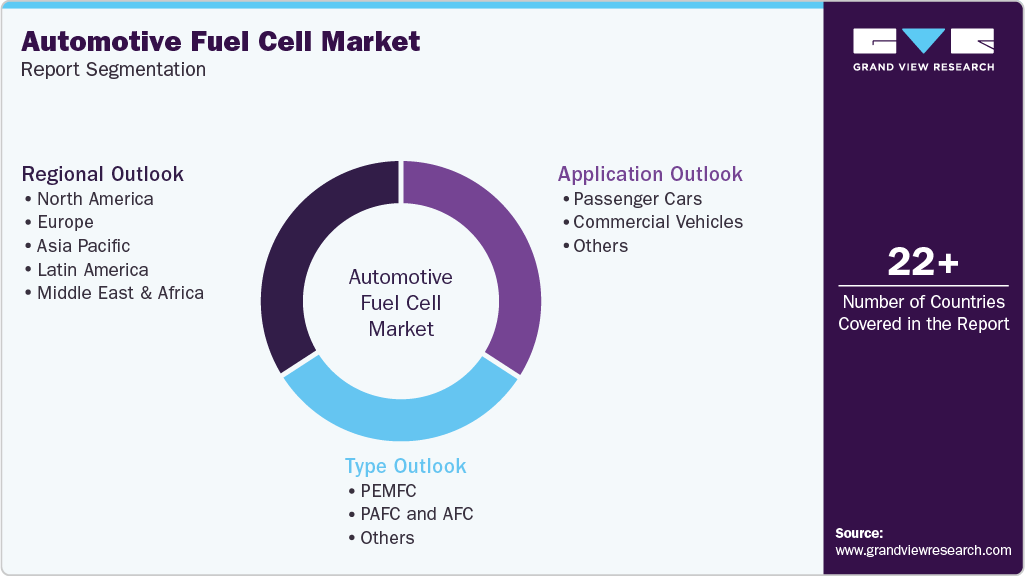
This report forecasts revenue growth at global, regional, and country levels and provides an analysis of the latest industry trends in each of the sub-segments from 2021 to 2033. For this study, Grand View Research has segmented the global automotive fuel cell market report based on type, application, and region.
-
Type Outlook (Revenue, USD Million, 2021-2033)
-
PEMFC
-
PAFC and AFC
-
Others
-
Application Outlook (Revenue, USD Million; 2021-2033)
-
Passenger Cars
-
Commercial Vehicles
-
Others
-
Regional Outlook (Revenue, USD Million, 2021-2033)
-
North America
-
Europe
-
Asia Pacific
-
China
-
India
-
Japan
-
South Korea
-
Latin America
-
Middle East & Africa
Frequently Asked Questions About This Report
b. The global automotive fuel cell market size was estimated at USD 6.89 billion in 2025 and is expected to reach USD 7.21 billion in 2026.
b. Some of the key players operating in the global automotive fuel cell market include Toyota Motor Corporation, Hyundai Motor Company, Honda Motor Co., Ltd., Ballard Power Systems, Plug Power Inc., Cummins Inc., Robert Bosch GmbH, Bloom Energy, Doosan Fuel Cell Co., Ltd., and Nedstack Fuel Cell Technology, among others.
b. The key factors driving the global automotive fuel cell market include the rising demand for zero-emission mobility, increasing adoption of hydrogen fuel cell electric vehicles (FCEVs), and strong government support through emission regulations, subsidies, and hydrogen infrastructure development.
b. The global automotive fuel cell market is expected to grow at a compound annual growth rate of 4.9% from 2026 to 2033 to reach USD 10.06 billion by 2033.
b. Based on the type segment, PEMFC held the largest revenue share of 91.9% in 2025.

 Download Sample Report














